

More than half of British properties in Greater London risk falling short of energy standards, leading to financial penalties and missed opportunities. For property owners and landlords, staying compliant with EPC regulations is not just about avoiding fines, it means benefiting from lower operational costs and increased property value. This guide breaks down practical steps to help you assess your building’s energy performance, pinpoint cost-effective improvements, and monitor ongoing savings while meeting legal requirements.
Table of Contents
- Step 1: Assess Current Property Energy Performance
- Step 2: Identify Cost-Effective Improvement Opportunities
- Step 3: Implement Targeted Energy Efficiency Upgrades
- Step 4: Verify Improvements With Updated EPC Assessment
- Step 5: Monitor Ongoing Energy Performance And Savings
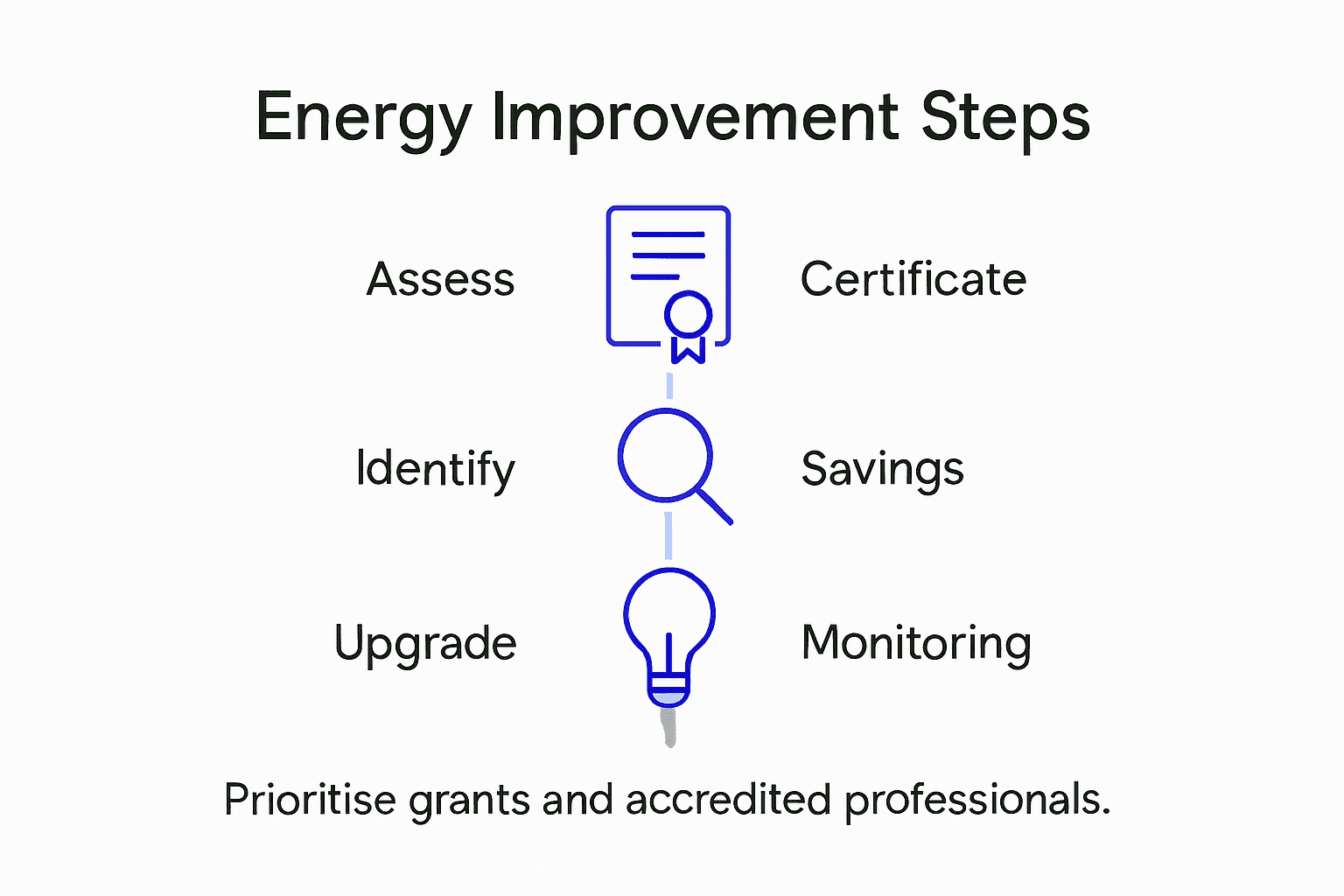
Overview of Energy Performance Improvement Steps
| Key Message | Explanation |
|---|---|
| 1. Assess Energy Performance | Obtain an Energy Performance Certificate to evaluate your property’s current energy efficiency and identify improvement areas. |
| 2. Identify Cost-Effective Upgrades | Review EPC recommendations to implement high-impact, low-cost energy efficiency upgrades for optimal financial return. |
| 3. Implement Strategic Upgrades | Focus on priority areas from the EPC, using accredited professionals for effective energy efficiency improvements. |
| 4. Verify with Updated EPC | After upgrades, obtain a new EPC to officially document your property’s enhanced energy efficiency and savings. |
| 5. Monitor Energy Performance | Regularly track energy consumption and savings to ensure improvements continue to deliver benefits and guide future upgrades. |
Step 1: Assess current property energy performance
Assessing your London property’s energy performance begins with understanding its current efficiency rating. The Standard Assessment Procedure provides a comprehensive method to evaluate your property’s energy characteristics, helping you identify potential improvements and cost savings.
To start, you’ll need an Energy Performance Certificate (EPC), which rates your property’s energy efficiency from A (most efficient) to G (least efficient). These certificates provide detailed insights into your property’s energy consumption, including estimated heating and lighting costs, carbon emissions, and specific recommendations for enhancing performance. An EPC is valid for 10 years and is mandatory when selling or renting out a property in the United Kingdom.

During the assessment, a qualified assessor will examine key elements such as insulation quality, heating systems, lighting efficiency, and overall building construction. They will use reduced Data Standard Assessment Procedure (RdSAP) to generate a comprehensive report that highlights your property’s current energy performance and potential areas for improvement.
Expert Tip: Request your EPC assessment during off-peak seasons to potentially secure more competitive pricing and faster scheduling.
Step 2: Identify cost-effective improvement opportunities
Identifying cost-effective improvement opportunities requires a strategic approach to maximising your property’s energy efficiency while minimising financial investment. The goal is to prioritise upgrades that deliver the most significant performance gains relative to their implementation costs.
Start by carefully reviewing your Energy Performance Certificate recommendations, which will outline specific improvement suggestions tailored to your property. These typically include options like upgrading insulation, improving heating systems, installing double glazing, and enhancing lighting efficiency. Focus on interventions that offer the best return on investment by calculating potential energy savings against initial implementation expenses.
Consider implementing improvements in stages, beginning with low-cost, high-impact modifications such as draught proofing, installing smart thermostats, and using LED lighting. These relatively inexpensive changes can deliver substantial energy performance improvements without requiring significant capital investment. For more comprehensive upgrades like wall or roof insulation, obtain multiple quotes from certified energy efficiency contractors and compare potential long term savings against installation costs.
Expert Tip: Prioritise improvements that qualify for government energy efficiency grants to reduce your overall implementation expenses.
Step 3: Implement targeted energy efficiency upgrades
Implementing targeted energy efficiency upgrades requires a methodical approach to transforming your London property’s performance. Your goal is to strategically install improvements that will significantly reduce energy consumption and enhance overall property efficiency.
Begin by focusing on priority areas identified in your Energy Performance Certificate. Key upgrades for domestic properties typically include installing efficient insulation, upgrading heating systems, implementing smart heating controls, and replacing outdated lighting with energy-efficient alternatives. Prioritise interventions that offer the most substantial impact on your property’s energy rating, such as cavity wall insulation, loft insulation, and installing double glazed windows.
When executing these upgrades, always work with accredited professionals who specialise in energy efficiency improvements. Ensure that each modification is installed correctly to maximise its potential benefits. Consider phased implementation to manage costs, starting with lower expense upgrades like draught proofing and LED lighting, then progressing to more comprehensive improvements such as heating system replacements. Document each upgrade carefully, as these improvements can potentially increase your property’s market value and reduce long-term energy expenditure.
Here is a quick comparison of common energy efficiency upgrades and their typical impact on London properties:
| Upgrade Type | Expected Energy Reduction | Typical Investment Range | Effect on EPC Rating |
|---|---|---|---|
| Loft insulation | Up to 25% | £400 – £900 | Significant improvement |
| Double glazing | Up to 15% | £2,000 – £5,000 | Moderate improvement |
| LED lighting | Up to 8% | £60 – £200 | Small but noticeable boost |
| Smart thermostat | Up to 12% | £120 – £300 | Incremental enhancement |
| Cavity wall insulation | Up to 20% | £600 – £1,500 | Major uplift |
Expert Tip: Obtain multiple professional quotes and verify contractor credentials before commencing any significant energy efficiency upgrades.
Step 4: Verify improvements with updated EPC assessment
Verifying your property’s energy performance improvements requires obtaining a new Energy Performance Certificate that accurately reflects the recent upgrades. This crucial step provides official documentation of your property’s enhanced energy efficiency and potential cost savings.
Commissioning a new energy certificate allows you to officially validate the impact of your recent energy efficiency interventions. An accredited assessor will conduct a comprehensive evaluation of your property, examining the specific upgrades you have implemented and determining how these modifications have improved overall energy performance. The updated certificate will demonstrate your property’s new energy rating, estimated energy savings, and provide concrete evidence of your investment in sustainability.
During the assessment, ensure you have comprehensive documentation of all improvements for the assessor to review. This includes receipts for equipment installations, photographs of upgrades, and any technical specifications of new energy efficient systems. Be prepared to walk the assessor through the specific modifications, highlighting the areas where you have made significant improvements. The goal is not just to obtain a new certificate, but to understand how your targeted upgrades have positively impacted your property’s energy performance and potential market value.
Expert Tip: Schedule your new EPC assessment during off peak seasons to potentially secure more competitive pricing and faster service.
Step 5: Monitor ongoing energy performance and savings
Monitoring your property’s energy performance is a critical ongoing process that ensures your efficiency improvements continue to deliver tangible benefits. By systematically tracking your energy consumption and savings, you can make informed decisions about future upgrades and maintain optimal performance.
The Home Energy Model provides advanced tracking capabilities for homeowners seeking comprehensive insights into their energy consumption patterns. Implement a regular monitoring routine that involves reviewing utility bills, tracking monthly energy usage, and comparing current performance against your previous Energy Performance Certificate ratings. Consider using digital energy monitoring tools that can provide real-time data on electricity and heating consumption, helping you identify unexpected spikes or areas where further efficiency could be achieved.
Establish a consistent review schedule where you analyse your energy performance every quarter. Look for trends in your consumption, assess the financial impact of your efficiency upgrades, and be prepared to make incremental adjustments. Keep detailed records of your energy bills, noting seasonal variations and the ongoing effectiveness of your implemented improvements. This proactive approach will not only help you maintain energy efficiency but also provide valuable documentation for future property valuations or potential sales.
The following table summarises digital tools and methods for monitoring ongoing property energy performance:
| Monitoring Method | Frequency | Key Benefit | Typical User Requirement |
|---|---|---|---|
| Utility bill analysis | Monthly/Quarterly | Identifies savings trends | Record keeping |
| Smart energy monitor | Real-time | Detects usage spikes | Smartphone or tablet |
| Digital folder tracking | Ongoing | Simplifies documentation | Computer with cloud access |
| Home Energy Model app | Customisable | Detailed performance reports | Account setup and device pairing |
Expert Tip: Create a dedicated digital folder to store all energy performance documentation, making future tracking and analysis significantly easier.
Enhance Your London Property’s Energy Efficiency with Expert Help
If you are aiming to overcome the challenges of improving your property’s energy performance in London, it is essential to have professional guidance that understands the complexities of EPC assessments and cost-effective upgrades. Many property owners face uncertainty about identifying the best improvement opportunities or ensuring that their investments deliver real savings and higher EPC ratings. With terms like RdSAP, home energy models and the need for updated EPC certificates, the process can quickly feel overwhelming.
At Complete EPC, we specialise in providing accurate and legally compliant Energy Performance Certificates for domestic and commercial properties across London. Our experienced assessors deliver detailed reports with tailored recommendations that help you plan targeted energy efficiency upgrades confidently. By choosing our service now, you benefit from competitive pricing, guaranteed lowest rates in the UK market and streamlined service designed to cut through complexity and save you time. Let us support your journey from assessment to certification so you can reduce long-term energy costs while increasing your property’s value.
Start your energy performance improvement plan today by exploring our comprehensive EPC services. Take the first step towards achieving a higher EPC rating and measurable savings with trusted experts by your side.
Frequently Asked Questions
What is an Energy Performance Certificate and how can I obtain one?
An Energy Performance Certificate (EPC) rates your property’s energy efficiency from A (most efficient) to G (least efficient). To obtain one, hire a qualified assessor who will examine your property and provide you with the EPC, which is valid for 10 years.
How can I identify cost-effective improvements for my property’s energy performance?
Review the recommendations outlined in your Energy Performance Certificate for specific improvements that suit your property. Focus on low-cost measures, such as smart thermostats and draught proofing, which can enhance energy efficiency within a limited budget.
What upgrades should I prioritize for energy efficiency in my London property?
Start by implementing improvements that have the highest potential for energy reduction, such as loft insulation or smart heating controls. Prioritise these upgrades based on both their impact on energy consumption and your available budget to manage costs effectively.
How do I verify the effectiveness of my energy efficiency upgrades?
To verify improvements, commission a new Energy Performance Certificate after implementing your upgrades. This will provide you with an updated energy rating that reflects the changes made and helps demonstrate the enhancements to prospective buyers or tenants.
What methods can I use to monitor my property’s ongoing energy performance?
Regularly analyse your utility bills and track your energy consumption using a smart energy monitor for real-time insights. Consider implementing monthly evaluations to assess your progress and identify further areas for efficiency enhancements.
How often should I review my property’s energy performance?
Establish a consistent schedule to review your energy performance every quarter. This will help you identify trends, assess savings from your energy improvements, and make informed decisions about future upgrades.