

Selling or letting a property in London can feel fraught with shifting rules, especially as Energy Performance Certificate requirements evolve. The current EPC validity period stands at 10 years, but government reforms will soon shorten this window and tighten compliance. For London property owners and landlords, understanding the true meaning of EPC validity, avoiding common misconceptions, and preparing for upcoming legal changes helps protect your investment and ensures a smoother transaction. This guide will clarify the rules so you stay ahead and maintain your property’s market appeal.
Table of Contents
- EPC Validity Period Defined and Debunked
- Domestic vs. Commercial EPCs in 2026
- Upcoming Regulatory Changes in the UK
- Renewal Triggers and Legal Liabilities
- EPC Validity: Financial and Market Impact
Key Takeaways
| Point | Details |
|---|---|
| EPC Validity Period | An Energy Performance Certificate (EPC) is valid for 10 years, but confusion exists about its implications once expired. An expired EPC does not make a property uninhabitable or unmarketable, but it must be renewed to let or sell legally. |
| Regulatory Changes in 2026 | Significant reforms to EPCs are set for 2026, including more detailed metrics for domestic properties and stricter validity requirements. Understanding these changes is essential for property owners to remain compliant and competitive. |
| Renewal Triggers | Property owners must obtain a valid EPC before marketing for sale or letting. Key moments for renewal can trigger legal liabilities and financial penalties if missed. |
| Market Impact of EPC Validity | A current EPC with a strong rating enhances marketability and value. Properties lacking an up-to-date certificate may struggle to attract buyers and tenants, impacting rental income and sale prices significantly. |
EPC Validity Period Defined and Debunked
An Energy Performance Certificate (EPC) is a snapshot of a property’s energy efficiency at a specific moment in time. The current EPC validity period stands at 10 years, which means once your certificate is issued, it remains valid for a full decade. This is not arbitrary. The 10-year window reflects the balance between ensuring data relevance and avoiding excessive re-assessment costs for property owners. Think of it like a building inspection: it tells you the property’s condition today, but circumstances change. Your home’s insulation degrades, heating systems age, and new tenants introduce different usage patterns. The validity period gives property owners a reasonable timeframe before needing to refresh the assessment.
However, confusion often arises around what “validity” actually means in practice. Many London landlords and property owners mistakenly believe that once an EPC expires, their property becomes uninhabitable or unmarketable. That is simply not true. An expired EPC does not invalidate your property; it merely means you cannot legally let the property or complete a sale without obtaining a new one. The certificate itself becomes legally redundant, but the building remains perfectly functional. The UK government’s reforms to the EPC regime are exploring adjustments to this validity period to improve accuracy and better support net-zero emissions targets by 2050. These potential changes underscore why understanding the current rules matters so much, especially as regulations continue to evolve.
Another common misconception is that an EPC’s validity period differs based on whether you own a flat or a house, or whether you are a landlord or owner-occupier. It does not. Whether you are managing a commercial office in Canary Wharf or letting a Victorian terrace in Notting Hill, the 10-year validity rule applies uniformly across domestic and certain commercial properties. The only variable is when you are required to obtain a fresh certificate. If you are selling, you need a current EPC before marketing begins. If you are letting, you must have a valid certificate before any tenant moves in. But once issued, that certificate remains legitimate for 10 years from the issue date, regardless of how many times the property changes hands or tenants rotate through. This distinction matters enormously when planning property transactions or lease renewals. Understanding that your existing EPC may still be valid saves unnecessary costs and administrative headaches during time-sensitive transactions.
Pro tip: Check your EPC’s issue date immediately. If it was issued between early 2014 and mid-2016, it will expire during 2024-2026, creating urgency for renewal before any planned rental or sale. Proactive scheduling of a new assessment avoids rushed decisions and gives you time to implement any energy efficiency improvements the new report recommends.
Domestic vs. Commercial EPCs in 2026
The Energy Performance Certificate landscape is shifting dramatically as 2026 approaches, but here’s what many London property owners miss: domestic and commercial EPCs are not evolving in lockstep. They are heading in fundamentally different directions. For domestic properties, the reforms will introduce a multi-metric approach that goes far beyond the single energy rating you see on current certificates. Starting in 2026, residential EPCs will assess fabric performance (how well the building envelope insulates), energy cost (what you actually pay), heating system efficiency, and smart readiness (whether the property can integrate with smart energy technologies). This shift reflects a move towards more comprehensive, nuanced data that helps homebuyers and tenants understand real operational costs rather than just a simple A-G rating. Commercial properties, by contrast, will maintain carbon emissions as their primary metric. This divergence is intentional. Commercial buildings need to support corporate net-zero targets and regulatory compliance, whilst domestic properties benefit from information that directly impacts household budgets.
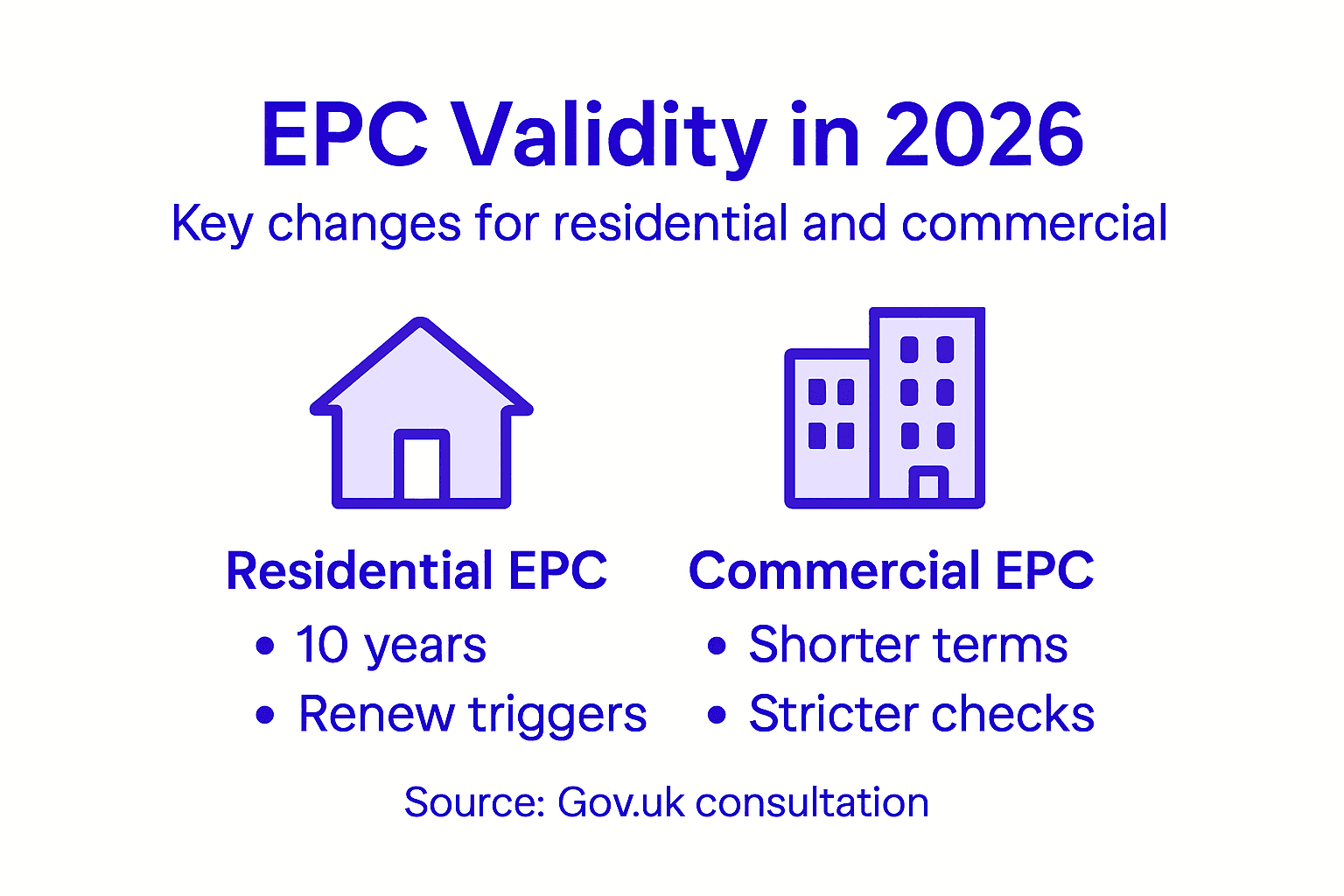
What does this mean for you in practical terms? If you own residential property in London, the 2026 reforms will reshape how your EPC looks and what information it communicates to potential buyers or tenants. The new multi-metric system will reveal more detail about energy performance, which can work in your favour if your property has been upgraded with modern insulation or efficient heating systems. Conversely, older properties with poor fabric performance may look less attractive on the new metrics, even if they held decent ratings under the old system. Commercial landlords and business property owners face a different reality. Since carbon emissions remain the headline metric for commercial buildings, the focus stays on operational efficiency rather than construction quality. A well-managed office building with efficient HVAC systems and strong building management will continue to score well, whilst properties relying on older fossil fuel heating may face greater scrutiny. Understanding commercial EPC requirements becomes increasingly important as these distinctions crystallise.
Another critical difference emerging in 2026 involves validity periods and enforcement. The government consultation proposes not just metric changes but also stricter validity requirements and potentially shorter certification periods. For domestic properties, this could mean more frequent assessments, which affects how long your current EPC remains useful for sales or lettings. Commercial properties may see different timescales applied. The underlying principle is clear: domestic properties will receive more granular, consumer-focused data, whilst commercial properties will continue emphasising carbon reduction and regulatory alignment. Neither approach is “better”—they simply reflect the distinct purposes each sector serves. Residential EPC reforms prioritise household decision-making and affordability transparency, whilst commercial reforms support organisational sustainability targets and decarbonisation pathways. If you manage both residential and commercial properties in London, you will need to understand these parallel but separate evolution tracks. The timeline, metrics, and strategic implications differ considerably, and planning ahead based on which side of the domestic-commercial divide you sit will prevent costly surprises when the reforms take effect.
Pro tip: Start reviewing your current EPC now and identify which metrics matter most for your property type. If you own residential property, prioritise improvements to fabric performance and heating efficiency before 2026. If you own commercial property, focus on carbon footprint reduction and energy management systems to maintain strong performance under the new regime.
Here’s a quick comparison of EPC metrics for domestic and commercial properties from 2026:
| Aspect | Domestic EPCs | Commercial EPCs |
|---|---|---|
| Primary Focus | Fabric, cost, efficiency, smart readiness | Carbon emissions only |
| Intended Audience | Homeowners, tenants | Landlords, businesses |
| Benefit Highlighted | Operational cost and comfort | Regulatory compliance |
| Assessment Nuance | Multi-metric, comprehensive | Single-metric, emissions-based |
This structure makes it easy to see how future EPCs will diverge for residential and commercial sectors.
Upcoming Regulatory Changes in the UK
The regulatory landscape for Energy Performance Certificates is undergoing its most significant overhaul in years, and 2026 marks the watershed moment when major changes take effect across the United Kingdom. The government is not simply tinkering with existing rules; it is fundamentally reshaping what EPCs measure, who must obtain them, and how quickly they must be provided. One of the most consequential shifts involves expanding EPC requirements to buildings previously exempt from the system. Houses in Multiple Occupation (HMOs), heritage properties, and other previously protected building types will now fall under mandatory EPC requirements. This expansion means more London landlords than ever before will need to understand EPC obligations. Additionally, the grace period for providing an EPC before marketing a property is being eliminated. Currently, landlords and agents have 28 days after marketing begins to supply an EPC. From 2026, that buffer disappears. An EPC must exist before any marketing activity commences, not after. This timing shift has cascading implications for transaction timelines and compliance risk. If you are planning to let or sell property in London, the removal of the 28-day grace period alone demands urgent action to obtain your certificate before you list anywhere, including on property portals.
Beyond these procedural changes, the substance of EPC assessments themselves is evolving. The government is introducing multiple measurement elements including energy cost and fabric performance to improve clarity and consumer information. Rather than relying on a single energy efficiency rating, property owners and tenants will receive more granular data about actual operational costs and building quality. This is intended to demystify energy performance, but it also means your property’s assessment will be more detailed and potentially more revealing about deficiencies. Older properties with poor insulation, inefficient heating, or structural weaknesses will likely show these issues more prominently in the new metrics. The flip side is that properties with recent upgrades or strong energy performance will have more opportunities to demonstrate their advantages. The reforms also strengthen Minimum Energy Efficiency Standards (MEES) enforcement, which sets the floor for lettable properties. Breaching MEES standards already carries penalties, but the reformed regime will enforce these requirements more rigorously and cover a broader range of rental arrangements, including short-term lets and individually rented rooms. Compliance is no longer optional, and enforcement budgets are being allocated accordingly.
Another critical change involves EPC validity periods themselves. Whilst the current 10-year validity will continue for existing certificates issued before 2026, the government is actively considering reducing this period to improve data relevance and alignment with UK net-zero 2050 targets. Shorter validity periods mean more frequent reassessments, which increases costs for property owners but ensures energy performance data remains current. If validity periods are reduced from 10 to, say, five years, property owners will face double the assessment frequency. This has obvious financial implications, but it also creates opportunities. More frequent assessments mean more regular feedback on energy performance and clearer tracking of whether your improvements are having measurable impact. The overarching objective binding all these changes is alignment with net-zero emissions targets. The government views EPCs as a critical tool for monitoring building-level progress towards decarbonisation. This is why the reforms are expanding scope, tightening enforcement, and potentially shortening validity periods. Property owners who understand this broader policy context are better positioned to anticipate future changes and plan strategically.
Pro tip: Obtain your EPC now, before 2026 arrives, if you are planning any property transactions or lettings. The grace period removal and expanded scope mean that delays will create compliance risk and marketing delays. Use your current assessment to identify specific fabric performance weaknesses or efficiency gaps, then prioritise improvements that will enhance your property’s performance under the new metrics before the reformed system kicks in.
Renewal Triggers and Legal Liabilities
EPC renewal is not simply a matter of convenience or preference. There are hard, legally defined moments when you must obtain a fresh certificate, and missing these triggers carries real financial and reputational consequences. The primary renewal trigger is straightforward: when you intend to let a property or sell it, you need a valid EPC before marketing begins. This is the most common scenario London landlords and property owners face. But the trigger points go deeper than that simple rule. If your current EPC is approaching expiry—or has already expired—and you receive a viewing request or a tenant inquiry, you are legally obligated to possess a valid certificate before showing the property to any prospective buyer or tenant. Waiting until someone expresses interest and then scrambling to arrange an assessment creates unnecessary risk. The second major trigger involves regulatory action. Local authorities conduct enforcement checks on lettings and monitor compliance with Minimum Energy Efficiency Standards (MEES). If an enforcement officer discovers that you are letting a property without a valid EPC, you face penalties. For domestic properties, this can result in fines up to £4,000 for first-time breaches, with repeat offences carrying even steeper charges. Commercial properties face different penalty structures, but the principle remains: operating without a valid EPC when required is a prosecutable breach, not merely a technical oversight.
Legal liability extends beyond simple penalties for missing a certificate. If you let a property without an EPC and the property later fails to meet energy performance standards, you may face additional enforcement action from local authorities. Tenants also have growing rights to challenge lettings that lack proper energy documentation. In some cases, tenants have successfully claimed that lettings without valid EPCs breached their rights, and courts have awarded remedies including rent reductions or contract cancellations. As a London landlord, this creates cascading exposure. You are not just facing a fine for missing the certificate itself; you are exposed to tenant claims, disputed tenancies, and enforcement action that can drag on for years. The financial impact extends to property valuation as well. Properties with expired EPCs or poor energy ratings often struggle to attract serious buyers or tenants. Estate agents increasingly refuse to market properties without current, valid certificates because expired documentation signals poor landlord management. Buyers and tenants increasingly view a current, strong EPC as a baseline expectation, not a bonus feature. A property without a valid EPC or with a weak rating may sit on the market longer, attracting fewer enquiries, and ultimately selling or letting for less money. This opportunity cost often dwarfs the modest cost of obtaining a fresh assessment.
Renewal triggers also apply to changes in property circumstances. If you undergo significant building works, install new heating systems, or substantially improve insulation, the EPC remains technically valid until expiry. However, the assessment no longer reflects your property’s current performance. From a commercial standpoint, obtaining a fresh EPC after major improvements can demonstrate your property’s enhanced efficiency to potential buyers or tenants, justifying a higher valuation or rental price. This is particularly valuable in London’s competitive property market, where energy efficiency increasingly influences purchasing decisions. Similarly, if property use changes—such as converting a single-occupancy home into a House in Multiple Occupation—you may trigger new EPC requirements under the expanding regulatory scope. The 2026 reforms will make these scenarios even more complex, with broader categories of properties requiring certificates and stricter enforcement. Planning ahead means understanding not just when your current EPC expires, but also anticipating regulatory changes and property changes that might affect your obligations. Landlords managing portfolios across London often find it practical to schedule EPC renewals in advance, clustering assessments strategically rather than reactively obtaining them under time pressure. This approach reduces administrative friction and ensures you maintain compliance buffer before any transaction activity begins.
Pro tip: Create a renewal calendar for each of your properties, marking the EPC expiry date at least six months in advance. Schedule your new assessment three to four months before expiry, allowing time for any follow-up questions and ensuring you have a valid certificate ready before any unexpected letting or sale opportunity arises. This proactive approach prevents last-minute compliance crises and demonstrates professional property management to potential tenants and buyers.
Below is a summary of common EPC renewal triggers and their consequences:
| Trigger | Requirement | Consequence if Missed |
|---|---|---|
| Property sale or new letting | Valid EPC before marketing | Fines, halted transactions |
| Prospective viewing/inquiry | EPC required before appointment | Legal breaches, tenant claims |
| Significant property upgrade | New EPC recommended after works | Missed valuation uplift |
| Change of property use | EPC may become mandatory | Regulatory enforcement risk |
Understanding renewal triggers helps property owners avoid compliance and market pitfalls.
EPC Validity: Financial and Market Impact
The financial implications of EPC validity extend far beyond the cost of the assessment itself. An expired or absent EPC does not simply create a compliance problem; it actively damages your property’s marketability and value. In London’s competitive property market, where buyers and tenants increasingly scrutinise energy efficiency, a valid EPC signals professional management and transparent disclosure. Conversely, a property without a current certificate immediately raises red flags. Estate agents report that properties without valid EPCs struggle to attract serious inquiries because the certificate absence itself suggests the landlord or owner has neglected basic due diligence. This perception cost is substantial. A property that sits on the market for an extra four to six weeks because of missing documentation could lose £5,000 to £15,000 in foregone rental income or reduced sale price, depending on the property type and location. When you factor in the modest cost of an EPC assessment (typically £80 to £120 for a domestic property in London), the financial calculus becomes obvious. Not obtaining a valid EPC is not cost-saving; it is value-destroying.

EPC ratings themselves carry direct financial weight in today’s market. Properties with strong energy ratings (A to C) command premium prices and rental yields compared to poorly rated properties (E to G). Research consistently shows that properties with an A or B rating attract 20 to 30 percent more buyer and tenant interest than properties rated D or below. For a London property valued at £400,000, this differential could translate to tens of thousands of pounds in lost value if the EPC reveals poor energy performance. Critically, an expired EPC means you cannot demonstrate your property’s actual current performance. If you have recently invested in insulation upgrades, installed a modern heat pump, or improved ventilation, a stale EPC assessment from five years ago does not reflect those improvements. You lose the opportunity to justify a premium valuation or rental price based on demonstrated energy efficiency. The inverse is also true: if your property has deteriorated or fallen behind market standards, an outdated EPC might temporarily mask those issues, but when a new assessment is eventually required, the downward adjustment to valuation can feel sharp and unexpected. Understanding the financial benefits of energy efficiency ratings helps property investors make strategic decisions about when to renew assessments and how to position their properties competitively.
The market impact of EPC validity varies significantly by property type and location within London. In prime central London markets, where properties compete intensely on quality and sustainability credentials, a valid EPC with a strong rating is virtually table-stakes for attracting serious interest. Estate agents in Kensington, Chelsea, and similar areas routinely turn away properties without current EPCs because buyers expect comprehensive sustainability documentation. In outer London and more value-focused markets, the EPC impact is somewhat less pronounced, but still material. Institutional investors and buy-to-let portfolios increasingly use EPC ratings as investment screening criteria. If your property carries a weak rating, you may find yourself excluded from institutional buyer databases or facing pressure to discount price when selling to professional investors. The timing dimension matters enormously as well. If you renew your EPC shortly before marketing your property, you signal to buyers and tenants that the assessment is current and reliable. If you renew it years in advance and then let it age, the psychological benefit fades. Marketing materials that reference an EPC issued three years ago feel stale, even though it remains technically valid. Prospective tenants and buyers often ask whether a newer assessment is available or whether the property’s performance has changed since the certificate was issued. This uncertainty creates friction and reduces negotiating strength. Strategic timing of EPC renewal to align with marketing activity maximises the certificate’s marketing value and the credibility signal it sends to the market.
Pro tip: Time your EPC renewal to occur within two to three months before you plan to market your property, whether for sale or lettings. This ensures the assessment feels current to prospective buyers and tenants, maximises the market-ready perception, and allows you to highlight any recent improvements that enhance your energy rating. Avoid renewing too far in advance, as older certificates lose their psychological impact even when technically valid.
Secure Your EPC Compliance and Stay Ahead of 2026 Changes
Navigating the evolving EPC validity period and new regulatory demands can be overwhelming for London property owners and landlords. With the 10-year validity rule soon facing potential changes and stricter renewal triggers in 2026, timing your EPC renewal correctly is essential to avoid costly fines, legal liabilities, and lost market opportunities. Don’t let an expired certificate delay your sale or letting—understanding the critical role of EPC validity helps you protect your investment and maintain compliance.
At Complete EPC, we specialise in delivering fast, reliable, and competitively priced Energy Performance Certificates for both domestic and commercial properties across London. Whether you need to renew your EPC before marketing begins or want expert advice on preparing for new multi-metric assessments, our qualified assessors guide you every step of the way. Learn how to optimise your building’s energy performance and meet upcoming government standards by exploring our services and insights. Act now to secure your property’s energy certification and avoid last-minute rushes by visiting Complete EPC and taking the first step toward effortless compliance.
Frequently Asked Questions
What is the validity period of an Energy Performance Certificate (EPC)?
The current validity period of an EPC is 10 years from the date of issue.
Do I need a new EPC if my current one is expired?
Yes, you must obtain a new EPC before marketing your property for sale or letting, as an expired EPC means you cannot legally conduct these activities.
What happens if I do not have a valid EPC when I show my property?
You could face legal penalties, including fines, for showing a property without a valid EPC. Additionally, tenants have the right to challenge lettings lacking proper EPC documentation.
How will the EPC validity period change in 2026?
The government is considering reducing the EPC validity period to improve data relevance, meaning property owners may need to renew their certificates more frequently to stay compliant.