

TL;DR:
- Higher EPC ratings increase property value, rental yields, and tenant attractiveness.
- Compliance with EPC regulations is crucial to avoid legal and financial penalties.
- Regular assessments and upgrades help London’s landlords meet standards and maximize investment benefits.
If you think an EPC certificate for your commercial property is just a box-ticking exercise, you are missing the bigger picture. Higher EPC ratings directly boost property value, rental yields, and your ability to attract quality tenants. In London’s competitive property market, a poor energy rating is not just a compliance problem — it is a financial liability. With tighter regulations on the horizon and a growing number of properties falling below upcoming minimum standards, understanding your commercial EPC is one of the most practical steps you can take to protect and grow your investment. This guide covers everything you need to know, from legal requirements to how ratings affect your bottom line.
Table of Contents
- What is a commercial EPC certificate and who needs one?
- How the EPC assessment process works
- Regulations, minimum standards, and compliance deadlines
- Exemptions, edge cases, and common pitfalls
- Why EPC ratings matter: Lessons from London’s property market
- Enhance your commercial EPC: Next steps and expert support
- Frequently asked questions
Key Takeaways
| Point | Details |
|---|---|
| EPCs are legally required | Commercial properties in London must have an EPC certificate to sell, rent, or construct buildings over 50m². |
| Rating impacts property value | A superior EPC rating can boost property value and rental yields while poor ratings may hinder sales and financing. |
| New regulation deadlines | Minimum standards are rising: properties must reach C by 2027/2028 and B by 2030 to remain compliant. |
| Exemptions exist | Certain buildings—including listed and temporary—may be exempt from EPC requirements if specific criteria are met. |
| Expert guidance accessible | Trusted resources and assessment support are available to help London businesses achieve compliance and enhance property value. |
What is a commercial EPC certificate and who needs one?
A commercial EPC certificate, or Energy Performance Certificate, is an official document that rates the energy efficiency of a non-domestic building. It tells you how energy-efficient your property is and what it would cost to run. Think of it as a nutritional label for your building’s energy use.
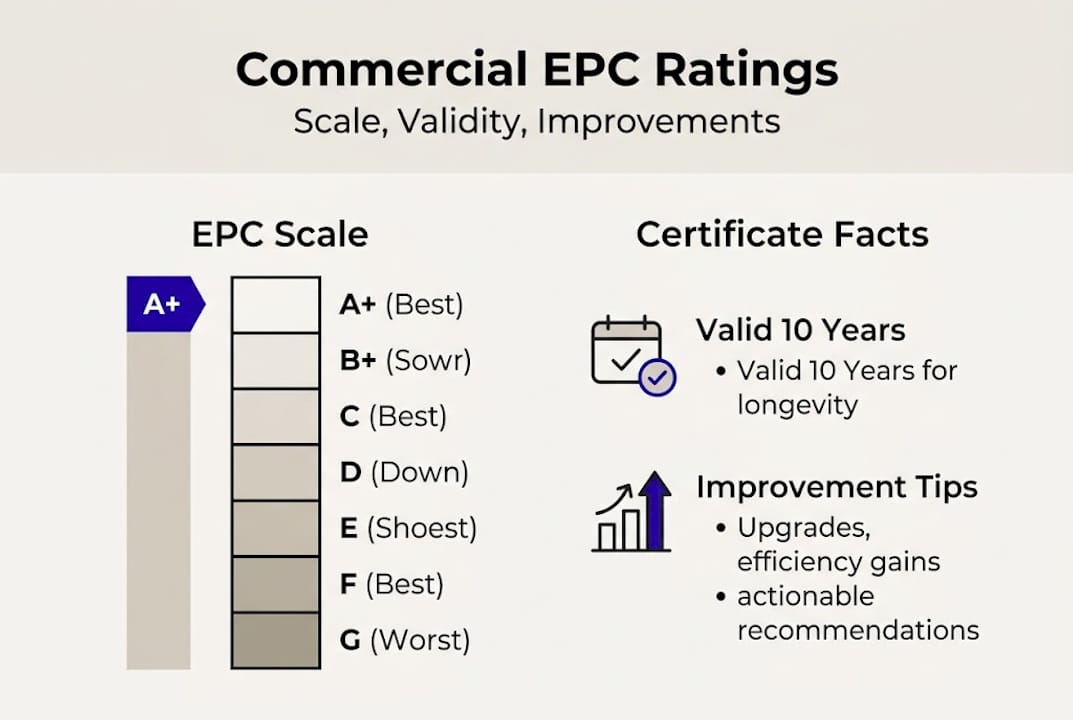
Commercial EPCs rate energy efficiency on a scale from A+ (most efficient) to G (least efficient), are valid for 10 years, and are required whenever you sell, rent, or construct a non-domestic building over 50m². That covers a wide range of properties across London.
Who needs a commercial EPC?
You are legally required to obtain a commercial EPC if you own or manage any of the following:
- Offices, retail units, and warehouses
- Hotels, restaurants, and leisure facilities
- Industrial buildings and factories
- Mixed-use buildings with commercial elements
- Any non-domestic building over 50m² being sold or let
The certificate must be made available to prospective buyers or tenants at the earliest opportunity. Failing to do so is a legal offence, not simply an administrative oversight.
Key statistic: Over 83% of commercial properties in major UK cities currently fall below Band B, meaning the majority of London landlords face significant upgrades ahead.
It is worth noting that the EPC also includes a Recommendation Report. This document lists practical improvements that could raise your property’s rating, from upgrading lighting systems to improving insulation. These recommendations are not legally binding, but they are genuinely useful for planning future works and budgeting for compliance.
If your property is currently on the market or you are preparing a lease renewal, confirming your EPC status should be one of your first actions. An expired or missing certificate can delay transactions and expose you to financial penalties.
How the EPC assessment process works
Knowing you need a commercial EPC is one thing. Understanding what actually happens during the assessment helps you prepare properly and avoid delays.
Commercial EPC assessments use a methodology called SBEM, which stands for Simplified Building Energy Model. SBEM software is used to assess non-domestic buildings, modelling energy use and CO2 emissions based on the building’s physical characteristics rather than actual energy bills. This is an important distinction: your EPC reflects how the building should perform, not how it has been used.
The assessment process, step by step:
- Initial enquiry and documentation: You provide floor plans, building specifications, and details about heating, cooling, ventilation, and lighting systems.
- Site visit: A qualified assessor visits the property to verify the building’s fabric, construction type, glazing, and installed services.
- Data entry into SBEM: The assessor inputs all collected data into the SBEM software, which calculates the building’s energy use intensity and CO2 output.
- Rating generation: The software produces an energy rating from A+ to G, along with a Recommendation Report outlining potential improvements.
- Certificate lodgement: The completed EPC is lodged on the national register and a copy is issued to you.
Pro Tip: Gather your building’s construction drawings, mechanical and electrical specifications, and any previous EPC certificates before the assessor arrives. This speeds up the process and reduces the risk of assumptions being made that could lower your rating.
Assessors look closely at wall and roof insulation, window glazing type, boiler and HVAC system efficiency, and lighting controls. If any of these are unknown or undocumented, the assessor must apply default values, which are almost always less favourable. Preparation genuinely pays off here.
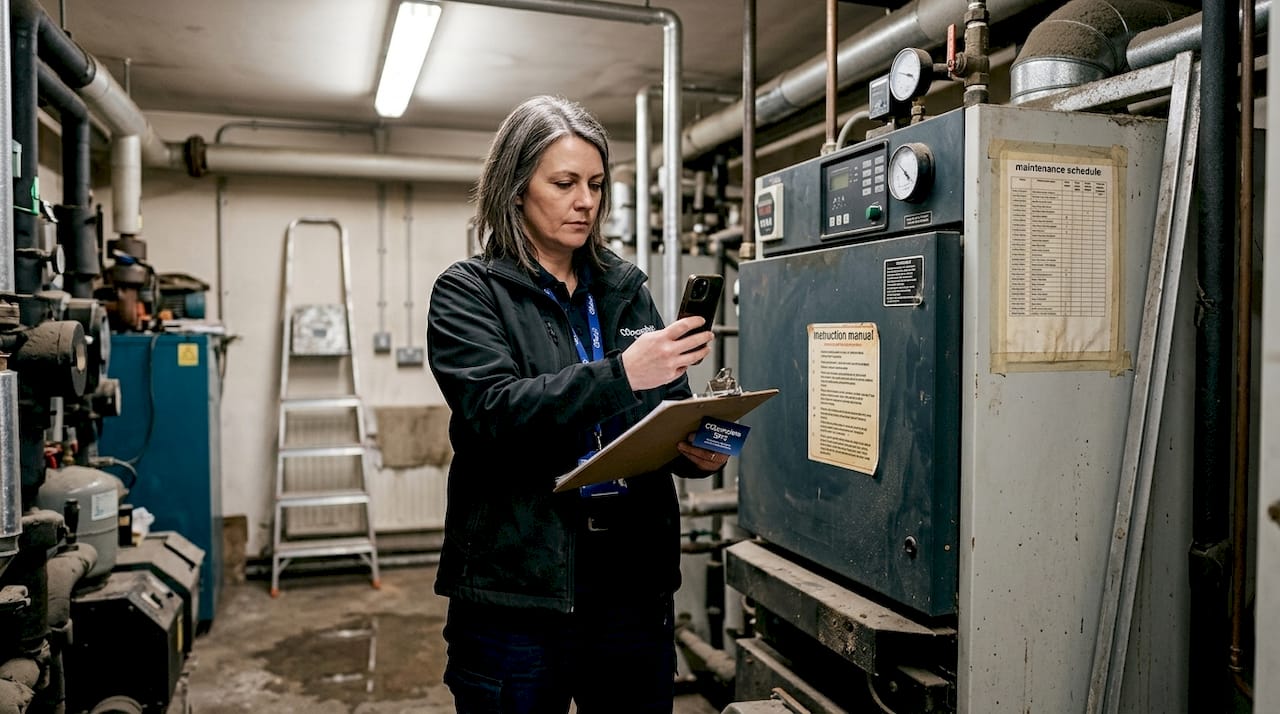
The entire process typically takes a few hours on site for a standard commercial unit, though larger or more complex buildings will take longer. Once lodged, your certificate is valid for 10 years, provided no major changes are made to the building’s fabric or services.
Regulations, minimum standards, and compliance deadlines
Regulations around commercial EPCs have tightened considerably, and the pace of change is accelerating. If you have not reviewed your compliance position recently, now is the time.
The Minimum Energy Efficiency Standards, known as MEES, set the legal floor for energy performance in rented commercial properties. MEES requires a minimum E rating since April 2023, with upcoming targets of C by 2027 to 2028 and B by 2030. These are not aspirational targets. They are legal requirements with real financial consequences.
| Standard | Target date | Minimum rating required |
|---|---|---|
| Current MEES | In force since April 2023 | E |
| Upcoming MEES | 2027 to 2028 | C |
| Future MEES | 2030 | B |
The scale of the challenge is significant. Over 83% of commercial assets in major UK cities currently sit below Band B. That means most London landlords will need to invest in energy improvements within the next few years to remain legally compliant.
“The direction of travel is clear. Properties that do not meet minimum standards will become increasingly difficult to let, finance, or sell.”
Non-compliance carries serious consequences. You may be unable to legally let your property, face difficulties securing finance, and risk reputational damage with tenants. Improving your building’s energy systems, such as upgrading to LED lighting or installing more efficient HVAC equipment, is often the most cost-effective route to a higher rating. Consulting commercial electrician services can help identify where electrical upgrades will deliver the greatest rating improvements.
Planning ahead is essential. Retrofitting a large commercial building takes time, budget, and often planning permission. Waiting until a deadline is imminent will cost you more and limit your options.
Exemptions, edge cases, and common pitfalls
Not every commercial property is subject to EPC requirements. Knowing whether your building qualifies for an exemption can save you time and money, but assuming you are exempt without checking is one of the most common and costly mistakes landlords make.
Properties that may be exempt from EPC requirements include:
- Standalone buildings with a total floor area under 50m²
- Temporary buildings intended for use of less than two years
- Places of worship and buildings used for religious activities
- Listed buildings where compliance would unacceptably alter their character or appearance
- Industrial sites, workshops, and agricultural buildings with low energy demand
Exemptions for listed buildings are not automatic. You must demonstrate that the required energy improvements would alter the building’s character or appearance, and this must be formally registered on the PRS Exemptions Register.
| Exemption type | Condition | Action required |
|---|---|---|
| Listed building | Improvements alter character | Register exemption formally |
| Under 50m² | Total floor area below threshold | Confirm measurement |
| Temporary structure | Use under two years | Document intended use |
| Religious use | Designated place of worship | Verify classification |
Pro Tip: Do not assume a listed building is automatically exempt. Many listed commercial properties still require an EPC, particularly if energy improvements can be made without affecting the building’s historic fabric. Always seek specialist advice before proceeding.
Common pitfalls include relying on an outdated EPC from a previous owner, failing to update the certificate after major refurbishments, and not registering exemptions correctly. Non-compliance fines range from £500 to £150,000 depending on the rateable value of the property, and a non-compliant property becomes significantly harder to let or sell. The financial risk of getting this wrong far outweighs the cost of obtaining a proper assessment.
Why EPC ratings matter: Lessons from London’s property market
Most landlords treat their EPC as a compliance document. We think that is a missed opportunity.
In London’s commercial property market, energy ratings are increasingly a factor in investment decisions, lease negotiations, and asset valuations. Higher EPC ratings can boost property value by up to 14% and improve rental yields by 6 to 10%. Those are not marginal gains. For a mid-sized commercial asset in London, that difference can amount to hundreds of thousands of pounds.
There is also a critical nuance worth understanding. EPCs are modelled, not measured from actual energy use. This means a well-run building with low real-world consumption may still receive a poor rating if its fabric or installed systems score badly under SBEM. Conversely, targeted improvements to the right building elements can yield a rating uplift that outperforms the actual energy savings. Understanding this distinction helps you invest in the right improvements, not just the most obvious ones. With methodology changes expected in coming years, staying ahead of the curve now is the smartest position for any London landlord.
Enhance your commercial EPC: Next steps and expert support
Whether you are preparing for a property transaction, facing a lease renewal, or planning ahead for the 2027 MEES deadline, taking action on your commercial EPC now puts you in a stronger position. Start by understanding commercial EPCs to build a solid foundation of knowledge. From there, our detailed EPC assessment guide walks you through exactly what to expect and how to prepare. To see how a better rating translates into real financial returns, explore the EPC benefits in London for property owners. Our qualified assessors serve commercial clients across London, offering competitive pricing and straightforward, expert guidance at every step.
Frequently asked questions
How often do I need to renew a commercial EPC certificate?
A commercial EPC is valid for 10 years unless major renovations or a change in ownership triggers the need for an updated assessment.
What happens if my property does not meet the EPC minimum standard?
Non-compliance fines range from £500 to £150,000 depending on the property’s rateable value, and a non-compliant building becomes significantly harder to let or sell.
Are there exemptions for listed or special commercial buildings?
Exemptions apply for listed buildings where energy improvements would alter their character, standalone structures under 50m², and certain temporary or religious buildings, but exemptions must be formally registered.
Will my EPC rating affect my ability to sell or finance my property?
Yes. Poor EPC ratings risk creating stranded assets that are difficult to sell or refinance, while higher ratings support stronger valuations and better rental returns.
How is a commercial EPC calculated and what is SBEM?
SBEM software models the building’s fabric, heating, ventilation, lighting, and cooling systems to calculate energy use and CO2 emissions, producing the final EPC rating.