

TL;DR:
- London landlords must ensure properties have valid EPCs meeting minimum ratings before letting, with fines increasing to up to £30,000.
- Future regulations require achieving EPC C by 2030, involving detailed assessments and potential costly upgrades.
- Early planning, grant access, and proper documentation are key to cost-effective compliance and avoiding severe penalties.
Fines for energy efficiency breaches in London are about to get much steeper. Under current Minimum Energy Efficiency Standards (MEES), landlords who let properties with an EPC rating below E can already face fines up to £5,000, but proposed new rules would push that penalty to £30,000 per property. With sweeping regulatory changes arriving between now and 2030, many London landlords are either unaware of what’s required or are underestimating the urgency. This guide breaks down exactly what compliance means, what it will cost, and how to stay ahead of the rules without unnecessary expense.
Table of Contents
- What does energy efficiency compliance mean for London landlords?
- Current and upcoming EPC rules: What you must do now (and by 2030)
- The real costs of compliance: Upgrades, exemptions, and cost-saving strategies
- Navigating enforcement, pitfalls, and top compliance tips
- Why most landlords leave compliance until it’s too late (and how to avoid it)
- Your next step: Cost-effective EPC support for full London compliance
- Frequently asked questions
Key Takeaways
| Point | Details |
|---|---|
| Major fines for non-compliance | Missing energy efficiency standards can lead to fines of up to £30,000 after 2026 in London. |
| Upgrades required by 2030 | All London private rented homes must achieve EPC C using the new Home Energy Model by 2030. |
| Cost caps and exemptions exist | You may be exempt or have a spending cap, but must register exemptions correctly for protection. |
| Early action saves money | Planning upgrades early and using grants can cut your out-of-pocket costs significantly. |
| Proactive compliance is best | Keeping fully up-to-date avoids last-minute stress and the risk of legal problems with tenants. |
What does energy efficiency compliance mean for London landlords?
Energy efficiency compliance, in practical terms, means holding a valid Energy Performance Certificate (EPC) that meets the minimum rating required by law before you let or market a property. An EPC is an official document that grades a property’s energy efficiency on a scale from A (most efficient) to G (least efficient). It covers insulation quality, heating systems, windows, and hot water provision, among other factors.
For most London landlords, the key obligation is straightforward: your property must have at least an EPC rating of E before you can legally let it or advertise it to tenants. Importantly, there is no 28-day grace period. As noted in updated EPC guidance, the certificate must be in place before any marketing activity begins, and it remains valid for ten years from the date it was issued.
Key legal obligations for landlords in London:
- Obtain a valid EPC before marketing or letting any residential property
- Ensure the rating meets the minimum legal standard for the relevant tenancy type
- Provide a copy of the EPC to new tenants at the start of any tenancy
- Keep track of expiry dates across your portfolio
- Register valid exemptions on the official PRS Exemptions Register if applicable
The regulatory landscape is shifting significantly. The current system uses a single Energy Efficiency Rating (EER). From October 2026, a new assessment methodology called the Home Energy Model (HEM) will be introduced. This new system will assess properties across multiple metrics, including fabric performance, heating systems, and smart readiness, replacing the single rating with a more detailed picture of a property’s energy profile.
Looking further ahead, from October 2030 all private rented homes in England, including every borough in London, must achieve an EPC C equivalent using this new multi-metric framework. The cost cap per property is set at £10,000, or 10% of the property’s value for those valued below £100,000.
| Metric | Current rules | From October 2026 | From October 2030 |
|---|---|---|---|
| Minimum rating | E | E (HEM transition) | C equivalent |
| Assessment model | EER | Home Energy Model | Home Energy Model |
| Cost cap | £3,500 | £10,000 | £10,000 |
| Maximum fine | £5,000 | Up to £30,000 | Up to £30,000 |
London’s enforcement environment is becoming more active. Local authorities are taking compliance increasingly seriously, and several boroughs have already begun issuing fines to landlords who have not updated expired certificates or who are letting properties below the legal minimum. The scale of the challenge is real: a significant proportion of London’s older Victorian and Edwardian stock sits at rating D or below, meaning many landlords will need to plan substantive upgrades well before 2030.
Current and upcoming EPC rules: What you must do now (and by 2030)
With the basics in view, it is important to understand precisely what action is required today and what you need to plan for as deadlines approach.
Step-by-step guide to ongoing EPC compliance:
- Check your current EPC rating and expiry date. Log in to the national EPC register and confirm the rating and validity for each property in your portfolio. If any certificate is expired or close to expiry, commission a new assessment immediately.
- Confirm you meet the minimum E rating. Under current MEES regulations, all tenancies, including ongoing ones since April 2020, must meet at least EPC E. Letting a property below this rating without a registered exemption exposes you to fines.
- Plan upgrades for the 2030 C standard. Even if you are currently compliant at E, properties rated D or E will need improvement works before 2030. The sooner you assess the gap, the more manageable the cost and disruption.
- Understand the 2026 HEM transition. From October 2026, new EPCs will be issued using the Home Energy Model. If your current EPC was issued before this date and is still valid, it remains compliant until its expiry, a principle known as “grandparenting.”
- Register any valid exemptions. If you genuinely cannot achieve compliance within the cost cap or due to specific property constraints, you must register your exemption on the PRS Exemptions Register before letting the property.
- Prepare documentation for tenants and agents. Every new tenancy must be accompanied by a copy of a valid EPC. Keep records organised and accessible.
“From October 2030, all private rented homes in England must achieve EPC C equivalent under a new multi-metric system, with a cost cap of £10,000 per property.” EPC C by 2030
Comparison of key compliance requirements:
| Requirement | 2026 | 2030 |
|---|---|---|
| Minimum standard | E (existing EPCs valid) | C equivalent |
| Assessment methodology | HEM introduced | HEM fully in force |
| HMO rule | Whole-building EPC | Whole-building EPC |
| Penalty for breach | Up to £30,000 | Up to £30,000 |
One area landlords often overlook is the rules for Houses in Multiple Occupation (HMOs). HMOs are now assessed on a whole-building basis, meaning a single EPC covers the entire structure rather than individual units. This changes planning and budgeting for landlords with converted properties or bedsit-style accommodation.
Pro Tip: Commission your next EPC at least six months before any planned re-letting or lease renewal. This gives you time to obtain quotes for improvement works, apply for available grants, and complete works without rushing, all before the clock runs down on your existing certificate.
The real costs of compliance: Upgrades, exemptions, and cost-saving strategies
So what will compliance actually cost? The figures may be more manageable than you expect, especially if you plan ahead and use available grant schemes.

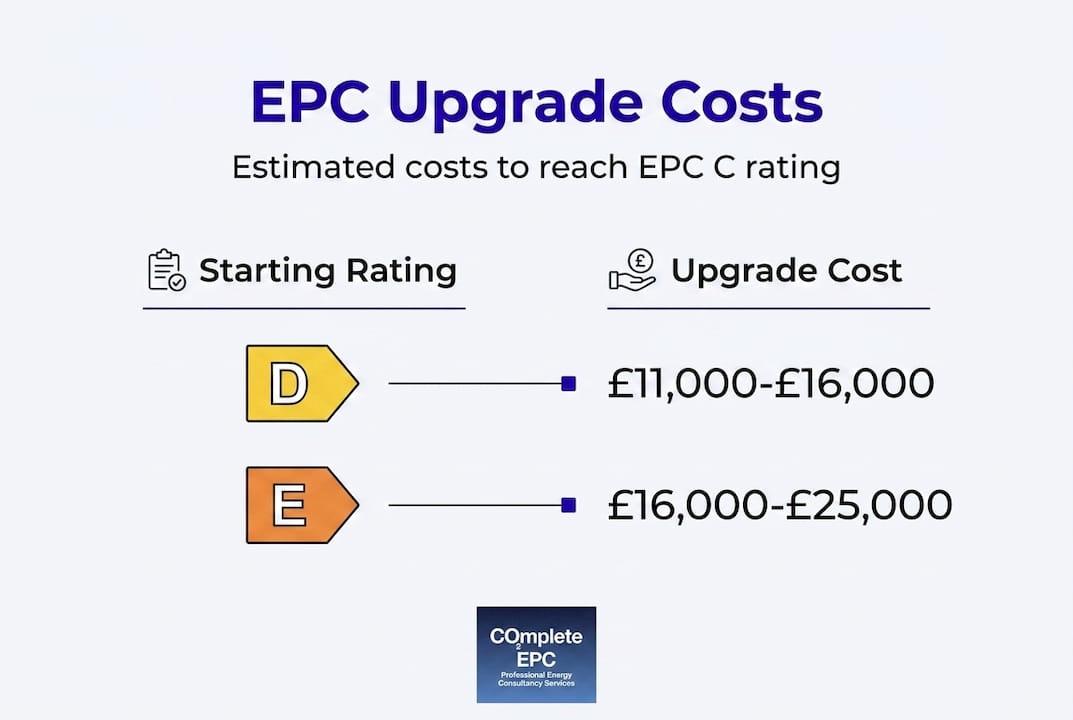
According to the English Housing Survey 2024 to 2025, the mean cost of upgrading a private rented dwelling to EPC C is approximately £7,040. For properties currently at EPC D, the median cost ranges between £11,000 and £16,000 across a sample of 85 properties. However, after factoring in available grants, average out-of-pocket costs have been recorded at as low as £1,488 in some case studies.
Average upgrade costs by starting rating:
| Starting EPC rating | Estimated upgrade cost to C | After grants (typical) |
|---|---|---|
| D | £11,000 to £16,000 | £3,000 to £6,000 |
| E | £7,040 (mean) | £1,500 to £4,000 |
| F or G | £15,000 or more | £5,000 to £10,000 |
The biggest cost drivers tend to be the age and construction type of the property. Solid wall properties, common across much of inner London, are significantly more expensive to insulate than those with cavity walls. Properties with older gas boilers, single-glazed windows, or no loft insulation will also face higher upgrade bills. Conversely, a property that already has modern double glazing and a recent combi boiler may only need minor improvements to reach the C standard.
Common compliance upgrades and their impact:
- Loft insulation: low cost, high EPC gain
- Cavity wall insulation: moderate cost, significant improvement
- Solid wall insulation (internal or external): higher cost, required for older London stock
- Boiler replacement or heat pump installation: substantial cost, major improvement
- Solar PV panels: higher upfront cost, long-term efficiency gain
- Draught-proofing and double glazing: targeted, cost-effective for specific properties
Exemptions do exist, and they are legitimate tools for landlords in specific circumstances. Valid exemptions under the PRS Exemptions Register guidance include situations where:
- You have already spent the maximum permitted cost cap without reaching the required rating
- Insulation or other improvements would cause structural damage (for example, with certain types of solid wall)
- A third party such as a freeholder or local council has refused consent for necessary works
- The property’s value is below £100,000 and the cost of works would exceed 10% of its market value
- The fabric of the building would be negatively affected by the required improvements
Each exemption lasts five years and must be registered formally. You cannot simply decide informally that an exemption applies. Failure to register places you in breach of the regulations, even if the underlying reason for the exemption is genuine.
Pro Tip: If you manage a portfolio of properties, consider bulk assessments. Many accredited assessors, including those at Complete EPC, offer reduced rates when you book multiple properties together. This reduces your per-unit cost and allows you to compare where upgrade spend will be most effective across your holdings.
The Great British Insulation Scheme (GBIS) and the Energy Company Obligation (ECO4) scheme are two active grant programmes that can reduce your upgrade costs by 30% to 50% or more, depending on property type and household circumstances. Always check eligibility before committing to self-funded works.
Navigating enforcement, pitfalls, and top compliance tips
With costs and exemptions in hand, it is worth understanding what actually happens when landlords miss a step and how proactive management keeps you safely on the right side of the rules.
Local authority enforcement in London has grown noticeably more active. Wandsworth Council, for example, has been publicly recognised for cracking down on landlord EPC rule breaches, issuing fines in the range of £4,000 to £5,000 per property. Other boroughs are expected to follow. Enforcement teams can access the national EPC register to identify properties with expired certificates or ratings below the legal minimum, making it increasingly easy to identify and pursue non-compliant landlords.
Top five compliance mistakes to avoid:
- Letting an expired EPC lapse unnoticed. Certificates are valid for ten years, but that date can creep up on you. A property let on an EPC from 2016 will have needed renewal by 2026, and many landlords miss this.
- Assuming exemptions are automatic. You must register on the PRS Exemptions Register before letting the property. An unregistered exemption offers no legal protection.
- Misunderstanding HMO requirements. Landlords with HMOs sometimes assume individual room ratings apply. A whole-building EPC is now required for the entire property.
- Not checking ratings before lease renewals. Even a rolling periodic tenancy technically requires a compliant EPC at all times. Renewing without checking is a common oversight.
- Overlooking the “fabric first” principle. Spending money on heating systems before addressing insulation and draught-proofing often delivers a lower EPC improvement per pound spent. Assessors consistently recommend tackling the building fabric before upgrading technology.
“Wandsworth Council has issued fines of £4,000 to £5,000 to landlords in breach of EPC regulations, and other London boroughs are increasing enforcement activity.”
Pro Tip: Build a simple compliance calendar for your portfolio. List each property, its current EPC rating, the certificate expiry date, and the works needed to reach C by 2030. Review it quarterly. This one habit prevents the majority of costly compliance failures and gives you time to plan upgrade works efficiently and cost-effectively.
Good documentation matters enormously. Keep copies of all EPCs, evidence of works carried out, contractor invoices, any correspondence regarding third-party consent, and your exemption registration confirmations. If a local authority queries your compliance, having a clear paper trail is your strongest defence.
Why most landlords leave compliance until it’s too late (and how to avoid it)
In our experience working with landlords across London, the most common reason for compliance failures is not wilful disregard. It is a combination of inertia and misplaced optimism: the belief that there is still time, that grants are too much hassle, or that the rules will change before they take effect.
The reality is that London’s enforcement environment is shifting faster than many expect. Wandsworth’s recent crackdown is not an isolated case. It is a signal of direction. As fines rise towards £30,000 and more boroughs activate their enforcement teams, the cost of waiting becomes genuinely severe.
There is also a competitive advantage to acting early. Landlords who upgrade now can access grant funding that may become oversubscribed as 2030 approaches. Properties with strong EPC ratings command higher rents and attract better tenants. A rating of C or above is increasingly a factor in tenant decision-making, particularly among younger renters who are more energy-cost conscious.
For portfolio landlords, a “fabric first” strategy combined with bulk EPC assessments is the most cost-effective path. Addressing insulation and draught-proofing across multiple properties simultaneously reduces contractor mobilisation costs and maximises EPC gains per pound spent. Waiting until each property’s certificate expires individually is the most expensive and stressful approach.
Start now. Commission updated assessments, map the gap between your current ratings and the 2030 standard, and draw up a phased improvement plan. Compliance is not a destination you reach all at once. It is an ongoing process, and the earlier you begin, the easier it becomes.
Your next step: Cost-effective EPC support for full London compliance
Ready to make compliance straightforward and cost-effective? Complete EPC provides fully qualified EPC assessments across all London boroughs, with competitive rates and assessors who understand the specific challenges of London’s housing stock. Whether you need a certificate for a single flat or assessments across a large portfolio, our team delivers accurate, timely results. Learn more about how EPC certificates in London work, understand your options through our guidance on EPC exemption rules, or follow our step-by-step walkthrough of the EPC assessment process to know exactly what to expect when our assessor visits your property.
Frequently asked questions
What is the penalty for missing energy efficiency compliance in London?
Landlords can currently be fined up to £5,000 per property for letting below the minimum EPC rating, with proposed new rules increasing this to £30,000.
How long is an EPC certificate valid for?
An EPC is valid for ten years from its date of issue, but you must have a valid one in place before marketing any property.
What are the exemptions from EPC energy efficiency standards?
You may qualify for an exemption if works exceed the cost cap, if structural damage would result, or if third-party consent is refused, but you must register this formally on the PRS Exemptions Register before letting.
Will the rules for EPC ratings change in the future?
Yes. From October 2030, all private rented homes must achieve EPC C using the new Home Energy Model, with a cost cap of £10,000 per property.
Can HMO landlords use one EPC for all units?
Yes. Under current HMO rules, a single whole-building EPC is required for the entire property rather than separate certificates for each unit.