

TL;DR:
- London landlords must ensure their properties have valid EPCs rated E or above before letting.
- Upgrading energy efficiency or registering exemptions is required if ratings fall below E.
- Future regulations aim to raise the minimum EPC standard to C by 2030, demanding proactive improvements.
Many London landlords still rely on outdated assumptions about Energy Performance Certificates. Some believe a certificate from several years ago is perfectly fine; others are unaware that the legal minimum rating directly affects their right to let. These misunderstandings carry real consequences. Landlords found in breach of current EPC rules face enforcement action from local authorities, financial penalties, and reputational damage. This guide cuts through the confusion, explaining exactly what the law requires today, how to navigate exemptions, and what changes are coming that every London landlord needs to plan for now.
Table of Contents
- What is an EPC and why does it matter for rentals?
- Step-by-step EPC compliance process for London landlords
- When does a property qualify for a MEES exemption?
- Looking ahead: Upcoming changes to EPC rental standards
- Why compliance is more than just a minimum requirement
- Take the next step: Expert EPC support for London landlords
- Frequently asked questions
Key Takeaways
| Point | Details |
|---|---|
| Legal EPC obligation | You must provide a valid EPC with at least an E rating when letting rental property in London. |
| EPC compliance workflow | Regularly check your EPC, address sub-E ratings promptly, and register exemptions if eligible before letting. |
| Changing standards | Prepare now for the likely minimum EPC C standard from October 2030 to avoid urgent future upgrades. |
| Exemptions require evidence | MEES exemptions must be registered on the PRS Exemptions Register with supporting documentation. |
What is an EPC and why does it matter for rentals?
An Energy Performance Certificate, known as an EPC, is an official document that rates a property’s energy efficiency on a scale from A to G. A is the most efficient and G is the least. The certificate is produced by an accredited domestic energy assessor who inspects the property and calculates its energy use, carbon dioxide emissions, and estimated fuel costs. Alongside the rating, the EPC also includes a set of recommendations for improvement, giving landlords a practical starting point for reducing energy costs and boosting a property’s performance.
For landlords in London, an EPC is not optional. It is a legal requirement. Before marketing a property to let, you must have a current, valid EPC in place. Prospective tenants must be provided with a copy, either at the viewing stage or upon request. Failing to do so puts you in breach of the regulations before a tenancy even begins.
The core legal framework that governs EPC requirements in the private rented sector is the Minimum Energy Efficiency Standards, known as MEES. Under MEES, domestic private landlords must not let properties with an EPC rating below E unless they hold a valid, registered exemption. This means that properties rated F or G cannot legally be let without an exemption on record. The rule applies to new tenancies and renewals, and has applied to all existing tenancies since 2020.
Here is a quick summary of the key EPC obligations for London landlords:
- A valid EPC must exist before a property is marketed or let
- The EPC rating must be E or above under current MEES rules
- A copy of the EPC must be provided to tenants
- The certificate is valid for 10 years, unless the property undergoes significant changes
- If the rating falls below E, improvements or a registered exemption are required
- Local authorities enforce compliance and can impose financial penalties
The penalties for non-compliance are significant. Local authorities can issue compliance notices and financial penalties ranging from £2,000 to £4,000 per property, depending on how long the breach has continued. Beyond the financial cost, enforcement action can also be listed on the PRS Exemptions Register, affecting your ability to let in future.
A property with a rating of F or G cannot be legally rented out to new or existing tenants without a valid exemption registered on the PRS Exemptions Register. The burden of proof sits firmly with the landlord.
Understanding these basics is the foundation of staying compliant. From here, it is important to know exactly how to act on them.
Step-by-step EPC compliance process for London landlords
Now you know what an EPC is and why it is essential, here is how to make sure your property is compliant in practice. Following a clear process removes the guesswork and protects you from costly errors.
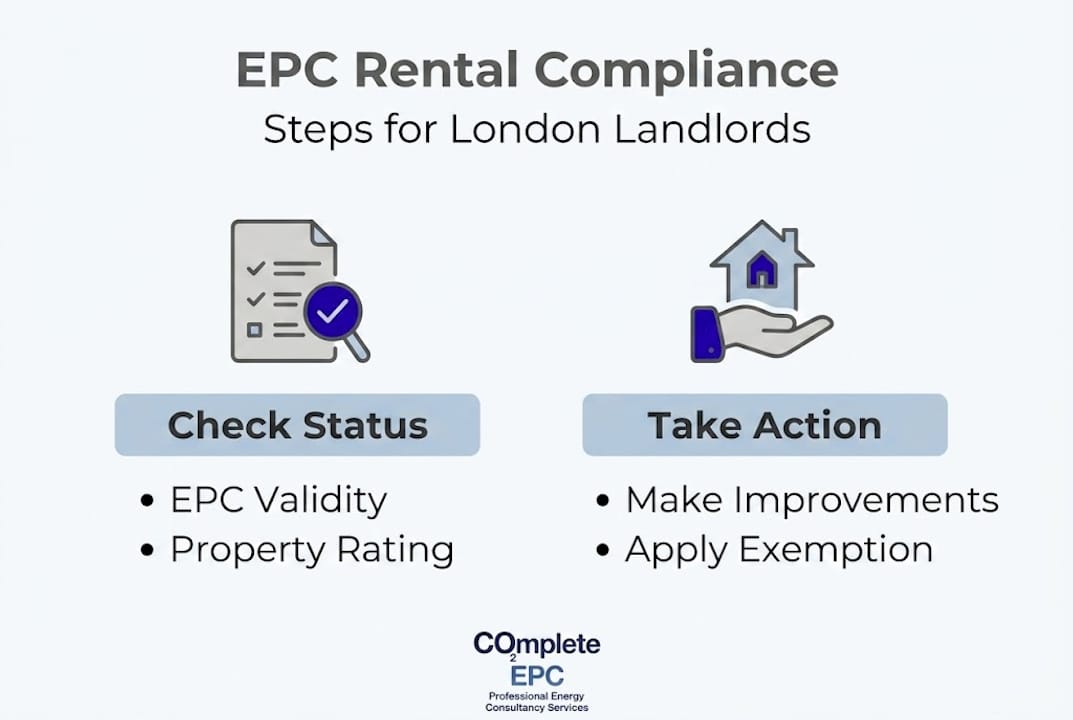
The practical compliance workflow for London landlords involves four key stages: obtaining or renewing a valid EPC, checking the rating against the MEES minimum, taking action if the rating is below E, and understanding what happens if a breach is found. Let us walk through each one in detail.
Step 1: Check whether your EPC is current and valid
Start by searching the national EPC register at the government’s official portal. You can search by postcode or property address. If your EPC was issued more than 10 years ago, it is expired and must be renewed before you market or re-let the property. Also check whether the property has had significant work done since the last assessment, such as a loft conversion, new heating system, or major insulation upgrade. Material changes to the property can affect energy performance and may warrant a fresh assessment even within the 10-year validity window.
Step 2: Evaluate the EPC rating
Once you have confirmed the EPC is valid, look at the rating. If it is E or above, you currently meet the MEES minimum standard. If it is F or G, you are in breach of the regulations unless you have a registered exemption. A rating of E, while legally compliant today, may not be sufficient by 2030 when the standards are set to tighten further, but more on that shortly.
Step 3: Plan and carry out improvements if needed
If the rating falls below E, your first route is to make energy efficiency improvements. Common improvements include adding loft insulation, upgrading cavity wall insulation, fitting a more efficient boiler, or installing double glazing. There is a cost cap in place, currently set at £3,500 including VAT, per property. If improvements can be made within that cost cap that would bring the property to an E or above, you are required to carry them out. Skipping this step and jumping straight to an exemption application is not permitted if improvements are available within the cap.

Step 4: Apply for an exemption if improvements are not viable
If the property cannot reach an E rating even after spending up to the cost cap, or if there are specific barriers such as a refusal of consent from a freeholder, you may qualify for a MEES exemption. You must register this exemption on the PRS Exemptions Register before marketing or letting the property.
Step 5: Understand enforcement risks
If a local authority finds that you are letting a property without a valid EPC, without meeting the minimum rating, and without a registered exemption, you face formal enforcement action. This can result in substantial financial penalties and a public record of non-compliance.
Pro Tip: Book a new EPC assessment at least six to eight weeks before a tenancy starts or an existing EPC expires. This gives you time to act on recommendations or sort an exemption without being pushed into an unlawful let.
When does a property qualify for a MEES exemption?
If you have discovered your property cannot reasonably achieve an EPC E or above, you may need to explore MEES exemptions. It is important to understand that exemptions are not a loophole. They are a defined and documented route for genuine cases where compliance is not achievable.
Certain properties may qualify for MEES exemptions, but the exemption must be registered on the PRS Exemptions Register with supporting documentation and costing evidence. Simply believing that improvement is impractical is not sufficient. You must be able to demonstrate it.
The main exemption categories are outlined in the table below:
| Exemption type | Qualifying criteria | Duration |
|---|---|---|
| Cost cap exemption | Improvements made up to £3,500 cap but E not reached | 5 years |
| Consent not obtained | Freeholder, lender, or tenant refuses required works | 5 years |
| Property devaluation | Independent surveyor confirms works would reduce value | 5 years |
| New landlord exemption | Recently inherited or acquired the property | 6 months |
| Wall insulation exemption | Technical issues make insulation inappropriate | 5 years |
For each exemption type, you must provide specific evidence. For a cost cap exemption, this typically means quotes or invoices from qualified contractors confirming that available improvements have been carried out or costed, and that an E rating is still not achievable. For a consent exemption, you will need written evidence of the request and the refusal.
The PRS Exemptions Register is publicly accessible. Local authorities and tenants can view registered exemptions. This transparency means that incomplete or poorly evidenced registrations are more likely to be scrutinised and challenged.
Pro Tip: Keep all correspondence, contractor quotes, and written refusals in a dedicated file for each property. If your exemption is ever challenged, having organised documentation is what protects you.
Common reasons that exemption applications fail include submitting quotes rather than actual work records when improvements were theoretically feasible, failing to approach all recommended measures listed on the EPC, and applying for the wrong exemption category. Getting these details right from the start saves considerable time and potential enforcement risk.
It is also worth noting that exemptions are not permanent. Most last five years, after which you must reassess the property and either carry out improvements or re-register a qualifying exemption. Treat exemptions as a temporary arrangement, not a permanent fix.
Looking ahead: Upcoming changes to EPC rental standards
Besides current standards, London landlords should stay ahead of evolving rules to avoid being caught out. The regulatory landscape is shifting significantly, and early preparation makes a real financial difference.
The most significant change on the horizon is a planned increase in the MEES minimum from EPC E to an equivalent of EPC C by October 2030. This policy direction affects all tenancies, both new and existing. For landlords whose properties currently sit at a D or E rating, this is a direct call to action.
Current vs. future EPC requirements
| Requirement | Current standard (2026) | Proposed standard (2030) |
|---|---|---|
| Minimum EPC rating | E | C (equivalent) |
| Applies to | All rented properties | All tenancies |
| Enforcement | Local authorities | Local authorities |
| Exemptions available | Yes | Expected to continue |
There is another layer of complexity to factor in. The government is in the process of reforming how EPC ratings are calculated. The new system, known as the Home Energy Model, is expected to replace the current Standard Assessment Procedure (SAP) methodology. The Home Energy Model places greater emphasis on the source of heating energy rather than purely on fabric efficiency. This means a property currently rated D under SAP could receive a different score under the new model. Properties with electric heat pumps, for example, may score better under the new system, while those relying on mains gas may face a relative disadvantage compared to today’s ratings.
Key points to be aware of regarding the upcoming changes:
- The October 2030 deadline applies to all private rented tenancies, not just new lets
- Properties rated D or E today will likely need upgrades to meet the new C equivalent
- The shift to the Home Energy Model may change ratings independently of physical works
- Planning upgrades now avoids last-minute competition for contractors and materials
- Government financial support schemes such as the Warm Homes Plan may help fund improvements
The practical implication is clear. If you wait until 2029 to begin planning improvements, you risk higher contractor costs due to demand, difficulty sourcing materials, and insufficient time to register exemptions if improvements fall short. Starting now means you can make phased improvements, spread costs across multiple financial years, and benefit from any available grants or incentives as the government scales up support.
London properties, in particular, include a high proportion of older housing stock, Victorian terraces, converted flats, and period buildings, many of which currently sit below a C rating. The scale of improvement work across the capital will be substantial, which is another reason to act well ahead of the deadline.
Why compliance is more than just a minimum requirement
There is a tendency among some landlords to treat an EPC as a box-ticking exercise. Get the certificate, satisfy the legal requirement, move on. We would challenge that approach. Not because the rules demand more, but because the opportunity to do more is genuinely valuable.
Tenants are increasingly energy-conscious. Rising energy bills have made EPC ratings a practical factor in rental decisions, not just an abstract number on a piece of paper. A property with a B or C rating is a tangible selling point. It signals lower running costs, greater comfort, and a landlord who maintains their asset thoughtfully. That tends to attract and retain better tenants, reducing void periods and turnover costs.
There is also the matter of asset value. Energy efficiency improvements funded today become embedded in the property’s value. As minimum standards tighten toward 2030, properties that already meet or exceed the new threshold will hold a competitive advantage in the market.
Reactive landlords will face rushed spending decisions, pressure to meet deadlines, and potentially higher costs. Proactive landlords will have already made the improvements, locked in contractor rates, and positioned their properties favourably. The difference between the two is not technical knowledge. It is timing and willingness to look further ahead than the current tenancy.
Take the next step: Expert EPC support for London landlords
If you are ready to move from understanding to action, Complete EPC is here to support you. Whether you need to arrange a fresh assessment, understand your current rating, or plan upgrades to meet future standards, we provide expert guidance tailored to London landlords. Our detailed EPC assessment process guide walks you through exactly what to expect from your assessment visit through to receiving your certificate. For a broader overview of how EPCs work, our comprehensive EPC guide covers everything from methodology to implications. When you are ready to act on your rating, our EPC rating advice section helps you identify the most cost-effective improvements for your property. Get in touch with our qualified assessors today for reliable, competitively priced EPC services across London.
Frequently asked questions
How long is an EPC valid for rental property in London?
An EPC is valid for 10 years unless the property undergoes major changes that affect its energy use, such as structural alterations or the installation of a new heating system.
Can I rent out my London property with an EPC rating of F or G?
No. Landlords cannot let properties with an F or G rating unless a valid exemption is registered on the PRS Exemptions Register before the tenancy begins.
What happens if I don’t comply with EPC rental requirements?
Local authorities can issue compliance notices and impose financial penalties for confirmed breaches, with fines typically ranging from £2,000 to £4,000 per property depending on the severity and duration of the breach.
Do EPC rental requirements apply to all types of rental properties in London?
Most private rented homes are covered, but certain properties may qualify for MEES exemptions, including some listed buildings, properties where consent for works has been refused, and short-term holiday lets that fall outside the scope of the regulations.
Is the EPC minimum standard expected to change soon?
Yes. Government plans would raise the MEES minimum from EPC E to an equivalent of EPC C by October 2030 for all tenancies, making early planning and phased improvements a sensible strategy for London landlords.