

TL;DR:
- Proper energy assessments reveal potential savings and help ensure compliance with legal standards.
- The UK’s MEES regulations require landlords to improve EPC ratings or register exemptions to avoid penalties.
- Using assessment data proactively enables smarter property management and investment decisions in London.
Energy efficiency assessments are often treated as a box-ticking exercise, something to complete quickly and file away. But for London property owners and landlords, that mindset costs money. A well-used assessment can reveal thousands of pounds in savings, protect you from enforcement action, and position your property ahead of increasingly strict standards. This guide cuts through the confusion, explains exactly what the law requires, and shows you how to turn your next assessment into a genuine business advantage.
Table of Contents
- What is an energy efficiency assessment?
- The legal landscape: compliance and MEES
- Navigating exemptions and evolving standards
- What assessments reveal: typical recommendations and costs
- Action plan: steps to maximise your assessment’s value
- Why a data-driven approach changes the game for London property owners
- Connect with London’s energy assessment experts
- Frequently asked questions
Key Takeaways
| Point | Details |
|---|---|
| Assessments serve multiple roles | Energy efficiency assessments are not just for legal compliance—they reveal cost-saving opportunities and future-proof your property. |
| MEES and exemptions matter | London property owners must meet minimum efficiency standards or properly register an exemption to avoid penalties. |
| Reform is on the horizon | EPC and assessment standards will soon get stricter and more data-driven, calling for a proactive approach. |
| Data-driven action is key | Using assessment data to guide upgrades yields the best blend of compliance, cost savings, and property value. |
What is an energy efficiency assessment?
Now that we see energy efficiency assessments as more than a regulatory formality, let’s clarify what they actually involve.
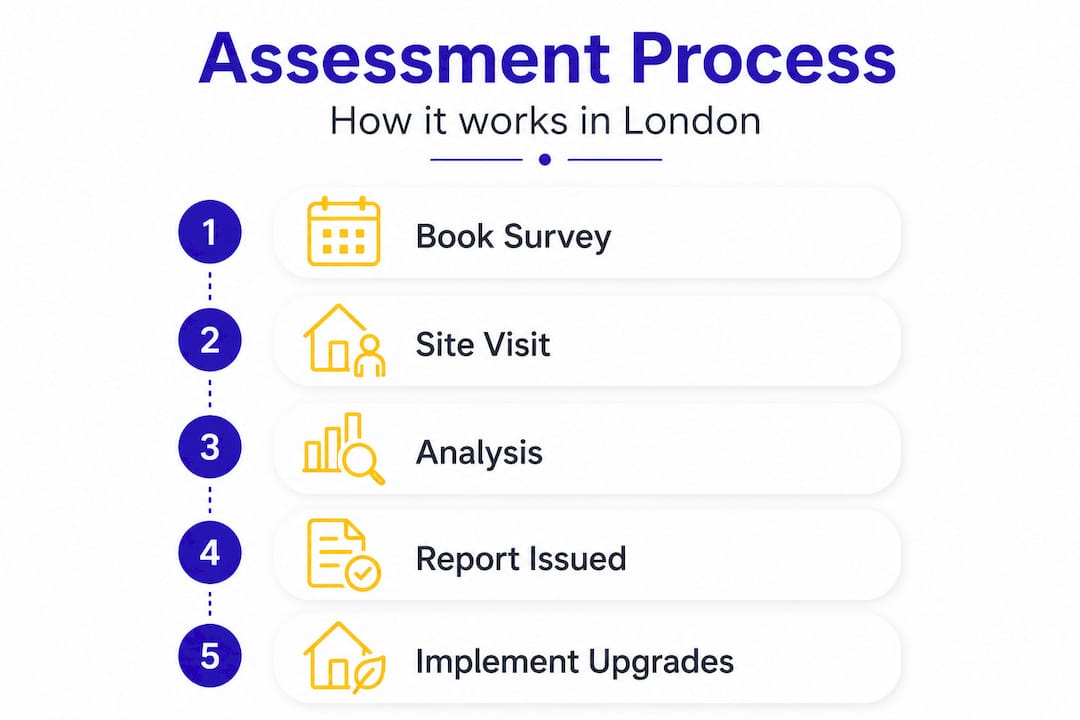
An energy efficiency assessment is a structured evaluation of how much energy a building uses and how efficiently it uses it. For most London property owners and landlords, the most familiar form is the Energy Performance Certificate (EPC), a modelled rating from A (most efficient) to G (least efficient) based on the building’s fabric, heating systems, ventilation, and lighting. EPCs are generated using standard software rather than live meter readings, which means two identical properties with different boiler types will produce different ratings.
Business owners sometimes confuse EPCs with energy audits. These are not the same thing. As business energy assessments demonstrate, an energy audit focuses on actual operational energy use and real behavioural patterns within your organisation, while an EPC is a modelled snapshot of the building itself. One tells you how your people and systems use energy day to day; the other tells you what the building is theoretically capable of.
When should you use each?
- EPC: Required for property sales, lettings, and new builds; the legal compliance tool for MEES
- Energy audit: Used by businesses seeking to cut operational costs, reduce carbon footprints, or meet ESOS (Energy Savings Opportunity Scheme) obligations
- Both: Larger commercial landlords may need both to satisfy different legal requirements and drive real-world savings
“Your EPC rating tells you what your building could achieve under standard conditions. An energy audit tells you what your building is actually doing right now.”
Beyond compliance, assessments offer a practical roadmap. A good EPC report lists specific, costed recommendations for improvement, giving you a clear starting point for any retrofit programme. Understanding EPCs in London is the foundation of sound property management in 2026.
| Assessment type | Based on | Primary use | Who needs it |
|---|---|---|---|
| EPC | Modelled data | Legal compliance, property transactions | Landlords, sellers, new build developers |
| Energy audit | Actual usage data | Operational savings, ESOS compliance | Businesses, larger commercial landlords |
| SAP assessment | Detailed modelled calc | New build compliance, planning | Developers, architects |
The legal landscape: compliance and MEES
With definitions in place, understanding the legal requirements is essential, especially for landlords and property owners.
The Minimum Energy Efficiency Standards, known as MEES, sit at the heart of energy compliance in London. Domestic landlords must not let a property with an EPC rating below band E unless a valid exemption applies and is registered. This rule covers new tenancies and renewals, and it applies to existing tenancies too. Ignoring it is not a low-risk option.
Here is what the compliance timeline looks like in practice:
- Obtain a valid EPC before marketing the property for let. EPCs are valid for ten years, but you should reassess after significant works.
- Check the rating. Band E or above means you can let. Band F or G means action is required before or during the current tenancy.
- Make improvements or apply for an exemption. Both routes have specific requirements, which we cover in the next section.
- Register any exemption on the PRS Exemptions Register if improvements are not possible or viable.
- Retain evidence. Local authorities can request documentation, and enforcement can result in civil penalties of up to £5,000 for domestic properties and significantly more for commercial ones.
Statistic to note: Properties rated F or G account for a meaningful proportion of London’s private rented housing stock, making compliance a genuine priority across the sector rather than a niche concern.
Pro Tip: Do not wait until a tenancy renewal to check your EPC rating. If your certificate is approaching its ten-year expiry or was issued before major works, commission a new one immediately. An updated assessment often reflects improvements that could push you from an F to an E rating with no additional work required.
MEES also applies to commercial properties, where the rules are structured differently but the principle is the same: below-standard properties carry legal and financial risk. If you are managing a mixed-use portfolio, you need to treat domestic and commercial compliance as separate workstreams.
Navigating exemptions and evolving standards
Once compliance basics are understood, dealing with exceptions and the future of standards is the next challenge.
Exemptions exist because not every property can be cost-effectively upgraded. But as MEES guidance for commercial buildings makes clear, exemptions are not a simple administrative escape. They require specific independent evidence, formal registration, and they interact directly with local authority enforcement.
The main exemption categories are:
- Payback period exemption: The recommended improvements would not pay for themselves within seven years based on energy savings.
- Devaluation exemption: An independent surveyor confirms that making the improvements would reduce the market value of the property by more than five per cent.
- Golden rule exemption: You have made all the improvements that can be funded using available finance schemes, but the property still falls below E.
- Third-party consent exemption: You genuinely cannot get consent from a freeholder, tenant, or planning authority to carry out the required works.
- New landlord exemption: A six-month grace period for landlords who have recently inherited a non-compliant property.
| Exemption type | Evidence required | Duration |
|---|---|---|
| Payback period | Quotes from qualified installers | 5 years |
| Devaluation | Independent RICS surveyor report | 5 years |
| Golden rule | Evidence of finance scheme application | 5 years |
| Third-party consent | Written refusal from relevant party | 5 years |
| New landlord | Proof of landlord status | 6 months |
Pro Tip: Always gather your exemption evidence before you register. If your documentation is incomplete or doesn’t match the specific criteria, your exemption registration may be challenged. Work with a qualified assessor to ensure your evidence pack is watertight from the start.
Looking beyond current requirements, the landscape is shifting. EPC methodology is moving towards a multi-metric, data-driven framework, which means future compliance will likely consider factors such as actual carbon emissions, primary energy use, and fabric performance separately rather than combining them into a single band. For London property owners, this is significant. A property that comfortably meets today’s single-metric E rating may face greater scrutiny under a multi-metric system.
What assessments reveal: typical recommendations and costs
Armed with knowledge of compliance and exemptions, property owners should know what to expect from an assessment and what it might cost.
An EPC assessment does more than assign a letter rating. The accompanying report sets out specific improvement measures, ranked by impact and cost. Government evaluation data on energy efficiency schemes confirms that assessments consistently flag a common set of measures, and the frequency with which each appears tells you a great deal about where London’s housing stock struggles most.

Common recommendations and indicative costs:
| Measure | Typical cost range | Potential annual saving |
|---|---|---|
| LED lighting throughout | £100 to £400 | £50 to £150 |
| Loft insulation (top-up) | £300 to £600 | £150 to £250 |
| Cavity wall insulation | £500 to £1,500 | £200 to £400 |
| Double or triple glazing | £3,000 to £8,000 | £100 to £300 |
| High-efficiency condensing boiler | £2,000 to £4,000 | £200 to £500 |
| Air source heat pump | £7,000 to £13,000 | £300 to £700 |
| Solar photovoltaic panels | £5,000 to £10,000 | £400 to £900 |
“Not every measure needs to be implemented at once. Prioritise by payback period and impact on your EPC band, not by cost alone.”
The most important thing to understand is sequencing. Installing an air source heat pump in a poorly insulated property will not deliver the savings projected. Your assessor should help you identify the logical order of works, starting with fabric improvements such as insulation and draught proofing before moving to heating system upgrades.
- Quick wins: LED lighting, draught-proofing, and loft insulation top-ups are low-cost and can sometimes shift a rating by a full band.
- Medium investment: Boiler replacement or cavity wall insulation delivers meaningful savings and improves EPC ratings significantly.
- Larger capital projects: Heat pumps and solar panels require more planning but can future-proof a property against tightening standards.
Action plan: steps to maximise your assessment’s value
All this information only helps if you know how to put it into practice; here’s how to act on your assessment.
Follow this structured approach to get the most from your energy efficiency assessment:
-
Prepare before the assessor arrives. Gather all documentation about the property: boiler installation records, insulation certificates, glazing specifications, and any previous EPC reports. The more evidence you provide, the more accurate your assessment will be.
-
Walk through the property with the assessor. Point out recent improvements that may not be visible, such as insulated pipework or upgraded controls. Assessors can only credit what they can verify, so clear communication matters.
-
Review the recommendation report in detail. Do not just look at your band. Read through every measure listed, note the projected impact on your rating, and compare that against the cost estimate provided.
-
Align findings with your compliance strategy. As landlord guidance makes clear, exemptions are legal mechanisms that require specific evidence aligned to exact criteria. If you plan to use an exemption rather than make improvements, your assessment evidence must directly support the exemption type you are claiming.
-
Obtain quotes promptly. Costs in the report are estimates. Get three real quotes from qualified contractors and use these for your payback calculations or exemption evidence pack.
-
Commission a new EPC after works. Once improvements are complete, update your EPC. This is the document that demonstrates compliance to tenants, agents, and local authorities.
Common pitfalls to avoid:
- Assuming an old EPC still reflects the current state of the property after renovations
- Claiming an exemption without registering it formally on the PRS Exemptions Register
- Delaying improvements because standards feel far away, when in fact they are moving faster than expected
- Overlooking commercial properties in a mixed portfolio, which have separate MEES obligations
Pro Tip: If you own multiple properties, consider commissioning assessments in batches. A single assessor covering several properties in one area can often offer better pricing, and you gain a clearer portfolio-level picture of your compliance exposure.
Why a data-driven approach changes the game for London property owners
Most articles on this subject stop at compliance. Here is what they miss.
The property owners who benefit most from energy efficiency assessments are not those who treat them as a one-time legal requirement. They are the ones who treat assessment reports as data assets. Every recommendation, every cost estimate, every projected saving is a data point that feeds into smarter capital allocation decisions.
Think about what this means in practice. If you have a portfolio of ten properties and you commission assessments across all of them, you can rank them by compliance risk, improvement potential, and expected return on investment. You can sequence your works programme to maximise the properties most at risk first, then reinvest savings from quick wins into more expensive upgrades elsewhere.
The shift towards a multi-metric compliance framework makes this approach even more important. When future standards measure carbon intensity, primary energy use, and fabric performance separately, a property that scores well on one metric but poorly on another becomes a risk. Landlords who have been tracking this data over time will be far better placed to respond quickly than those who have only ever looked at their EPC band.
Our view is that too many London landlords are still in reactive mode. They commission an EPC when they legally need one and do nothing until the next trigger point. In a market where standards are tightening, energy costs are volatile, and tenants are increasingly aware of running costs, that approach leaves real value on the table. A proactive, data-informed strategy is no longer just good practice; it is a competitive necessity.
Connect with London’s energy assessment experts
Ready to put these insights into practice or want expert help? Here’s where to start.
At Complete EPC, we work with London landlords, property owners, and businesses to make energy efficiency assessments genuinely useful, not just compliant. Whether you need a straightforward EPC for a letting, want to understand your EPC exemption options, or are planning a longer-term improvement programme, our qualified assessors are ready to help. We offer competitive pricing, fast turnaround, and clear reports that give you the information you need to act. Explore our full range of EPC services in London and take the next step towards lower energy costs and full legal compliance today.
Frequently asked questions
Who needs an energy efficiency assessment in London?
Landlords and property owners must obtain an EPC before letting a property, and many businesses face separate obligations under schemes such as ESOS. Assessments are also useful for anyone seeking to reduce energy costs or increase property value.
What happens if my property does not meet MEES requirements?
You cannot lawfully let the property without a valid, registered exemption. Non-compliant properties risk civil penalties and enforcement action by local authorities, so acting promptly is essential.
How do exemptions for energy efficiency standards work?
You must meet specific criteria and register the exemption, with supporting evidence, on the PRS Exemptions Register. Exemptions require documentation and cannot simply be self-declared without proper evidence.
Are business energy audits and EPCs the same?
No. Business energy audits examine actual operational energy use and workplace behaviour, whereas EPCs are modelled assessments of a building’s theoretical energy performance based on its fabric and systems.
What kind of upgrades do energy efficiency assessments typically recommend?
Assessment reports commonly recommend measures such as LED lighting, loft insulation, and cavity wall insulation at lower cost, with higher-cost options including boiler replacements, heat pumps, and solar panels for greater long-term impact.