

TL;DR:
- Holding an EPC does not guarantee compliance, and enforcement is increasing under stricter energy regulations. Landlords must provide valid EPCs when marketing, re-letting, or selling a property, with ratings of E or above becoming legally required to let or renew rent legally. Failure to comply can result in significant penalties, enforcement notices, and the need for proper documentation and strategic planning for future standards.
Holding an EPC is not the same as being compliant. Many London landlords assume that as long as they have a certificate somewhere on file, they are covered, but energy efficiency regulations have tightened considerably and local authorities are increasingly active in enforcing them. Landlords must provide a valid EPC to prospective tenants when letting a domestic property. This guide walks you through what the rules actually require, how ratings are assessed, what penalties look like, and how to prepare for the stricter standards coming in 2030.
Table of Contents
- What is an energy performance certificate (EPC) and why do landlords need one?
- Understanding minimum energy efficiency standards (MEES)
- How EPC ratings are calculated (and why they can change)
- What happens if you don’t comply? Enforcement, penalties, and documentation
- Planning for future EPC rules: from E to C and managing upgrades
- What most landlords miss about EPC compliance
- Get expert EPC support for your London rentals
- Frequently asked questions
Key Takeaways
| Point | Details |
|---|---|
| EPC is a legal requirement | Every rental property must have a valid EPC to be let or marketed lawfully. |
| MEES sets the EPC minimum | You must achieve at least rating E or register an exemption before letting to tenants. |
| Enforcement is strict | Non-compliance can mean substantial fines and public enforcement action by local authorities. |
| Upgrades are getting tougher | Future rules are moving towards EPC C by 2030, so plan improvements early to avoid a rush. |
| EPC ratings can change | Changes in assessment methods could alter your rating even if the property remains the same. |
What is an energy performance certificate (EPC) and why do landlords need one?
An EPC is an official document that rates a property’s energy efficiency on a scale from A (most efficient) to G (least efficient). It is a statutory requirement in England, introduced alongside the Minimum Energy Efficiency Standards (MEES) regulations. MEES sets the legal floor for the energy performance of privately rented homes. Without a valid EPC, you cannot legally market or let your property.
“An EPC is required when letting a domestic property and the landlord must be able to provide it to prospective tenants.”
When exactly do you need an EPC as a London landlord? The requirement applies in several specific situations:
- When marketing a property to prospective tenants for the first time
- When an existing tenancy ends and the property is re-let
- When renewing a fixed-term tenancy agreement
- When selling a tenanted property, as buyers and their solicitors will request it
The certificate contains information that tenants are entitled to see and act upon. A valid EPC includes the property’s current energy rating, the potential rating if recommended improvements are made, estimated energy costs, and specific recommendations such as insulation upgrades or more efficient heating systems. This information helps prospective tenants judge likely running costs, which increasingly influences letting decisions in London’s competitive rental market.
It is worth noting that the EPC must be provided free of charge to any prospective tenant. Failing to do so is not just an administrative oversight; it is a breach of your legal obligations as a landlord.
| EPC information shown | What it tells tenants |
|---|---|
| Current energy rating (A to G) | How efficient the property is right now |
| Potential energy rating | What could be achieved with improvements |
| Estimated energy costs | Likely annual bills for heating, lighting, hot water |
| Recommended improvements | Specific measures to raise the rating |
| Certificate validity | Date of assessment and expiry |
Understanding minimum energy efficiency standards (MEES)
Knowing you need an EPC is only half the picture. The other half is understanding what rating that EPC must show. Under MEES, domestic private landlords must not market or let a rental property with an EPC rating below E unless they have a valid, registered exemption.
This means a rating of F or G renders your property unlettable in most circumstances. You have two legal routes if your property falls below the minimum: improve the property to reach E or above, or register a formal exemption through the official PRS Exemptions Register.
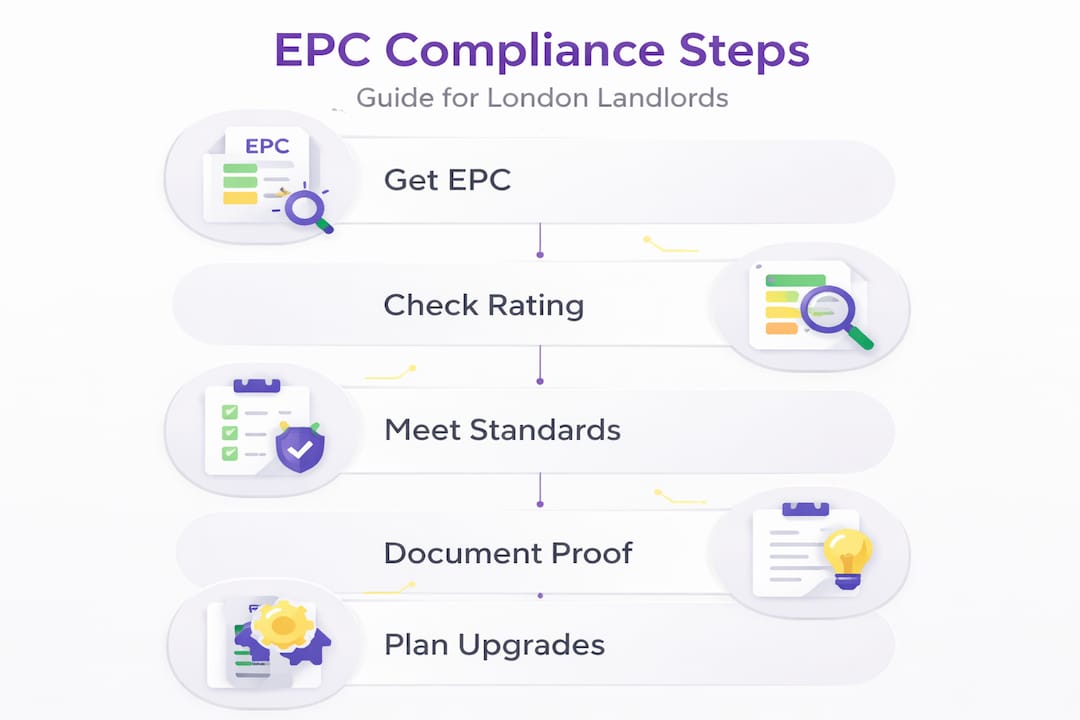
Here is the compliance decision process most London landlords should follow:
- Check your current EPC rating. Retrieve your certificate from the national EPC register and confirm the rating and expiry date.
- If rated E or above, you are currently compliant and can let the property lawfully. Plan ahead for future standards.
- If rated F or G, you must either carry out qualifying improvement works to bring the property up to E, or assess whether an exemption applies to your situation.
- If claiming an exemption, you must register it formally on the government’s PRS Exemptions Register. Verbal or informal claims carry no legal weight.
- Document everything. Keep records of your EPC, any upgrade work carried out, invoices, and your exemption registration confirmation.
| EPC rating | Legal status for letting | Action required |
|---|---|---|
| A to E | Compliant | Let as normal, keep EPC valid |
| F or G | Non-compliant | Improve to E or register exemption |
| F or G with valid exemption | Conditionally compliant | Register on PRS Exemptions Register |
Valid exemptions are narrow. They include situations where a third party (such as a tenant or freeholder) refuses consent for improvements, where recommended works would devalue the property by more than 5%, or where the cost of all relevant improvements exceeds the cost cap. Each exemption has specific eligibility criteria and must be renewed when it expires, typically after five years.
Pro Tip: Do not assume an exemption applies to your property without formally checking. Registering an exemption without meeting the criteria can leave you just as exposed as not registering at all. Always document why the exemption applies and keep that evidence on file.
How EPC ratings are calculated (and why they can change)
Many landlords are surprised to discover that their EPC rating can change between assessments even when they have made no physical changes to the property. Understanding why this happens can save you from unexpected compliance problems.

EPCs for existing homes are calculated using the domestic RdSAP methodology (Reduced Data Standard Assessment Procedure), which is periodically updated. RdSAP assigns energy values to different building features and fuel types based on national data. When that underlying data or methodology changes, properties can move up or down the ratings scale without any bricks being moved.
RdSAP 10, the most recent significant update, altered how certain features are scored, particularly relating to heating systems and renewable energy. A property that comfortably held an E rating under an older methodology might find itself at F under a new assessment. This is not a mistake or an inconsistency. It reflects a recalibration of how energy performance is evaluated nationally.
Common factors that influence your EPC rating include:
- Insulation levels in walls, roof, and floor (cavity wall, solid wall, loft insulation)
- Heating system type and age (gas boiler, heat pump, electric storage heaters)
- Window glazing (single, double, or triple glazed)
- Renewable energy features (solar photovoltaic panels, solar thermal systems)
- Lighting (percentage of fixed low-energy lighting)
- Hot water system (cylinder insulation, immersion heater, combi boiler)
- Updated fuel emission factors applied under the latest RdSAP version
Improving your property’s air conditioning efficiency can also contribute to a better EPC outcome, particularly in newer London flats where cooling systems are increasingly standard.
Pro Tip: Always ask your assessor which version of the RdSAP methodology they are using. If your current EPC was produced under an older version, the score you see on file may not reflect what a new assessment would produce. Review this before renewing tenancies, not after.
What happens if you don’t comply? Enforcement, penalties, and documentation
The consequences of EPC non-compliance are real, and enforcement has become more active in recent years. Understanding how local authorities handle this helps you avoid expensive mistakes.
“MEES enforcement is handled by local authorities, and non-compliance can result in compliance notices, financial penalties, and public outcomes.”
Local councils have the power to issue compliance notices requesting information about your property’s energy performance. If a breach is confirmed, they can issue financial penalties. The scale of those penalties depends on how long the breach has been in place and the property’s rateable value, but they can reach into the tens of thousands of pounds for extended non-compliance. The breach can also be made publicly available, which can affect your reputation as a landlord.
Here is the practical compliance workflow you should follow to protect yourself:
- Retrieve and review your EPC. Check the rating and confirm it has not expired. An EPC lasts 10 years, but conditions may have changed.
- Carry out any required improvements. If rated F or G, arrange the necessary works before re-letting or renewing.
- Register any exemption formally. If improvements are not possible, use the official PRS Exemptions Register before any tenancy begins.
- Prepare a compliance file. Collate your valid EPC certificate, invoices or records of improvements carried out, and your exemption registration confirmation if applicable.
- Have documents ready for inspection. If a compliance notice arrives, you need to respond with evidence promptly. Scrambling to locate paperwork after the fact adds risk.
Staying organised is your first line of defence. Local authority officers are not looking to catch well-prepared landlords off guard; they are targeting those who have ignored the rules or left paperwork incomplete.
Planning for future EPC rules: from E to C and managing upgrades
Reaching the current E minimum is essential, but it should not be your endpoint. The minimum standard for rentals is expected to rise toward EPC C by 2030, meaning landlords with properties currently sitting at D or E will need to plan further improvements even though they are fully compliant today.
This shift represents a meaningful challenge, particularly for older London properties. Victorian terraces, mansion flats, and period conversions often have structural features that make reaching C more difficult and more expensive than a modern build. Acting now, while contractor demand is lower and the deadline is not yet imminent, gives you a financial and practical advantage.
Steps you can take today to future-proof your property:
- Improve loft and cavity wall insulation if not already at the current standard
- Upgrade heating systems from older gas boilers to more efficient alternatives, including heat pumps where structurally suitable
- Install double or triple glazing in properties still using single-pane windows
- Add solar photovoltaic panels where planning permission and roof orientation allow
- Upgrade to LED lighting throughout all fixed fittings
- Draught-proof doors and windows to reduce heat loss at low cost
Exploring energy-efficient renovation ideas early means you can spread costs across multiple years, apply for any available grants, and avoid the premium pricing that typically hits landlords who rush upgrades as a deadline approaches.
Pro Tip: A phased improvement plan, reviewed annually, is far more cost-effective than a single large retrofit under deadline pressure. Commission an updated EPC after each phase of works to track your progress toward C and demonstrate ongoing compliance intent.
What most landlords miss about EPC compliance
There is a pattern we see repeatedly among London landlords. Compliance activity clusters around two moments: when a certificate is about to expire, and when a tenancy is about to be renewed. Outside those moments, EPC obligations tend to be forgotten. That reactive approach is where problems begin.
The first thing most landlords miss is the methodology risk. Your EPC may have been accurate when it was issued, but if the assessment method has since been updated, the score on file may no longer reflect what a fresh assessment would show. A landlord who assumes their D-rated property is comfortably above the E threshold could find themselves with an F after reassessment. The gap between a valid EPC and a current one can be significant.
The second gap is in improvement timing. Retrofit costs in London are sensitive to demand. When a regulatory deadline approaches, insulation contractors, boiler engineers, and glazing companies see a surge in work. Prices rise. Lead times extend. Landlords who delay action until the last year before a deadline routinely pay more and get less choice. Those who act two or three years early secure better pricing, better contractors, and retain rental income without interruption.
The third oversight is documentation. An EPC in a drawer is not the same as a compliance file. Local authority compliance checks can arrive without much notice. If you cannot produce your certificate, evidence of improvements, and any exemption documentation immediately, the process becomes much more stressful than it needs to be. Good recordkeeping is not bureaucracy for its own sake. It is protection for your property and your income.
Pro Tip: Book your EPC and any planned upgrades at least six months before your tenancy renewal date. This gives you time to act on findings, arrange works, and have paperwork ready before any compliance question arises.
Get expert EPC support for your London rentals
Staying compliant does not need to be complicated, and it certainly does not need to be left to chance. At Complete EPC, we work with London landlords every day to make the process straightforward, from initial assessment through to improvement advice and full documentation support. If you are new to the process, start with our guide to understanding energy certificates for a clear foundation. When you are ready to arrange a formal assessment, our step-by-step EPC assessment process guide explains exactly what to expect on the day. And if you want to see how a strong EPC rating directly supports your property’s value and lettability, explore EPC benefits for landlords to see the bigger picture. Our assessors are qualified, experienced, and available across all London boroughs at competitive rates.
Frequently asked questions
How long is an EPC valid for rental properties?
An EPC is valid for 10 years, but landlords should arrange a new assessment if significant improvements have been made or if assessment methodology has changed since the original certificate was issued.
Can I let a property with EPC rating F or G if I plan improvements?
No. You must improve the property to at least an E rating or formally register a valid exemption before letting or renewing a tenancy, as F/G ratings require either improvement or a registered exemption to be lawful.
What documentation do I need for compliance checks?
You should hold a valid EPC certificate, evidence of any improvement works carried out, and any exemption certificate. Landlords must have this documentation readily available for local authority inspection at any time.
Can my EPC rating change without making property changes?
Yes. If the RdSAP assessment methodology is updated nationally, your property’s rating on reassessment may differ from the previous certificate even if nothing physical has changed.
What are the penalties for not having a compliant EPC?
Landlords face fines and compliance notices issued by local authorities, and confirmed breaches can be published publicly, affecting both your finances and your reputation as a landlord.