

TL;DR:
- Selling a property in London without a valid energy performance certificate is a legal offence that can lead to fines and sale delays.
- An EPC assesses a home’s energy efficiency and must be obtained before marketing the property, influencing buyer interest and value.
- Preparing for assessment by booking accredited assessors and improving energy features can enhance your EPC rating and sales prospects.
Selling a property in London without an energy performance certificate is not just an oversight — it is a legal offence. According to UK government regulations, sellers must obtain a valid EPC before marketing their property for sale in England and Wales. Yet a surprising number of homeowners assume their estate agent will sort it out. They will not. The energy certificate for house sale is your responsibility as the seller, and getting it wrong risks fines, delays to completion, and buyers walking away before they have even viewed the property.
Table of Contents
- What is an energy performance certificate and why is it mandatory
- How the EPC assessment process works in London
- Risk and consequences of missing or invalid EPCs
- Checking existing EPCs and knowing when to get a new one
- How EPC ratings affect your property sale value and buyer appeal
- Practical steps to improve your EPC rating before sale
- Why energy performance certificates are more vital than ever in London’s property market
- How Complete EPC supports your property sale in London
- Frequently asked questions
Key Takeaways
| Point | Details |
|---|---|
| EPC is mandatory before sale | You must have a valid energy performance certificate to legally market your property in London. |
| EPC validity and cost | An EPC is valid for 10 years and costs typically between £60 and £120 in London. |
| Check existing EPC first | Use the official government register to see if you already have a valid EPC before booking a new one. |
| EPC rating affects sale outcomes | Higher EPC ratings increase buyer appeal, speed up sales and can enhance your property’s value. |
| Simple steps boost your EPC | Small improvements like insulation, efficient boilers and LED lights can increase your EPC rating and attract buyers. |
What is an energy performance certificate and why is it mandatory
An EPC (Energy Performance Certificate) is a standardised document that tells buyers how energy-efficient your home is and what it costs to run. The rating scale runs from A to G, where A is the most efficient and G is the least, and it must be provided free of charge to any prospective buyer. This is not optional paperwork.
Under the Energy Performance of Buildings Regulations, you are legally required to have a valid EPC before your property can be marketed for sale in England and Wales. Estate agents cannot list your property on Rightmove, Zoopla, or any other platform without one. The certificate also includes a recommendation report, which outlines practical steps to improve the rating, giving buyers a clear picture of potential future costs.
Here is what every London seller should know about EPCs:
- Valid for 10 years from the date of issue, so you may already have one you can reuse
- Must be presented to buyers free of charge at the earliest opportunity
- Covers both current and potential ratings, showing what the property could achieve with improvements
- Required before marketing begins, not at exchange or completion
- Covers all residential properties including flats, terraced houses, and detached homes
“An EPC is not just a legal box to tick. It tells buyers the real cost of living in your home. In a market where energy bills have soared, that information carries serious weight.”
Having established why an EPC is essential, the next step is understanding exactly how the assessment process works.

How the EPC assessment process works in London
Obtaining your EPC follows a clear and manageable process. A qualified Domestic Energy Assessor conducts an on-site inspection lasting between 30 and 60 minutes, checking your property’s insulation, heating system, glazing, and lighting. The certificate is typically delivered within 24 to 48 hours of the visit.
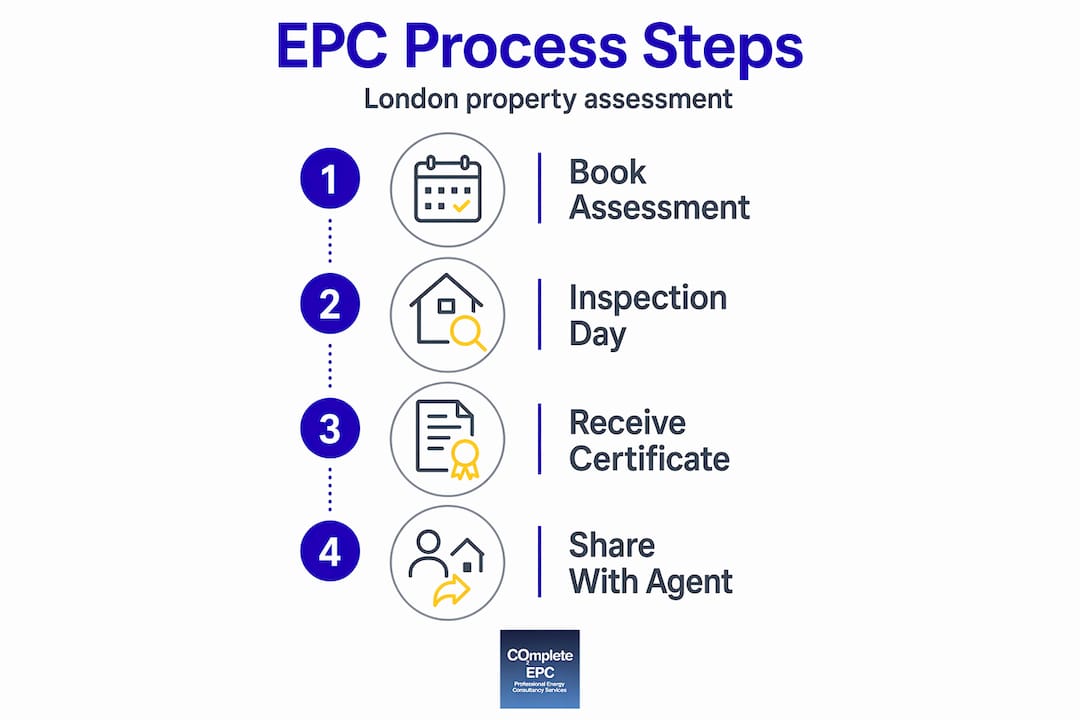
Here is what the energy certification process looks like from start to finish:
- Book an accredited assessor. Only assessors on an approved scheme register (such as Elmhurst Energy or Stroma) can produce a legally valid EPC. Always verify accreditation before booking.
- Prepare your property. Ensure the assessor has access to the loft, boiler cupboard, meter cupboard, and all rooms. Locked spaces that cannot be inspected are assumed to be uninsulated, which harms your rating.
- Gather documentation. Any installation certificates for insulation, a new boiler, double glazing, or solar panels should be ready. These prove the presence of improvements that the assessor might not be able to verify visually.
- The inspection takes place. The assessor records wall construction, roof insulation depth, boiler make and age, window type, and lighting. They do not assess cosmetic features or general condition — only energy-related elements count.
- Certificate is registered and issued. Your EPC is uploaded to the official national register and emailed to you, usually within 24 hours.
In London, the typical cost for a home energy assessment ranges from £60 to £120, depending on property size and complexity. A one-bedroom flat in Islington will sit at the lower end; a four-bedroom semi-detached in Bromley will be closer to the top. Always get a fixed quote that includes VAT and registration.
Pro Tip: If you have had insulation, a new boiler, or solar panels installed in the last few years but cannot find the paperwork, contact the installer directly for copies before your assessment. That documentation could be the difference between a D and a C rating.
Risk and consequences of missing or invalid EPCs
The risks of selling without a valid EPC go beyond a modest fine. Failure to hold a valid EPC before marketing results in a £200 fixed penalty, with penalty levels planned to rise significantly by 2030, potentially reaching £5,000 for non-compliance. These figures are not hypothetical — Trading Standards authorities in London have issued fines to sellers and agents alike.
Beyond the financial penalty, the practical consequences are just as damaging:
- Your estate agent must legally refuse to list the property without an EPC, meaning you cannot go to market until it is in place
- Sale delays knock confidence. Buyers who spot a missing EPC often assume the seller is disorganised or concealing something about the property’s condition
- Mortgage lenders and solicitors expect it. During conveyancing, the absence of a valid EPC can create complications that add weeks to the process
- Rental compliance overlap. If you are a landlord selling a previously let property, be aware that the minimum EPC rating rules for lettings (currently E, with reform proposals targeting C) may already apply and have different enforcement routes
“An estate agent who lists your property without a valid EPC is also exposed to legal liability. Most reputable agents in London will simply refuse to proceed without one — which means no advertising, no viewings, and no sale.”
Checking the status of your EPC before instructing an agent takes five minutes and costs nothing. That five minutes could save you weeks.
Checking existing EPCs and knowing when to get a new one
Before booking a new assessment, check whether a valid EPC already exists for your property. Homeowners can search the government EPC register for free using a postcode or address. If a certificate was produced within the last 10 years and no significant building work has taken place, you can reuse it.
Key questions to ask when reviewing an existing EPC:
- Is it less than 10 years old from the date on the certificate?
- Have you made any significant changes to heating, insulation, or windows since it was issued?
- Does the rating still accurately reflect the property as it stands today?
Pro Tip: If you have made energy improvements since the last EPC was issued, commissioning a new assessment almost always pays for itself. A rating improvement from E to D, or D to C, can meaningfully increase buyer interest and justify a higher asking price in London’s competitive market.
| Situation | Action required |
|---|---|
| EPC under 10 years old, no major changes | Reuse existing EPC — no new assessment needed |
| EPC over 10 years old | New assessment is mandatory |
| Significant energy improvements made | New assessment recommended to reflect upgrades |
| No EPC on register | New assessment required before marketing |
| Property converted or extended significantly | New assessment required |
Having established when a new certificate is needed, the next question is how your EPC rating actually affects what buyers are willing to pay.
How EPC ratings affect your property sale value and buyer appeal
In London’s property market, energy efficiency for home sale is no longer a secondary concern. Buyers are acutely aware of energy bills, and A to C rated homes sell faster with significantly less price discounting, while properties rated D or below face longer time on market and value reductions of 5 to 10%. That is a meaningful sum on a London property.
The energy label for homes is now one of the first filters buyers apply when shortlisting properties. Properties rated A or B attract buyers interested in lower running costs and often command a premium. Those rated F or G face an uphill battle, particularly with buyers using mortgages, as some lenders apply tighter lending criteria to poorly rated homes.
| EPC rating band | Typical buyer demand in London | Expected price impact |
|---|---|---|
| A to B | Very high | Premium of 2 to 5% |
| C | Strong | Broadly at market value |
| D | Moderate | Slight discount of 2 to 3% |
| E | Lower | Discount of 5 to 7% |
| F to G | Weak | Discount of 8 to 10% or more |
There are practical steps you can take to move your property up the scale before your assessment. Explore energy efficiency improvement steps that are relevant to residential properties and consider which apply to your home before booking the assessor.
The rating impact guides which improvements are worth prioritising before your assessment — which is exactly what the next section addresses.
Practical steps to improve your EPC rating before sale
Not every improvement requires significant expenditure. Simple measures such as loft insulation, draught proofing, thermostatic radiator valves, and switching to LED bulbs can raise your EPC rating quickly and affordably. More substantial upgrades, like a new boiler or cavity wall insulation, can shift your rating by multiple bands.
Low-cost improvements (under £500):
- Switch all bulbs to LED lighting throughout the property
- Install draught proofing on doors, windows, and letterboxes
- Add thermostatic radiator valves to controllable rooms
- Fit a hot water cylinder jacket if you have a tank
- Use a smart thermostat to demonstrate heating controls
Medium investment upgrades (£500 to £5,000):
- Install 270mm of loft insulation if currently below the recommended depth
- Upgrade to a modern condensing boiler if your current boiler is over 10 to 15 years old
- Add cavity wall insulation where the property construction allows
Higher investment, longer-term gains:
- External or internal wall insulation for solid-walled properties (common in older London stock)
- Double or triple glazing to replace single-glazed windows
- Solar photovoltaic panels, which can push a property to a B rating and generate ongoing savings
Pro Tip: Provide your assessor with all available installation certificates and manufacturer invoices on the day of inspection. Assessors can credit improvements they cannot physically verify if documentation confirms they were carried out. This costs you nothing extra and can make a tangible difference to your final rating.
Why energy performance certificates are more vital than ever in London’s property market
Most sellers treat the energy certificate for house sale as a nuisance — a piece of paperwork required to get the listing live. That framing is costly. An EPC is a buyer’s first financial forecast for your property. With energy price volatility showing no signs of settling, buyers are treating running costs with the same seriousness as the asking price itself.
What many sellers miss is that the EPC landscape is actively shifting. UK government reform proposals now aim to expand EPC metrics to include fabric performance, heating system type, and smart readiness — aligning property markets with net-zero targets by 2050. This means the certificate your buyer sees today will be a more detailed document within a few years. The sellers who understand this trajectory are already acting on it.
There is also a buyer psychology dimension that rarely gets discussed. A well-rated property signals to buyers that the home has been maintained and updated. It removes one of the most common negotiating tools — “the boiler is old and the windows are draughty, so we want £15,000 off.” A solid EPC rating closes that conversation before it starts.
The importance of energy certificate status is not just regulatory — it is commercial. Sellers who treat their EPC as an asset rather than an obligation arrive at negotiations in a stronger position. They attract buyers who are informed, motivated, and less likely to chip away at the asking price. In a London market where every percentage point of sale price matters, that is a real and measurable advantage.
How Complete EPC supports your property sale in London
When you are ready to get your EPC in place, Complete EPC makes the process straightforward. Our guide to energy performance certificates in London covers everything you need to understand your legal obligations before your property goes to market. We work with local, fully accredited assessors across all London boroughs, offering fast appointment slots and certificate delivery within 24 to 48 hours.
If you are unsure what to expect on inspection day, our EPC assessment process guide walks you through exactly what the assessor checks and how to prepare your property for the best possible outcome. And if your existing certificate has lapsed, our EPC renewal guide explains when and how to commission a new assessment without unnecessary cost or delay.
Complete EPC offers some of the most competitive pricing in the London market, with no hidden fees. Booking early means no last-minute scramble before your property goes live — and no risk of fines or delays slowing your sale.
Frequently asked questions
How long is an energy performance certificate valid for when selling a house?
An EPC is valid for 10 years from the date of issue, so if a valid certificate already exists on the register, you can use it for your sale without commissioning a new assessment.
What happens if I sell my property without a valid EPC?
Selling without a valid EPC can result in a £200 fixed penalty fine, rising to potentially £5,000 by 2030, and estate agents are legally barred from advertising your property until one is in place.
Can I reuse an existing EPC for my house sale?
Yes. If a valid EPC exists and is under 10 years old with no significant renovations carried out since issue, you are not required to commission a new assessment before selling.
How much does it typically cost to get an EPC done in London?
EPC assessment costs in London typically range between £60 and £120, depending on the size and complexity of the property, and should always include VAT and registration on the national register.
What improvements can increase my EPC rating before selling?
Loft insulation, LED lighting, draught proofing, thermostatic radiator valves, and modern boilers are among the most effective upgrades for raising your EPC rating, with solar panels offering the greatest potential gain for higher-rated properties.