

TL;DR:
- All privately rented properties in England and Wales must meet EPC band C by October 2030 under MEES Regulations. Landlords can register exemptions and spend up to £10,000 on fabric improvements first, prioritizing early action to ensure compliance. Fines for non-compliance can reach up to £30,000 per property, and proper documentation is essential for legal protection.
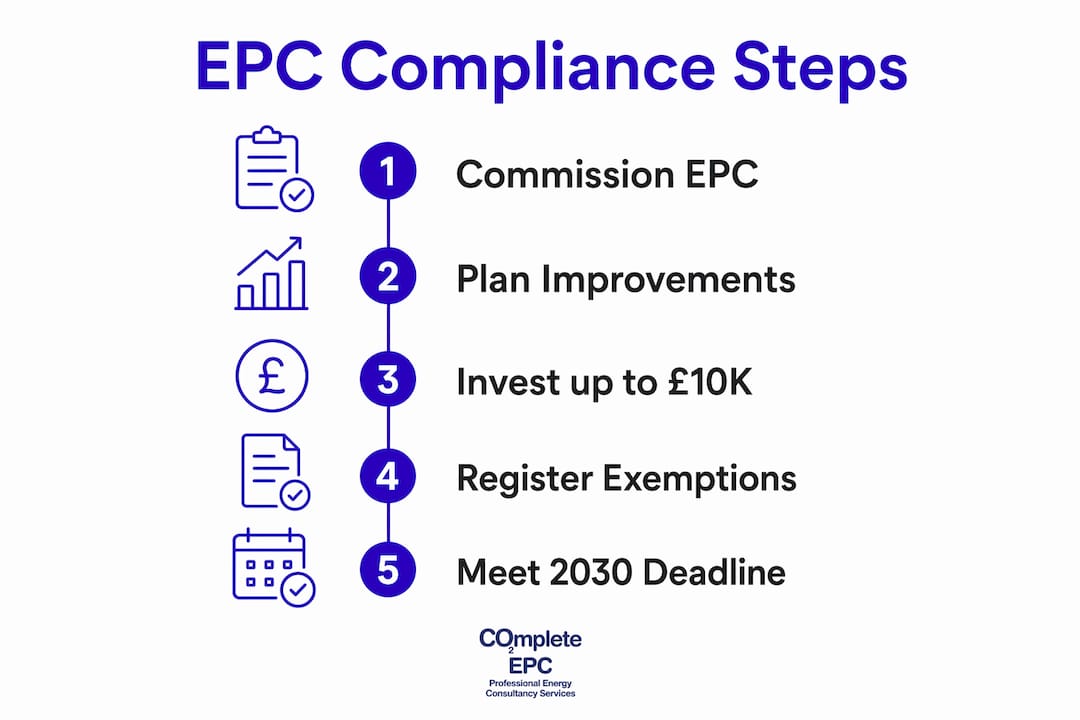
Landlord EPC rules require all privately rented domestic properties in England and Wales to achieve a minimum Energy Performance Certificate rating of band C by 1 october 2030. The regulatory framework sits under the Minimum Energy Efficiency Standards (MEES) Regulations, enforced by local authorities. The 2026 Warm Homes Plan tightens this further, introducing a £10,000 expenditure cap per property and fines of up to £30,000 for non-compliance. These are not proposals. They are confirmed legal obligations that every landlord in England and Wales must plan for now.
What are the latest EPC rating requirements for landlords?
All privately rented properties in England and Wales must reach at least EPC band C by 1 october 2030. This single deadline replaces the previous phased approach, which had separate dates for new and existing tenancies. Every active tenancy must comply by that date, with no exceptions based on when the tenancy started.
The current minimum under MEES Regulations is EPC band E. Landlords who already meet band E are legally compliant today, but band C is the confirmed target. The gap between E and C is significant for many older properties, particularly Victorian terraces and pre-war stock common across London.
Key points on EPC validity and deadlines:
- An EPC is valid for 10 years from the date of issue.
- A new certificate is required after significant energy efficiency works.
- Properties rated C or above before 1 october 2029 are deemed compliant until that certificate expires, under a grandparenting provision. This gives early movers a meaningful advantage.
- The 1 october 2030 deadline applies to all tenancies in England and Wales, including those already in progress.
- Scotland and Northern Ireland operate under separate frameworks and have different requirements.
The grandparenting provision is one of the most underused tools available to landlords. If your property achieves band C before october 2029, you lock in compliance for the full 10-year certificate period. That means you could avoid the new multi-metric assessment methodology entirely for that cycle.
Pro Tip: Commission your EPC assessment as early as possible. An early C rating secured before october 2029 could protect you from the more demanding new assessment framework for up to a decade.
How much must landlords invest, and what exemptions exist?
Landlords must invest up to £10,000 per property on energy efficiency improvements. If band C cannot be achieved within that cap, a cost cap exemption can be registered. For properties valued under £100,000, the alternative cap is 10% of the property value, which requires detailed records of expenditure from october 2025 onwards.

The £10,000 cap is not a budget. It is the maximum you are legally required to spend before you can claim an exemption. Spending less and stopping short of band C without registering an exemption is a compliance failure.
The order in which you spend matters. Landlords must prioritise fabric improvements before spending on heating upgrades or smart readiness measures. Only after the fabric performance metric is met do secondary expenditures count toward the cap.
Valid exemption categories include:
- Cost cap exemption — band C is not achievable within the £10,000 limit (or 10% cap for lower-value properties).
- Solid wall insulation exemption — solid wall insulation is not technically feasible or has been refused by a third party such as a freeholder.
- Negative impact exemption — works would devalue the property by more than 5%.
- Third-party consent exemption — planning permission or listed building consent was refused.
- Recently let property exemption — the property was let before the landlord could carry out works.
All exemptions must be registered on the national PRS MEES Exemptions Register. An unregistered exemption offers no legal protection. Exemptions typically last up to 10 years, after which the obligation to comply resumes.
Pro Tip: Keep every invoice, quote, and contractor report from october 2025 onwards. This documentation is your evidence base for both the cost cap calculation and any exemption registration.
What penalties do landlords face for non-compliance?
Fines for non-compliance reach up to £30,000 per property. That figure represents a sixfold increase from the previous maximum of £5,000. Local authorities issue both improvement notices and penalty notices, and they have the power to act without waiting for a landlord to self-report.
Non-compliance records are made public. A penalty notice on the public register can affect your ability to secure buy-to-let mortgage products and property insurance. Lenders increasingly check EPC ratings as part of their lending criteria.
The financial penalties are serious, but the administrative consequences can be equally damaging. Failure to provide a valid EPC at the start of a tenancy can block you from serving a Section 21 notice for possession. This applies even if the property itself is energy efficient. The paperwork must be in order before the tenancy begins.
The enforcement process typically follows this path: a local authority identifies a non-compliant property, issues an improvement notice with a compliance deadline, and then issues a penalty notice if the landlord fails to act. Both notices are recorded publicly. Landlords who act promptly after an improvement notice can avoid the penalty notice, but the improvement notice itself remains on the public record.
Documentation is your best protection. Keep copies of your current EPC, all expenditure records, exemption registrations, and any correspondence with contractors or local authorities.
How does the new multi-metric EPC assessment work?
The 2026 policy shift moves away from a single energy efficiency rating toward a multi-metric EPC assessment that prioritises fabric performance first. Fabric performance covers insulation, draught-proofing, window glazing, and the thermal envelope of the building. Only once the fabric metric is satisfied do secondary metrics such as heating efficiency and smart readiness come into play.
This changes retrofit planning fundamentally. Under the old single-rating system, installing a new boiler could push a property from D to C. Under the new framework, that same boiler upgrade may not count toward compliance at all if the fabric standard has not been met first.
| Assessment element | Old EPC methodology | New multi-metric methodology |
|---|---|---|
| Primary metric | Single energy efficiency rating | Fabric performance (insulation, glazing, thermal envelope) |
| Secondary metrics | Not separately assessed | Heating efficiency and smart readiness |
| Retrofit order | Flexible | Fabric improvements must come first |
| Compliance proof | Certificate at point of assessment | Pre-retrofit and post-retrofit certificates required |
| Cost cap counting | All qualifying works | Heating/smart costs only count after fabric standard is met |
Landlords are advised to commission a new EPC using the updated multi-metric methodology before any retrofit work begins. This establishes your baseline under the new framework. A post-retrofit EPC then proves compliance and confirms which costs count toward the £10,000 cap.
Pro Tip: Do not commission retrofit work based on an EPC produced under the old methodology. The new multi-metric framework may assess your property differently, and works planned under the old system may not deliver the compliance outcome you expect.
What practical steps can landlords take to comply efficiently?
Early action is the single most effective compliance strategy. Landlords who plan early can secure the grandparenting provision, avoid the rush of contractors before 2030, and spread costs across multiple tax years. Waiting until 2029 means competing with every other landlord in the country for the same pool of qualified installers.
Common energy efficiency measures that contribute to band C compliance include:
- Loft insulation — one of the most cost-effective fabric improvements, typically costing £300–£600 for a standard property.
- Cavity wall insulation — effective for properties built between 1920 and 1995 with unfilled cavity walls.
- Double or triple glazing — replaces single-glazed windows and contributes to the fabric performance metric.
- Draught-proofing — low-cost measure that improves the thermal envelope score.
- Heat pump installation — counts as a heating efficiency improvement, but only after fabric standards are met.
- Smart heating controls — contribute to the smart readiness metric, again only after fabric compliance.
Budget planning within the £10,000 cap requires a clear priority order. Spend on fabric first, then heating, then smart measures. Get quotes before committing, and keep all receipts from october 2025 onwards. For property maintenance and compliance planning, a structured schedule helps you track expenditure against the cap in real time.
The EPC rating guide from Completeepc provides a clear breakdown of what each band requires and which improvements deliver the most rating points per pound spent. Understanding this before you commission any works saves both time and money.
Pro Tip: Get an EPC assessment before you spend a penny on improvements. The current certificate tells you exactly how far from band C your property sits and which measures will close that gap most efficiently.
Key takeaways
Landlord EPC obligations under the MEES Regulations require all privately rented properties in England and Wales to reach band C by 1 october 2030, with a £10,000 investment cap, fabric-first improvement rules, and fines of up to £30,000 for non-compliance.
| Point | Details |
|---|---|
| Band C by 2030 | All active tenancies in England and Wales must meet EPC band C by 1 october 2030. |
| £10,000 investment cap | Landlords must spend up to £10,000 before claiming a cost cap exemption; lower-value properties use a 10% cap. |
| Fabric improvements first | Spending on heating or smart measures only counts toward the cap after the fabric performance metric is satisfied. |
| Grandparenting provision | Properties rated C or above before 1 october 2029 are deemed compliant until the certificate expires. |
| Register exemptions formally | All exemptions must be recorded on the PRS MEES Exemptions Register to carry legal weight. |
Danny’s view on getting ahead of the 2030 deadline
The landlords I see struggling most with EPC compliance are not the ones with the worst-rated properties. They are the ones who assumed they had more time. The 2030 deadline feels distant until you factor in contractor availability, planning delays for listed buildings, and the time needed to gather exemption evidence properly.
My honest view is that the grandparenting provision is the most underappreciated tool in this entire framework. Achieving band C before october 2029 under the existing methodology is almost certainly easier and cheaper than achieving it under the new multi-metric system after that date. The new framework is more demanding, and the assessment methodology is more granular. Acting now is not just about avoiding fines. It is about locking in compliance on the most favourable terms available.
The £10,000 cap also misleads some landlords into thinking compliance is capped at that figure. It is not. The cap defines when you can stop spending and register an exemption. If band C is achievable within £3,000, you are expected to spend £3,000 and comply. The cap only protects you when compliance is genuinely unachievable within that budget.
Engage a qualified assessor before you plan any works. An accurate baseline EPC under the new methodology tells you exactly where you stand. Everything else follows from that.
— Danny
How Completeepc can help you meet your EPC obligations
Completeepc provides domestic EPC assessments for landlords across London, carried out by qualified assessors with direct experience of the updated MEES Regulations. Whether you need a baseline assessment before retrofit works or a post-improvement certificate to prove compliance, Completeepc delivers accurate results at competitive rates. The team also supports landlords with understanding cost cap documentation and identifying which improvements will move the needle most efficiently. For landlords managing energy efficient upgrades across a portfolio, having a reliable assessment partner removes uncertainty from the compliance process. Book your assessment with Completeepc and approach the 2030 deadline with confidence.
FAQ
What is the minimum EPC rating for rental properties in 2026?
The current legal minimum under MEES Regulations is EPC band E. The confirmed target is band C, which all privately rented properties in England and Wales must achieve by 1 october 2030.
How long is an EPC valid for a rental property?
An EPC is valid for 10 years from the date of issue. A new certificate is required after significant energy efficiency works, or when the existing certificate expires before the tenancy ends.
What happens if a landlord cannot afford to reach band C?
Landlords who cannot achieve band C within the £10,000 investment cap can register a cost cap exemption on the PRS MEES Exemptions Register. For properties valued under £100,000, the alternative cap is 10% of the property value.
Can a landlord be fined for not having an EPC?
Yes. Fines reach up to £30,000 per property for non-compliance with MEES Regulations. Failure to provide a valid EPC at the start of a tenancy can also prevent a landlord from serving a Section 21 notice.
Do EPC rules apply differently to new and existing tenancies?
No. The 1 october 2030 deadline applies to all active tenancies in England and Wales, regardless of when the tenancy began. There is no separate phased deadline for new lettings.