


TL;DR:
- London property owners face stricter energy standards requiring effective insulation choices.
- Evaluating thermal performance involves considering lambda, U-values, and R-values alongside practical factors.
- Combining insulation with professional surveys and airtight measures maximizes EPC and cost savings.
Owning or letting a property in London puts you under real pressure from two sides: rising energy bills and tightening EPC requirements. From 2026 onwards, landlords face stricter minimum energy efficiency standards, and insulation remains the single most effective tool for meeting them. The right insulation choice depends on your building’s age, construction type, and budget, and a wrong decision can cost you thousands or still leave you short of the EPC band you need. This guide walks you through every major insulation type, how they perform, what they cost, and how to choose the right one for your specific London property.
Table of Contents
- How to evaluate building insulation options
- Cavity wall, solid wall, and floor insulation: Main types explained
- Loft, roof, and advanced insulation systems
- Direct comparison: How the main insulation types stack up
- Choosing the right insulation for your London property
- Why insulation choices in London are rarely one-size-fits-all
- Connect insulation upgrades with EPC improvement
- Frequently asked questions
Key Takeaways
| Point | Details |
|---|---|
| Cavity and loft first | Cavity wall and loft insulation offer the quickest, most affordable boost to EPC ratings for most London homes. |
| Solid wall for older builds | Pre-1920s or solid-walled properties often benefit most from external insulation, though cost and permissions are higher. |
| Thermal metrics matter | Always compare thermal conductivity (λ), R-value, and U-value to judge real impact on bills and comfort. |
| Survey before you buy | Every property should be surveyed for damp, wall construction, and energy losses before installing insulation. |
| Match to EPC goals | Insulation upgrades not only cut costs but make it easier to legally let or sell your London property. |
How to evaluate building insulation options
Before picking an insulation product, you need to understand the three numbers that really matter in any assessment.
- Thermal conductivity (λ, lambda): This measures how easily heat passes through a material. A lower λ means better insulating performance. Mineral wool sits around 0.038 W/mK, while aerogel can reach 0.015 W/mK.
- U-value: This measures how much heat escapes through a complete building element, such as a wall or roof. Lower is better. Building Regulations Part L sets maximum U-values for walls, floors, and roofs in new builds and major refurbishments. A solid wall might have a U-value of 2.0 W/m²K uninsulated; the target after insulation is typically 0.18 to 0.30 W/m²K depending on the element.
- R-value: This is the thermal resistance of an insulation layer. Higher is better. It is the inverse of the U-value contribution from that layer. Thicker or denser materials give higher R-values.
Understanding thermal performance measures such as λ, U-value, and R-value is essential before comparing products or getting quotes. Beyond the numbers, practical factors matter just as much for London properties: moisture and damp risk (especially in older brick terraces), fire resistance ratings, breathability, available installation space, and how much EPC improvement you can realistically expect.
Different parts of your building also have different priorities. A basement floor needs moisture resistance above all else. A Victorian solid wall needs breathability to avoid trapping damp. A loft conversion needs fire compliance and space efficiency.
Pro Tip: Commission a whole-building heat-loss survey before choosing insulation. It identifies your biggest sources of heat loss precisely, so you spend money where it actually makes a difference rather than where it is easiest to install.
The Energy Saving Trust offers a clear overview of where heat escapes in typical UK homes, which is a useful starting point for prioritising your spend.
Cavity wall, solid wall, and floor insulation: Main types explained
London’s housing stock is unusually varied. You have post-war cavity-wall semis sitting next to Edwardian terraces and 1970s purpose-built flats. Each calls for a different approach.
Cavity wall insulation suits homes built roughly from the 1920s onwards, where a gap exists between the inner and outer leaf of the wall. Common fill materials include mineral wool batts, expanded polystyrene (EPS) beads, and polyisocyanurate (PIR) boards. Installation is minimally disruptive and relatively affordable, typically costing between £700 and £1,200 for a London semi-detached property. Choosing the right insulation material for the cavity width and exposure zone is critical to avoid moisture bridging.
Cavity wall insulation can save up to £240 a year in a London semi-detached home.
Solid wall insulation applies to pre-1920s properties and some non-standard constructions. You have two routes:
- Internal wall insulation: Rigid PIR boards or mineral wool slabs fixed to the inner face of external walls. Typical cost around £7,500 for a full house. Reduces floor area slightly and requires re-routing of sockets and radiators.
- External wall insulation (EWI): Boards fixed to the outside, finished with render or cladding. Typical cost around £11,000 or more. More disruptive externally but preserves internal space and keeps the wall structure warm.
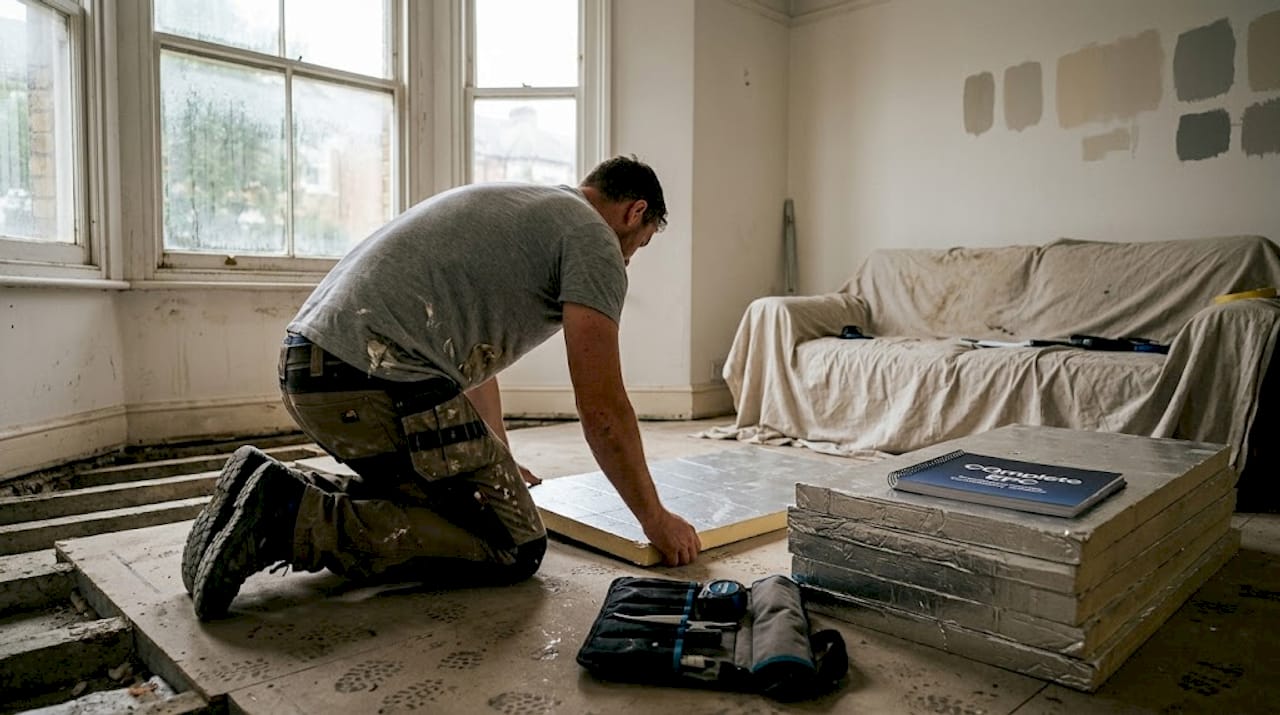
Floor insulation is most relevant during major refurbishments. Rigid PIR boards go under concrete slabs; mineral wool or EPS batts fit between the joists of suspended timber floors. Insulating a ground floor can add meaningful EPC points if the property is poorly performing overall.
Pro Tip: For listed buildings or properties in conservation areas, breathable natural insulations such as wood fibre or mineral wool are usually the safest choice. They manage moisture without synthetic vapour barriers that can trap damp in historic masonry.
Loft, roof, and advanced insulation systems
The roof is responsible for up to 25% of a home’s heat loss, making it one of the highest-return places to insulate. Fortunately, it is also one of the most accessible.
Loft insulation options include:
- Mineral wool rolls: Laid between and over joists to a depth of 270mm. This is the standard recommended thickness and the most cost-effective solution for accessible lofts.
- Rigid boards at rafter level: Used when the loft is a habitable conversion. PIR or phenolic boards between and below rafters achieve high thermal performance in a reduced depth.
- Spray foam: Applied in complex roof spaces or around irregular structures. Useful for awkward geometries but carries well-documented risks around mortgage lending and resale value, so consider it carefully.
Advanced and high-performance insulation systems are increasingly relevant for London retrofits where space is tight or very low U-values are required:
- Phenolic foam: Lower λ than standard PIR, meaning thinner boards for the same performance.
- Aerogel: The highest thermal resistance per millimetre available commercially. Expensive, but critical for heritage properties where wall thickness cannot increase significantly.
- Wood fibre boards: Breathable, sustainable, and good for summer overheating as well as winter heat retention.
- Structural insulated panels (SIPs): Used in extensions or full-fabric replacements rather than retrofits.
Real-world performance from loft insulation types can vary from lab figures depending on installation quality and ventilation. Always use a registered installer. You can also check insulation R-values by product type to compare options before committing.
Pro Tip: Combining top-up loft insulation with thorough draught-proofing around hatches, pipes, and eaves gives the biggest EPC improvement for most older London homes, often at the lowest combined cost.
Direct comparison: How the main insulation types stack up
To help you decide quickly, here is a side-by-side view of the main options relevant to London properties.
| Insulation type | Approx. cost (London) | Typical λ (W/mK) | Space loss | Fire/moisture notes | EPC uplift |
|---|---|---|---|---|---|
| Cavity wall (mineral wool/EPS) | £700 to £1,200 | 0.032 to 0.040 | None | Low risk if correctly installed | Moderate to high |
| Solid wall, internal | ~£7,500 | 0.022 to 0.038 | 80 to 100mm per wall | Vapour control layer needed | High |
| Solid wall, external | ~£11,000+ | 0.022 to 0.038 | External only | Keeps wall warm, lower damp risk | High to very high |
| Loft (mineral wool, 270mm) | £300 to £500 | 0.038 to 0.044 | Roof space only | Good fire resistance | High |
| Floor (PIR under slab) | £1,500 to £3,000 | 0.022 to 0.028 | 50 to 100mm floor height | Moisture barrier essential | Moderate |
| Advanced (aerogel/phenolic) | £2,000+ per room | 0.015 to 0.021 | Minimal | Varies by product | Very high per mm |
External wall insulation can be 20 to 30% more thermally efficient than internal insulation applied to the same wall, though the cost difference is significant. Key points to weigh up:
- Synthetic insulations (PIR, EPS) have higher fire class requirements and need careful detailing around openings
- Natural insulations (mineral wool, wood fibre) are more breathable and forgiving in older properties
- Cavity fill gives the best value EPC boost per pound spent in most London scenarios
- External solid wall insulation causes the least internal disruption but the most external change, which matters in terraces and conservation areas
For further guidance on solid versus cavity wall options, the Energy Saving Trust provides reliable, up to date advice.
Choosing the right insulation for your London property
Applying all of this to your specific building comes down to a few clear priorities.
- Cavity walls present: Start here. It is the most cost-effective route to an EPC improvement. Survey first to confirm the cavity is clear and dry.
- Accessible loft: Add or top up mineral wool to 270mm. Combine with draught-proofing for maximum impact.
- Solid walls on a tight budget: Internal insulation is the practical choice for most flats and terraces where external works are restricted.
- Solid walls with budget and planning permission: External insulation delivers the best thermal and EPC outcome, and is worth exploring for whole-building refurbishments.
- Complex or heritage layouts: Advanced materials such as aerogel or phenolic boards make meaningful EPC gains possible without significant structural change.
Before any installation, check for existing damp or non-standard construction. Insulating over a damp wall will lock in moisture and create mould. Address the source of damp first, always.
External insulation keeps the wall structure on the warm side of the insulation layer, which significantly reduces condensation and damp risk for London’s older brick buildings.
Landlords should also confirm current Minimum Energy Efficiency Standards (MEES) requirements and check whether any government grants or local authority schemes apply to their property. A guide for solid wall houses from the Energy Saving Trust covers grant eligibility and installer accreditation in detail.
Why insulation choices in London are rarely one-size-fits-all
The figures in product data sheets and energy calculators are a starting point, not a guarantee. In practice, real-world R-value performance often falls short of lab results once you account for thermal bridging, installation gaps, and the specific quirks of London’s ageing building stock.
Installation quality is the factor most property owners underestimate. The industry has seen serious quality failures: 39 firms were suspended over poor cavity wall installation jobs, a statistic that underlines why choosing an accredited, experienced installer matters as much as choosing the right product. A badly installed cavity fill can actually worsen performance by introducing moisture pathways.
We have also found that hybrid combinations tend to outperform single-material solutions in complex properties. Pairing PIR boards with mineral wool, for instance, balances thermal performance with fire resistance and breathability in a way that neither material achieves alone. For a Victorian mid-terrace with solid walls, an external wood fibre board with a lime render finish can be the only approach that manages heat loss, moisture, and heritage character simultaneously.
Our recommendation is straightforward: prioritise a professional survey, then design a tailored solution around your building’s actual heat-loss profile. Always combine insulation upgrades with draught-proofing. And never let a low upfront quote substitute for proper assessment.
Connect insulation upgrades with EPC improvement
Insulation upgrades directly raise your EPC band, and that matters more than ever for London landlords who must meet minimum energy efficiency standards to legally let their properties. Understanding which insulation delivers the biggest EPC gain for your specific building type is exactly where a professional assessment adds real value. At Complete EPC, our qualified assessors help you understand your current rating, identify the upgrades that will move the needle most, and guide you through the EPC assessment process from start to finish. Whether you are planning improvements or need to certify a completed project, learn more about EPC rating improvement or read our full guide to understanding EPC certificates to plan your next step.
Frequently asked questions
What type of insulation improves EPC rating the most?
Cavity wall and loft insulation typically yield the fastest, biggest EPC gains in most London homes because they address the two largest sources of heat loss at relatively low cost.
How much can I save on energy bills with proper insulation?
You could save up to £240 per year with cavity wall insulation and around £40 with loft insulation top-up in a London semi-detached home, depending on current energy tariffs.
Can insulation cause damp problems?
Properly installed insulation should not cause damp, but any existing moisture must be diagnosed and resolved before walls are insulated, otherwise you risk trapping it and causing mould.
Do I need permission to insulate externally in London?
External wall insulation may require planning permission, particularly for listed buildings, properties in conservation areas, or where the external appearance of the building would change significantly.
What thickness of insulation is recommended in lofts?
270mm of mineral wool is the standard recommended thickness for loft insulation, balancing cost, performance, and compliance with current energy efficiency guidelines.