
TL;DR:
- Simple behavioral changes like turning off standby power and using LED bulbs can reduce energy bills immediately.
- For homeowners, investing in insulation and an energy audit offers long-term savings, while tenants should focus on thermostat and habit adjustments.
Energy bills have become one of the biggest drains on household budgets across the UK, and finding the best ways to save energy can feel like searching for a needle in a haystack. There is no shortage of advice out there, but much of it is vague, overly technical, or simply not suited to your situation. This guide cuts through the noise. Whether you own your home or rent it, you will find proven, practical strategies here, ranging from quick daily habits to targeted upgrades, all ranked and explained so you can act with confidence.
Table of Contents
- Key takeaways
- How to choose the best ways to save energy for your situation
- 1. Switch off standby power and unused lights
- 2. Wash clothes in cold water and run full loads
- 3. Line dry your clothes instead of tumble drying
- 4. Take shorter showers and fix leaking taps
- 5. Optimise your thermostat settings
- 6. Use ceiling fans strategically
- 7. Maintain your heating and cooling system
- 8. Lower your water heater temperature
- 9. Seal draughts around doors and windows
- 10. Upgrade to energy-efficient appliances and lighting
- 11. Invest in insulation and get an energy audit
- Comparing energy-saving strategies at a glance
- My honest take on where to start
- Find out how your property rates for energy efficiency
- FAQ
Key takeaways
| Point | Details |
|---|---|
| Start with daily habits | Household behaviours are the biggest immediate opportunity for savings, requiring no upfront cost. |
| Thermostat scheduling saves 10% | Setting back your thermostat by 7 to 10 degrees for 8 hours daily cuts annual heating and cooling bills by roughly 10%. |
| Renters have real options too | Behavioural changes and smart thermostat use deliver meaningful savings without requiring landlord permission. |
| Upgrades need a plan | An energy audit identifies the highest-impact improvements before you spend money on insulation or appliances. |
| EPCs provide a clear roadmap | An Energy Performance Certificate reveals your property’s efficiency rating and flags the specific upgrades that will make the most difference. |
How to choose the best ways to save energy for your situation
Not every energy-saving idea is right for every household. Before you commit to a change, it helps to weigh it against four factors: upfront cost, ease of implementation, likely impact on your bills, and whether it is actually available to you.
Some of the most effective changes cost nothing at all. Adjusting your behaviour, your thermostat schedule, and how you use appliances can shave pounds off your bills this month. Other strategies, such as loft insulation or replacing a boiler, require capital and often require you to own the property.
Here is a quick framework to apply to any energy-saving idea:
- Cost: Is this free, low-cost (under £50), or a significant investment?
- Ease: Can you do it today, or does it need a tradesperson or landlord approval?
- Impact: Does it target a major energy user such as heating, hot water, or large appliances?
- Suitability: Are you a homeowner with full control, or a tenant with restrictions?
Pro Tip: If you are a tenant, focus first on habits and thermostat use. These deliver real savings and require no structural changes or landlord sign-off.
Tenants benefit most from behavioural changes and smart thermostat use, whereas homeowners gain lasting savings from insulation and sealing improvements. Keep this distinction in mind as you work through the list below.
1. Switch off standby power and unused lights
Appliances left on standby continue drawing electricity around the clock. A television, a games console, a broadband router, a phone charger left plugged in with nothing attached. Together, these can account for a surprising slice of your annual electricity bill. Switching them off at the wall costs nothing and takes seconds.
The same principle applies to lighting. LED bulbs use 75% less energy and last up to 10 times longer than older incandescent bulbs. If you have not already replaced your bulbs, this is one of the cheapest and most impactful swaps available to both renters and homeowners.
Make the most of natural daylight by keeping curtains open during the day and arranging work or reading areas near windows. At night, close curtains to retain warmth and reduce the heat your heating system needs to replace.
2. Wash clothes in cold water and run full loads
Your washing machine is one of the more energy-hungry appliances in your home, and most of that energy goes to heating the water. Switching to a cold wash cycle can cut the energy used per wash by up to 90% compared with a hot cycle, with no noticeable difference in cleaning performance for everyday loads.
Running full loads rather than half-empty ones is equally straightforward. The machine uses roughly the same energy regardless of how full it is, so you are effectively doubling your cost per item when you run a half load.
Pro Tip: Modern detergents are formulated to work effectively at 30°C or below. You do not need a hot wash for most fabrics.
3. Line dry your clothes instead of tumble drying
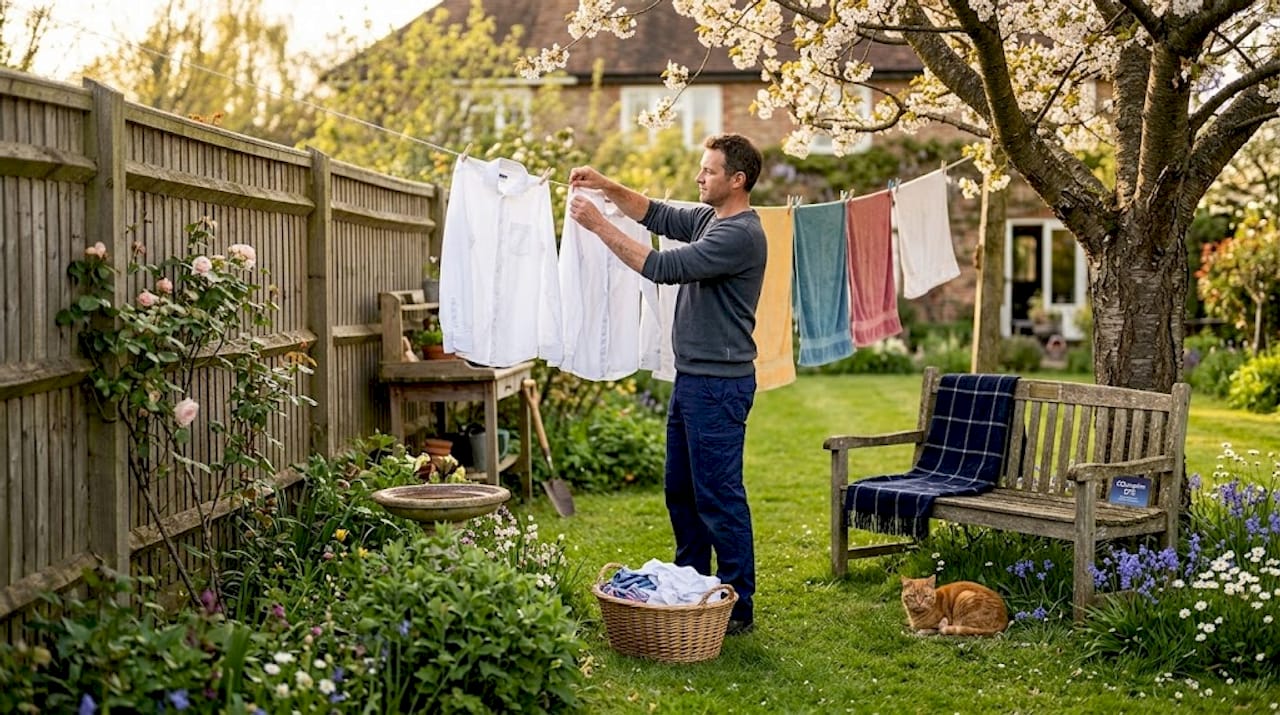
Tumble dryers are among the most energy-intensive appliances in the home. Line drying instead can save over £100 per year, making it one of the single most impactful habit changes available at zero cost. In warmer months, outdoor drying is straightforward. In winter, an indoor drying rack placed in a well-ventilated room works well, though keep in mind that drying clothes indoors can raise humidity, so crack a window if possible.
If you do use a tumble dryer, clean the filter before every use. A blocked filter forces the machine to work harder and use more energy, which means your laundry takes longer and costs more.
4. Take shorter showers and fix leaking taps
Hot water heating accounts for about 18% of total home energy consumption. Showers are a significant contributor, especially powerful electric showers. Cutting a daily shower from 10 minutes to 5 minutes saves both water and the energy used to heat it. Over a year, across a household of four people, those saved minutes add up to a considerable reduction.
A dripping tap wastes more water than most people realise. A tap dripping once per second wastes over 3,000 litres of water per year. If it is a hot tap, you are paying to heat every drop. Fixing a dripping tap is often a simple washer replacement costing under £5.
5. Optimise your thermostat settings
Thermostat management is one of the highest-impact and lowest-cost changes you can make. Setbacks of 7 to 10 degrees for 8 hours a day, such as while you are at work or asleep, can save approximately 10% on your annual heating and cooling bills.
Equally important is avoiding temperature extremes. Setting your heating higher than needed in winter, or cooling lower than needed in summer, does not warm or cool your home faster. It simply forces your system to run longer. Aim for 18 to 21°C in winter and 23 to 26°C in summer and resist the urge to push beyond those ranges.
Programmable or smart thermostats take the effort out of this process by scheduling setbacks automatically. Many models also learn your routine over time, making the savings genuinely hands-free.
6. Use ceiling fans strategically
Running a ceiling fan costs roughly 2 pence per hour. Used correctly, a fan allows you to raise your air conditioning thermostat by a few degrees without feeling any warmer, which reduces your cooling costs significantly. The key word is “used correctly.” Fans cool people through the wind chill effect, not rooms. Leaving a fan running in an empty room wastes electricity without providing any benefit.
In winter, most ceiling fans have a reverse setting that pushes warm air down from the ceiling. This is particularly effective in rooms with high ceilings, where heat naturally pools above head height.
7. Maintain your heating and cooling system
Blocked vents and dirty filters force your heating and cooling system to work harder to deliver the same result. That means longer run times, higher energy consumption, and more wear on the equipment. Checking and replacing filters every one to three months is one of the simplest maintenance tasks available and costs only a few pounds.
Beyond filters, check that furniture or curtains are not blocking radiators or air vents. A sofa pushed against a radiator absorbs a significant amount of heat before it ever reaches the room. Also avoid placing lamps, televisions, or other heat-generating appliances near your thermostat. The thermostat reads the ambient temperature, and a nearby heat source tricks it into thinking the room is warmer than it is, causing the system to underperform.
8. Lower your water heater temperature
If your hot water tank is set above 60°C, you are likely paying more than you need to. Lowering the temperature to around 60°C is recommended for safety reasons, as it prevents the growth of Legionella bacteria, but many tanks are set higher than this by default. Check your tank’s setting and adjust if needed.
You can also insulate your hot water pipes and tank with foam lagging, available from any hardware shop for a few pounds. This reduces heat loss from the pipes and means your boiler does not have to fire up as often to maintain the water temperature.
9. Seal draughts around doors and windows
Air leaking in and out of your home makes your heating and cooling systems work continuously to compensate. Sealing draughts around doors and windows is one of the most cost-effective improvements available, with draught-proofing strips costing as little as £10 to £20 for a whole house.
Run your hand around window frames, door edges, loft hatches, and letterboxes on a cold day and you will quickly feel where the heat is escaping. Self-adhesive foam strips, silicone sealant, and brush draught excluders are all easy DIY fixes. Tenants can use removable draught-proofing products that leave no permanent marks.
Pro Tip: Draught-proofing is one of the very few home improvements that both tenants and homeowners can carry out without specialist skills, significant cost, or structural changes.
10. Upgrade to energy-efficient appliances and lighting
When appliances reach the end of their life, replacing them with energy-efficient models makes a lasting difference. Look for products with an A rating on the EU energy label, which is the most efficient category. A rated washing machines and dishwashers use considerably less water and electricity per cycle than older models.
Smart power strips, which cut power to peripheral devices when a main device is switched off, are a low-cost upgrade worth considering for home offices and entertainment systems. For lighting, any remaining halogen or incandescent bulbs should be replaced with LEDs as a priority.
11. Invest in insulation and get an energy audit
For homeowners, adding loft or wall insulation can deliver substantial, permanent reductions in heating bills. The loft is typically the easiest and most cost-effective place to start. Energy audits and incentive programmes can guide and accelerate these improvements, identifying where heat is being lost and which upgrades will deliver the best return.
A professional energy assessment provides a structured plan rather than a guessing approach. It can also unlock rebates and grants that reduce the upfront cost of improvements significantly. The Energy Saver Guide recommends starting with the largest energy users, specifically heating, cooling, and hot water, before moving on to appliance and lighting upgrades.
Comparing energy-saving strategies at a glance
| Strategy | Upfront cost | Ease | Typical impact | Suitable for tenants? |
|---|---|---|---|---|
| Standby and lighting habits | Free | Very easy | Low to moderate | Yes |
| Cold wash and full loads | Free | Easy | Moderate | Yes |
| Line drying | Free | Easy | High | Yes |
| Thermostat scheduling | Free to low | Easy | High (up to 10%) | Yes (with smart thermostat) |
| Draught-proofing | Low (£10 to £50) | Easy to moderate | Moderate to high | Yes (removable options) |
| Water heater and pipe insulation | Low (£10 to £30) | Moderate | Moderate | Sometimes |
| Loft or wall insulation | High (£300+) | Requires tradesperson | Very high | Homeowners only |
| Appliance upgrades | Medium to high | Easy (on replacement) | High over time | Yes |
| Energy audit | Low to medium | Requires professional | Guides all other actions | Yes |
My honest take on where to start
In my experience, the biggest mistake people make is skipping straight to expensive upgrades before they have dealt with the basics. I have seen households spend thousands on a new boiler while still running a tumble dryer for every wash and leaving appliances on standby throughout the day. The savings from those habits alone can rival the output of a moderately priced upgrade, and they start working immediately.
What I find consistently undervalued is the cumulative effect of small changes. Fixing a dripping tap, adjusting the thermostat schedule, switching to cold washes, and sealing a couple of draughts might each feel minor. Together, they can reduce a household’s energy consumption by 15 to 20%, which translates to real money every quarter.
If you own your home and you are ready to invest, I strongly recommend getting an energy assessment before committing to any specific upgrade. The assessment tells you exactly where your heat is being lost, which insulation makes sense for your property type, and which improvements will pay back fastest. Without it, you are essentially guessing.
The programmed thermostat approach is the single habit I recommend to everyone, renters and owners alike. Set it, forget it, and let the savings accumulate. Comfort does not have to suffer. In fact, most people report feeling more comfortable once their home maintains a consistent temperature rather than swinging between too hot and too cold.
— Danny
Find out how your property rates for energy efficiency
If you are serious about making progress on your energy bills, understanding your property’s current performance is the logical next step. That is exactly what an Energy Performance Certificate gives you. An EPC rates your home from A to G, identifies where energy is being wasted, and provides a prioritised list of recommended improvements specific to your property.
At Completeepc, our qualified assessors carry out fast, accurate EPC assessments across London for both domestic and commercial properties. Whether you need a certificate for a property transaction or simply want a clear picture of where to focus your efforts, we can help. Read our full guide to EPCs to understand exactly what the assessment covers, or explore our EPC assessment process to see what to expect from start to finish.
FAQ
What is the single most effective way to save energy at home?
Thermostat scheduling is widely regarded as one of the highest-impact changes. Setting back your thermostat by 7 to 10 degrees for 8 hours a day can save around 10% annually on heating and cooling costs.
Can tenants save energy without permission from their landlord?
Yes. Behavioural changes such as cold washes, shorter showers, standby switching, and thermostat adjustments require no landlord approval and deliver meaningful savings regardless of property type.
How much can LED bulbs actually save?
LED bulbs use 75% less energy than older incandescent bulbs and last up to 10 times longer, making them one of the most cost-effective upgrades available at any budget.
What is an EPC and why does it matter for saving energy?
An Energy Performance Certificate rates your home’s energy efficiency from A to G and provides a list of recommended improvements. It gives you a clear, property-specific roadmap rather than generic advice. Learn more about energy performance certificates from Completeepc.
Is an energy audit worth doing before making upgrades?
Yes. Energy audits identify which improvements will deliver the greatest return for your specific property, preventing you from spending money on upgrades that may have little impact on your actual energy use.