

Getting your commercial EPC wrong in London is not just an administrative headache. It can mean fines, unlettable premises, and costly delays to sales or lettings. Yet many property owners and business managers still misunderstand what their EPC grade actually reflects about their building’s energy use. This guide walks you through every stage, from understanding your legal obligations and preparing for assessment, to interpreting your rating and planning genuine efficiency improvements. Whether you manage a single office or a portfolio of commercial spaces, the steps here will help you stay compliant and in control.
Table of Contents
- What is a commercial EPC and why does it matter?
- What you need before your EPC assessment
- Step-by-step commercial EPC assessment process
- Understanding your EPC rating and planning improvements
- Renewing your commercial EPC and understanding exemptions
- Where to get expert support for your commercial EPC in London
- Frequently asked questions
Key Takeaways
| Point | Details |
|---|---|
| Check exemptions early | Review your building’s status and exemptions before investing in improvements or assessments. |
| Prepare complete documentation | Accurate records and full access will yield a better EPC outcome and smoother assessment. |
| Renew every five years | Ensure your commercial EPC is valid and up to date after works or every five years. |
| Boost real efficiency | Look beyond EPC grades by targeting genuine energy-saving upgrades and accurate resubmissions. |
| Stay ahead of regulations | Monitor pending rule changes—higher grades may soon be mandatory—plan upgrades now to future-proof. |
What is a commercial EPC and why does it matter?
A commercial EPC, or Energy Performance Certificate, rates a non-domestic building on a scale from A (most efficient) to G (least efficient). It is a legal requirement for nearly all commercial properties being sold, let, or constructed. Understanding commercial EPC requirements is the first step to avoiding costly compliance failures.
The minimum legal standard for letting or selling a commercial property is currently an E rating. Buildings that fall below this threshold cannot legally be placed on the market. Non-compliance can result in financial penalties and, in some cases, a property becoming entirely unlettable.
Not every building requires an EPC. Exempt categories include properties scheduled for demolition, detached buildings under 50m², low-energy industrial sites, and buildings used for worship. A further exemption applies where the cost of improvements would not be recovered within a 7-year payback period. Use the London EPC checklist to confirm whether your property qualifies.
Key legal points to keep in mind:
- EPCs must be renewed every 5 years
- You have a legal duty to update your EPC after significant energy-related improvements
- Displaying a valid EPC is required at the point of marketing
- Failure to comply can result in penalties and restrictions on letting
Important: An EPC is not just a box-ticking exercise. It is a legal document that directly affects your ability to let or sell your property.
Now that you know why EPCs are critical for your property, let’s explore what’s needed to get started.
What you need before your EPC assessment
Preparing thoroughly before your assessment makes a real difference to the accuracy of your rating. The assessor needs access to every part of the building, including plant rooms, roof spaces, and any areas with mechanical or electrical systems. Restricted access leads to assumptions, and assumptions almost always result in a lower rating.
Gather the following before your assessment:
- Construction details: Wall types, roof construction, floor insulation, and glazing specifications
- Heating and cooling systems: Make, model, age, and fuel type of all HVAC equipment
- Lighting: Type, wattage, and controls for all zones
- Building layout: Floor plans, zoning information, and any recent refurbishment records
- Previous EPC: If one exists, bring it along for reference
Only an accredited energy assessor holding NDEA (Non-Domestic Energy Assessor) status is authorised to carry out and issue a commercial EPC. Choosing the right assessor matters because accurate site data directly affects your rating. When an assessor cannot verify a specification, they apply a default value, and defaults are always conservative, meaning they push your rating down.

Pro Tip: Locate your original building specifications or any refurbishment certificates before the visit. Even older documents confirming insulation thickness or glazing U-values can prevent your assessor from applying unfavourable defaults.
| Preparation area | Why it matters | Impact on rating |
|---|---|---|
| Full site access | Prevents assumptions | High |
| HVAC documentation | Confirms system efficiency | High |
| Lighting specifications | Avoids default penalties | Medium |
| Insulation records | Reduces conservative estimates | High |
| Floor plans and zoning | Ensures accurate modelling | Medium |
With the right information and access, you’ll avoid mistakes and delays. Next, let’s walk through the steps of the assessment itself.
Step-by-step commercial EPC assessment process
Knowing what happens during the assessment helps you support the process and avoid common pitfalls. Here is what to expect:
- Initial walkthrough: The assessor surveys the entire building, noting construction materials, window types, and any visible insulation.
- Zone identification: The building is divided into zones based on use, heating, and lighting. Each zone is assessed separately.
- HVAC inspection: All heating, ventilation, air conditioning, and hot water systems are recorded, including controls and fuel sources.
- Lighting audit: Every lighting circuit is logged, including type, wattage, and whether occupancy or daylight controls are present.
- Data input and modelling: The assessor enters all collected data into specialist software, which compares your building against a notional standard building of the same size and type.
- Certificate issue: Once modelling is complete, the EPC is lodged on the national register and a certificate is issued.
Refer to the complete step-by-step EPC guide for a detailed breakdown of each stage, or review the EPC application workflow to understand the full process from booking to certificate.
| Common mistake | Consequence | How to avoid it |
|---|---|---|
| Restricted access | Defaults applied, lower rating | Arrange full access in advance |
| Missing HVAC records | System efficiency underestimated | Gather service records beforehand |
| No lighting schedule | Conservative defaults used | Prepare a full lighting inventory |
| Outdated EPC not reviewed | Missed improvement opportunities | Review previous certificate first |
One important nuance: EPC modelling reflects a standardised pattern of use, not your actual energy consumption. Two identical buildings with different occupancy patterns will receive the same EPC grade. This is why the grade alone does not tell the full story of your building’s real-world performance.
Pro Tip: If you have recently upgraded insulation, replaced your boiler, or installed LED lighting, request a reassessment. Better data and improved specifications frequently result in a higher grade, sometimes by two or three bands.
Once your assessment is complete, you’ll receive your EPC rating. Understanding the grade and what it really means comes next.
Understanding your EPC rating and planning improvements
Your EPC grade sits on a scale from A to G. Grade A represents the most energy-efficient buildings, while G indicates the least. The current legal minimum for letting or selling a commercial property is grade E. Anything below that means your property cannot legally be marketed.
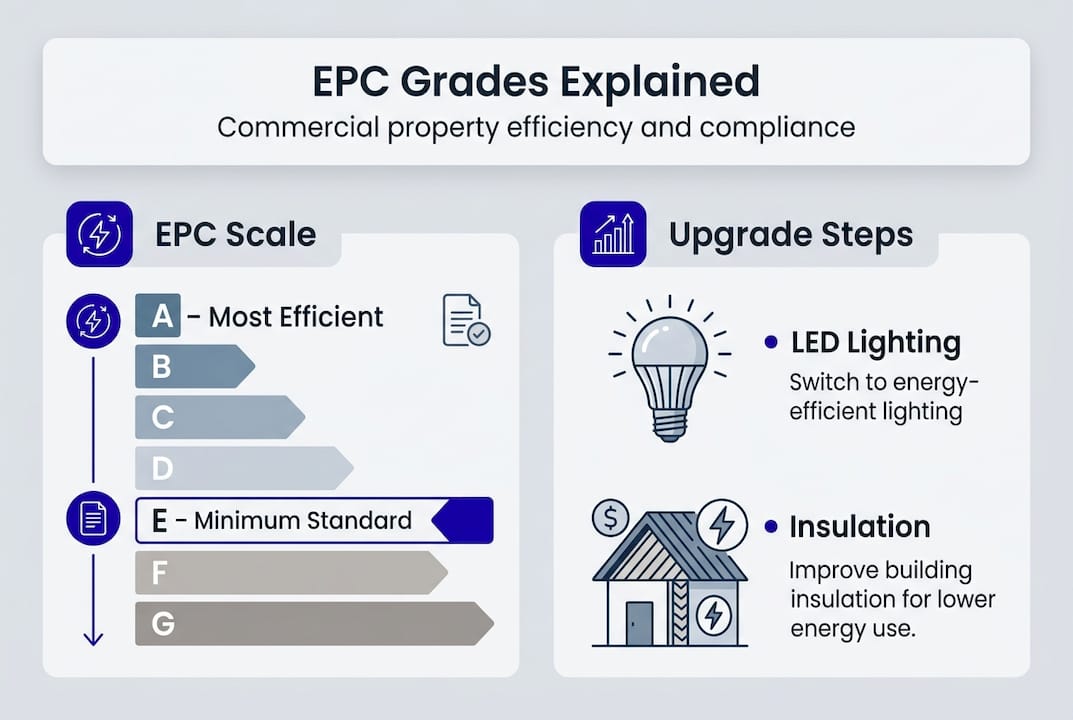
Looking ahead, regulations may require commercial properties to reach a minimum of B by around 2030. The British Property Federation has warned that up to four in five commercial buildings could become unlettable without clear regulatory guidance and sufficient time to act. Starting your improvement planning now puts you well ahead of that risk.
It is also worth noting that EPC grades reflect modelled use, not actual consumption. A building with a C grade may still have high energy bills if it is heavily occupied or poorly managed. Use your EPC recommendations alongside real meter data for a complete picture.
Practical areas to target for improvement:
- Insulation: Upgrading roof, wall, and floor insulation typically delivers the strongest rating improvement
- Heating and cooling: Replacing ageing boilers or chillers with high-efficiency alternatives has a significant impact
- Lighting: Switching to LED with occupancy sensors is one of the most cost-effective upgrades
- Controls and building management systems: Improving zoning and scheduling reduces modelled energy demand
- Data accuracy: Providing verified specifications rather than relying on defaults can improve your grade without any physical works
For targeted advice, review these better EPC rating tips and follow the EPC improvement steps to prioritise the changes with the greatest impact. You can also explore EPC rating improvement strategies specific to London properties.
Key insight: Improving your EPC grade is not only about compliance. A higher rating can increase your property’s market value, attract quality tenants, and reduce service charge disputes related to energy costs.
With a plan to improve your EPC and compliance, let’s look at renewal, exemptions, and staying up to date with new regulations.
Renewing your commercial EPC and understanding exemptions
Commercial EPCs are valid for 5 years from issue. You must renew before marketing the property again after expiry. You are also legally required to update your EPC following significant energy-related improvements, even if the existing certificate has not yet expired.
Keeping your records current is important not just for compliance but also for any future audits or due diligence during property transactions. Buyers and tenants increasingly scrutinise EPC ratings as part of their decision-making process.
Exemptions from the EPC requirement include:
- Demolition candidates: Buildings with planning permission for demolition
- Small detached buildings: Standalone structures under 50m² of useful floor area
- Low-energy industrial buildings: Workshops, agricultural buildings, and similar low-demand premises
- Places of worship: Religious buildings used for prayer or ceremonies
- 7-year payback rule: Where the cost of required improvements cannot be recovered within 7 years, an exemption may apply
| Exemption type | Qualifying condition | Action required |
|---|---|---|
| Demolition | Planning permission in place | Document and retain evidence |
| Small detached | Under 50m² floor area | Confirm measurement and record |
| Low-energy industrial | Minimal heating or cooling | Verify with assessor |
| Worship buildings | Religious use confirmed | Retain proof of use |
| 7-year payback | Cost-benefit analysis fails | Register exemption formally |
If you believe your property may qualify, review the full EPC exemptions guidance and check the latest EPC regulations insights to ensure you are applying the correct rules for 2026.
Where to get expert support for your commercial EPC in London
Navigating commercial EPC requirements, exemptions, and improvement planning is straightforward when you have the right support. At Complete EPC, we work with property owners, landlords, and business managers across London to deliver accurate, compliant assessments at the most competitive rates available. Our qualified NDEAs bring extensive experience across all commercial property types, from small offices to large mixed-use buildings.
Whether you need a first-time assessment, a renewal, or guidance on whether your property qualifies for an EPC exemption, we make the process simple and efficient. Start by understanding EPCs and what they mean for your specific property, then get in touch for a tailored quote. Visit Complete EPC today to book your assessment or request a free quote, and ensure your property meets every legal requirement with confidence.
Frequently asked questions
How long is a commercial EPC valid?
Commercial EPCs are valid for 5 years and must be renewed before the property is marketed again or after significant energy-related works are carried out.
What happens if my building doesn’t meet the minimum EPC grade?
Properties below grade E cannot legally be let or sold and may be subject to financial penalties and restrictions until the required standard is met.
Who can carry out a commercial EPC assessment?
Only an accredited NDEA is authorised to conduct and issue a commercial EPC, so always verify your assessor’s credentials before booking.
Are all buildings required to have an EPC?
Most commercial buildings require one, but exempt categories include demolition candidates, detached buildings under 50m², low-energy industrial premises, and buildings used for worship.
Can my EPC rating improve after making energy upgrades?
Yes. Better data and improved specifications frequently result in a higher grade on reassessment, particularly when verified documentation replaces previously assumed default values.
Recommended
- Commercial building EPC guide: compliance and savings
- The Commercial EPC Handbook for London Businesses: Increase Your Energy Savings – Complete EPC
- Commercial EPC Step by Step: Complete Guide for London
- 7 Steps to Improving Commercial Property EPC Effectively
- Eficiência energética em casas: guia para isolamento celulose