

TL;DR:
- Most commercial property owners treat EPCs as a compliance formality, but failing to meet standards can be costly. EPC ratings influence the legality of letting, rental income, and property valuation, with stricter thresholds coming by 2030. Upgrading building fabric through insulation and glazing offers the best return, and proactive compliance management safeguards value and marketability.
Most commercial property owners treat an EPC as a box-ticking exercise before a transaction. That assumption is becoming expensive. Your commercial EPC rating determines whether you can legally let your property, what rents you can justify, and how investors will price your asset in 2026 and beyond. MEES regulations mandate a minimum E rating to let commercial premises, with that floor rising to C by 2027 and B by 2030. This guide cuts through the complexity, covering what your rating means, how it is assessed, how to improve it, and what non-compliance actually costs you.
Table of Contents
- Key takeaways
- What is a commercial EPC rating and why it matters
- How commercial EPC assessments work
- How to improve your commercial EPC rating
- Impact of EPC ratings on property value and leasing
- Maintaining compliance and managing exemptions
- My take on EPC as a strategic asset
- How Completeepc can help you stay compliant
- FAQ
Key takeaways
| Point | Details |
|---|---|
| EPC ratings run A to G | Commercial properties must currently meet a minimum E rating to be legally let in the UK. |
| Penalties for non-compliance are severe | Letting a property below the minimum standard risks fines up to £150,000 and unlettable status. |
| Higher ratings command higher rents | Properties rated A or B can achieve up to 15% higher rents and better occupancy than lower-rated stock. |
| Fabric upgrades deliver the best returns | Insulation, glazing, and draught-proofing yield more EPC points per pound spent than technology-first solutions. |
| Exemptions must be registered proactively | Exemptions are time-limited and must appear on the PRS Exemptions Register before a lease begins. |
What is a commercial EPC rating and why it matters
A commercial EPC rating is a standardised measure of how energy-efficient your building is. Ratings run from A to G, where A represents the highest efficiency and G the lowest. The certificate is legally required whenever a commercial property is built, sold, or let, and it remains valid for ten years from the date of issue.
The Minimum Energy Efficiency Standards (MEES) set the legal threshold for letting. Since April 2023, landlords cannot grant or renew a lease on a commercial property rated below E without a registered exemption. The trajectory tightens further: the minimum rises to C in 2027 and B between 2030 and 2035. These are not distant policy goals. They are fixed legislative targets that will affect your asset’s lettability within this decade.
The legal consequences of non-compliance are worth treating seriously:
- Letting below the minimum rating is illegal without a valid registered exemption
- Civil penalties can reach up to £150,000 depending on the property’s rateable value and duration of breach
- A non-compliant property will be publicly listed on the MEES enforcement register
- Tenants can use a poor rating to renegotiate lease terms or exit early
Beyond legal risk, the EPC rating shapes market perception. Sophisticated tenants, institutional investors, and lenders increasingly screen properties by energy performance. A D or E rating signals future liability, not just present inefficiency.
How commercial EPC assessments work
The certificate does not appear from nowhere. It is produced by an accredited Non-Domestic Energy Assessor (NDEA), a qualified professional who carries out a physical inspection and collects structured data about your building.
Here is what typically happens during a commercial EPC assessment:
- Building survey. The assessor measures floor area, records construction materials, and notes the age and type of the building fabric.
- Systems data collection. Heating, ventilation, air conditioning, and lighting systems are all logged, including fuel types and controls.
- Occupancy and usage profiling. The assessor records how the building is used, its hours of operation, and how many zones it contains.
- Asset Rating calculation. Using approved software, the assessor generates an Asset Rating based on theoretical energy consumption per square metre, independent of actual bills.
- Recommendations Report production. Alongside the certificate, the assessor produces a tailored recommendations report, identifying cost-effective improvements ranked by impact and payback period.
The Asset Rating is often misunderstood. It is not based on how you actually use the building. It models theoretical energy use under standardised conditions. This means two identical buildings with different occupants can have the same EPC rating, even if their actual bills differ significantly.
Common reasons commercial properties receive poor ratings include ageing single-glazed windows, uninsulated roofs and walls, inefficient gas boilers without modern controls, and outdated fluorescent lighting with no daylight sensors. These are structural issues, not occupant behaviours, and the assessment reflects that distinction clearly.
Pro Tip: Before your assessor visits, gather documentation for all installed systems. Boiler service records, lighting specifications, and HVAC installation dates can all influence the final rating. Missing or unverifiable data leads assessors to make conservative assumptions, which typically results in a worse score.
How to improve your commercial EPC rating
The most common mistake landlords make is reaching for technology solutions first. Solar panels and heat pumps make headlines, but they rarely produce the best return on EPC investment unless the building fabric is already sound. Most landlords misinterpret EPC compliance as an opportunity to install new technology, when foundational fabric improvements typically yield a higher return on investment.

The fabric-first principle
Start with the building’s physical structure. Insulation, glazing, and draught-proofing consistently deliver the highest EPC points per pound spent. Uninsulated cavity walls and flat roofs are among the most common culprits for poor ratings in commercial stock, and addressing them directly reduces the energy demand that all other systems have to compensate for.
Practical upgrades that move the needle
- Roof and wall insulation. Often the single largest EPC improvement available. Flat roof insulation on a mid-sized commercial unit can shift a property from E to C in isolation.
- LED lighting retrofit. Replacing fluorescent tubes with LED panels cuts lighting energy consumption by up to 75%, with significant EPC score improvements and reduced electricity bills.
- Heating system upgrades. Replacing an older gas boiler with a modern condensing unit, combined with updated thermostatic controls, reduces both energy demand and EPC-modelled consumption.
- Building Management Systems (BMS). Adding automated controls to heating and ventilation systems demonstrates to the assessor that energy is being used intentionally, not wastefully.
- Glazing improvements. Where budget allows, upgrading to double or triple glazing cuts heat loss substantially and signals long-term building quality to tenants.
Pro Tip: Align your EPC upgrades with planned maintenance cycles. If your roof is due for replacement in the next two years, spec it with insulation at the same time. The marginal cost of adding insulation during a scheduled roof replacement is far lower than retrofitting it separately later.
Utility bill analysis provides a practical starting point. Reviewing 12 to 24 months of energy data highlights which systems are consuming disproportionately and where targeted investment will produce the fastest results. Studies suggest this approach can identify opportunities to reduce consumption by up to 30%. Use the EPC Recommendations Report as your upgrade roadmap, then overlay it with planned capital expenditure to minimise disruption.
Impact of EPC ratings on property value and leasing
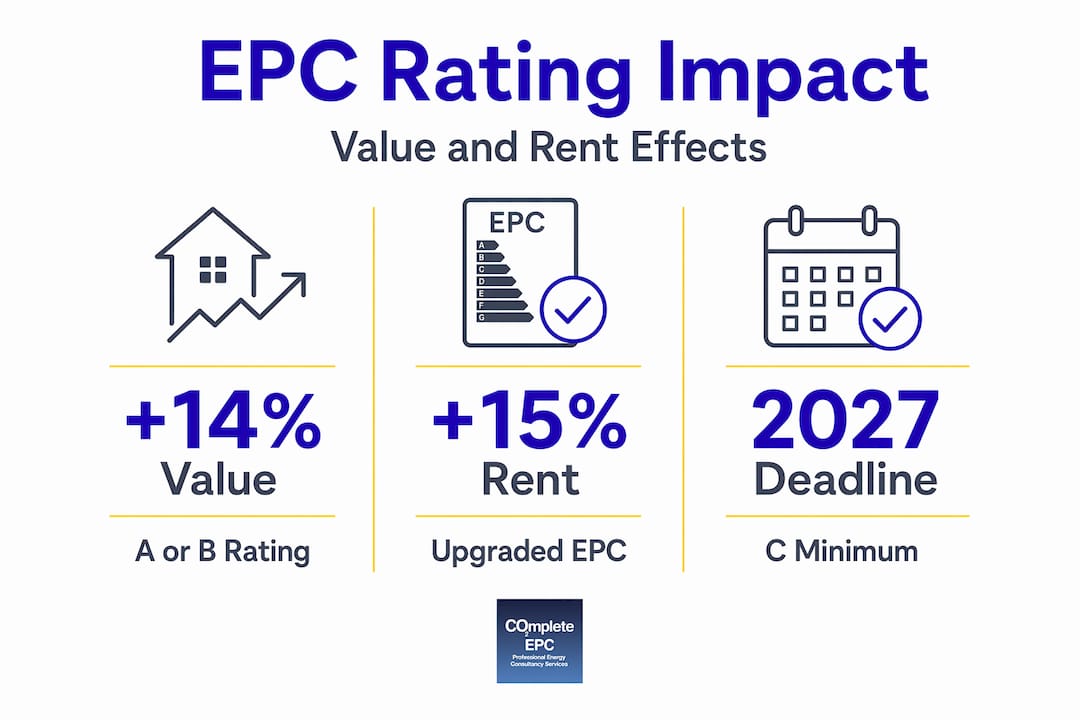
The financial case for a strong commercial EPC rating has grown considerably clearer in recent years. Properties rated A or B command up to 14% higher sale prices and up to 15% higher rents than equivalent lower-rated buildings. That is not a marginal difference. On a £1 million asset, a 14% premium represents £140,000.
| EPC rating | Typical effect on value | Typical effect on rent |
|---|---|---|
| A or B | Up to +14% premium | Up to +15% premium |
| C or D | Market rate | Market rate |
| E | Compliant minimum; risk of void periods | Discounted to attract tenants |
| F or G | Cannot be let without exemption | Effectively unlettable |
Upgrading from an E to a C can increase property value by £8,000 to £20,000 depending on size and location. Across a portfolio, these numbers compound quickly.
The inverse risk is equally important. Properties that fall below minimum standards suffer what valuers call the “brown discount.” This includes longer void periods as tenants avoid the liability, discounted rents to compensate tenants for higher running costs, and downward valuation adjustments by lenders and purchasers who price in future retrofit costs.
“Estimates indicate that around 70% of commercial spaces are rated C or below, placing a significant portion of the market at risk from tighter MEES enforcement.”
That statistic should focus minds. Much of London’s commercial stock will require meaningful investment to meet the 2027 C-rating threshold. Owners who act now face manageable upgrade costs and can spread expenditure across planned maintenance. Those who wait face compressed timescales, supply chain pressure, and fewer contractors available at competitive rates.
Maintaining compliance and managing exemptions
Compliance is not a one-time event. Your commercial EPC certificate is valid for ten years, after which it must be renewed before any new letting or sale. Within that period, significant building alterations may also trigger a reassessment requirement.
Exemptions exist for situations where compliance is genuinely impractical, but they carry specific conditions:
- Devaluation exemption. If a qualified surveyor confirms that improvements would reduce the property’s market value, you may claim an exemption. This is not a blanket escape route; it requires formal written evidence.
- Consent exemption. Where listed building status, planning restrictions, or third-party consent prevents works, an exemption can be registered. Heritage buildings often fall here, though the exemption covers only the specific restricted works, not the entire improvement programme.
- Third-party consent exemption. Relevant where works require freeholder or neighbouring occupier consent that cannot reasonably be obtained.
- All-improvements-made exemption. Available after all cost-effective improvements have been completed and the property still falls below the threshold.
Crucially, exemptions must be registered on the PRS Exemptions Register before the lease commences. Registering retrospectively after an enforcement notice has been served does not provide protection. Exemptions also last only five years and require renewal.
For audit readiness, maintaining a rigorous evidence pack covering all upgrades, survey reports, contractor invoices, and exemption records is non-negotiable. Enforcement authorities, lenders, and prospective purchasers all have grounds to request this documentation. Having it organised and accessible protects both your compliance position and your asset’s valuation.
My take on EPC as a strategic asset
From my experience working with commercial property owners across London, I see the same pattern repeatedly. An EPC is commissioned just before a transaction, the result comes back as a D or E, and the owner is surprised. At that point, they are under time pressure, unable to negotiate properly, and paying retrofit costs in haste rather than by design.
The owners who manage this well treat the EPC Recommendations Report as part of their capital planning process. They align energy upgrades with planned refurbishments, budget ahead, and arrive at lease renewal or sale in a strong position. Energy assessments used this way deliver genuine operating cost reductions and improve tenant retention, not just a compliance certificate.
My strong advice: commission an EPC assessment now if your certificate is more than five years old. The regulatory trajectory is clear, the penalty regime is tightening, and the financial risk of inaction now outweighs retrofit costs for most owners. The landlords who treat their EPC rating as a strategic asset rather than a legal inconvenience will hold the better positions in three years’ time.
— Danny
How Completeepc can help you stay compliant
Completeepc provides professional EPC assessments for commercial properties across London, carried out by fully accredited Non-Domestic Energy Assessors. Whether you need a new certificate, a renewal ahead of a lease, or guidance on navigating exemptions, the team is equipped to support you at every stage.
You can explore the full EPC compliance process through the Completeepc knowledge centre, or review the EPC exemption register guidance to understand whether your property qualifies and how to register correctly. If you are planning upgrades, the detailed recommendations included with every assessment give you a prioritised, costed roadmap you can take directly to contractors.
Proactive owners who act before the 2027 MEES deadline will face lower costs and fewer complications than those who wait. Contact Completeepc today to book your commercial assessment and get clear on where you stand.
FAQ
What is the minimum EPC rating for commercial lettings?
The current minimum is E. From 2027, the threshold rises to C, and by 2030 to 2035 it will increase to B. Letting below the minimum without a registered exemption is illegal.
How long does a commercial EPC last?
A commercial EPC is valid for ten years from the date of issue. Any significant building alterations during that period may require a reassessment before that deadline.
How do I obtain a commercial EPC rating?
You must commission an accredited Non-Domestic Energy Assessor to carry out an inspection. The assessor surveys the building fabric and systems, generates the Asset Rating, and produces a Recommendations Report alongside the certificate.
Can EPC improvements increase my property value?
Yes. Properties rated A or B command up to 14% higher sale prices and 15% higher rents. Upgrading from E to C alone can increase property value by between £8,000 and £20,000.
What happens if my commercial property fails to meet EPC requirements?
Non-compliant properties cannot be legally let, and landlords face civil penalties of up to £150,000. The property may also suffer reduced valuations and extended void periods as tenants avoid the compliance liability.