

TL;DR:
- Commercial EPC requirements mandate a minimum rating of E for commercial buildings being let in 2026, with non-compliance risking fines up to £150,000.
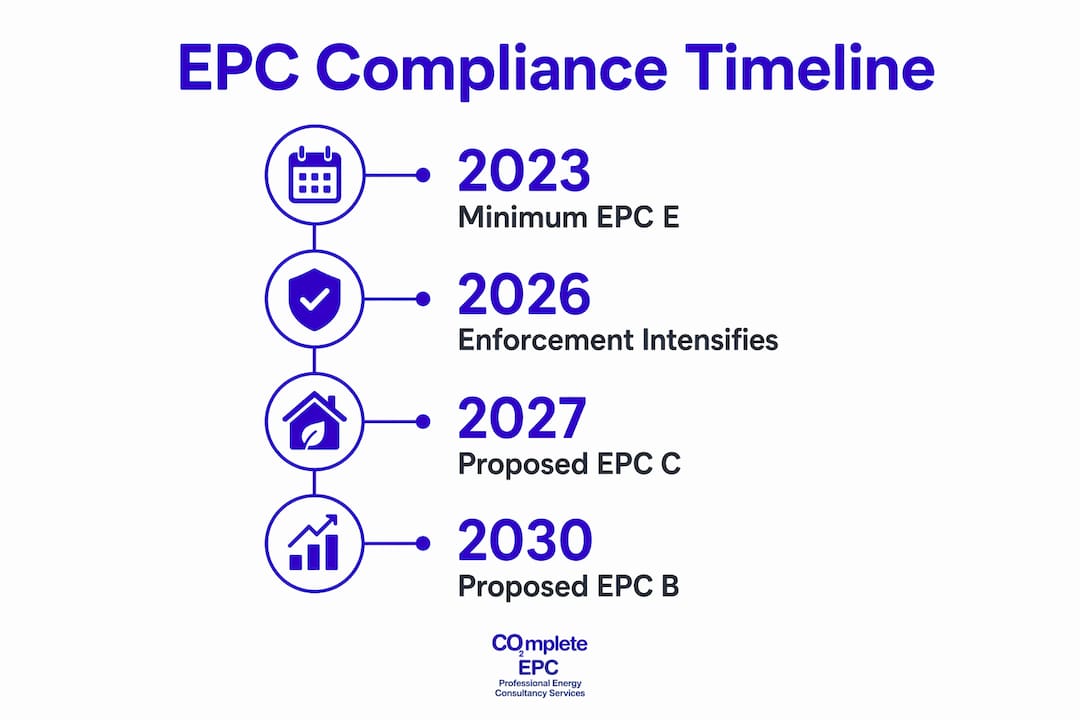
- Proposed standards aim for EPC C by 2027 and B by 2030, requiring proactive asset management and targeted improvements.
- Landlords should treat EPC compliance as an ongoing portfolio discipline, incorporating assessments and upgrades into their strategic planning.
Commercial property EPC requirements establish the minimum energy efficiency standards that commercial buildings in England and Wales must meet before they can be legally marketed or let. A commercial energy performance certificate, formally known as a Non-Domestic EPC, rates a building from A (most efficient) to G (least efficient) and is a legal document, not an optional advisory report. Under the Minimum Energy Efficiency Standards (MEES), fines reach £150,000 per property for landlords who let premises below the required threshold. For London commercial landlords managing multiple assets, that exposure is not theoretical. It is an active compliance risk in 2026.
What are commercial property EPC requirements in 2026?
Commercial property EPC requirements in England and Wales currently mandate a minimum rating of E for any commercial premises being let. This applies to new tenancies and renewals alike, meaning a landlord cannot simply wait for a lease to expire before the obligation kicks in. The legal framework sits within the Energy Efficiency (Private Rented Property) (England and Wales) Regulations 2015, commonly referred to as MEES.

The EPC itself must be produced by an accredited Non-Domestic Energy Assessor. It is valid for ten years, though proposed reforms may reduce this to five years. The certificate must be lodged on the national Non-Domestic EPC Register and made available to prospective tenants or buyers. For London landlords managing office blocks, retail units, or industrial premises, the certificate is a transactional prerequisite, not a box-ticking exercise.
2026 marks a regulatory tipping point where enforcement has intensified significantly. Local authorities and the Environment Agency are actively targeting F and G rated buildings, and public registers mean non-compliance is visible. Understanding these requirements now gives you the lead time to act before enforcement reaches your door.
When is an EPC required for commercial properties?
Commercial EPCs are mandatory for new builds, sales, lettings, and substantial refurbishments. The obligation is triggered at the point of marketing, which means you need a valid certificate in place before you advertise a property, not after you find a tenant.
The specific circumstances requiring a commercial EPC include:
- Selling a commercial property, where the EPC must be available to prospective buyers from the point of marketing
- Letting or re-letting commercial premises, including lease renewals and new tenancies
- Completing a new build commercial property, where an EPC is required on practical completion
- Carrying out a substantial refurbishment that affects the building’s energy performance, such as replacing the heating system or significantly altering the building fabric
- Modifying a building to increase the number of separate units within it
There are limited exemptions. Listed buildings may be exempt where compliance would unacceptably alter their character or appearance. Temporary structures intended for use of less than two years, industrial sites with low energy demand, and stand-alone buildings with a total useful floor area of less than 50 square metres are also excluded. However, these exemptions are narrowly defined and must not be assumed without proper verification.
Pro Tip: Commission your EPC assessment at least four to six weeks before your intended marketing date. This gives you time to act on any recommendations if the rating comes back lower than expected, rather than delaying a letting or sale.
What are the minimum EPC rating standards under MEES?
The current legal minimum for commercial lettings is EPC E. Any property rated F or G cannot lawfully be let, and government proposals target EPC C by April 2027 and EPC B by 2030. These are not distant aspirations. They represent a trajectory that requires capital planning now.
| Standard | Timeline | Implication for landlords |
|---|---|---|
| EPC E minimum | Current (2026) | Properties rated F or G cannot be legally let |
| EPC C minimum | Proposed April 2027 | Significant upgrade works required for many older London buildings |
| EPC B minimum | Proposed 2030 | Near-zero carbon performance expected across commercial stock |
The financial impact of rising standards is considerable. A London office building currently rated D may require HVAC upgrades, improved insulation, and LED lighting retrofits to reach B by 2030. RICS guidance confirms that MEES improvement works can also influence business rates liability through valuation adjustments and available reliefs, meaning the investment case extends beyond compliance alone.
For landlords managing older stock in areas such as the City of London or Southwark, the gap between a current D or E rating and the proposed 2030 B standard is substantial. Phased capital programmes, aligned with lease events and planned maintenance cycles, are the most cost-effective way to close that gap without disrupting tenants or triggering disproportionate expenditure in a single year.
Pro Tip: Do not wait for a lease event to commission an energy audit. A bespoke audit now will identify which improvements deliver the greatest rating uplift per pound spent, allowing you to prioritise works strategically across your portfolio.
How can landlords improve their commercial EPC rating?
Achieving and maintaining EPC compliance is a matter of structured asset management, not reactive repair. The most effective approach combines early assessment with targeted physical improvements.
-
Commission a pre-assessment or mock EPC before any lease event. This identifies your current rating and flags any shortfall against the legal minimum, giving you time to act. Early EPC commissioning is consistently recommended to avoid last-minute compliance failures that delay lettings or sales.
-
Upgrade lighting to LED throughout the building. LED retrofits are among the highest-impact, lowest-cost interventions available. A typical commercial office can improve its EPC rating by one band through lighting alone, depending on the baseline.
-
Improve HVAC efficiency. Replacing ageing air conditioning and heating systems with modern, high-efficiency alternatives has a significant effect on the asset rating. Variable refrigerant flow (VRF) systems and heat pumps are increasingly common in London commercial refurbishments.
-
Enhance building fabric insulation. Roof insulation, cavity wall treatments, and double or triple glazing reduce heat loss and directly improve the fabric efficiency score, which will carry greater weight under the forthcoming multi-metric EPC format.
-
Install smart building controls. Automated lighting controls, occupancy sensors, and building management systems (BMS) reduce operational energy consumption and are recognised within EPC methodology.
-
Commission a bespoke energy audit rather than relying solely on the statutory EPC recommendation report. Standard recommendation reports often lack commercially actionable advice. A tailored audit maps improvements to your specific building type, tenancy structure, and capital budget.
Aligning improvement works with planned maintenance cycles and lease renewals reduces disruption and spreads cost. For a London landlord managing a mixed portfolio, this kind of phased planning is the difference between controlled investment and reactive expenditure under enforcement pressure.
What exemptions apply, and how do you register them?
Exemptions from MEES obligations exist but are strictly defined. Assuming an exemption applies without formally registering it is one of the most common and costly compliance errors London landlords make.
The main exemptions available to commercial landlords include:
- All relevant improvements made: Where all cost-effective improvements identified in the EPC recommendation report have been carried out and the property still falls below the minimum rating
- Devaluation: Where a landlord obtains a report from a qualified surveyor confirming that the required works would reduce the market value of the property by more than five per cent
- Third-party consent refused: Where the landlord has made reasonable efforts to obtain consent from a tenant, superior landlord, or planning authority and that consent has been refused
- Recently purchased property: A temporary exemption available for six months following purchase of a non-compliant property
Exemptions must be registered on the PRS Exemptions Register before the letting commences. An unregistered exemption provides no legal protection. The evidence supporting each exemption must be thorough, contemporaneous, and retained. Unregistered or invalid exemptions carry the same penalty exposure as outright non-compliance, with fines reaching £150,000 per property. Exemptions are also time-limited and must be renewed periodically, so a calendar-based review process is advisable for any landlord holding multiple exemptions across a portfolio.
How will EPC assessments change for commercial landlords?
The EPC as London landlords currently know it is set to change significantly. Future EPCs will adopt a multi-metric format assessing fabric efficiency, HVAC performance, operational energy use, carbon emissions, and projected occupant energy cost, rather than a single A to G rating.
| Current EPC format | Proposed future EPC format |
|---|---|
| Single A to G energy rating | Multiple metrics across fabric, HVAC, emissions, and cost |
| Based on design assumptions | Reflects operational and in-use building performance |
| Valid for 10 years | Proposed validity period of 5 years |
| One overall score | Separate scores per performance category |
This shift reflects a broader government ambition to make EPCs more representative of how buildings actually perform in use, rather than how they were designed to perform. For London landlords, this means a building that currently holds an E rating on design assumptions alone may be reassessed differently under operational data. The practical implication is that properties which appear compliant today may require reassessment and potential works once the new methodology takes effect.
The proposed reduction in EPC validity from ten to five years also increases the frequency of assessment costs and creates more regular touchpoints for enforcement. Landlords with large portfolios should begin mapping their EPC expiry dates now to anticipate the volume and cost of reassessments under the new regime.
Key takeaways
Commercial property EPC compliance in 2026 requires a minimum E rating to let, with legally enforceable penalties up to £150,000 and rising standards of C by 2027 and B by 2030 making proactive asset management the only viable strategy.
| Point | Details |
|---|---|
| Minimum rating in 2026 | EPC E is the legal minimum for commercial lettings; F and G rated properties cannot be let. |
| Rising standards ahead | Government proposals target EPC C by April 2027 and EPC B by 2030, requiring planned capital works. |
| Exemptions must be registered | Unregistered exemptions carry the same fine exposure as non-compliance, up to £150,000. |
| Early assessment pays off | Commissioning a pre-assessment before marketing prevents costly delays and last-minute failures. |
| Multi-metric EPCs are coming | Future assessments will cover fabric, HVAC, emissions, and cost, with a likely five-year validity period. |
Why I treat EPC compliance as a portfolio discipline, not a deadline
I have worked with enough London commercial landlords to know that the ones who struggle most with EPC compliance are those who treat it as a one-off task rather than an ongoing discipline. They commission a certificate when a lease event forces them to, discover the rating is lower than expected, and then face a compressed timeline to carry out works or risk losing a tenant.
The landlords who manage this well do the opposite. They run mock assessments 12 to 18 months before any planned letting or sale. They commission bespoke energy audits rather than relying on the statutory recommendation report, which often lists improvements without any regard for cost-effectiveness or tenancy structure. They track EPC expiry dates across their portfolio the same way they track rent review dates.
The upcoming shift to multi-metric assessments is the most significant change to EPC methodology in over a decade. A building that looks compliant today under a single rating may tell a different story when fabric efficiency, HVAC performance, and operational emissions are scored separately. Landlords who understand this now and begin integrating EPC into asset planning will be far better positioned than those who wait for the new format to arrive before acting.
My honest advice: treat your EPC programme the same way you treat your planned maintenance schedule. Build it into your annual capital planning cycle, assign responsibility within your team or managing agent, and review it every time a lease event, refurbishment, or regulatory change occurs. The cost of proactive management is a fraction of the cost of enforcement.
— Danny
How Completeepc helps London commercial landlords stay compliant
Completeepc provides accredited EPC assessments for commercial properties across London, carried out by experienced Non-Domestic Energy Assessors who understand the specific demands of the city’s diverse building stock. Whether you manage a single retail unit in Islington or a portfolio of office buildings in the City, Completeepc delivers accurate, timely assessments that meet current MEES obligations and prepare you for the standards ahead.
The service covers the full process from initial assessment through to lodgement on the national register, with clear guidance on improvement recommendations and exemption registration where applicable. Completeepc also offers advisory support to help landlords prioritise works and plan ahead for the proposed 2027 and 2030 rating thresholds. For a clear starting point, explore the commercial EPC compliance guide or read the detailed EPC guide for London to understand exactly what your property needs.
FAQ
What is the minimum EPC rating for commercial properties in 2026?
The minimum EPC rating for commercial lettings in England and Wales is E. Properties rated F or G cannot be legally let, and fines for non-compliance reach £150,000 per property.
How long is a commercial EPC valid for?
A commercial EPC is currently valid for ten years from the date of issue. Government proposals under review in 2026 may reduce this to five years under the forthcoming multi-metric assessment framework.
Do all commercial properties need an EPC?
Most commercial properties require an EPC when sold, let, or substantially refurbished. Exemptions apply to listed buildings where compliance would alter their character, temporary structures, and stand-alone buildings under 50 square metres.
What happens if a landlord lets a property without a valid EPC?
Letting a commercial property without a valid EPC or below the minimum E rating exposes the landlord to fines of up to £150,000 per property, plus public register exposure through local authority enforcement action.
When will EPC standards for commercial properties increase beyond E?
Government proposals target a minimum of EPC C by April 2027 and EPC B by 2030. These are proposed standards under active consultation, and landlords should begin capital planning now to meet these thresholds within the required timelines.