

TL;DR:
- Understanding your EPC rating is crucial for London’s property owners, as it impacts legal compliance, market value, and tenant demand. The rating reflects estimated energy efficiency on a letter scale from A to G, based on a numerical score derived during assessment, with current and potential ratings guiding retrofit priorities. Timely upgrades and assessments are essential for meeting regulations before 2030, reducing costs, and enhancing property appeal.
If you own, let, or invest in property in London, understanding how to define EPC rating is no longer optional. An Energy Performance Certificate (EPC) rating is the official measure of a building’s energy efficiency, and it directly affects your legal standing, your tenants’ fuel bills, and your property’s market value. With regulatory deadlines tightening and penalties increasing, getting to grips with what the rating means, how it is calculated, and what you can do about it has never been more pressing.
Table of Contents
- Key takeaways
- What the EPC rating actually means
- Why EPC rating significance matters in London
- The accuracy gap: what EPC ratings do and do not tell you
- Practical steps to improve your EPC rating
- How to commission, renew, or update your EPC
- My take on EPC ratings after years in the field
- Get your London EPC sorted with Completeepc
- FAQ
Key takeaways
| Point | Details |
|---|---|
| EPC rating definition | An EPC rating measures a property’s energy efficiency on an A to G scale, backed by a numerical score from 1 to 100. |
| Legal minimum for landlords | Private landlords in England must meet a minimum EPC C rating by 1 October 2030; currently the minimum is EPC E. |
| Ratings are estimates | EPC ratings reflect modelled energy use, not actual consumption, so real-world bills may differ from predictions. |
| Investment cap applies | The government caps landlord spending on EPC-related improvements at £10,000 per property. |
| Update after upgrades | Commissioning a fresh EPC after refurbishment is the only way to reflect genuine improvements in your official rating. |
What the EPC rating actually means
An Energy Performance Certificate rating is the letter grade assigned to a property after a qualified assessor evaluates its energy efficiency. The formal scale runs from A down to G, where A indicates very high efficiency and G signals poor performance. That letter is not chosen arbitrarily. It maps directly to a numerical score from 1 to 100, with the bands distributed as follows:
| Rating band | Numerical score range |
|---|---|
| A | 92–100 |
| B | 81–91 |
| C | 69–80 |
| D | 55–68 |
| E | 39–54 |
| F | 21–38 |
| G | 1–20 |
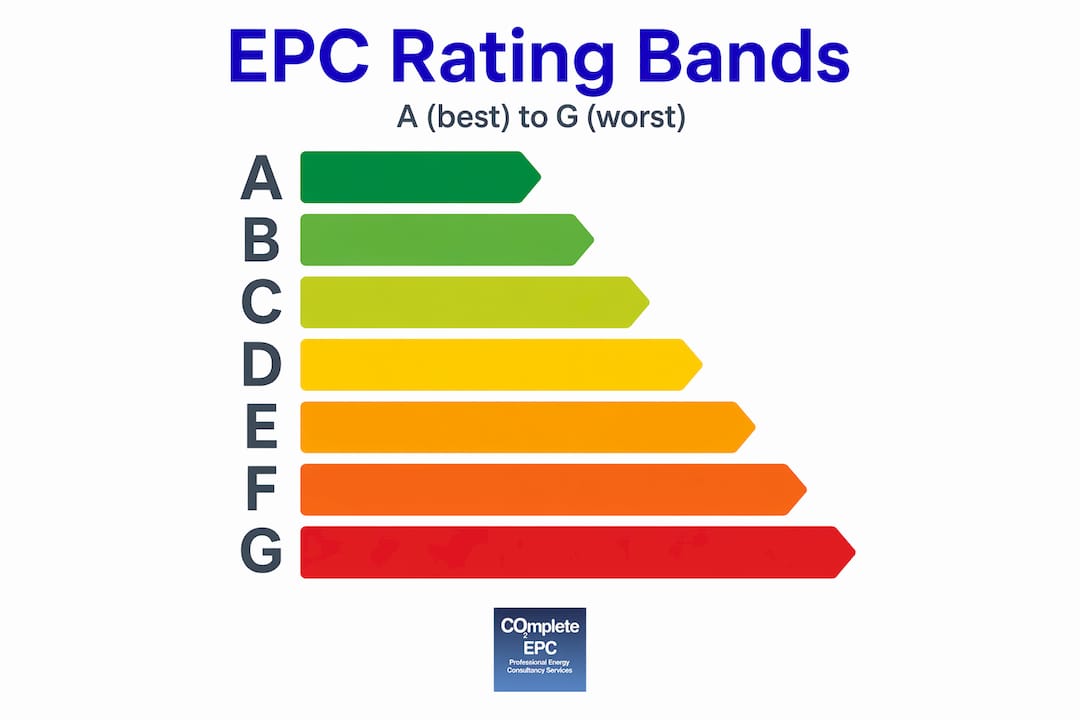
The score itself is derived using either SAP (Standard Assessment Procedure) for new builds or RdSAP (Reduced data SAP) for existing properties. Assessors input data on the building fabric, heating system, insulation, glazing, and lighting, and the calculation produces a score that reflects likely fuel costs and CO2 emissions under standard occupancy conditions. The A to G rating gives anyone, from a prospective tenant to a mortgage lender, an immediate sense of how efficient a property is without needing to read a technical report.
One detail that surprises many property owners is that every EPC shows two ratings: a “current” rating and a “potential” rating. The current rating reflects the property as it stands today. The potential rating shows what the building could achieve if all the assessor’s recommended improvements were carried out. That gap between the two numbers is your upgrade roadmap.
- The current rating determines your legal compliance position.
- The potential rating guides which improvements will have the greatest impact.
- Both ratings appear on the certificate alongside estimated annual energy costs.
Pro Tip: Ask your assessor to explain which specific measures drive the biggest jump between your current and potential score. Prioritising those measures first gives you the best return on any retrofit investment.
Why EPC rating significance matters in London
London’s property market is competitive, regulated, and under close scrutiny when it comes to energy efficiency. Understanding the EPC rating significance for your portfolio is about far more than passing an inspection.
The current legal minimum for letting residential property in England’s private rented sector is EPC E. Letting a property rated F or G is already unlawful. But the requirement is moving: private landlords must achieve EPC C by 1 October 2030. That deadline may feel distant, but the retrofit work needed to shift a Victorian terraced house from an E to a C is rarely quick or cheap.
Key compliance and market considerations for London landlords and investors include:
- Penalties for non-compliance. Letting a property below the minimum standard can result in significant fines, reputational damage, and difficulty securing future tenancies.
- Tenant demand. Higher EPC ratings mean lower fuel bills, which matters increasingly to tenants facing energy cost pressures. A C-rated property is a more attractive prospect than an E-rated one.
- Property value. Better-rated properties are generally easier to sell and may command a premium, particularly as buyers and lenders pay greater attention to running costs.
- Mortgage lending. Some lenders already apply preferential rates or additional scrutiny based on EPC band, a trend that is likely to grow.
London’s older housing stock makes compliance particularly challenging. Many properties were built before modern insulation standards existed, meaning upgrades require more planning and expenditure than in newer buildings. The sooner you understand your current rating, the more time you have to budget appropriately.
Pro Tip: Commission your EPC well ahead of any sale or new tenancy rather than at the last moment. A certificate is valid for ten years, so timing it to capture recent upgrades means the rating you show prospective tenants or buyers reflects the property at its best.

The accuracy gap: what EPC ratings do and do not tell you
There is a detail about EPC ratings that does not get discussed nearly enough: they are modelled estimates, not measurements of real energy use. The GOV.UK EPC accuracy research published findings that reveal meaningful gaps between the energy use an EPC predicts and the energy a building actually consumes once occupied.
“EPC ratings reflect standardised assumptions about occupancy behaviour and conditions, which means actual energy consumption in a real household will often diverge from the modelled figure, sometimes significantly.”
The reasons for this divergence include:
- Occupant behaviour. A household that heats every room to 22°C all day will use far more energy than the standard occupancy model assumes.
- Building alterations. Extensions, loft conversions, or boiler replacements that occurred after the last assessment will not be reflected in an outdated certificate.
- Measurement limitations. RdSAP relies on data collected during a relatively brief site visit, so assessors make reasonable assumptions about elements they cannot directly measure.
This does not make EPCs useless. It means you should treat your rating as a comparative benchmark rather than an exact prediction of running costs. If your property has undergone significant work since the last assessment, the existing certificate may overstate or understate your true position.
Pro Tip: If you have completed any notable upgrades since your last EPC was issued, commission a new assessment. An outdated certificate that no longer reflects your property’s actual condition could leave you on the wrong side of compliance or underselling your asset.
Practical steps to improve your EPC rating
Your potential EPC rating is not just a number on a document. It is a prioritised list of improvements that an assessor has calculated will make the biggest difference to your score. Working through that list methodically is the most efficient path to compliance and added value.
The government caps landlord retrofit spending at £10,000 per property for EPC-related improvements under the new regulations. That cap makes it even more important to invest in the measures that deliver the greatest gain.
Common improvements and their typical impact:
| Improvement | Likely EPC impact | Estimated cost range |
|---|---|---|
| Loft insulation (top up to 270mm) | High | £300–£600 |
| Cavity wall insulation | High | £500–£1,500 |
| Double or triple glazing | Moderate to high | £3,000–£10,000 |
| Air source heat pump | High | £7,000–£14,000 |
| Solar photovoltaic panels | High | £5,000–£9,000 |
| Smart heating controls | Low to moderate | £150–£500 |
| LED lighting throughout | Low | £100–£300 |
A few practical points to keep in mind:
- Focus first on the building fabric: insulation and glazing tend to deliver the most points for the money spent.
- Replacing a gas boiler with a heat pump scores very well under SAP calculations, but the installation cost may exceed the £10,000 cap on its own for some properties.
- Energy efficiency improvements also reduce tenant fuel bills, which can reduce void periods and improve retention.
Once improvements are complete, commission a new EPC assessment. The upgrade work is wasted from a compliance and marketing perspective if your certificate still shows the pre-improvement rating.
How to commission, renew, or update your EPC
Understanding when and how to get an EPC is just as important as understanding what the rating means. Here is a straightforward sequence for London property owners:
- Check the existing certificate. Search the government’s EPC register using the property postcode. You may already have a valid certificate that does not need replacing yet.
- Confirm the validity period. EPCs are valid for 10 years. If your certificate is approaching expiry or was issued before significant refurbishment, plan a new assessment.
- Appoint a qualified assessor. In England, domestic energy assessors must be accredited. Completeepc works with qualified assessors who carry full accreditation and extensive London-specific experience.
- Prepare the property. Gather documentation for any upgrades completed since the last assessment: boiler installation records, insulation guarantees, glazing certificates. These can influence the outcome.
- Receive and review the report. The certificate will show your current and potential ratings alongside a list of recommended measures. Use the recommendations to plan future upgrades.
- Time the assessment strategically. Coordinating EPC commissioning with planned transactions or completed refurbishments means the rating you present reflects your property accurately.
For new tenancies, landlords must provide a valid EPC to prospective tenants before they commit. For sales, an EPC must be available to buyers at the point of marketing. Missing these requirements creates legal exposure that is entirely avoidable with a little forward planning.
My take on EPC ratings after years in the field
I have spoken with dozens of London landlords who view their EPC as a bureaucratic hurdle. Get the certificate, file it away, and forget about it until the next renewal. That approach made some sense when EPCs were relatively new and the penalties for poor ratings were limited. It makes no sense now.
What I have seen repeatedly is landlords who leave retrofit decisions until they are legally forced to act. By that point, the timeline is short, the contractors are busy, and the budget has not been planned. The result is reactive spending on measures that may not be the most cost-effective, simply because there was no time to compare options properly.
My view is that an EPC should be read as a strategic document. The potential rating tells you what your property could achieve. The gap between current and potential is where your investment decisions live. Landlords who treat that gap as a planning tool rather than an inconvenience tend to upgrade more efficiently and get better outcomes.
There is also a real risk of over-relying on the certificate rating without engaging with actual energy performance. A property rated C on paper can still have poor draught sealing, inefficient heating controls, or uninsulated pipework that drives up real bills. The certificate is evidence of compliance. Actual energy management is a separate, ongoing discipline.
Plan ahead of the 2030 deadline. Commission your EPC now, understand your position, and build a realistic upgrade schedule. That is the approach that protects both your tenants and your investment.
— Danny
Get your London EPC sorted with Completeepc
If you need a clear, accurate EPC assessment for a London property, Completeepc provides exactly that. Whether you are a landlord planning ahead of the 2030 compliance deadline, an investor preparing for a sale, or a property owner who simply wants to understand where you stand, Completeepc’s qualified assessors cover the full range of domestic and commercial assessments across London.
Start with the London EPC guide to understand what an assessment involves and how Completeepc approaches each property. For a step-by-step breakdown of the renewal process and when to act, the EPC renewal guide covers everything you need. Completeepc guarantees the lowest EPC rates in the UK market, with experienced assessors who understand London’s distinct property stock and regulatory context. Book an assessment today and know exactly where your property stands.
FAQ
What does EPC rating stand for?
EPC stands for Energy Performance Certificate. The rating is the letter grade from A to G assigned to a property based on its assessed energy efficiency.
What is the minimum EPC rating for renting a property?
The current minimum EPC rating for renting in England’s private rented sector is E. Landlords must reach EPC C by 1 October 2030.
How do I check my property’s EPC rating?
You can check an existing EPC by searching the government’s EPC register online using your property’s postcode. The register shows the current rating, potential rating, and certificate expiry date.
How long does an EPC last?
An EPC is valid for ten years from the date of issue. You should commission a new one sooner if significant improvements have been made to the property.
Can improving my EPC rating increase property value?
Yes. Higher EPC ratings correlate with lower fuel bills and reduced carbon emissions, which improves a property’s attractiveness to buyers and tenants and can support a higher sale or rental price.