

Rising energy prices and strict new regulations have made managing energy bills a real headache for London landlords. Every tenancy agreement carries its own challenges, especially when utility costs must be accounted for accurately. Understanding the difference between bills-inclusive arrangements and direct supplier payments is vital as you balance compliance, tenant satisfaction, and your bottom line. This guide explains key billing methods, breaks down what really makes up an energy bill, and highlights how smart energy management protects your investment while keeping your portfolio future-proof.
Table of Contents
- Energy Bills Explained For Landlords
- Types Of Charges On Energy Bills
- Epc Regulations And Energy Bill Impact
- Landlord Responsibilities And Compliance Risks
- Reducing Costs And Improving Efficiency
Key Takeaways
| Point | Details |
|---|---|
| Understand Energy Responsibilities | Tenancy agreements structure determines whether landlords cover energy bills or if tenants pay directly to suppliers. Clarifying this is essential for financial management. |
| Compliance with EPC Regulations | London landlords must have valid Energy Performance Certificates, with upcoming regulations tightening minimum standards from EPC E to EPC C by 2030. Early compliance planning is crucial to avoid penalties. |
| Impact of Energy Efficiency | Properties with better energy ratings attract higher-quality tenants and can justify higher rents, while poor efficiency leads to elevated costs. Investing in upgrades is key to maintaining property value. |
| Monitoring and Cost Management | Regularly reviewing energy costs and tenancy agreements helps landlords anticipate expenses and adjust strategies, especially if managing bills-inclusive properties. Effective tracking of charges and upgrades is essential. |
Energy bills explained for landlords
Understanding your energy bills is crucial when you rent out properties in London. Your responsibility depends on how your tenancy agreements are structured. If you’ve included utilities in the rent (a bills-inclusive tenancy), you’re liable for the full cost of gas, electricity, and water. If your tenants pay their own bills directly to suppliers, you’re not responsible for those charges—but you still need to understand how energy efficiency affects your property’s appeal and resale value.
The way you charge tenants for energy matters legally and financially. You can only charge for gas or electricity if your tenancy agreement explicitly states this. Common billing methods include incorporating costs into the rent, requiring separate meter payments, or using smart meters for transparent tracking. Many London landlords are moving away from bills-inclusive arrangements because energy costs have become unpredictable. Rising utility prices mean you could face significant losses if you’ve underestimated tenant consumption or locked in fixed costs that no longer cover actual expenses.
Several factors influence your energy bills and what you can reasonably charge:
- Property age and insulation: Older London properties lose heat faster, increasing heating costs. Better insulation reduces expenses significantly.
- Tenant behaviour: Usage patterns vary dramatically. Some tenants maintain modest consumption while others leave heating on constantly.
- Energy supplier rates: London’s competitive energy market means rates fluctuate. Securing good deals requires active management.
- Energy efficiency improvements: Properties with better ratings attract tenants willing to pay more, offsetting your investment in upgrades.
When bills are inclusive in tenancy agreements, you bear all the financial risk. If energy prices spike or a tenant uses excessive heating, you absorb those costs. This is why many landlords now prefer tenants paying suppliers directly. However, bills-inclusive packages can be attractive to tenants on fixed incomes and may justify slightly higher rent.
This table compares the main methods for managing energy billing in rented properties:
| Billing Method | Landlord Risk | Tenant Appeal | Financial Predictability |
|---|---|---|---|
| Bills-inclusive | High | Fixed income tenants | Hard to forecast |
| Direct supplier payment | Low | Independent tenants | Tenants manage increases |
| Smart meter tracking | Medium | Tech-savvy tenants | Consumption-based costs |
Pro tip: Review your tenancy agreements and energy costs quarterly. If you’re managing bills-inclusive properties, calculate your true average costs over the past year and assess whether your current rent covers those expenses—if not, plan to transition tenants to direct supplier billing at renewal.
Types of charges on energy bills
Your energy bill is far more complicated than simply paying for the gas or electricity you use. When you look at what your tenants (or you) are charged, several distinct components make up the total cost. Understanding these charges helps you predict expenses, manage bills-inclusive tenancies effectively, and explain costs to tenants who question their bills.
The main components of any energy bill include the unit rate (the price per kilowatt-hour of gas or electricity consumed), the standing charge (a daily fixed fee for maintaining the connection), and various levies and policy costs. The composition of energy bills includes wholesale energy costs, network charges for maintaining pipes and cables, supplier business costs, and government-funded environmental or social schemes. Beyond these basics, you’ll encounter:
- Wholesale energy costs: The actual price suppliers pay to generate or purchase electricity and gas. This fluctuates based on global commodity markets and can shift dramatically month to month.
- Network costs: Charges for maintaining the local distribution infrastructure, pipes, and cables that deliver energy to properties. These vary by region across the UK.
- Supplier costs: The retailer’s operational expenses, profit margin, and customer service provision.
- Policy levies and environmental schemes: Government levies account for approximately 16% of electricity bills and 5.5% of gas bills. These fund programmes like energy efficiency retrofits, renewable energy development, and support for vulnerable households.
For London landlords managing bills-inclusive tenancies, these charges matter considerably. If energy prices spike due to wholesale cost increases, you cannot simply pass those costs to tenants mid-contract. Network charges and policy levies also rise annually, eating into your margin if you’ve fixed the rent. The standing charge alone, multiplied across multiple properties, creates a hidden baseline cost that many landlords underestimate when calculating affordable bills-inclusive rents.
One often overlooked element is that different properties face different network charges based on their postcode and local distribution company. Two similar London properties in different postcodes might have substantially different ongoing network fees, affecting your true costs.
Pro tip: Request a detailed bill breakdown from your energy supplier showing unit rates, standing charges, and levies separately. Track these components quarterly so you spot cost escalations early and can adjust bills-inclusive rents or plan tenant transitions before they become problematic.
EPC regulations and energy bill impact
Energy Performance Certificates (EPCs) directly shape your costs as a London landlord and will increasingly affect your rental income. Every residential property you let must have a valid EPC. This document rates your property’s energy efficiency on a scale from A (most efficient) to G (least efficient). The current minimum legal standard is EPC E, but this requirement tightens significantly in the coming years. Understanding how EPC regulations impact your bills and investment is crucial for planning ahead.
The regulatory timeline is accelerating. Under current rules, all rental properties in England and Wales must achieve a minimum of EPC E to remain lettable. From 2030 onwards, the minimum standard shifts to EPC C. This is not optional. Properties that fall below the required rating cannot legally be let to new or existing tenants. For London landlords with older stock, this creates a significant financial challenge. Properties with poor insulation, old boilers, or inefficient windows often sit at EPC D, E, F, or G. Upgrading these to EPC C typically requires substantial investment:
- Insulation improvements: Cavity wall, loft, or external wall insulation costs thousands.
- Heating system upgrades: Replacing gas boilers with heat pumps or modern efficient alternatives.
- Window and door replacements: Installing double or triple glazing.
- Renewable energy installation: Solar panels or other renewable technologies can significantly improve ratings.
Estimated upgrade costs range between £6,100 and £6,800 for most properties, with a proposed £15,000 cost cap to protect landlords from excessive expenses.
Here is the critical connection to your energy bills: properties with better EPC ratings consume less energy, directly reducing running costs. A property at EPC C uses substantially less heating and electricity than one at EPC E or F. If you manage bills-inclusive tenancies, better-rated properties mean lower costs for you and higher appeal to cost-conscious tenants. Even for tenants paying their own bills, a property with strong efficiency ratings justifies higher rent and attracts quality tenants who value lower energy expenses. Your investment in EPC improvements now protects you from future regulatory breaches and positions your portfolio competitively. Properties that meet 2030 standards ahead of schedule will have market advantages as landlords scramble to comply.
Here’s a summary of how different EPC ratings affect landlord costs and property value:
| EPC Rating | Energy Costs | Legal Status From 2030 | Impact on Rent | Investment Required |
|---|---|---|---|---|
| A-B | Lowest bills | Fully compliant | Highest rent | Minimal upgrades |
| C | Moderate bills | Fully compliant | Attractive rent | Some upgrades |
| D-E | High bills | Not lettable post-2030 | Lower rent | Significant upgrades |
| F-G | Very high bills | Illegal to let post-2030 | Very low rent | Major investment |
The compliance deadline creates urgency. Many London landlords are waiting until 2029 or 2030 approaches, but supply chain delays, surveyor availability, and installation backlogs could inflate costs dramatically if everyone rushes simultaneously. Acting now spreads your capital outlay and guarantees compliance without last-minute pressure.
Pro tip: Commission an EPC survey immediately if you haven’t had one recently. Use the recommendations section to prioritise low-cost upgrades first (draught-proofing, thermostat controls) before planning major investments, spreading costs whilst steadily improving your rating toward EPC C compliance.
Landlord responsibilities and compliance risks
As a London landlord, you carry specific legal obligations regarding energy efficiency and tenant safety. These responsibilities extend beyond simply collecting rent. You must provide a safe, properly maintained home with a valid Energy Performance Certificate, and you must comply with Minimum Energy Efficiency Standards (MEES) regulations. Failing to meet these obligations exposes you to significant financial penalties, enforcement action, and potential rental bans.

Your primary duties include supplying tenants with a valid Energy Performance Certificate before they move in, maintaining gas safety compliance (where applicable), and ensuring your property meets the current minimum energy efficiency rating. Under MEES regulations, you cannot legally let a property rated F or G. The consequences of breaching these rules are serious. Local authorities can issue enforcement notices, pursue civil penalties up to £5,000 per breach, or ban properties from being let entirely. These fines accumulate quickly, especially if you own multiple properties across London.
Non-compliance creates cascading problems. A tenant discovering their property fails to meet energy standards can challenge the letting legally. They may withhold rent, pursue compensation for discomfort or inflated energy bills, or terminate the tenancy without penalty. Estate agents will refuse to market non-compliant properties. Your property becomes unmortgageable because lenders view energy efficiency risks as security threats. Insurance companies may deny claims if you cannot demonstrate compliance. The ripple effect of cutting corners on energy standards damages your entire rental business.
The practical compliance risks are equally pressing. Many landlords receive enforcement notices because they lack current EPCs or fail to track MEES deadlines across their portfolio. Others don’t realise that EPC ratings expire every ten years and must be renewed. Some invest in improvements but fail to commission updated assessments, missing the opportunity to demonstrate compliance or justify higher rents. Documentation failures frequently lead to penalties even when properties have actually been improved.
You must also understand that Minimum Energy Efficiency Standards changes create escalating obligations. Current rules require EPC E minimum. From 2030, this tightens to EPC C. Landlords who delay improvements will face compressed timelines, inflated contractor costs, and higher risk of falling out of compliance during renovation work. Properties you could still let today at EPC E will become unlettable in five years without substantial investment.
Pro tip: Create a compliance tracking spreadsheet with each property’s EPC rating, expiry date, MEES deadline, and planned improvement works. Set calendar reminders three months before EPC expiry to commission renewals, and review your portfolio annually to identify properties approaching non-compliance so you can plan upgrades strategically rather than reactively.
Reducing costs and improving efficiency
Reducing your energy costs as a London landlord requires a strategic approach. You cannot simply hope tenants use less heating or expect bills to stabilise on their own. Instead, invest in targeted improvements that lower energy consumption, improve your EPC rating, and make your properties more attractive to quality tenants. The good news is that many upgrades qualify for government funding, significantly reducing your out-of-pocket expenses.
Start with the improvements that deliver the fastest returns. Insulation is your priority. Most London properties built before 1990 lack adequate cavity wall insulation, and loft insulation is often thin or missing entirely. Upgrading these areas reduces heat loss dramatically and costs less than major heating system replacements. Heating system upgrades come next. Replacing an old gas boiler with a modern efficient condensing boiler or exploring heat pump technology reduces consumption substantially. Double glazing and draught-proofing prevent heat escaping through windows and doors. Smart thermostats and controls allow tenants to manage heating precisely, cutting waste. These measures work together. A property with poor insulation and an old boiler wastes energy regardless of how carefully tenants operate controls. Conversely, excellent insulation combined with modern heating maximises efficiency gains.
Government funding schemes like Energy Company Obligation and Great British Insulation Scheme can cover much of your improvement costs. These programmes target insulation, heating upgrades, and renewable energy installations. Eligibility depends on property type, location, and current energy rating, but many London landlords qualify. The schemes cover:
- Cavity wall and loft insulation installation
- Boiler replacement with efficient alternatives
- Heat pump installation for properties suitable for conversion
- Heating controls and smart thermostat fitting
- Draught-sealing and window improvements
Applying for these grants requires working with accredited installers and following specific application processes, but the funding can cover 50-100% of costs depending on the scheme. This transforms the financial case for upgrades. An insulation project costing £3,000 becomes a £1,500 or even free investment when grants apply.
Beyond individual upgrades, think strategically about your portfolio. Properties with the poorest efficiency ratings deserve priority investment because they create the largest bill reductions for tenants and generate the biggest EPC improvements for you. Improving a property from EPC F to EPC D reduces energy consumption by 20-30%, which is substantial. Spreading improvements across multiple properties rather than concentrating on one ensures your entire portfolio moves toward compliance. Track which properties qualify for which funding schemes. Some areas have additional local authority support beyond national programmes. Contact your local council’s energy efficiency team to identify available grants.
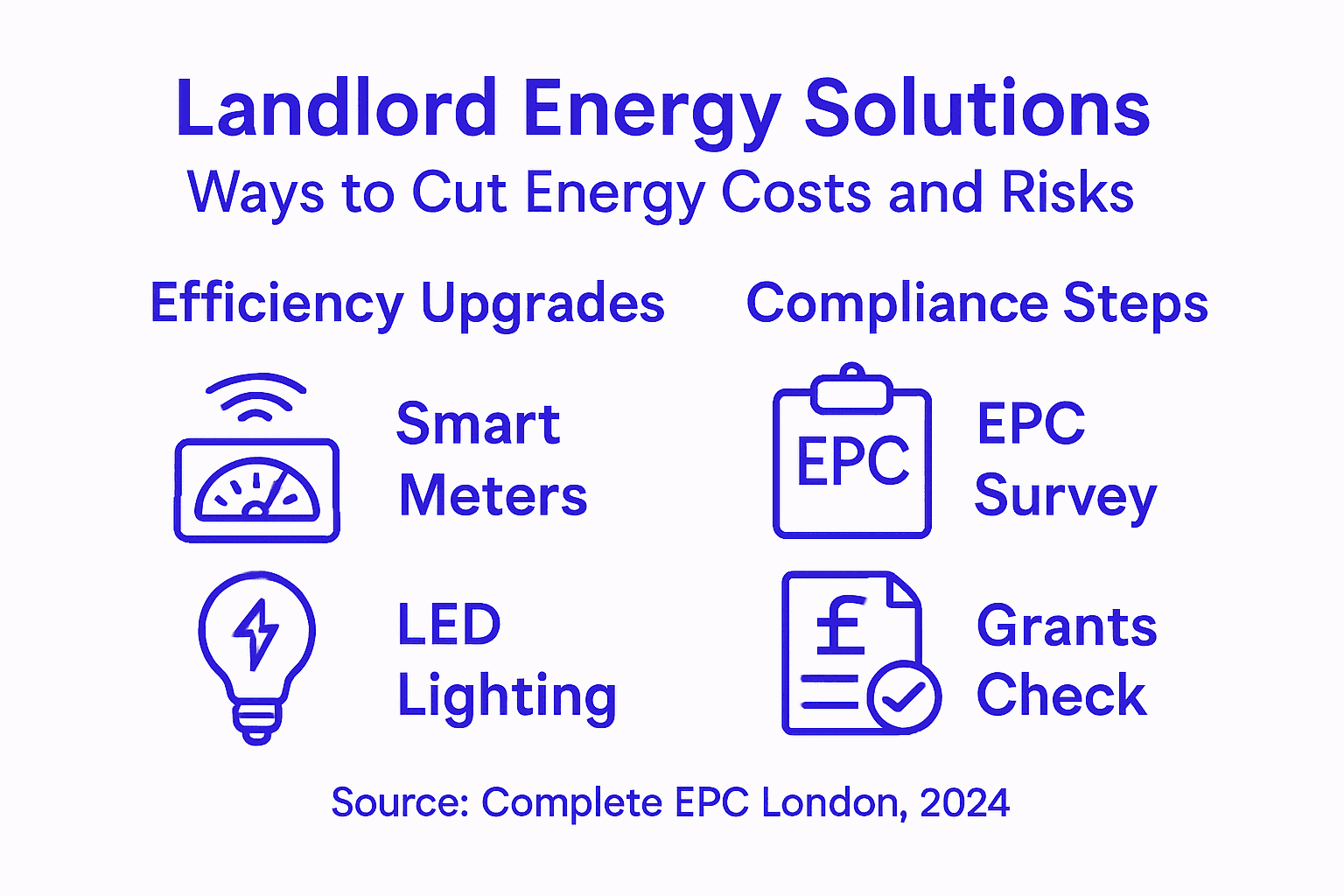
For bills-inclusive tenancies, efficiency improvements directly increase your profit margins. Lower energy consumption means lower costs you absorb. For market-rate lettings, improved efficiency justifies higher rents because tenants pay less in their own bills. Both models benefit from investment.
Pro tip: Request free energy audits from accredited assessors in your network. These identify which improvements deliver the greatest returns for your specific properties and reveal which government schemes apply. Start with one property as a pilot project, track the results for six months, then roll out successful measures across your portfolio.
Take Control of Your Energy Costs with Expert EPC Support
Understanding the complexities of energy bills and meeting evolving EPC regulations can be overwhelming for London landlords. Rising energy costs and tightening legal standards create real financial and compliance challenges. Whether you manage bills-inclusive tenancies or tenants who pay suppliers directly, knowing your property’s energy efficiency rating and acting on it is essential to avoid penalties and reduce costs.
At Complete EPC, we specialise in delivering accurate, competitively priced Energy Performance Certificates that help you stay compliant with minimum energy efficiency standards. Our experienced assessors provide detailed, reliable reports with clear recommendations so you can prioritise upgrades that lower energy consumption and enhance your property’s value. Don’t wait until new regulations come into force or energy bills spiral out of control. Visit Complete EPC today to secure your EPC and start making informed decisions that protect your investment and attract quality tenants. Learn more about how we support landlords like you at Complete EPC. Take the first step now toward sustainable lettings and long-term savings.
Frequently Asked Questions
What factors influence energy bills for landlords?
Energy bills for landlords are influenced by property age, insulation quality, tenant behaviour, energy supplier rates, and energy efficiency improvements. Properties with better insulation and energy ratings typically incur lower running costs.
How can I charge tenants for energy when managing a property?
You can charge tenants for energy through various methods, such as incorporating utility costs into the rent (bills-inclusive arrangements), requiring separate meter payments, or using smart meters for transparent tracking of usage. Ensure the tenancy agreement explicitly states your charging method.
What are the legal responsibilities for landlords concerning energy efficiency?
Landlords must provide a valid Energy Performance Certificate (EPC) before tenants move in, ensure compliance with Minimum Energy Efficiency Standards (MEES), and maintain gas safety compliance where applicable. Properties must meet a minimum EPC rating to be let legally.
How can I improve energy efficiency in my rental properties?
Improving energy efficiency can be achieved through upgrades like proper insulation, installing modern heating systems, double glazing, draught-proofing, and smart controls. Some improvements may qualify for government funding, significantly reducing costs for landlords.