

TL;DR:
- An energy performance certificate (EPC) is a required document that assesses a property’s energy efficiency on a scale from A to G. Tenants should verify the certificate’s validity, current rating, and registered exemptions before signing a lease, as regulations demand a minimum EPC band E, with a future goal of band C by 2030. Landlords bear the cost of EPCs, which are valid for ten years, and tenants can use the certificate’s recommendations as a negotiation tool to promote energy upgrades.
An energy certificate for renting, formally known as an Energy Performance Certificate (EPC), is a legally required document that rates a property’s energy efficiency on a scale from A (most efficient) to G (least efficient). In England and Wales, EPCs must be valid and available to prospective tenants before a property is marketed or let. The certificate tells you how much energy the property is likely to use, what that means for your bills, and whether the landlord is meeting minimum legal standards. Understanding your rights around EPCs before you sign a tenancy agreement puts you in a far stronger position as a renter.
What are the legal minimum energy efficiency requirements for rental properties?
The current legal baseline for rental properties in England and Wales is EPC band E. Properties rated F or G cannot legally be let unless the landlord holds a valid registered exemption. This rule has applied to all tenancies since April 2020 under the Minimum Energy Efficiency Standards (MEES) regulations. If a landlord is renting out an F or G rated property without a registered exemption, they are in breach of the law.
The key points tenants should know about current requirements include:
- Band E is the minimum. Any property rated below E is unlawful to let without a registered exemption.
- Exemptions must be formal. Landlords cannot simply claim improvements are too costly or impractical. Exemptions must be registered on the official PRS MEES Exemptions Register with supporting evidence.
- The £10,000 cost cap applies. Landlords are only required to spend up to £10,000 per property on energy improvements. If reaching band E would cost more, they may register a cost cap exemption.
- Exemptions are time-limited. Most exemptions last five years, after which landlords must reassess whether improvements are now feasible.
- Penalties for non-compliance are significant. Local authorities can issue fines of up to £5,000 per property for breaches.
Pro Tip: Before viewing a property, search the address on the government’s EPC register to confirm the current rating. If the rating is F or G, ask the landlord directly whether a valid exemption is registered before you proceed.
As a tenant, you have the right to request a copy of the EPC before signing any agreement. A landlord who cannot or will not provide one is a clear warning sign worth taking seriously.

How long is an energy performance certificate valid?
EPCs are valid for 10 years from the date of issue. This means a certificate produced in 2015 expired in 2025 and cannot be used to demonstrate compliance for a new tenancy. Tenants should always check the issue date on any EPC they are shown, not just the rating itself.
Here is how to verify EPC validity step by step:
- Ask for the EPC before viewing. Landlords are legally required to provide it to prospective tenants free of charge.
- Check the issue date. The certificate must have been issued within the last 10 years. Anything older is expired and non-compliant.
- Search the national register. Visit the government’s EPC register and enter the property address to find the most recent certificate independently.
- Look for post-improvement updates. If a landlord has made significant energy improvements, they should have commissioned a new EPC to reflect the updated rating. An old certificate may not accurately represent the current state of the property.
- Flag discrepancies. If the certificate the landlord shows you differs from what appears on the national register, ask for clarification before proceeding.
An expired EPC is not a minor administrative oversight. It means the landlord has not demonstrated compliance with current energy standards, and you have no verified basis for understanding the property’s energy costs or legal status.
What does an energy certificate cost, and who pays?
EPC costs in England and Wales typically range from £65 to £120, depending on property size, type, and location. This pricing data reflects the market as of late 2025. The cost is almost always borne by the landlord, not the tenant, since the legal obligation to obtain and provide the certificate sits with the property owner.
Several factors influence where a specific EPC falls within that price range:
- Property size. Larger properties take longer to assess, which increases the assessor’s fee.
- Location. Assessors in central London or other high-cost areas may charge more than those in less expensive regions.
- Property type. Flats, terraced houses, and detached properties each have different assessment complexities.
- Urgency. Some assessors charge a premium for same-day or next-day appointments.
Cost in context: A £65 to £120 EPC fee is a one-off cost that covers a full decade of compliance. For landlords managing multiple properties, this represents a modest investment relative to the legal risk of non-compliance.
As a tenant, you should not be asked to pay for the EPC. If a landlord attempts to pass this cost on to you as a condition of renting, that is not standard practice and worth querying. The certificate exists to protect your interests as much as the landlord’s legal standing.
How can tenants check if a rental property complies with EPC regulations?
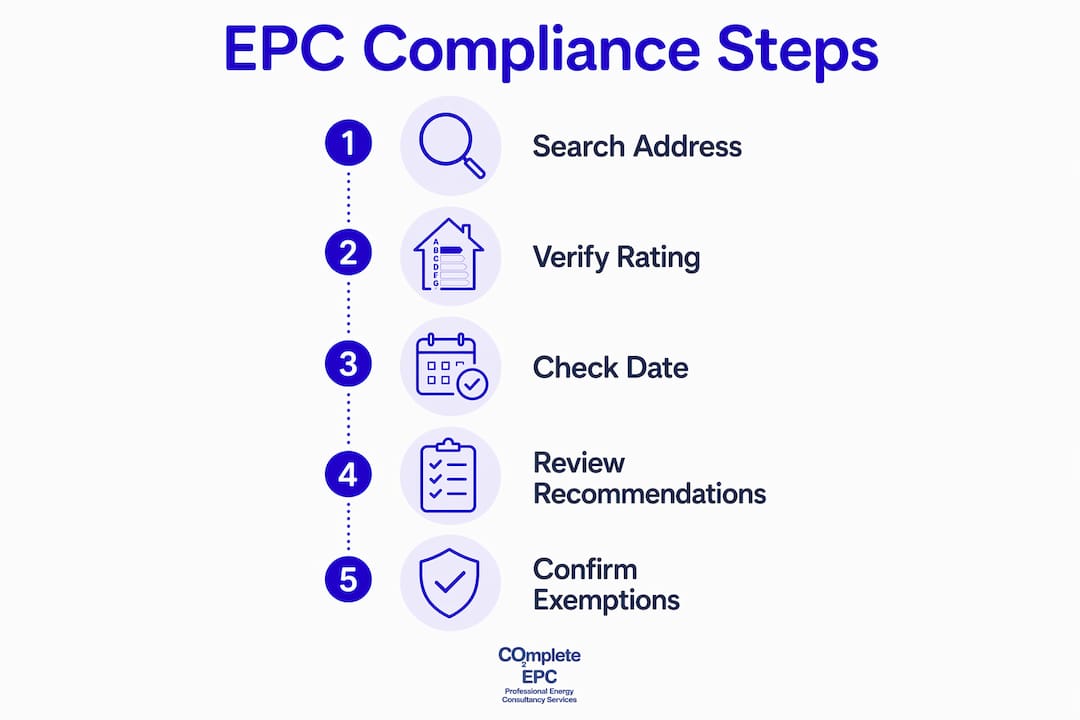
Verifying EPC compliance is straightforward once you know where to look. The government provides two key tools: the national EPC register and the PRS Exemptions Register, which lists all formally registered exemptions by property address and landlord details.
| What to check | Where to check it | What it tells you |
|---|---|---|
| Current EPC rating and issue date | Government EPC register (search by address) | Whether the certificate is valid and what band the property holds |
| Registered exemptions | PRS MEES Exemptions Register | Whether a landlord has a legitimate reason for renting below band E |
| Recommended improvements | EPC document itself (recommendations section) | What upgrades could improve the rating and reduce running costs |
| Assessor accreditation | Accreditation body registers (e.g. Elmhurst Energy, Stroma) | Whether the certificate was produced by a qualified assessor |
Understanding EPC bands matters beyond simple compliance. A band D property will typically cost noticeably more to heat than a band B property of similar size. EPC ratings are modelled estimates based on standard occupancy assumptions, not a guarantee of your exact bills. They are, however, a reliable comparative tool when choosing between properties.
The recommendations section of an EPC is particularly useful. It lists specific improvements, such as loft insulation, double glazing, or a more efficient boiler, along with estimated cost savings. These recommendations give tenants a basis for discussing potential upgrades with landlords, particularly if you plan a long tenancy and want to reduce your energy bills over time.
Pro Tip: If a property has a registered exemption, check the reason and the registration date. An exemption registered five years ago may be close to expiry, which means the landlord will soon need to reassess whether improvements are now viable.
Only accredited domestic energy assessors can produce valid EPCs in England, Wales, and Northern Ireland. If you have any doubt about a certificate’s legitimacy, you can verify the assessor’s accreditation through bodies such as Elmhurst Energy or Stroma Certification.
What future changes are planned for energy certificate standards in rentals?
The most significant upcoming change is the requirement for all private rental properties to reach EPC band C by 1 October 2030. Unlike previous rule changes, this deadline applies regardless of when a tenancy started. There is no new tenancy trigger. Every rented property in England and Wales must meet the standard by that date or hold a valid registered exemption.
Key points about the 2030 changes include:
- Dual metric compliance. The reformed EPC scheme will assess properties against two standards: fabric performance (insulation, windows, draught-proofing) and either smart readiness or heating system quality. A property must meet both to comply.
- The £10,000 cost cap remains. Landlords who cannot reach band C within this spend limit can register a cost cap exemption, valid for 10 years.
- Legacy EPCs have transitional recognition. Properties with a current valid EPC may continue to rely on it until it expires, but landlords making improvements must commission a new EPC under the updated metrics to demonstrate compliance.
- Tenants stand to benefit materially. Properties upgraded to band C or above typically have lower heating costs, better draught control, and more consistent indoor temperatures. For tenants on fixed incomes or in older housing stock, this is a meaningful improvement.
- Exemptions require evidence. As with current rules, landlords cannot self-certify. Every exemption must be formally registered with supporting documentation on the PRS MEES Exemptions Register.
The shift to band C represents the most substantial tightening of renting energy efficiency standards since MEES was introduced. Tenants signing long-term agreements now should factor in whether their landlord is likely to meet the 2030 standard, since properties that fall short may face restrictions on re-letting or require significant works during the tenancy.
Key takeaways
An EPC is a legal requirement for every rental property in England and Wales, and tenants have the right to see it before committing to a tenancy.
| Point | Details |
|---|---|
| Legal minimum is band E | Properties rated F or G cannot be let without a formally registered exemption on the PRS MEES Register. |
| EPCs are valid for 10 years | Always check the issue date on the certificate and verify it independently via the government EPC register. |
| Landlords bear the cost | EPC fees of £65 to £120 are the landlord’s responsibility; tenants should not be charged for this. |
| Band C required by 2030 | All private rental properties must reach EPC band C by 1 October 2030, regardless of tenancy start date. |
| Recommendations section is useful | The EPC’s improvement recommendations help tenants understand potential upgrades and negotiate with landlords. |
Why tenants should treat the EPC as a negotiating tool, not just a formality
Most tenants glance at the EPC rating and move on. That is a missed opportunity. The certificate contains far more useful information than a single letter grade, and understanding it properly can genuinely affect your renting decisions and your monthly outgoings.
In my experience working with EPC assessments across London, the properties that generate the most tenant complaints about energy costs are almost always those where the EPC was never properly read. A band D flat in a Victorian conversion might look attractive at a competitive rent, but the heating costs in winter can quickly erode any saving on the monthly payment. The EPC’s estimated energy costs section gives you a direct comparison between properties before you commit.
I would also encourage tenants to pay close attention to the exemption register. A landlord with a registered exemption is not necessarily acting in bad faith, but it does tell you that the property has not been upgraded to the legal minimum standard and that the landlord has formally acknowledged this. That is worth a direct conversation before you sign. Ask what improvements, if any, are planned before the exemption expires.
The 2030 band C deadline adds another layer of practical consideration. If you are looking at a long tenancy in a property currently rated D or E, ask the landlord what their plan is for meeting the new standard. A landlord with no answer or no awareness of the requirement is one who may be scrambling to comply in a few years, potentially with disruptive works during your tenancy.
Understanding the EPC recommendations section and using it as a basis for dialogue with your landlord is one of the most practical things a tenant can do. It costs nothing and can lead to real improvements in comfort and cost.
— Danny
Get a reliable EPC for your rental property with Completeepc
Whether you are a tenant wanting to understand your property’s energy rating or a landlord needing a valid certificate before letting, Completeepc provides accredited EPC assessments across London at competitive rates. Their London EPC guide covers everything from compliance requirements to interpreting your certificate’s recommendations. For landlords approaching the 2030 band C deadline, Completeepc’s qualified assessors can identify exactly what improvements are needed and produce a valid certificate that meets current and upcoming standards. You can also explore their EPC exemption guidance if you need to understand whether a registered exemption applies to your property.
FAQ
Do I need an energy certificate to rent out a property?
Yes. Landlords in England and Wales must have a valid EPC before marketing a property to let, and the certificate must be provided to prospective tenants free of charge.
What is the minimum EPC rating for a rental property in 2026?
The current minimum is band E. Properties rated F or G cannot legally be rented without a valid exemption registered on the government’s PRS MEES Exemptions Register.
How do I check if a rental property has a valid EPC?
Search the property address on the government’s national EPC register. The result will show the current rating, the issue date, and whether the certificate is still within its 10-year validity period.
Who pays for the EPC on a rental property?
The landlord arranges and pays for the EPC. Typical costs range from £65 to £120 depending on property size and location. Tenants are not responsible for this cost.
When will the EPC minimum standard change to band C?
All private rental properties in England and Wales must reach EPC band C by 1 October 2030, regardless of when the tenancy began, unless a valid exemption is registered.