

Over 60 percent of British buildings fall short of optimal energy efficiency standards according to recent national assessments. Rising utility costs and strict regulations make this issue impossible to ignore for property owners across the UK. Understanding energy performance benchmarks is the first step to avoiding unnecessary expenses and penalties while unlocking real savings and environmental benefits for both commercial and domestic buildings.
Table of Contents
- Defining Energy Performance Benchmarks In The UK
- Key Types Of Energy Benchmarks Explained
- Assessment Methods For Domestic And Commercial Buildings
- Legal Standards And Compliance In London
- Impacts, Costs, And Common Pitfalls
Key Takeaways
| Point | Details |
|---|---|
| Importance of Energy Performance Benchmarks | Energy performance benchmarks are critical for assessing and comparing the efficiency of buildings, helping stakeholders to make informed decisions regarding energy management. |
| Types of Benchmarks | Understanding operational, design stage, and sector-specific benchmarks allows property owners to tailor their strategies for energy efficiency improvements. |
| Assessment Methods | Effective energy assessments for domestic and commercial buildings help identify inefficiencies and provide targeted strategies for enhancement. |
| Legal Compliance in London | Building owners must be aware of evolving regulations like mandatory Energy Performance Certificates and standards for renewable energy integration to ensure compliance and support sustainability. |
Defining Energy Performance Benchmarks in the UK
Energy performance benchmarks represent standardised measurements that quantify the energy efficiency of buildings across different sectors in the United Kingdom. According to CIBSE, these benchmarks provide crucial graphical representations that help property owners, facility managers, and engineers understand and compare energy consumption patterns.
At their core, these benchmarks serve as comprehensive reference points that enable comparative analysis of energy use across various building types. The UK Government highlights their significance in assessing and comparing building energy efficiency, allowing stakeholders to make informed decisions about energy management and potential improvements.
Key components of energy performance benchmarks typically include:
- Total energy consumption (kilowatt hours)
- Energy use intensity (EUI)
- Carbon emissions
- Comparative performance against similar building types
- Potential cost savings from energy efficiency upgrades
These metrics provide a standardised approach to understanding and evaluating a building’s energy performance, enabling property owners to identify inefficiencies and develop targeted strategies for reducing energy consumption. By understanding energy efficiency metrics, building managers can implement more sustainable practices and contribute to broader environmental conservation efforts.
Key Types of Energy Benchmarks Explained
Energy benchmarks are sophisticated analytical tools that help organisations understand and improve their energy consumption across different sectors. CIBSE provides comprehensive categorisations of these benchmarks, which are strategically designed to evaluate operational energy use across diverse building types including educational institutions, healthcare facilities, and retail environments.
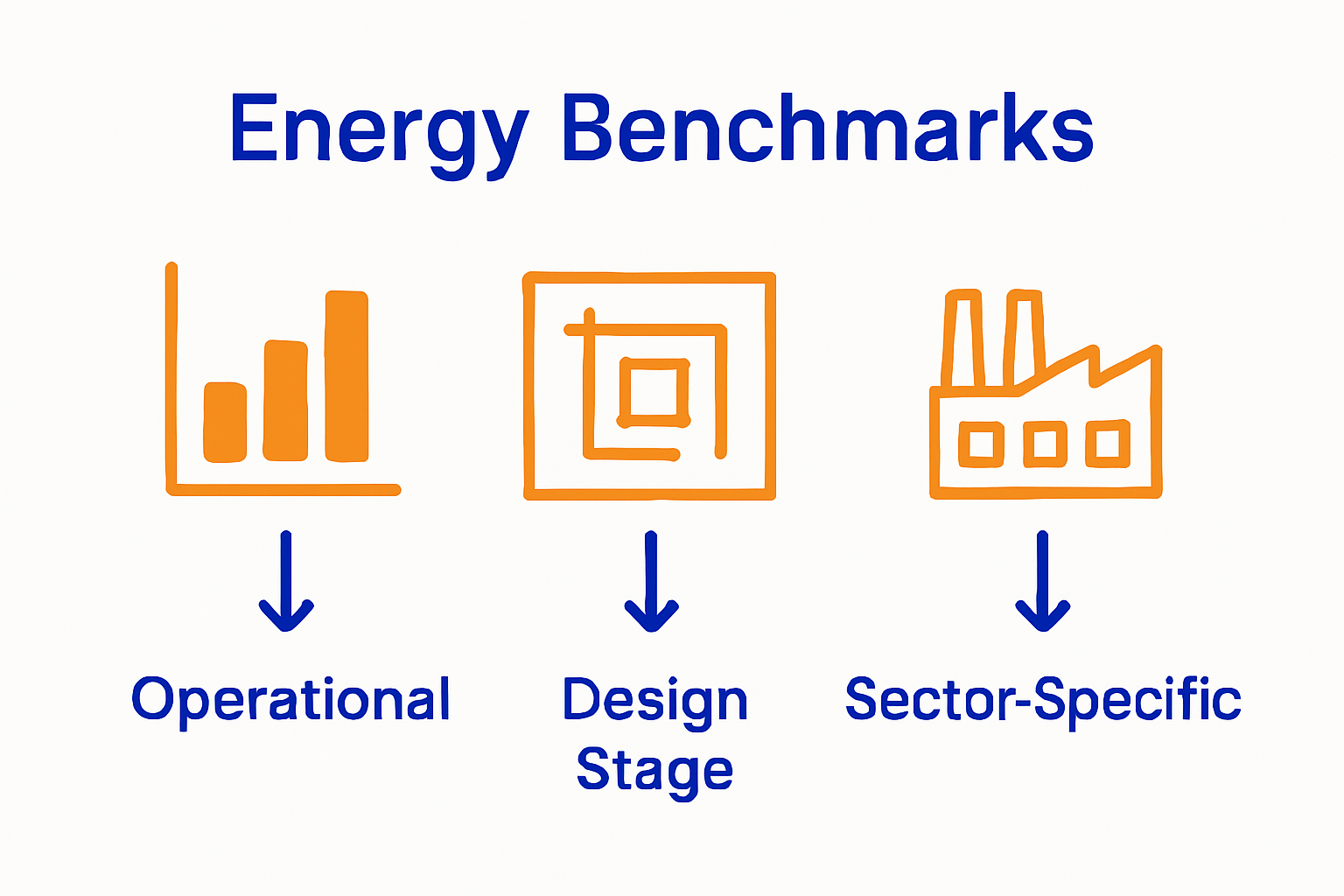
According to the Better Buildings Partnership, there are several critical types of energy benchmarks that property managers and sustainability professionals should understand:
- Operational Performance Benchmarks
- Measure actual energy consumption
- Track real-world building performance
- Compare against similar property types
- Design Stage Benchmarks
- Assess potential energy efficiency before construction
- Predict potential energy consumption
- Support sustainable design strategies
- Sector-Specific Benchmarks
- Tailored for specific industries
- Account for unique energy requirements
- Provide targeted performance insights
These varied benchmark types enable property owners to develop targeted strategies for reducing energy consumption. By understanding energy performance data, organisations can implement precise interventions that not only reduce carbon emissions but also generate significant cost savings across their property portfolios.
Assessment Methods for Domestic and Commercial Buildings
Energy performance assessments are critical tools for understanding building efficiency across residential and commercial sectors. Office for National Statistics provides comprehensive data revealing significant variations in energy performance across different property types, highlighting the importance of tailored assessment methodologies.
CIBSE outlines distinct assessment approaches for domestic and commercial properties, which typically involve:
Domestic Building Assessment Methods:
- On-site property inspection
- Review of heating and insulation systems
- Analysis of building fabric and construction
- Evaluation of energy consumption patterns
- Calculation of estimated energy performance rating
Commercial Building Assessment Methods:
- Comprehensive energy use analysis
- Detailed examination of operational systems
- Assessment of mechanical and electrical infrastructure
- Benchmarking against similar commercial properties
- Identification of potential energy efficiency improvements
These nuanced assessment techniques enable property owners to understand their building’s energy performance comprehensively. By exploring the EPC assessment process, stakeholders can develop targeted strategies to enhance energy efficiency, reduce carbon emissions, and potentially decrease long-term operational costs.

Legal Standards and Compliance in London
Energy performance regulations in London represent a comprehensive framework designed to drive sustainable building practices and reduce carbon emissions. UK Government consultations highlight ongoing efforts to reform and strengthen legal standards governing building energy efficiency across the capital.
A pivotal example of London’s innovative approach is the Merton Rule, which Wikipedia describes as a groundbreaking policy requiring new commercial buildings over 1000m² to generate at least 10% of their energy needs through on-site renewable equipment. This regulation demonstrates the city’s commitment to progressive environmental standards.
Key legal compliance requirements for London properties include:
- Mandatory Energy Performance Certificates (EPCs)
- Required for all properties during sale or rent
- Minimum energy efficiency standards
- Penalties for non-compliance
- Renewable Energy Integration
- Minimum on-site renewable energy generation
- Carbon reduction targets
- Incentives for sustainable design
- Building Regulation Updates
- Regular policy refinements
- Stricter energy efficiency standards
- Alignment with national climate goals
Property owners and developers must stay informed about these evolving regulations. By understanding energy performance certificate regulations, stakeholders can ensure compliance, avoid potential financial penalties, and contribute to London’s sustainable development objectives.
Impacts, Costs, and Common Pitfalls
Energy performance benchmarking introduces both significant opportunities and challenges for property owners and organisations. Great British Insulation Scheme research highlights the complex landscape of energy efficiency improvements, demonstrating that strategic interventions can yield substantial financial and environmental benefits.
CRC Energy Efficiency Scheme analysis reveals several critical impacts and potential pitfalls property stakeholders must navigate:
Financial Impacts:
- Initial investment costs for energy efficiency upgrades
- Potential long-term savings on energy expenditure
- Return on investment timelines
- Potential tax incentives and government grants
Common Implementation Pitfalls:
- Inadequate initial energy performance assessments
- Misunderstanding compliance requirements
- Overlooking sector-specific regulations
- Underestimating retrofit complexity
- Insufficient budget allocation
Potential Cost Considerations:
- Professional assessment fees
- Retrofit and upgrade expenses
- Potential non-compliance penalties
- Ongoing maintenance of energy efficiency systems
Navigating these challenges requires comprehensive planning and expert guidance. By exploring the EPC assessment process, organisations can develop robust strategies to minimise risks and maximise energy performance improvements.
Take Control of Your Energy Performance Compliance in London
Navigating the complex world of energy performance benchmarks and legal regulations can feel overwhelming. This guide highlights common challenges such as understanding sector-specific benchmarks and staying compliant with London’s evolving requirements like the Merton Rule. Property owners and managers face pressure to reduce carbon emissions while avoiding costly pitfalls related to inadequate assessments or overlooked regulations.
At Complete EPC, we specialise in delivering accurate energy performance certificates for both domestic and commercial properties across London. Our qualified assessors provide detailed reports that not only ensure you meet mandatory standards but also offer practical recommendations to improve your building’s energy efficiency and potentially reduce operational costs. Whether you need help with comprehensive EPC assessment processes or want to deepen your understanding of energy efficiency metrics, we guide you every step of the way.
Don’t risk non-compliance or missed savings. Discover how you can turn energy performance challenges into opportunities for sustainability and enhanced property value. Visit Complete EPC today to secure your professional assessment and start benefiting from expert advice tailored to London’s unique energy landscape.
Frequently Asked Questions
What are energy performance benchmarks?
Energy performance benchmarks are standardised measurements used to quantify the energy efficiency of buildings, helping to compare energy consumption patterns across different building types.
Why are energy performance benchmarks important for property owners?
These benchmarks enable property owners to understand their energy usage, identify inefficiencies, and develop strategies for improving energy efficiency, ultimately leading to cost savings and reduced carbon emissions.
What types of energy benchmarks are available?
There are several types of energy benchmarks, including operational performance benchmarks, design stage benchmarks, and sector-specific benchmarks, each tailored to different evaluation needs and building types.
How can I ensure compliance with energy performance regulations?
To ensure compliance, property owners should stay informed about mandatory Energy Performance Certificates (EPCs), renewable energy integration requirements, and updates to building regulations, making necessary adjustments to meet legal standards.
Recommended
- London’s Ultimate Guide to Energy Performance Certificates: Enhance Your Property’s Efficiency – Complete EPC
- Energy Efficiency Steps for London Properties Made Simple
- Energy Performance Overview: Complete Guide for London – Complete EPC
- 7-Step Energy Efficiency Checklist for London Properties – Complete EPC
- Construction Estimating Guide 2025: Accurate UK Cost Plans – My Project Estimating
- Energy Efficiency in Buildings: Complete Guide – Mats4U USA