


TL;DR:
- London landlords face increasing pressure from rising energy costs and stricter regulations. Upgrading insulation, draught-proofing, and heating controls first offers the best cost-effective improvements and compliance benefits. Funding schemes and strategic sequencing of upgrades can significantly enhance property value and market appeal.
London landlords are under more pressure than ever. Energy bills have surged, regulatory expectations are tightening, and tenants increasingly expect efficient, comfortable homes. From 2028, proposed changes to Minimum Energy Efficiency Standards (MEES) could require all privately rented properties to reach EPC band C or above. That is not a distant concern; it is a live planning issue. The good news is that the right upgrades, tackled in the right order, can cut bills, satisfy compliance requirements, and add measurable value to your property. This guide covers the most cost-effective upgrades, available grants, and a clear process to help you act with confidence.
Table of Contents
- What to know before upgrading: Essential groundwork
- Step-by-step: Implementing high-impact energy saving upgrades
- Grants, incentives, and funding options for London upgrades
- Proving energy performance: EPC impacts and market rewards
- What most landlords miss: Value from timing, sequencing, and market signals
- Get expert support: Upgrade your London property with confidence
- Frequently asked questions
Key Takeaways
| Point | Details |
|---|---|
| Focus on fabric-first steps | Start with insulation and draught-proofing before considering advanced technology upgrades. |
| Use grants to offset costs | London landlords can access multiple funding options to reduce costs and maximise returns. |
| EPC rating boosts property value | Each EPC band improvement increases your property’s market value and rental potential. |
| Document all upgrades | Careful record-keeping ensures your improvements are reflected in future property valuations and EPC assessments. |
What to know before upgrading: Essential groundwork
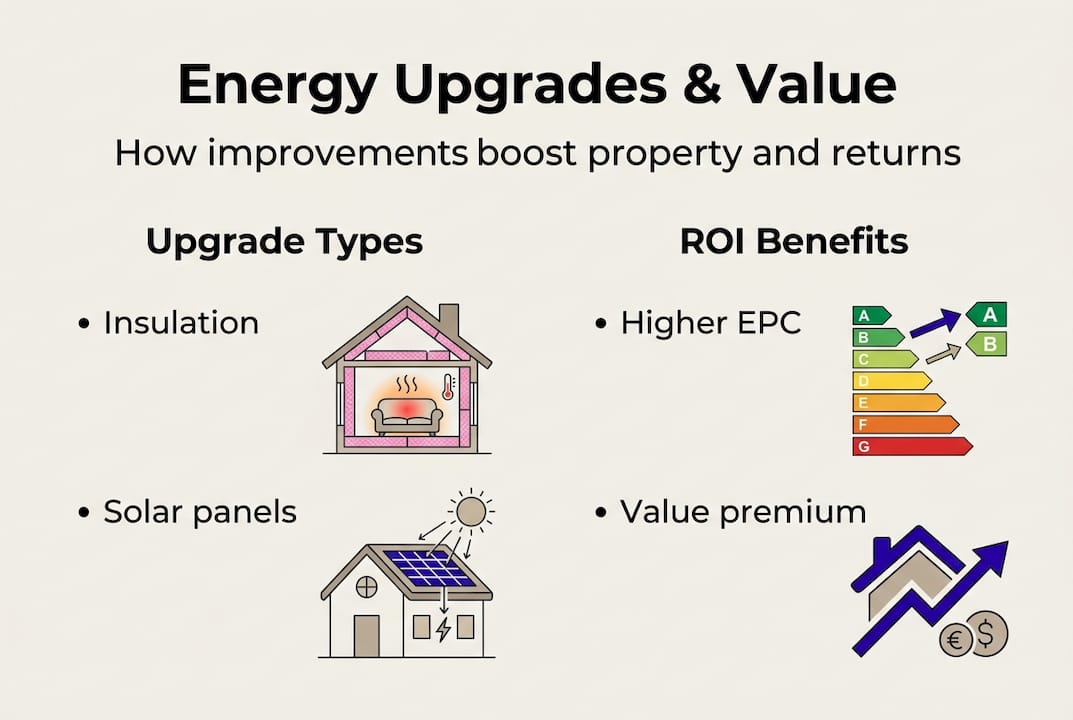
Before spending a single pound on new technology, it pays to understand the order in which upgrades deliver the best results. The fabric-first approach is the most cost-effective strategy, prioritising insulation and draught-proofing before any new heating systems or renewables. This principle exists because even the most efficient heat pump will underperform in a poorly insulated building. Seal the gaps first, then invest in the technology.
Here are the essential upgrades to consider, roughly in order of quickest return:
- Loft and cavity wall insulation: The single biggest lever for EPC improvement
- Draught-proofing doors, windows, and floors: Low cost, high impact on comfort and bills
- LED lighting throughout: Cheap to install, fast payback
- Smart thermostat and heating controls: Reduces waste without major works
- Boiler replacement or heat pump: Higher cost but significant long-term savings
- Solar panels: Best installed after insulation and heating upgrades are complete
Before starting, review your current EPC report. It already lists recommended improvements in priority order, making it a practical starting checklist. You can also explore our energy saving tips and a broader overview of types of energy saving measures to build your full picture.
Pro Tip: Always address insulation and draught-proofing before investing in smart controls or renewables. Doing it the other way around wastes money and limits the EPC band improvement you will achieve.
| Upgrade | Typical cost (£) | Estimated annual saving (£) | Simple payback (years) |
|---|---|---|---|
| Draught-proofing | 100–300 | 60–120 | 1–3 |
| LED bulbs | 50–150 | 40–80 | 1 |
| Loft insulation | 300–600 | 150–300 | 2–4 |
| Cavity wall insulation | 500–1,500 | 150–300 | 3–5 |
| Smart thermostat | 150–300 | 75–150 | 2 |
| New boiler | 2,000–4,000 | 200–400 | 8–12 |
These figures are indicative. Actual savings vary by property size, construction type, and existing efficiency level.
Step-by-step: Implementing high-impact energy saving upgrades
With your groundwork complete, here is a practical sequence to follow for maximum impact and cost-effectiveness.
- Book a professional EPC assessment. Your current EPC report is the starting point. It tells you your band, your score, and the recommended improvements. If your certificate is out of date, get a fresh one before spending anything.
- Tackle loft insulation first. Loft insulation benefits are well established. It frequently boosts EPC rating by one to three bands and saves £300 to £600 per year in a typical home.
- Add cavity wall or solid wall insulation. This is often the second-biggest EPC mover after loft insulation. Costs vary significantly between cavity and solid wall, so get quotes for both where applicable.
- Install draught-proofing. Simple, affordable, and often overlooked. Gaps around windows, doors, and floorboards account for a surprising amount of heat loss.
- Upgrade heating controls. A smart thermostat and thermostatic radiator valves (TRVs) give tenants control and reduce wasted heat. Payback is typically around two years.
- Replace the boiler if needed. A modern condensing boiler is significantly more efficient than older models. If your boiler is over 15 years old, replacement is likely cost-effective.
- Consider renewables last. Solar panels and heat pumps deliver strong returns, but only once the building fabric is solid. Installing them in a poorly insulated property is like filling a leaking bucket.
Caution: Do not invest in solar panels or heat pumps before completing insulation and draught-proofing. The efficiency gains from renewables are significantly reduced in a building that loses heat rapidly. Sequence matters.
Common pitfalls to avoid:
- Skipping the EPC assessment and guessing at priorities
- Choosing the cheapest installer without checking accreditation
- Overlooking ventilation when sealing a property too tightly
- Failing to document upgrades for future EPC reassessment
For a structured overview of how each step affects your rating, our guide on energy rating steps is a useful reference. In terms of investment paybacks, a hot water tank jacket pays back in around six months, LED bulbs in one year, and a smart thermostat in approximately two years.
| Upgrade | Typical EPC band improvement | Approx. ROI period |
|---|---|---|
| Loft insulation | 1–3 bands | 3–4 years |
| Cavity wall insulation | 1–2 bands | 4–6 years |
| Smart thermostat | 0–1 band | 2 years |
| New boiler | 1–2 bands | 8–12 years |
| Solar PV | 1–2 bands | 8–12 years |
| LED bulbs | Minimal band, high saving | 1 year |
Grants, incentives, and funding options for London upgrades
Funding can dramatically reduce the upfront cost of upgrades. London landlords have access to several schemes in 2026, and layering them correctly can mean significant savings.
The main schemes currently available include:
- ECO4 (Energy Company Obligation): Funded by energy suppliers, covering insulation and heating upgrades for lower-income households or properties with low EPC ratings. Eligibility is linked to tenant income or EPC band.
- Great British Insulation Scheme: Targets single insulation measures for properties in EPC bands D to G. A straightforward route for landlords with older stock.
- Warm Homes Local Grant: Provides funding for low-income households, covering insulation, heating, and sometimes solar. London-local support of up to £10,000 in match funding is available through this and Westminster MEES Plus.
- Westminster MEES Plus: A borough-level grant targeting landlords who need to meet MEES requirements, covering a range of measures.
- Boiler Upgrade Scheme: Provides £7,500 towards the cost of an air source heat pump, making this technology genuinely accessible for many London landlords.
- VAT zero-rating: Many energy efficiency measures, including insulation and heat pumps, qualify for 0% VAT, reducing overall project cost.
Eligibility varies by available schemes depending on property EPC band, tenant circumstances, and location. Always check current eligibility before committing to a project sequence.
Pro Tip: Plan your upgrade sequence around grant eligibility windows. Some schemes require a minimum EPC band or specific tenancy type. Doing the insulation work first can qualify your property for heating grants that were previously out of reach.
For a full breakdown of what is available in your area, our guide to London efficiency schemes covers the current landscape in detail. You can also review energy efficiency steps London properties for a practical sequencing guide.
Proving energy performance: EPC impacts and market rewards
Upgrades only deliver their full value when they are documented and reflected in your EPC rating. Here is what the evidence shows about the market rewards on offer.
Research confirms that achieving EPC A or B delivers a 3 to 8% property value premium nationally, rising to as much as 14% in London. Every band improvement is worth roughly 1 to 3% in added value. For a £500,000 London property, moving from band D to band B could add £40,000 to £70,000 to its market value. That is not a marginal gain.

On the rental side, properties rated A to C command a 3 to 5% rental premium over equivalent lower-rated homes. The inverse is also true. Properties with poor EPC ratings increasingly suffer a brown discount, where buyers and tenants discount the asking price to account for expected energy costs and future upgrade liability.
| EPC band achieved | Typical value uplift | Rental premium |
|---|---|---|
| A or B | 3–8% (up to 14% in London) | 3–5% |
| C | 1–3% | 1–3% |
| D (baseline) | None | None |
| E, F, or G | Negative (brown discount) | Lower demand |
To protect and maximise these gains, take the following steps:
- Commission a new EPC after every significant upgrade to capture the band improvement officially
- Keep records of all works carried out, including invoices and installer certificates
- Share your EPC rating in all listings to attract energy-conscious tenants and buyers
- Understand MEES compliance to avoid fines and unlettable property risk
For a full picture of how upgrades translate into market value, our guide on upgrades and property value is worth reading alongside our EPC guide.
What most landlords miss: Value from timing, sequencing, and market signals
Most landlords focus on the fastest payback. That is understandable, but it is not always the smartest approach. The upgrades with the quickest ROI, such as LED bulbs and draught-proofing, rarely shift market perception the way that insulation or a heat pump does. Buyers and tenants respond to EPC band, not itemised receipts.
The landlords who extract the most value from upgrades are those who think in sequences, not individual measures. They identify which combination of works will push their property from band D to band C, then check which grants that unlocks, then time the project to coincide with a lease renewal or planned sale. That is a fundamentally different mindset from simply replacing the boiler when it breaks.
There is also a documentation gap that costs landlords money. Many carry out genuine improvements but fail to get a new EPC issued, so the band on record does not reflect the actual property. The upgrades for value are only realised when the certificate confirms them. Do not leave that step out.
Get expert support: Upgrade your London property with confidence
Navigating upgrades, grants, and compliance requirements is much easier with the right support. At Complete EPC, we work with London landlords every day, helping them understand their current EPC rating, identify the most valuable improvements, and stay ahead of regulatory changes. Whether you need a fresh assessment, guidance on understanding EPCs, or a clear plan for your energy efficiency upgrade services, our qualified assessors are ready to help. Book your assessment today and take the first practical step towards a more efficient, more valuable property.
Frequently asked questions
What energy saving upgrade has the fastest payback for London landlords?
Hot water tank jackets and LED bulbs offer the fastest paybacks, often under a year, with low upfront costs. Payback periods for these measures are typically six months and one year respectively.
How much can an EPC upgrade increase my London property value?
Upgrading to EPC A or B can boost value by 3 to 8% nationally and up to 14% in London, with a further rental premium for properties rated A to C.
What funding is available for London landlords in 2026?
Eligible landlords can access multiple grant schemes including ECO4, the Great British Insulation Scheme, Warm Homes Local Grant, Westminster MEES Plus, and the £7,500 Boiler Upgrade Scheme.
Do I need to upgrade insulation before installing solar panels or heat pumps?
Yes. The fabric-first approach is recommended by experts, as insulation and draught-proofing must be in place before new technology can operate at peak efficiency.
Recommended
- Energy efficiency upgrades: boost property value and compliance
- Essential Energy Rating Improvement Steps for UK Properties
- Energy Efficiency Steps for London Properties Made Simple
- 7 Steps for Better Energy Efficiency in London Properties
- Why upgrade heating systems with heat pumps in 2026 – CoolFix Appliance & HVAC Service