

TL;DR:
- EPC ratings influence property value, marketability, and legal compliance in London.
- Improving EPC ratings can increase property value by up to 14% and attract tenants.
- Staying compliant with MEES regulations and investing in energy upgrades safeguard long-term asset value.
Many landlords and property owners in London treat an EPC certificate as little more than a formality, something to tick off before a sale or letting. That view is costing them money. Your EPC rating directly affects what buyers and tenants will pay, whether you can legally let your property, and how exposed you are to future regulation. With MEES rules tightening and new standards on the horizon, understanding your EPC is one of the most practical steps you can take to protect and grow your property’s value in London.
Table of Contents
- What is an EPC certificate and who needs one?
- How EPC ratings influence property value and marketability
- Understanding EPC regulations, exemptions, and compliance in London
- Boosting your EPC rating: Practical steps and future-proofing
- Why EPC success in London is about much more than compliance
- Get professional help with your EPC certificate today
- Frequently asked questions
Key Takeaways
| Point | Details |
|---|---|
| EPCs are legally required | You cannot market a property in London for sale or rent without a valid EPC certificate, except in rare cases. |
| High EPC rating means more value | Boosting your EPC rating can increase your property’s worth by up to 14% and attract better tenants. |
| Upgrades and evidence are key | Improving insulation and heating, and documenting these upgrades, is the fastest way to higher EPC scores. |
| Exemptions exist for edge cases | Listed and historic buildings may be exempt from EPC requirements, but evidence is essential. |
| Future-proof early | Upgrading now safeguards your property’s value as EPC rules get stricter over the next few years. |
What is an EPC certificate and who needs one?
An EPC, or Energy Performance Certificate, is an official document that rates a property’s energy efficiency on a scale from A (most efficient) to G (least efficient). It also includes estimated energy costs and a list of recommended improvements. The certificate is produced by an accredited assessor following an inspection of the property.
Understanding EPC certificate importance is the first step for any London landlord or owner. The legal requirement is straightforward: you must have a valid EPC before you market a property for sale or rent. This applies to both domestic and commercial buildings. There are some narrow exemptions, particularly for listed buildings where required upgrades might damage the historic fabric, but these must be formally documented and registered.
Who needs an EPC?
- Residential landlords letting any property in London
- Sellers of domestic or commercial buildings
- Estate agents marketing properties on behalf of owners
- Developers completing new builds or conversions
- Commercial property owners renewing or granting leases
The scale of EPC activity in England is significant. 400,000 EPCs were lodged in Q4 2025 alone, with 357,000 of those being domestic certificates. That figure covers roughly 60% of the England housing stock, and MEES enforcement has already reduced the proportion of F and G-rated properties in the private rented sector.
Pro Tip: If you are unsure whether your property qualifies for an exemption, always check with a qualified assessor before assuming one applies. Incorrectly claiming an exemption can lead to fines and complications at the point of sale or letting. It is also worth understanding the EPC vs SAP differences if you are dealing with new builds or conversions, as the assessment methodology differs.
How EPC ratings influence property value and marketability
Your EPC rating is not just a compliance number. It is a market signal that buyers, tenants, and investors read carefully. Properties with higher ratings are genuinely more attractive, and the financial evidence supports this.
Research published on ScienceDirect confirms that A and B rated properties sell and rent at a 1 to 3% premium per band compared to equivalent lower-rated stock. Moving a property from a G rating all the way to an A can increase its value by up to 14%. For a London property worth £500,000, that is a potential uplift of £70,000. The numbers are hard to ignore.
“Improving your EPC rating is one of the few property upgrades that simultaneously reduces running costs, increases value, and strengthens legal compliance.”
Here is a summary of how ratings typically affect value and lettability:
| EPC band | Typical value impact | Lettability under MEES |
|---|---|---|
| A or B | Up to 14% premium over G | Fully compliant |
| C | Moderate premium | Compliant; target standard from 2028 |
| D or E | Neutral to slight discount | Currently compliant |
| F or G | Significant discount | Not legally lettable |
The risks of a low EPC rating go beyond lost value. Here are the key consequences:
- You cannot legally let an F or G-rated property under current MEES rules.
- Tenants increasingly factor energy bills into affordability calculations, reducing demand.
- Mortgage lenders are beginning to price risk based on EPC ratings.
- Low-rated properties face longer void periods and reduced sale prices.
- Future regulatory changes could render currently compliant properties non-compliant overnight.
For a deeper look at how ratings affect London specifically, the London EPC impact guide covers the city’s unique property landscape. Commercial landlords should also review the EPCs for business value resource, which outlines how ratings affect lease terms and asset valuations.
Understanding EPC regulations, exemptions, and compliance in London
The regulatory picture around EPCs has become more detailed in recent years, and London landlords need to stay on top of the rules. The core requirement is simple: a valid EPC must be available before a property is marketed for sale or let. But the compliance obligations go further than that.

Under the Minimum Energy Efficiency Standards, known as MEES, all privately rented properties must currently meet at least band E. The government has confirmed plans to raise this to band C for new tenancies, with all tenancies expected to follow. Preparing now rather than waiting for the deadline is the smarter approach.
Common property types and their EPC obligations:
| Property type | EPC required? | Key exemptions |
|---|---|---|
| Standard residential let | Yes | None in most cases |
| Listed building | Possibly exempt | Only if upgrades harm fabric |
| Commercial lease | Yes | Some short-term lets |
| New build | Yes (SAP-based) | None |
| Holiday let | Depends on use | Check specific rules |
For listed and historic buildings, exemptions may apply where carrying out energy efficiency improvements would unacceptably alter the character of the building. However, this is not automatic. You must apply for the exemption formally and provide supporting evidence. Assuming an exemption exists without documentation is a common and costly mistake.
- Always register exemptions on the official PRS Exemptions Register
- Keep records of assessor reports and any improvement works carried out
- Review your EPC status before renewing or granting new tenancies
Pro Tip: If you own a period property in London, do not assume it is automatically exempt. Review the EPC exemptions in London guidance carefully and seek professional advice before marketing.
Boosting your EPC rating: Practical steps and future-proofing
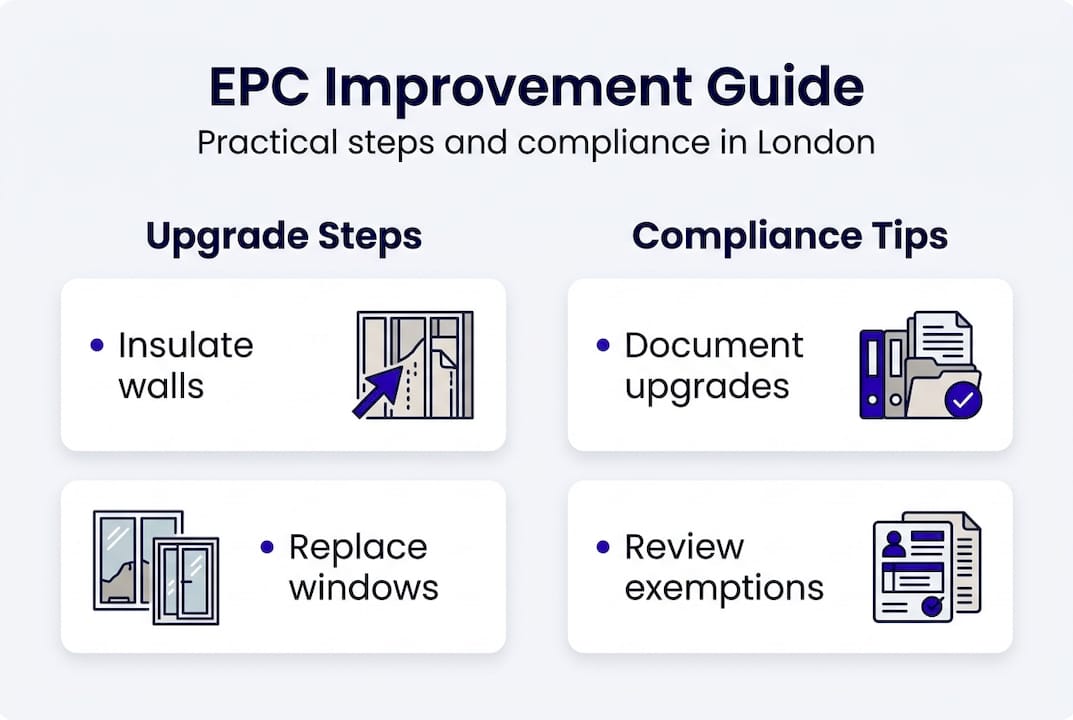
Improving your EPC rating is more straightforward than many owners expect. The key is to prioritise measures that deliver the biggest rating uplift for the investment made, and to document everything properly for your assessor.
Here is a practical sequence of improvements to consider:
- Loft and cavity wall insulation: Often the single most cost-effective improvement, reducing heat loss significantly.
- Upgrade to an efficient boiler or heat pump: Modern condensing boilers and air source heat pumps score highly in RdSAP calculations.
- Install LED lighting throughout: A quick win that assessors can verify easily.
- Add solar photovoltaic panels: Solar PV can push a property from a C to a B or even an A rating.
- Improve draught-proofing and double glazing: Reduces heat loss and improves the overall fabric score.
- Install a smart thermostat or heating controls: Demonstrates efficient management of energy use.
Documentation matters as much as the work itself. Your assessor uses the RdSAP methodology to calculate your rating, and they can only credit improvements they can verify. Keep receipts, installation certificates, and photographs of all works carried out. This is particularly important for energy efficiency upgrades that may not be visually obvious during an inspection.
Looking ahead, the government’s planned Home Energy Model (HEM) is expected to replace RdSAP from 2027 onwards. HEM uses dynamic modelling and is likely to assess properties more rigorously. Properties that meet band C under the current system may not automatically do so under HEM. As Q4 2025 data shows, prioritising insulation and efficient heating now is the most reliable way to stay ahead of tightening standards.
Pro Tip: Review the reasons to improve EPC for landlords and the improvement steps guide before booking your next assessment. Going in prepared means fewer surprises and a better outcome.
Why EPC success in London is about much more than compliance
Most landlords approach EPCs defensively, asking only what the minimum requirement is and how to avoid a fine. That mindset leaves significant value on the table. The London landlords who are genuinely winning in this market treat their EPC rating as a strategic asset, not a regulatory hurdle.
Think about what a band A or B property signals to a prospective tenant: lower bills, a well-maintained home, and a landlord who invests in their portfolio. That perception commands higher rents and attracts more reliable tenants. It also provides a buffer against future rule changes. If the minimum standard rises to band C and then beyond, landlords who have already invested are insulated from the cost and disruption of emergency upgrades.
We believe the most successful approach is to treat EPC improvement as an ongoing investment cycle rather than a one-off cost. Review your rating after every significant upgrade, plan improvements in phases, and stay informed about upcoming regulatory changes. The benefits of improving EPC ratings extend well beyond compliance, touching tenant satisfaction, asset value, and long-term portfolio resilience.
Get professional help with your EPC certificate today
If you have found this guide useful, the next step is to ensure your properties are assessed accurately and efficiently. At Complete EPC, we provide fast, reliable EPC assessments for both domestic and commercial properties across London, carried out by fully accredited assessors with extensive local experience. Whether you need to achieve compliance, plan upgrades, or understand your exemption options, we can help.
Explore our energy performance certificates guide for a thorough overview, or review the EPC assessment steps to understand exactly what to expect on the day. We offer the lowest rates in the UK market and can typically arrange assessments at short notice across all London boroughs.
Frequently asked questions
How long is an EPC certificate valid for in London?
An EPC certificate is valid for 10 years across England and London, unless major renovations are carried out on the property before that period ends.
Can I let or sell my property without an EPC in London?
No. All properties marketed for sale or rent must display a valid EPC before advertising begins, with only narrow exemptions applying in specific circumstances.
What are the penalties for breaching EPC regulations?
Fines can reach up to £5,000 for non-compliance, and MEES enforcement action can also result in landlords being prohibited from letting their properties until standards are met.
How can I improve my EPC score effectively?
Prioritise loft insulation, a modern heating system, and energy-efficient lighting, as insulation and efficient heating consistently deliver the most significant rating improvements for London properties.
Recommended
- EPC Certificates Explained: What London Homeowners Need to Know – Complete EPC
- Understanding EPCs: Your Guide to Energy Performance Certificates in London – Complete EPC
- Understanding the EPC Certificate Process in London – Complete EPC
- Why Every London Home Needs an EPC Certificate: Understanding the Benefits – Complete EPC