

TL;DR:
- An EPC is a legal document measuring a property’s energy efficiency that must be obtained before selling or renting in London. Landlords need an EPC with at least an E rating to comply with MEES, and upcoming reforms will raise this standard to C by 2030. Proper planning and checking exemptions can help property owners meet future regulations efficiently and avoid penalties.
An Energy Performance Certificate (EPC) is an official document that measures a property’s energy efficiency and is a legal requirement before selling or renting any residential or commercial building in London. Under the Energy Performance of Buildings Regulations 2012, you must have a valid EPC before marketing your property for sale or let. For landlords, the Minimum Energy Efficiency Standards (MEES) add a further layer: privately rented properties must achieve at least an E rating or hold a valid registered exemption. Getting the EPC for your property right from the start protects you from fines, supports your transaction timeline, and positions your asset well in an increasingly energy-conscious market.
What are the EPC requirements for homes in London?
The legal obligation to hold a valid energy performance certificate applies to virtually every property transaction in England and Wales. Whether you are selling a Victorian terrace in Islington or letting a new-build flat in Canary Wharf, the rules are the same.
When is an EPC required?
- When selling a residential or commercial property
- When letting a property to new tenants
- When constructing a new building
- When making certain types of significant alterations to an existing building
A certificate remains valid for 10 years from the date of issue. If your property already has a lodged EPC that is less than 10 years old, you can reuse it for a new transaction without commissioning a fresh assessment, provided the property has not changed significantly.
For the private rented sector, MEES compliance is the critical standard. Private rented properties require an EPC rating of E or above, or a valid registered exemption. Landlords who let a property rated F or G without a registered exemption face civil penalties of up to £30,000 per property. Since 2020, landlords have also been required to invest up to £3,500 per property to meet the E minimum standard before claiming a cost-cap exemption.

Pro Tip: Commission your EPC before you instruct an estate agent or letting agent. Getting an EPC after marketing starts may constitute a regulatory breach under the Energy Performance of Buildings Regulations 2012, so treat it as the first step in your transaction workflow, not an afterthought.
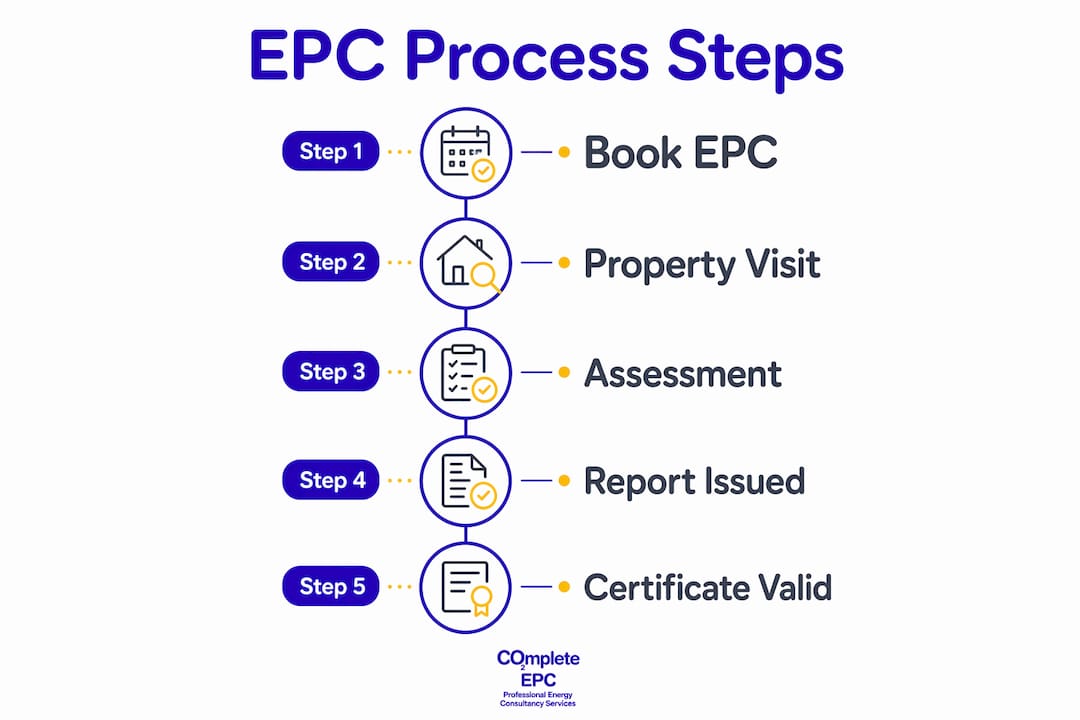
How to get an EPC for your property: the step-by-step process
Obtaining an energy performance certificate is straightforward when you know the correct sequence. Here is the process from start to finish.
- Find a qualified domestic energy assessor (DEA). All assessors must be accredited by a government-approved scheme such as Elmhurst Energy or Stroma Certification. You can search for accredited assessors via the official Energy Performance of Buildings Register or contact a specialist provider such as Completeepc, which covers all London boroughs.
- Book the onsite assessment. The assessor visits your property and inspects key features including wall construction, loft insulation, glazing type, heating system, and hot water provision. A typical domestic assessment takes between 45 minutes and one hour.
- Receive the calculated rating. The assessor enters the collected data into government-approved software, which calculates your Energy Efficiency Rating (EER) and Environmental Impact Rating (EIR) using the Standard Assessment Procedure (SAP) methodology.
- The EPC is lodged on the official register. Once issued, the certificate is uploaded to the Energy Performance of Buildings Register, which recorded 460,000 lodgements in Q1 2026 alone. That volume confirms the register as the definitive record for compliance verification.
- Download and share your certificate. You or your agent can download the certificate directly from the register using the property address or unique reference number.
Typical costs and timeframes
| Service | Typical cost (London) | Turnaround |
|---|---|---|
| Domestic EPC (1-2 bed flat) | £60 to £90 | Same day or next day |
| Domestic EPC (3-4 bed house) | £80 to £120 | Same day or next day |
| Commercial EPC | £200 to £500+ | 2 to 5 working days |
Pro Tip: Always verify that your assessor is currently accredited before booking. Accreditation can lapse, and a certificate issued by an unaccredited assessor will not be accepted on the official register.
Understanding EPC ratings and what they mean for your property
EPCs show energy efficiency on a scale from A (most efficient) to G (least efficient), combining two separate scores into one document. Understanding both scores helps you make informed decisions about improvements and compliance.
EER vs EIR: what is the difference?
| Rating type | What it measures | Scale |
|---|---|---|
| Energy Efficiency Rating (EER) | Estimated annual energy cost to run the property | A (cheapest) to G (most expensive) |
| Environmental Impact Rating (EIR) | Carbon dioxide emissions associated with the property | A (lowest emissions) to G (highest) |
Most compliance obligations, including MEES, reference the EER rather than the EIR. However, both scores appear on the certificate and both matter to prospective buyers and tenants who are increasingly focused on running costs and carbon footprint.
What the bands mean in practice
- Band A (92 to 100): Highly insulated, low-carbon heating. Typical of new-build properties with heat pumps or solar panels.
- Band B (81 to 91): Well-insulated with efficient gas or heat pump systems.
- Band C (69 to 80): The upcoming minimum standard for rented properties by 2030.
- Band D (55 to 68): The UK average for existing housing stock.
- Band E (39 to 54): The current minimum for private rented sector compliance under MEES.
- Bands F and G (below 39): Non-compliant for letting without a valid exemption.
Every EPC also includes a list of recommended improvements, such as loft insulation, cavity wall insulation, or upgrading to a condensing boiler. These recommendations are ranked by cost-effectiveness and show the potential rating your property could achieve after each measure is implemented. For London property owners considering financial planning for improvements, understanding these recommendations before committing to works is a practical first step.
What exemptions apply and how to check the exemption register
Not every property can reach the minimum EPC rating, and the government recognises this. Valid exemptions exist under MEES for specific circumstances, and knowing how to use them correctly is as important as obtaining the certificate itself.
Common valid exemptions include:
- The property cannot be improved to EPC E or above despite all cost-effective measures being installed
- All relevant improvements have been made but the property still falls below E (a “all improvements made” exemption)
- A third party, such as a tenant or planning authority, refuses consent for the required works
- The property is newly acquired and the landlord requires time to arrange improvements (a temporary six-month exemption)
- The works would devalue the property by more than 5% (a devaluation exemption, supported by a surveyor’s report)
Checking the exemption register before marketing or re-letting is a practical compliance shortcut. A valid MEES exemption can be verified via the government exemption register by postcode, landlord name, or exemption type, confirming compliance without the need for a new certificate.
Exemptions are not automatic. You must register them on the government’s PRS Exemptions Register before you let the property. An unregistered exemption offers no legal protection. Checking the EPC exemption register can also confirm whether a previous landlord has already registered an exemption for a property you have recently acquired, which affects your obligations and timelines from day one.
What are the upcoming EPC reforms and how will they affect London property owners?
The EPC regime is not static. The government has confirmed significant reforms that will reshape compliance obligations for London landlords and sellers over the next four years.
The most consequential change is the plan to raise minimum standards to EPC band C by 2030, with a maximum investment cap of £10,000 per property for landlords. This replaces the current £3,500 cap and signals a significant increase in the expected level of investment. For a large portion of London’s older housing stock, rated D or below, this means substantial works will be required within the next few years.
Beyond the rating threshold, the EPC regime is evolving towards multi-metric reports that will separately assess fabric performance, heating system efficiency, and smart readiness. A property could score well on one metric and poorly on another, making the certificate more granular and more useful for identifying specific upgrade priorities.
Key reform points to plan for:
- Minimum EPC band C required for all new tenancies by 2030
- New headline metrics covering fabric, heating, and smart readiness will appear on certificates
- Houses in Multiple Occupation (HMOs) and short-term lets face tighter compliance scope under the reforms
- New EPCs will be required both before and after significant property improvements
- Landlords should treat their current EPC as a compliance document subject to change, not a static record
For London property owners, the practical implication is clear: if your property currently sits at band D or E, the time to plan and budget for improvements is now, not in 2029.
Key takeaways
Obtaining and maintaining a valid EPC is a legal requirement for every London property transaction, and upcoming MEES reforms make proactive compliance planning the most cost-effective approach.
| Point | Details |
|---|---|
| EPC is legally mandatory | You must have a valid certificate before marketing any property for sale or rent in London. |
| Validity lasts 10 years | An existing certificate under 10 years old can be reused, provided the property has not changed significantly. |
| MEES minimum is currently band E | Private rented properties must achieve E or above, or hold a registered exemption, to avoid penalties. |
| Reforms raise the bar to band C | By 2030, all rented properties must reach band C, with a £10,000 investment cap for landlords. |
| Exemptions must be registered | Unregistered exemptions carry no legal protection; always lodge them on the PRS Exemptions Register before letting. |
Why I think most London landlords are leaving themselves exposed
From my experience working with property owners across London, the most common mistake is treating the EPC as a box-ticking exercise rather than a compliance asset. Landlords commission the certificate, file it away, and forget about it for a decade. That approach is increasingly risky.
The reforms moving the minimum standard to band C by 2030 are not a distant concern. For a Victorian terrace in Hackney or a converted flat in Brixton, reaching band C from band D or E typically requires a combination of loft insulation, improved glazing, and a heating system upgrade. Planning and funding those works takes time, and the £10,000 investment cap means you need to prioritise carefully to get the maximum rating improvement per pound spent.
The second mistake I see regularly is ignoring the exemption register as a compliance tool. Many landlords assume they need a new EPC when, in fact, a valid registered exemption already exists for the property. Checking the register takes five minutes and can save the cost and disruption of an unnecessary assessment.
My honest view is that the EPC is one of the most underused planning tools available to London property owners. The improvement recommendations on the certificate are a free, property-specific roadmap to reducing energy bills and increasing letting appeal. Using that roadmap proactively, rather than waiting for a compliance deadline, is the approach that consistently delivers the best outcomes for the owners I work with.
— Danny
Get your EPC sorted with Completeepc
Completeepc provides professional energy performance certificate assessments for domestic and commercial properties across all London boroughs. Whether you need a certificate for a sale, a new tenancy, or to understand your position ahead of the 2030 MEES reforms, the team of qualified assessors delivers accurate results with fast turnaround and transparent pricing. You can read the full EPC assessment process guide to understand exactly what to expect, or explore the complete EPC guide for London for a broader overview of ratings, compliance, and improvement options. Completeepc guarantees the lowest rates in the UK market and offers additional guidance on exemptions and rating improvements.
FAQ
What is an EPC and why do I need one?
An Energy Performance Certificate is an official document that rates a property’s energy efficiency from A to G. It is legally required before you market any property for sale or rent in England and Wales under the Energy Performance of Buildings Regulations 2012.
How long does an EPC last?
A certificate is valid for 10 years from the date of issue. You can reuse an existing certificate for a new transaction within that period, provided the property has not undergone significant changes.
What is the minimum EPC rating for renting out a property?
Private rented properties must currently achieve a minimum of band E under MEES regulations. Letting a property rated F or G without a valid registered exemption can result in a civil penalty of up to £30,000.
How much does an EPC cost in London?
A domestic EPC in London typically costs between £60 and £120 depending on property size. Commercial EPCs start from around £200 and vary based on building complexity and floor area.
What happens if I do not have a valid EPC?
Marketing a property for sale or rent without a valid EPC constitutes a breach of the Energy Performance of Buildings Regulations 2012. Penalties for non-compliance with MEES can reach £30,000, and local authorities are responsible for enforcement.