

TL;DR:
- Most UK commercial buildings fall below EPC Band B, risking penalties and asset value decline.
- Regulations tighten over time, with mandatory EPC Band C by 2027 and Band B by 2030.
- Upgrading involves fabric improvements, energy systems, and strategic planning to meet future standards.
EPC regulations for commercial property: Compliance and value boost
Over 80% of commercial buildings in major UK cities, including London, fall below EPC Band B, and up to 60% may fail future targets without significant upgrades. For commercial property owners and landlords, this is not a distant problem. Upcoming regulatory milestones are fast approaching, and non-compliance could mean losing the legal right to let your property, facing financial penalties, and watching your asset’s value erode. This guide covers everything you need to know: what EPCs are, the current and future regulations, how ratings are assessed, available exemptions, and practical steps to protect your investment.
Table of Contents
- What are EPCs and when are they required?
- Understanding current and future EPC regulations
- How commercial EPCs are assessed and what affects your rating
- Exemptions, penalties and strategic compliance tips
- A practical perspective: Navigating EPC compliance in London’s evolving market
- How Complete EPC can simplify your journey to compliance
- Frequently asked questions
Key Takeaways
| Point | Details |
|---|---|
| Most buildings need upgrades | Over 80% of commercial properties in London risk failing future EPC targets without improvement. |
| EPCs mandatory for most deals | A valid EPC is legally required for new lets, sales, and major modifications to commercial property. |
| MEES standards are increasing | The legal energy efficiency minimum is now Band E, rising to C by 2027 and B by 2030. |
| Exemptions and strategy matter | Smart planning and understanding exemptions can save costs and minimise letting disruption. |
| High EPC equals high value | Boosting your EPC can increase rental income, property value, and reduce running costs. |
What are EPCs and when are they required?
An Energy Performance Certificate, or EPC, is a formal document that rates a building’s energy efficiency on a scale from A+ (most efficient) to G (least efficient). It is a legal requirement in England and Wales, backed by European-derived legislation now embedded in UK law. The certificate gives property owners, tenants, and buyers a standardised view of how energy-efficient a building is, along with recommendations for improvement.
Under current legislation, commercial properties in England require a valid EPC when constructed, sold, let, or when certain building services are installed or significantly modified. A commercial EPC remains valid for 10 years from the date it is issued, after which a new assessment is required.
When is a commercial EPC legally required?
- When a commercial building is newly constructed
- When the property is placed on the market for sale
- When it is advertised for let or a new tenancy begins
- When major building services (heating, ventilation, air conditioning) are installed or replaced
- When a building undergoes significant renovation that affects energy performance
It is worth noting that not every commercial building is automatically covered. Some property types create genuine confusion.
| Property type | EPC required? | Notes |
|---|---|---|
| Office, retail, warehouse | Yes | Standard requirement applies |
| Buildings under 50m² | No | Exempt by size |
| Places of worship | No | Explicitly exempt |
| Temporary structures (<2 years) | No | Exempt by use |
| Listed buildings | Conditional | Only if improvements do not alter character |
| Mixed-use buildings | Yes (commercial part) | Residential and commercial parts assessed separately |
A common source of confusion is fit-out or cat A/cat B refurbishments. If a tenant fits out a bare shell, the landlord’s EPC for the shell may not reflect the fit-out. Similarly, if major building services are replaced as part of a refurbishment, a new EPC is likely required even if the existing one is still within its 10-year life. This is a detail that catches many London landlords off guard.
Pro Tip: If your property has recently undergone a significant mechanical or electrical upgrade, do not assume your existing EPC still reflects the building’s true performance. A reassessment could reveal a much better rating, which is a direct advantage when negotiating with prospective tenants.
Understanding current and future EPC regulations
With the basics understood, the next step is to grasp the regulatory landscape and what is ahead. The rules governing commercial EPCs in England are set out under the Minimum Energy Efficiency Standards (MEES), which have been progressively tightened since their introduction.
Where the rules stand today
Since 1 April 2023, it has been illegal to let or continue letting commercial properties with an EPC rating below Band E. This applies to both new tenancies and existing ones, meaning landlords cannot simply wait for a lease to expire before complying. The rule covers the vast majority of commercial lets in England and Wales, with limited exemptions.
What is coming next
The government has proposed further tightening of these standards:
- Band C by 2027: All commercial properties being let must achieve at minimum an EPC Band C rating.
- Band B by 2030: The target rises again to Band B, representing a dramatic improvement requirement for the majority of London’s commercial stock.
- Ongoing enforcement: Local authorities and the Energy Savings Opportunity Scheme are increasingly active, and enforcement is expected to intensify as deadlines near.
| Year | Minimum EPC band | Applies to |
|---|---|---|
| 2023 (current) | Band E | All commercial lets |
| 2027 (proposed) | Band C | All commercial lets |
| 2030 (proposed) | Band B | All commercial lets |
Important: Proposed timelines may shift slightly as legislation is finalised. However, given the scale of upgrades required across London’s commercial stock, waiting for confirmed dates before acting is a risky strategy.
For those unfamiliar with understanding energy labels and what each band means in practical terms, it is helpful to know that moving from a Band D to a Band B typically involves meaningful investment in fabric and building services, not just minor adjustments.
Consequences of non-compliance
Non-compliance with MEES is not theoretical. Penalties for letting a property in breach of MEES regulations can reach up to £150,000 for commercial properties, depending on the rateable value of the building and the length of the breach. Beyond fines, a non-compliant property cannot legally be let, which means void periods and lost rental income. Lenders are also increasingly scrutinising EPC ratings as part of commercial mortgage underwriting, so a poor rating can affect your ability to refinance.

London’s commercial property market is particularly exposed given the age of its building stock. A significant proportion of London offices, retail units, and light industrial premises date from pre-1980 construction, and many of these carry D or E ratings that will require substantial work to meet even the 2027 target.
How commercial EPCs are assessed and what affects your rating
Knowing the regulations, it is essential to understand how EPCs are assessed and what you can influence. Commercial EPCs are not produced by direct energy metering. Instead, they use a calculation methodology called SBEM, which stands for Simplified Building Energy Model.
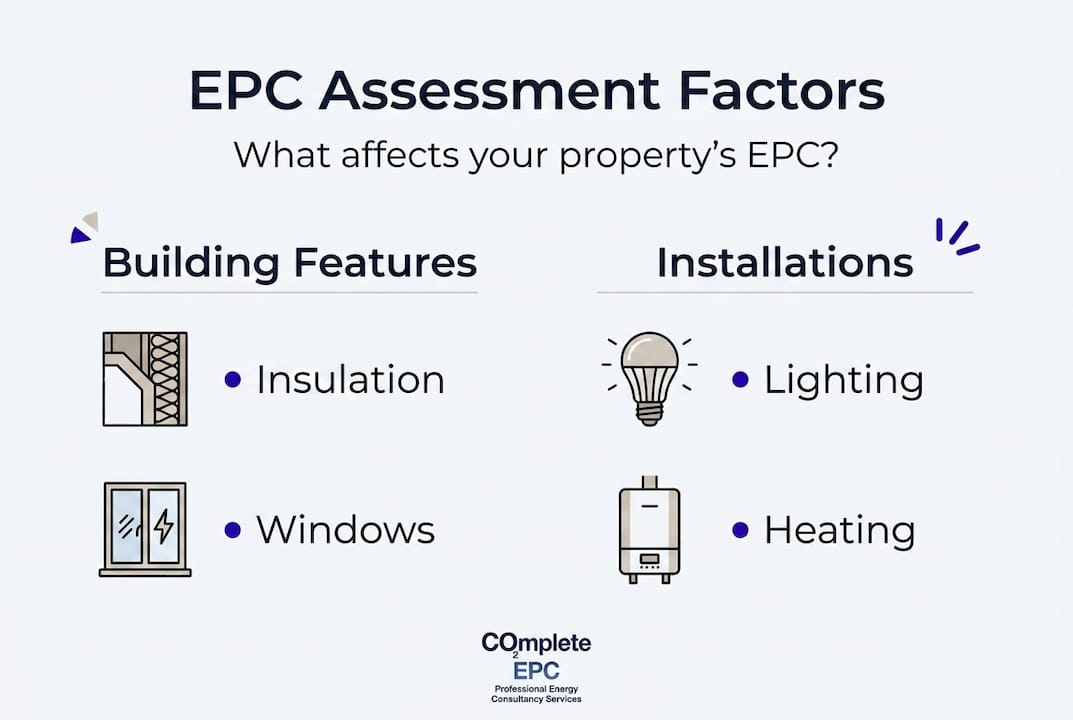
SBEM was developed by the Building Research Establishment and is the standard tool used by qualified Non-Domestic Energy Assessors (NDEAs) across England. The methodology assesses fabric, heating, cooling, ventilation, and lighting to produce a rating from A+ to G, based on modelled energy use and carbon emissions rather than actual consumption. This distinction matters enormously in practice.
What SBEM actually looks at
- Building fabric: Wall, roof, and floor U-values (thermal resistance), window glazing specifications, and air permeability
- Heating systems: Type of boiler or heat source, efficiency ratings, controls, and zoning
- Cooling systems: Air conditioning type, efficiency (EER/COP ratings), and distribution
- Ventilation: Mechanical ventilation systems, heat recovery, and air handling units
- Lighting: Lamp type (LED, fluorescent, or older technologies), lighting power density, and controls such as daylight sensors or occupancy detection
- Renewables: Any on-site solar PV, heat pumps, or combined heat and power (CHP) systems
Because SBEM models energy use rather than measuring it, operational habits do not affect the rating. A building that runs its air conditioning 24 hours a day will receive the same EPC as an identical building with careful energy management, if the installed assets are the same. This is a crucial point: the EPC reflects the asset, not the occupier’s behaviour.
Studies indicate that upgrading commercial lighting to LED can reduce lighting energy demand by 50-70%, often providing one of the most cost-effective routes to improving an EPC rating. Combined with improved heating controls and fabric upgrades, LED retrofits frequently push a property from Band D to Band C or better.
Pro Tip: Before commissioning major works, ask your assessor to run a sensitivity analysis. This shows which specific improvements will produce the greatest rating gain for the lowest investment. Not all upgrades are equal in SBEM terms, and some costly works may deliver surprisingly modest rating improvements.
Upcoming methodology changes
The government and industry bodies are actively reviewing the SBEM methodology. Future updates are expected to give greater credit to low-carbon heat sources such as heat pumps and district heating, as well as on-site renewables. Properties investing in these technologies now may benefit doubly: from improved current ratings and from favourable weighting in future methodology updates.
Exemptions, penalties and strategic compliance tips
To round out your compliance approach, consider available exemptions, risks, and advanced strategies. Not every commercial property owner will be required to make improvements before letting. The MEES regulations include several formal exemption categories, but these must be properly claimed and registered.
Recognised exemption categories
Key exemptions from MEES include situations where buildings are under 50m², used as temporary structures for fewer than two years, classified as places of worship, or categorised as low energy demand industrial buildings. Listed buildings qualify for exemption only where the required energy improvements would unacceptably alter the building’s character or appearance. Cost cap and payback exemptions also apply where:
- The total cost of all relevant improvements exceeds £3,500 including VAT (cost cap exemption)
- No improvement can be made with a payback period of seven years or less
- The works would devalue the property by more than 5% (supported by a surveyor’s report)
- Necessary third-party consents, such as landlord permission for a tenant, cannot be obtained
How to register an exemption
- Confirm which exemption category applies to your property and circumstances.
- Gather the required supporting evidence, such as cost quotes, surveyor valuations, or correspondence regarding consent.
- Register the exemption on the PRS Exemptions Register (the Private Rented Sector Exemptions Register), which is publicly accessible.
- Note the duration: most exemptions last 5 years, after which you must demonstrate the exemption still applies or make the required improvements.
- Keep records of all evidence in case of an enforcement challenge.
Word of caution: Exemptions are not a long-term solution. The cost cap and payback thresholds are subject to review, and future regulations may narrow the available routes to exemption. Treat them as a short-term bridge, not a permanent escape from compliance.
For practical building maintenance tasks that support both energy efficiency and compliance, addressing electrical infrastructure as part of a planned maintenance schedule often creates natural opportunities to introduce efficiency upgrades at lower marginal cost.
Strategic compliance tips for London landlords
- Time upgrades with void periods: Works carried out between tenancies avoid disruption and may be more cost-effective, as access is unrestricted.
- Coordinate with refurbishments: If a tenant is undertaking a fit-out, negotiate energy improvement works into the programme to share costs and reduce duplication of effort.
- Understand the lease: Make sure you know which party is responsible for building services maintenance and replacement. This directly affects who carries compliance obligations.
- Stagger improvements across a portfolio: If you own multiple properties, prioritise those with the weakest ratings and the nearest lease events to manage capital expenditure efficiently.
- Get a pre-assessment before committing to works: A desktop modelling exercise can identify the most impactful improvements before significant expenditure is committed.
A practical perspective: Navigating EPC compliance in London’s evolving market
Most commercial landlords we speak to have a reasonable grasp of the current Band E requirement. Far fewer have genuinely planned for the 2027 and 2030 targets. There is a tendency to treat EPC compliance as a box-ticking exercise, something you deal with when a lease event forces the issue. That approach is understandable, but it is increasingly costly.
The reality is that moving a typical London office or retail unit from Band D to Band B is not a single intervention. It often involves coordinating fabric improvements, full mechanical and electrical replacement, lighting upgrades, and potentially renewable energy systems. For a multi-let building, strategic upgrades during vacancies are strongly recommended to avoid disruption, but coordinating those windows across multiple tenancies requires planning that starts years in advance, not months.
There is also a real commercial upside that often goes undiscussed. Lenders are applying what is known as a “brown discount” to poorly rated commercial assets, meaning financing costs are higher and loan-to-value ratios lower for properties below Band C. Conversely, properties achieving Band B or above are increasingly commanding letting premiums from occupiers with sustainability commitments. Getting ahead of the 2030 target does not just avoid a penalty. It actively improves your asset’s bankability and marketability in London’s competitive commercial property market.
How Complete EPC can simplify your journey to compliance
Acting now can deliver lasting value and peace of mind. For those seeking an experienced partner, Complete EPC offers qualified, London-based commercial EPC assessors who understand both the regulatory requirements and the practical realities of the city’s diverse building stock. Whether you need a full EPC assessment for a new letting, guidance on your improvement options, or support navigating EPC exemptions, our team provides clear, actionable advice at competitive rates. We work with landlords, asset managers, solicitors, and estate agents to ensure compliance is achieved efficiently. Visit Complete EPC to book your assessment or speak with an assessor about your specific property situation.
Frequently asked questions
How long is a commercial EPC valid for in London?
A commercial EPC is valid for 10 years from the date of issue, after which a new assessment must be obtained before the property can be let or sold.
What is the cost cap exemption for EPC upgrades?
The cost cap for upgrades to Band E is £3,500 including VAT; if the total cost of all relevant improvements exceeds this threshold, you may register a cost cap exemption on the PRS Exemptions Register.
Can a tenant be required to improve a building’s EPC?
Landlords are usually responsible for EPC and MEES compliance, but lease terms may transfer some obligations to tenants, so it is essential to review the lease carefully before assuming who bears this responsibility.
Do listed buildings have an automatic exemption from EPC requirements?
No; listed buildings only qualify for exemption if the required energy improvements would unacceptably alter or damage the character or appearance of the protected building.
What percentage of London commercial buildings currently meet EPC B?
Only around 19 to 21% of London’s commercial building stock currently achieves EPC Band A or B, meaning the vast majority face significant upgrade requirements before the 2030 target.