

TL;DR:
- The Future Homes Standard mandates significant energy efficiency upgrades for new homes from March 2027.
- Existing London properties will need to improve EPC ratings to meet 2030 standards, such as EPC C.
- Proactive upgrades like insulation, low-carbon heating, and solar PV will enhance property value and tenant appeal.
Many London landlords and property owners assume the Future Homes Standard (FHS) is a concern only for developers building new homes. That assumption is costly. The FHS introduces significant regulatory shifts for energy efficiency in England, and its knock-on effects will touch every corner of the market, from Victorian terraces to modern flats. If you own or let property in London, understanding what is coming and when will help you plan upgrades, protect your asset’s value, and stay firmly on the right side of the law.
Table of Contents
- What is the Future Homes Standard and why does it matter?
- How will the new standard impact existing properties and rentals?
- Technical requirements: Low-carbon heating, fabric efficiency, and renewables
- Timeline, compliance steps and exemptions: What you need to do next
- Market effects and industry response: Value, risks, and opportunities
- A fresh perspective: Why future-proofing beats mere compliance in London
- Get expert guidance for energy compliance in London
- Frequently asked questions
Key Takeaways
| Point | Details |
|---|---|
| FHS targets lower emissions | The Future Homes Standard will require new homes from 2027 to cut carbon emissions by 75–80 percent versus 2013 standards. |
| Existing homes face EPC changes | Landlords and owners must prepare for rising minimum EPC ratings, with rentals requiring at least a C rating by 2030. |
| London landlords need proactive planning | Staging energy efficiency upgrades with future refurbishments will keep properties compliant, marketable, and valuable. |
| Technical rules drive upgrades | Heat pumps, strong insulation, and solar power are set to become the norm for new homes and recommended for existing ones. |
| Industry impact is broad | Clearer standards boost confidence, but costs and skills remain challenges—early action often pays off in increased property value. |
What is the Future Homes Standard and why does it matter?
The Future Homes Standard is a major update to Building Regulations Part L, which governs the energy efficiency of new homes in England. Its central aim is to drastically cut carbon emissions from housing by requiring low-carbon heating systems, improved building fabric, and on-site renewable energy generation. New homes built under the standard must be genuinely low-carbon from day one, not just modestly better than before.
New homes from March 2027 must target 75 to 80% lower carbon emissions compared to 2013 standards. That is a transformational shift, not an incremental tweak.
“The Future Homes Standard represents the most ambitious update to building energy regulations England has seen in over a decade, setting a clear trajectory for the entire property market.”
Here is a quick summary of the key facts:
| Feature | Detail |
|---|---|
| Regulation updated | Building Regulations Part L |
| Who it directly affects | New dwellings only |
| Emission reduction target | 75 to 80% lower than 2013 standards |
| Effective date | 24 March 2027 |
| Transition period | 12 months |
The standard directly applies only to new builds. However, FHS influences EPC standards for all dwellings, raising the bar for what tenants, buyers, and lenders consider acceptable energy performance across the board. As new homes reach EPC A and B ratings as standard, older stock at EPC D or below will look increasingly unattractive to tenants and investors.
Key aims of the FHS include:
- Mandating low-carbon heating systems such as heat pumps or connection to heat networks
- Requiring high levels of insulation and airtightness (known as fabric efficiency)
- Making on-site renewable energy, typically solar photovoltaic (PV) panels, a baseline expectation
- Reducing reliance on gas-fired boilers in new residential construction
For London landlords and owners, the message is clear. Even if your property is not new, the market around you is changing. Future-proofing your portfolio now is far smarter than scrambling to catch up later.
How will the new standard impact existing properties and rentals?
The FHS does not legally require you to retrofit your existing Victorian terrace or 1990s flat. But the market and regulators are moving in one direction, and existing properties face growing pressure from two sides.
First, FHS sets higher expectations that influence rental requirements and refurbishment expectations across the whole sector. Tenants renting new-build homes will increasingly expect efficient heating and low energy bills as standard. Older properties that cannot compete risk longer void periods and downward pressure on rents.
Second, and more immediately, rising EPC standards mean landlords may need upgrades by 2030 to remain legally compliant. The government is pushing all rental properties in England to achieve a minimum EPC rating of C by 2030. Currently, many London rentals sit at D or below.
| EPC rating | Current minimum for lets | 2030 requirement |
|---|---|---|
| A or B | Compliant | Compliant |
| C | Compliant | Compliant |
| D | Currently permitted | Non-compliant |
| E | Currently permitted (min) | Non-compliant |
| F or G | Illegal to let | Illegal to let |
Pro Tip: If your property is currently rated D or E, do not wait until 2029 to act. Upgrade costs are lower when planned ahead, and you may qualify for government grant schemes that reduce your outlay significantly.
Practical steps to move towards compliance:
- Obtain an up-to-date EPC to know your starting point
- Review the EPC’s improvement recommendations section
- Prioritise loft and wall insulation, as these deliver the greatest rating gains
- Explore low-carbon heating options, including heat pump eligibility for your property type
- Consider solar PV if roof access and orientation allow
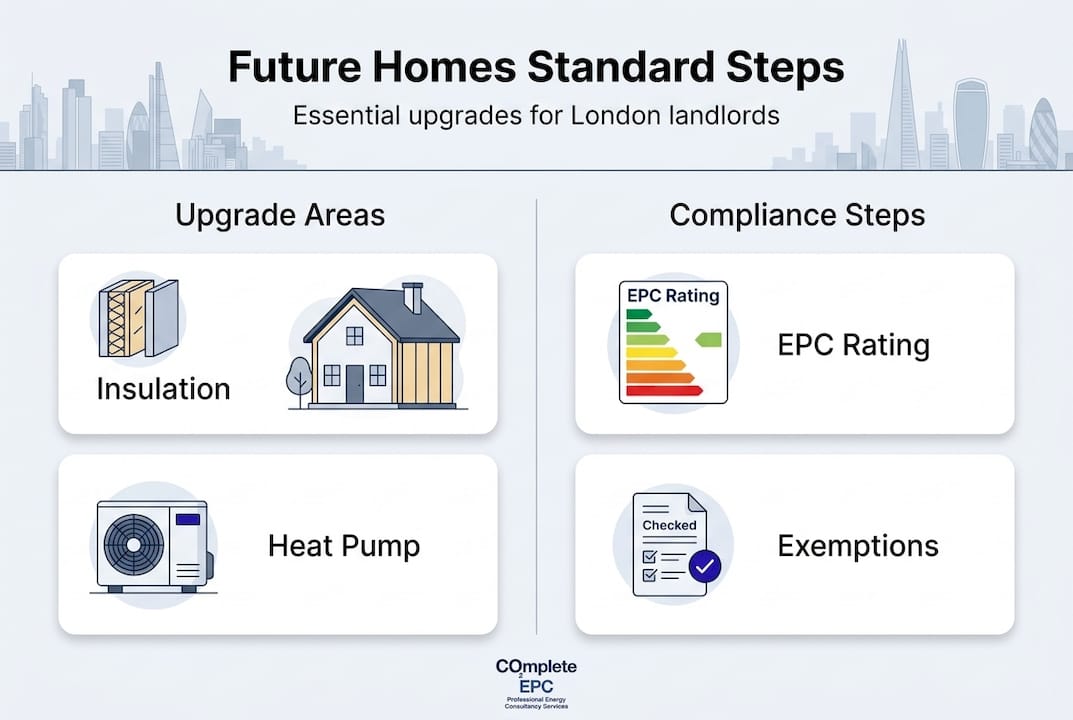
Exemptions do exist. If the cost of reaching EPC C would exceed £10,000, or if you cannot obtain consent from a freeholder or planning authority, you may register an exemption. However, these exemptions require documented evidence and do not exempt you indefinitely.
Technical requirements: Low-carbon heating, fabric efficiency, and renewables
For new builds, the FHS sets clear technical benchmarks. Understanding these helps you see where the market is heading and what upgrades make the most sense for your existing property.
FHS requires low-carbon heating, mandatory on-site renewables, and strict fabric standards. Here is what each of those means in practice:
| Technical area | FHS requirement |
|---|---|
| Heating system | Heat pump or heat network connection |
| On-site renewables | Solar PV panels (expected as standard) |
| Wall insulation (U-value) | Significantly better than current Part L |
| Glazing | Triple or high-performance double glazing |
| Airtightness | Tight build quality with mechanical ventilation |
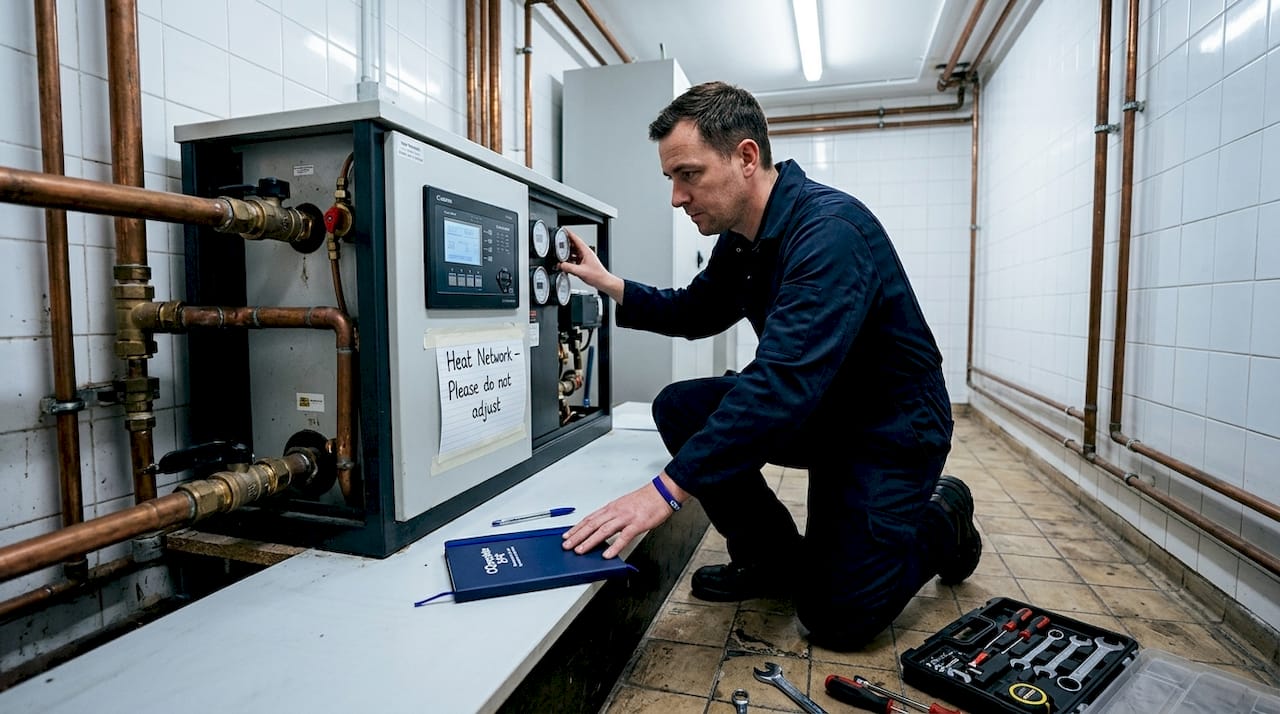
For London in particular, heat networks are a practical alternative to heat pumps in dense urban settings. Many central and inner London developments already connect to or plan to connect to district heat networks, which deliver low-carbon heat at scale without needing individual heat pump units in each flat.
For existing properties and extensions, the 2021 Part L rules already tightened glazing and insulation standards. If you are planning a refurbishment or extension, meeting or exceeding those standards now means less disruption and cost later.
Key fabric efficiency upgrades worth prioritising:
- Loft insulation to 270 mm depth or above
- Solid wall insulation (internal or external) for pre-1920 stock
- Floor insulation where suspended timber floors allow
- Air source heat pumps where outdoor space permits installation
- Solar PV to offset electricity consumption and improve EPC scores
Pro Tip: Even if your property is not covered by FHS directly, installing a heat pump and solar PV now puts you ahead of potential future retrofit obligations and can unlock better mortgage rates from green lenders.
Fabric improvements tend to offer the best value for EPC rating gains in older London stock. A well-insulated home retains heat more efficiently, reducing heating demand and making low-carbon systems perform better overall.
Timeline, compliance steps and exemptions: What you need to do next
FHS comes into force 24 March 2027, with a 12-month transition period. Existing rental properties face the EPC C requirement by 2030, and social housing must meet the Decent Homes Standard by 2035. These dates may feel distant, but the planning, procurement, and installation timeline for major upgrades means starting now is genuinely necessary.
Compliance checklist for London landlords and property owners:
- Get a current EPC if yours is more than two years old. Older certificates may not reflect recent improvements or updated methodology.
- Identify your EPC rating gap. If you are at D, you need targeted upgrades. If at E or below, action is urgent.
- Commission a retrofit assessment from a qualified assessor to identify the most cost-effective upgrade path.
- Stage improvements with planned refurbishments to reduce disruption and cost. Combining a boiler replacement with insulation upgrades, for example, saves on installation costs.
- Apply for available grants, including the Boiler Upgrade Scheme for heat pumps and local authority flexible eligibility schemes.
- Register exemptions where applicable, ensuring you hold the required documentation and evidence.
A key statistic to keep in mind: properties rated EPC C or above already command measurably higher rents and sale prices in London compared to those rated D or below. The financial case for upgrading is not just about compliance.
Certain exemptions exist, including cost caps and consent issues, which will shape your compliance strategy. If you own a leasehold property where the freeholder controls communal areas, gaining consent for external wall insulation or roof works can be complex. Document every attempt carefully.
Staging improvements with refurbishments is widely recommended. Trying to do everything at once is expensive and disruptive. A phased approach, aligned with natural refurbishment cycles, is smarter and more manageable for most landlords.
Market effects and industry response: Value, risks, and opportunities
The FHS has generated strong reactions across the property industry. On balance, the clarity it brings is welcome, even if the costs and challenges are significant.
“Industry has hailed the Future Homes Standard for providing long-awaited certainty, but warns that cost pressures, skills shortages, and the transition to a new Home Energy Model (HEM) could disproportionately impact SME builders and landlords.”
Key market effects to be aware of:
- Property values: Homes with EPC A or B ratings are increasingly attracting premium prices and stronger buyer interest across London.
- Mortgage access: Green mortgage products from major lenders offer lower rates for energy-efficient properties, giving compliant landlords a financing advantage.
- Insurance terms: Some insurers are beginning to factor energy efficiency into risk assessments, particularly for older, poorly insulated stock.
- Void periods: Tenants are more aware of energy costs following recent energy price spikes, making efficient homes more attractive and faster to let.
- Performance gap risk: A persistent concern in the industry is that properties built or upgraded to the letter of the standard may not perform as expected in real-world conditions. This can affect EPC ratings on reassessment.
For smaller landlords and SMEs, the cost and skills challenges are real. Qualified heat pump installers and retrofit assessors are in high demand across London. Booking reputable contractors early reduces both cost and scheduling risk.
The opportunity here is substantial. Landlords who move proactively will find themselves with more lettable, more financeable, and more valuable properties as the standards tighten around them.
A fresh perspective: Why future-proofing beats mere compliance in London
Most guidance focuses on hitting the legal minimum. Achieve EPC C by 2030, register an exemption if needed, and move on. That approach works, but it misses a more important point.
London’s property market rewards quality and efficiency. Landlords who treat the FHS and EPC C as a ceiling rather than a floor will find themselves back in the same position in five years when the next round of regulations arrives. And they will come.
The landlords we see performing best in London are those who treat energy upgrades as genuine property improvements, not regulatory boxes to tick. A well-insulated flat with a heat pump and solar PV does not just satisfy an assessor. It attracts better tenants, reduces maintenance call-outs, commands higher rent, and qualifies for greener financing.
In London’s high-density context, heat networks and communal energy solutions offer an especially compelling route. If your building is eligible, connecting to a heat network can deliver compliance and operational savings in one move, often with lower disruption than individual retrofits.
Build beyond EPC C. Aim for B. Your future self and your future tenants will both thank you.
Get expert guidance for energy compliance in London
Navigating the Future Homes Standard and upcoming EPC requirements is far simpler with the right support. At Complete EPC, we help London landlords and property owners understand exactly where they stand and what to do next. Our qualified assessors provide accurate, detailed EPC assessments that identify your compliance gap and the most cost-effective route to closing it. If you are new to the process, our guide to understanding EPCs explains everything clearly. For those ready to act, our resources on improving your EPC rating set out practical upgrade options tailored to London properties. Stay ahead of regulatory changes and protect your investment with expert guidance you can rely on.
Frequently asked questions
Does the Future Homes Standard affect existing properties in London?
The Future Homes Standard applies directly only to new builds, but existing homes face EPC C requirements for rentals by 2030 and growing market expectations that push all properties towards higher energy performance.
What upgrades can help landlords meet new EPC requirements ahead of 2030?
Improved insulation, heat pumps, and solar PV are the most effective upgrades. Rising EPC standards by 2030 mean these improvements also strengthen lettability, financing options, and overall property value.
Are there any exemptions from the new energy efficiency requirements for London landlords?
Yes, exemptions covering cost caps of £10,000 or consent issues from freeholders are available, but you must provide documented evidence when registering an exemption with the relevant authority.
When does the Future Homes Standard come into force?
FHS takes effect from 24 March 2027, with a 12-month transitional period during which some projects already in progress may complete under existing rules.
Do properties in London have any unique Future Homes Standard requirements?
No unique FHS rules apply specifically to London, but dense urban settings favour heat network connections over individual heat pumps, which is a practical consideration for many London landlords and developers.