

Deciding which Energy Performance Certificate provider to trust can leave many London landlords and property owners feeling uncertain. With government regulations making EPC compliance a clear legal responsibility, getting an accurate certificate is about more than just ticking a box. This guide reveals how gathering key property details and understanding your obligations leads to fair quotes, real cost savings, and reliable service from reputable London assessors.
Table of Contents
- Step 1: Gather Details Of Your Property And EPC Needs
- Step 2: Identify Reputable EPC Providers In London
- Step 3: Request And Review Tailored EPC Quote Offers
- Step 4: Compare Service Inclusions And Pricing Structures
- Step 5: Verify Assessor Qualifications And Customer Feedback
- Step 6: Confirm Compliance And Schedule Your EPC Assessment
Quick Summary
| Key Insight | Explanation |
|---|---|
| 1. Gather Comprehensive Property Details | Collect information about property type, age, size, and systems beforehand for accurate EPC quotes. |
| 2. Identify Reputable EPC Assessors | Research accredited assessors in London; check reviews and experience to ensure quality assessments. |
| 3. Request Detailed Quotes | Provide specific property details to assessors to compare quotes effectively and transparently. |
| 4. Compare Services and Pricing | Evaluate what each quote includes, such as additional recommendations, speeding options, and revision policies. |
| 5. Verify Qualifications and Feedback | Confirm the assessor’s credentials and check customer reviews to ensure reliability and accuracy of the assessment. |
Step 1: Gather details of your property and EPC needs
Before you start requesting quotes from EPC assessors, you need to collect essential information about your property. This groundwork saves time and helps you compare quotes accurately. When assessors have complete details, they can provide more precise pricing and realistic timelines, which means you avoid surprises later.
Start by documenting your property type. Is it a flat, terraced house, detached home, or semi-detached property? Note the age of the building, the number of bedrooms, and the total floor area. You’ll also need to identify your property’s heating system, insulation type, and whether you have double glazing or renewable energy sources like solar panels. If you’re unsure about any technical specifications, that’s fine, as the assessor will evaluate these during the inspection. However, knowing what you can tell them upfront helps them scope their work. Government guidance on energy performance certificates explains that property owners must understand when an EPC is necessary, typically during sales or lettings, and that EPCs provide essential details like energy performance ratings and improvement recommendations.
Next, clarify why you need the EPC. Are you selling your property, letting it to tenants, or seeking it voluntarily to identify energy efficiency improvements? Your reason matters because it affects urgency and may influence which recommendations matter most to you. Also consider whether you need the EPC urgently or have flexibility with timing, as some assessors offer faster turnarounds for slightly higher fees. Having property energy assessment steps for compliance in mind helps you understand what to expect during the process. Finally, gather any previous EPC reports if your property has been assessed before, as this provides baseline data and helps you track improvements over time.
Pro tip: Create a simple one-page document listing your property details, reason for the EPC, and preferred assessment dates, then share this with each assessor when requesting quotes. This consistency ensures you’re comparing genuinely comparable quotes rather than different service levels or scopes.
Here is a summary of key property details to prepare before requesting an EPC quote:
| Property Detail | Example Value | Why It Matters |
|---|---|---|
| Property Type | Semi-detached house | Affects assessment approach |
| Building Age | Built in 1975 | Influences insulation standards |
| No. of Bedrooms | Three | Impacts inspection time |
| Floor Area (m²) | 110 | Needed for accurate quotation |
| Heating System | Gas central heating | Affects energy rating |
| Insulation Type | Loft and wall insulation | Influences energy efficiency |
| Glazing | Double glazed windows | Improves performance rating |
| Renewable Sources | Solar panels installed | Potentially higher EPC score |
| Previous EPC Report | Yes (from 2020) | Enables progress tracking |
Step 2: Identify reputable EPC providers in London
Finding a trustworthy EPC assessor makes all the difference between a smooth process and a frustrating one. Not all providers offer the same quality, speed, or value. By taking time to identify reputable assessors upfront, you’ll feel confident that your assessment is thorough and your quote is fair.
Start by searching for accredited EPC assessors in your London area. Look for professionals registered with recognised schemes like NHER, SBEM, or CIBSE. You can verify their credentials through the scheme they’re registered with, and most legitimate assessors display this information prominently on their websites. Check online reviews on Google, Trustpilot, and industry forums to see what previous clients say about their experience. Pay attention to comments about professionalism, punctuality, and how well the assessor explained the findings. When you find candidates, ask about their experience with properties similar to yours. An assessor familiar with Victorian terraces in Islington, for example, will work faster and more accurately than someone who specialises primarily in new builds. Understanding how to choose an EPC assessor for London properties helps you ask the right questions and identify which provider genuinely fits your needs.

Don’t just pick the cheapest option. The lowest price often signals rushed work or cut corners, which can result in inaccurate energy ratings or missing improvement opportunities. Instead, compare a few providers and assess their responsiveness, willingness to answer questions, and transparency about their process. Request quotes from at least three assessors so you can see pricing variations and service levels. A reputable provider will respond promptly to enquiries, provide clear information about what’s included, and offer realistic timelines. They should also explain their qualification and experience without being defensive. By the time you’re ready to request formal quotes, you’ll have narrowed your field to assessors you genuinely trust.
Pro tip: Ask each potential assessor for references from recent London clients in your postcode area. A reputable provider will readily provide these, and speaking directly to previous customers gives you honest insight into their reliability and quality.
Step 3: Request and review tailored EPC quote offers
With a shortlist of reputable assessors, you’re ready to request formal quotes. The way you approach this stage significantly affects the quality and comparability of the quotes you receive. Clear communication upfront means each assessor understands your exact requirements, allowing you to compare apples with apples rather than different service levels.
Contact your chosen assessors and provide the property details you gathered in Step 1. Explain your specific situation, your timeline, and any particular concerns. For instance, if you’re selling and need the EPC urgently, say so. If you’re a landlord with multiple properties, mention this too, as assessors sometimes offer volume discounts. Request a written quote that itemises the service, including the assessment fee, report production time, and any optional extras like follow-up consultations or energy improvement recommendations. Ask whether the quote includes VAT and whether there are any additional charges if the property is larger or more complex than anticipated. A detailed quote prevents surprises when you receive the invoice. When reviewing quotes, look beyond the headline price. Some assessors offer faster turnarounds, others provide more detailed improvement recommendations, and some include post-assessment support. Comparing top EPC companies in London can help you understand the range of services and pricing currently available in your market.
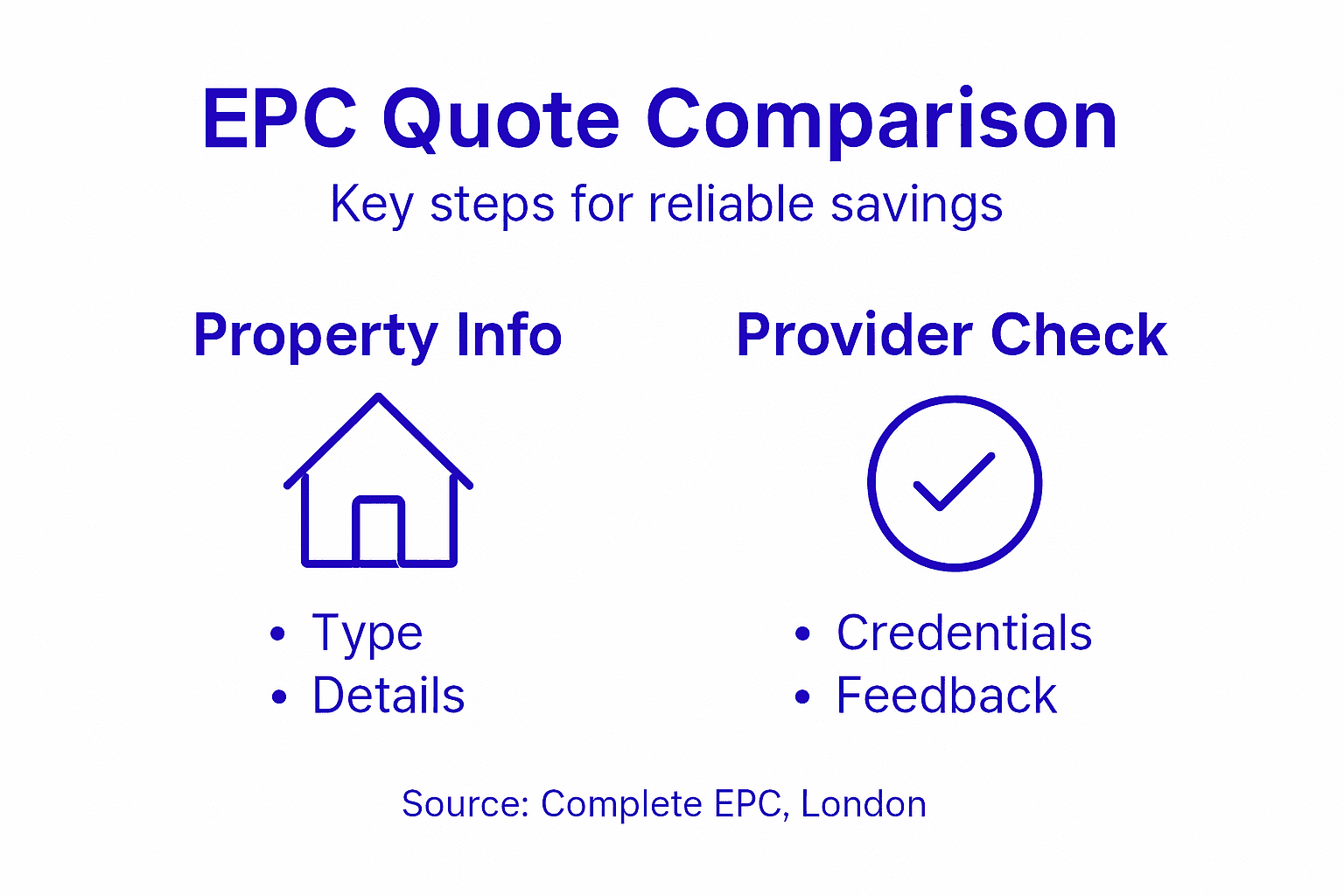
Once you’ve received quotes, create a simple comparison table. List each provider’s name, quoted price, estimated assessment date, how long the report takes to produce, and any standout inclusions or limitations. Pay particular attention to whether the assessor mentions their accreditation, their experience with your property type, and whether they offer any guarantees about accuracy or report amendments. A slightly higher quote from an experienced, responsive assessor is often better value than the cheapest option. Trust your instinct about which provider feels most professional and transparent in their communication.
Pro tip: Request each quote via email rather than phone, so you have written documentation to compare. Ask each assessor to clearly state what happens if you want amendments to the report and whether there are revision fees, as policies vary significantly.
Step 4: Compare service inclusions and pricing structures
Now that you have multiple quotes in hand, the real comparison work begins. Price alone tells only part of the story. Two assessors might quote different amounts because they’re offering genuinely different services, or because one is simply more efficient. Understanding what each quote includes helps you make a decision based on true value rather than just the headline figure.
Start by examining what’s included in each quoted price. Base assessments typically cover the physical inspection, data collection, and generation of the standard EPC report. However, some assessors include extras as standard whilst others charge separately. Look for whether the quote covers detailed improvement recommendations, advice on renewable energy options, or assistance with understanding the findings. Some providers offer follow-up support if you have questions after receiving the report, whilst others finish once the document is delivered. Check whether the price includes any revisions if you notice errors or want clarifications added. A provider offering unlimited amendments within 30 days adds genuine value, whereas one charging per revision could become expensive if discrepancies arise. Examining EPC costs in London and what you should expect provides context about typical pricing ranges and helps you identify whether quotes fall within reasonable market parameters.
Next, assess turnaround times and availability. If you’re selling and need the EPC quickly, a provider offering next-day assessment and same-week reports is worth paying more for. Conversely, if you have flexibility, a slower provider at lower cost makes sense. Consider whether the assessor can accommodate your preferred inspection dates or if they operate only during business hours. Look at payment terms too. Some demand full payment upfront, others accept payment after the assessment, and some offer invoicing arrangements. Calculate the total cost of ownership, not just the assessment fee. Factor in travel time to your property, any potential charges for complex buildings, and whether you’ll need additional services. When you’ve reviewed all quotes thoroughly, you’ll recognise which provider genuinely offers the best value for your specific situation rather than simply the lowest price.
This table compares typical EPC assessor service inclusions:
| Service Element | Commonly Included | Sometimes Extra Cost | Relevant Consideration |
|---|---|---|---|
| Physical Inspection | Yes | Rarely charged separately | Essential for report |
| Improvement Advice | Basic suggestions | Detailed recommendations | Adds long-term value |
| Report Turnaround Time | 3-5 days standard | Next-day available | Useful for urgent needs |
| Revision Policy | One free amendment | Charges for extra revisions | Important in complex cases |
| Post-assessment Support | Minimal (email FAQ) | Extended phone consultation | Helps with clarifications |
Pro tip: Create a weighted scoring system where price counts for perhaps 40 per cent, experience and accreditation for 30 per cent, turnaround time for 20 per cent, and customer reviews for 10 per cent. This helps you make a more objective decision rather than being swayed by a single factor.
Step 5: Verify assessor qualifications and customer feedback
Before making your final decision, invest time in verifying that your chosen assessor has genuine credentials and a track record of satisfied clients. This step protects you from unqualified practitioners and ensures your EPC assessment will be accurate and credible. Credentials matter because they determine whether your report will be accepted by estate agents, mortgage lenders, and local authorities.
Start by confirming the assessor’s accreditation scheme membership. Legitimate EPC assessors must register with an accreditation scheme approved by the UK Government. The main schemes include NHER, SBEM, and CIBSE. Visit the scheme’s website directly and search the register using the assessor’s name or registration number. This independent verification takes only a few minutes but provides absolute certainty they’re registered. Check whether their registration is current and whether there are any disciplinary notes or complaints flagged against them. Most schemes provide this information publicly. Additionally, ask the assessor for copies of their professional qualifications and insurance certificates. Professional indemnity insurance protects you if the assessment is later found to be inaccurate. Understanding the importance of hiring a qualified EPC assessor helps you recognise why these credentials genuinely matter for protecting your interests.
Next, check customer feedback across multiple platforms. Read reviews on Google, Trustpilot, and industry forums, but also contact references the assessor provides directly. Look for patterns in feedback rather than focusing on individual comments. Consistently positive reviews about professionalism, punctuality, and accuracy suggest reliability. Conversely, repeated complaints about missed appointments, inaccurate findings, or poor communication are red flags. Pay attention to reviews mentioning properties similar to yours, as they’re most relevant to your situation. Ask specifically about whether customers felt the assessor explained the findings clearly and whether they were willing to discuss recommendations. A good assessor communicates throughout the process, not just at the end. Finally, trust your own interactions with the assessor before booking. Did they respond promptly to your initial enquiry? Were they willing to answer questions about their approach? Did they listen to your specific needs? These behaviours often predict how they’ll conduct your assessment.
Pro tip: Request permission to contact two recent clients with similar property types in your London area. Speaking directly to people who’ve recently used the assessor provides honest insight that written reviews sometimes miss.
Step 6: Confirm compliance and schedule your EPC assessment
You’ve completed your research and selected your assessor. Now it’s time to formalise the booking and ensure everything is in place for a smooth assessment. This final step requires attention to detail so your EPC is valid, compliant, and delivered when you need it.
Before confirming your booking, double-check that your chosen assessor understands your specific compliance requirements. If you’re selling, your EPC must be in place before you market the property publicly. If you’re letting, it must be available to prospective tenants from the moment you advertise. The assessor should be clear about these legal requirements. According to UK Government guidance, property owners have specific legal responsibilities when marketing properties for sale or rent, and scheduling your assessment well in advance ensures you meet these obligations without rushing. Ask the assessor whether they can complete the assessment and deliver the report within your required timeframe. If you need it urgently, confirm they can prioritise your booking. Discuss any access requirements for your property, such as whether they need to visit during working hours, if there are parking restrictions nearby, or if they’ll need keys collected in advance. Providing this information upfront prevents last-minute complications.
Confirm the payment terms and method in writing. Clarify whether the assessor requires a deposit to secure the booking, when full payment is due, and what payment methods they accept. Ask for written confirmation of the appointment date, time, and any documentation you should prepare beforehand. Some assessors request utility bills or recent mortgage statements to help verify property details. Finally, set clear expectations about the report delivery timeline. Will you receive the report on the assessment day, within 24 hours, or within a week? Understanding the EPC assessment process step by step helps you know what to expect during the assessment itself. Once you’ve confirmed all these details and received written confirmation from your assessor, your booking is complete and you’re ready for the assessment.
Pro tip: Request a confirmation email from the assessor summarising the appointment date, time, location, cost, payment terms, and expected report delivery date. This written record protects both parties and eliminates any misunderstandings closer to the assessment date.
Make Confident EPC Decisions with Complete EPC
Comparing quotes for Energy Performance Certificates can be overwhelming when you face unclear pricing, varying services, and uncertain assessor qualifications. This article highlights the challenges of getting transparent, comparable EPC quotes while ensuring you select a qualified assessor who delivers accurate energy ratings and meaningful recommendations. If you want to avoid the pitfalls of rushed, low-quality assessments and ensure your property complies with legal requirements without overpaying, it is crucial to work with a trusted provider.
At Complete EPC, we simplify your EPC journey by offering clear, competitive pricing combined with expert assessors dedicated to London properties. Our service includes detailed reports, improvement advice, and efficient turnaround times so you can confidently meet compliance deadlines. Discover how to compare top EPC companies in London or learn more about choosing the right EPC assessor for London properties with our insightful guides. Take the next step today and secure your accurate, affordable EPC assessment by visiting Complete EPC now.
Frequently Asked Questions
How can I ensure I am comparing EPC quotes accurately?
To compare EPC quotes accurately, gather detailed information about your property, including its type, age, heating system, and insulation. Create a one-page document listing these details and share it with each assessor when requesting quotes to ensure you receive comparable offers.
What should I include when requesting EPC quotes from assessors?
When requesting EPC quotes, include your property’s details, your reason for needing the EPC, and any specific requirements or timelines. Clearly communicate your urgency, whether you’re selling, renting, or seeking energy efficiency improvements, as this helps assessors tailor their quotes accordingly.
How do I evaluate the value of different EPC services beyond just the price?
Evaluate the value of different EPC services by examining what’s included in each quote, such as assessment fee, report detail, and turnaround time. Create a comparison table highlighting these elements for each assessor to identify which offers the best overall value rather than solely the lowest price.
What factors should I consider when reviewing customer feedback on EPC assessors?
When reviewing customer feedback, consider the consistency of comments regarding professionalism, punctuality, and the clarity of findings communicated by assessors. Look for patterns in reviews rather than isolated incidents, as these factors will give you a better understanding of the assessors’ reliability.
How can I verify the qualifications of the EPC assessor I choose?
Verify the qualifications of your chosen EPC assessor by checking their registration with an accredited scheme. Contact the scheme directly to confirm their credentials and to ensure there are no complaints or disciplinary actions against them.
What steps should I take to finalise my EPC assessment booking?
To finalise your EPC assessment booking, confirm the assessor’s understanding of compliance requirements and your specific timelines. Ensure you receive written confirmation of the appointment details, payment terms, and expected report delivery to avoid misunderstandings.