
You can decrease your energy bill in three ways: use less energy, pay less for each unit you do use, and make the building itself waste less heat. Start with the free habits, check your tariff and meter readings, then use your home’s energy performance certificate (EPC) to decide which improvements are worth paying for. This guide takes you through each stage in that order, with figures from UK sources and the checks we run on London homes and commercial buildings.
TL;DR
- Start with free changes: switch off standby, wash colder with full loads, avoid the tumble dryer and cut shower time.
- Take regular meter readings and check your tariff, because estimated bills and an out-of-contract rate quietly cost money.
- Stop heat escaping: draught-proof windows and doors, insulate the hot water cylinder, and close curtains at night.
- Your EPC lists recommended improvements and the savings they could bring, so use it to rank any spending.
- Landlords and businesses should treat the EPC as a planning tool as well as a legal document.
Table of Contents
- Where your energy bill actually goes
- Quick wins that cost nothing
- Get the heating right
- Know your usage and check your tariff
- Invest to save: improvements that pay back
- Use your EPC to decide what to do first
- For landlords and businesses
- Our perspective
- Get an EPC that works for you
- A simple 12-month plan
- Common mistakes to avoid
- FAQ
- Sources
Where your energy bill actually goes
Before changing anything, it helps to know what you are paying for. A bill has two parts: the unit rate for each kilowatt hour (kWh) of gas or electricity, and a daily standing charge. You can influence the first part by using less energy and by choosing a better tariff. The standing charge is fixed per day, so your own usage cannot shrink it.
In most UK homes, heating and hot water are the biggest uses of energy. Lighting, appliances and cooking make up the rest. That is why the biggest long-term savings usually come from keeping heat in the building, while the quickest short-term savings come from how you use appliances and hot water.
There is a useful distinction here. Energy efficiency means the equipment or building performs better, for example an LED bulb or loft insulation. Energy conservation means you change what you do, for example turning the thermostat down or switching a device off. The U.S. Energy Information Administration draws the same line, and both lower bills. The best results come from doing both.
Quick wins that cost nothing
These changes need no builder, no loan and no waiting. Most take a few minutes to adopt, and together they add up over a year.
Switch off standby and unplug what you do not use
Chargers, printers, games consoles and set-top boxes keep drawing power when they are idle. The Energy Saving Trust lists switching appliances off standby among its everyday tips. A multi-socket extension with a switch makes it easy: one flick turns off the TV, console and box together.
Wash colder and fuller
Heating water is the costly part of a wash. Which? reports that washing clothes at 30ºC instead of 40ºC cuts laundry costs by 38%, based on its tests. Run the machine with a full load, and run the dishwasher only when it is full too.
Avoid the tumble dryer
Drying clothes is one of the most expensive habits in a home. Which? says washer dryers cost over £216 a year on average, and that condenser tumble dryers add at least £115 a year in electricity. The Energy Saving Trust says line drying, or using racks indoors, can save around £50 a year in Great Britain. In a small London flat, a heated airer is still cheaper than a tumble dryer, but keep a window ajar or run a dehumidifier so damp does not build up.
Spend less time in the shower, and swap baths for showers
Hot water is heated with gas or electricity, so every minute counts. A shorter shower and a tap aerator on the kitchen tap reduce how much hot water you use. Boil only the water you need in the kettle.
Turn off lights, and swap old bulbs
It is obvious advice, but it works. For bulbs still in use, Ofgem cites the Energy Saving Trust figure that replacing old bulbs with LEDs can save up to £4 per bulb per year. In a house with 15 or 20 fittings, that is worth doing as soon as the old bulbs fail.
Look after the fridge and freezer
Fridges and freezers run all day, so small habits matter. Which? advises defrosting freezers that are not frost-free, letting food cool before putting it in, and cleaning the coils and vent at the back of the fridge so it runs efficiently. A freezer that is in use but nearly empty works harder than a full one, so keep it reasonably stocked. Which? also notes that American-style fridge freezers are among the more costly appliances to run.
Quick-win checklist
| Habit | Why it saves | Effort |
|---|---|---|
| Switch off standby | Idle devices still draw power | Minutes |
| Wash at 30ºC, full loads | Less water to heat, fewer cycles | None |
| Line dry or use a rack | Avoids a high-use appliance | Low |
| Shorter showers | Less hot water to heat | Low |
| LED bulbs | Lower wattage for the same light | Low cost |
| Clean fridge coils, defrost freezer | Appliance runs efficiently | 15 minutes |
Get the heating right
Heating is where most households can save the most, and a lot can be done without replacing the boiler.
Turn the flow temperature down
If you have a combi boiler, its flow temperature setting is often higher than it needs to be. The Clean Energy homepage guidance that appears in search results suggests reducing a combi boiler flow temperature to 60C as one of three tips worth around £100 a year. Your boiler manual or a Gas Safe registered engineer can show you how to change it safely. Do not adjust settings you are unsure about.
Use controls so you heat only when needed
Ofgem advises using smart heating controls that run heating and hot water only when needed. A programmable thermostat, thermostatic radiator valves in rooms you rarely use, and a timer matched to your real routine all do the same job. Turning the thermostat down by a degree or two and wearing an extra layer is the cheapest form of control there is.
Keep the heat in
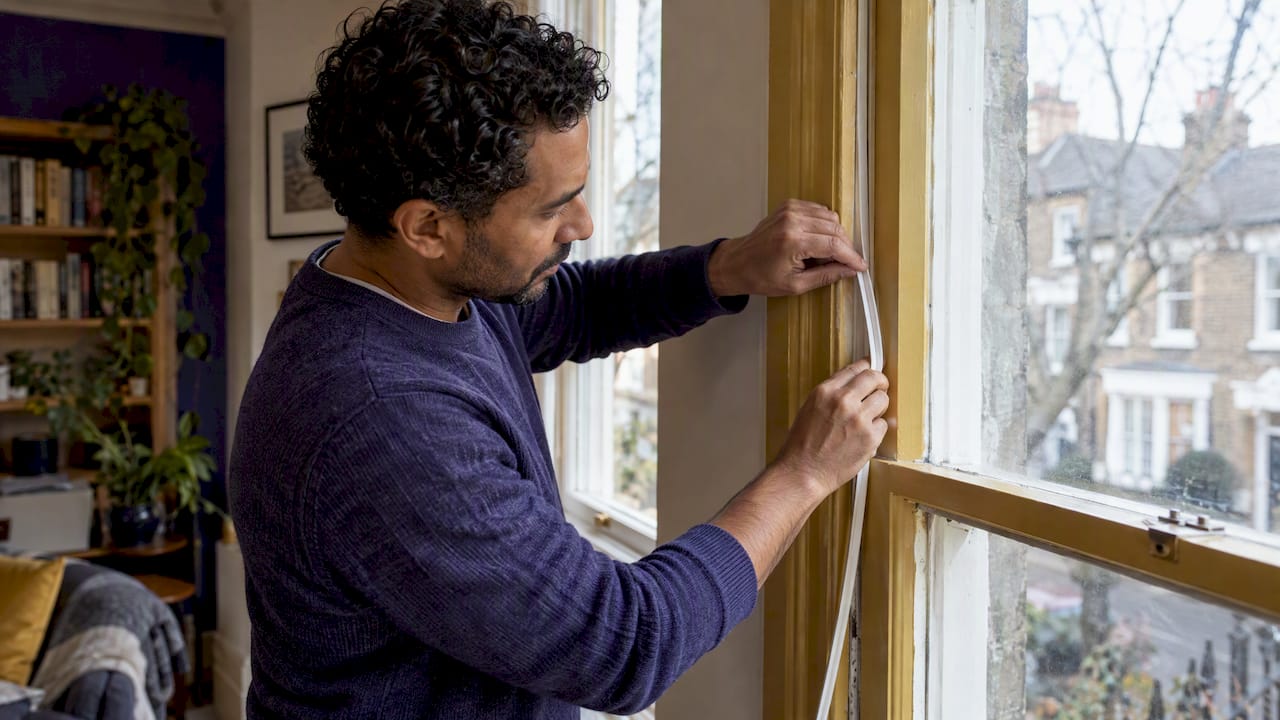
Ofgem recommends closing curtains at night, blocking gaps around windows and doors, and insulating your hot water tank. These measures are cheap and well within a DIY job:
- Fit draught excluders to external doors and letterboxes.
- Seal gaps around window frames with strip or sealant.
- Close curtains at dusk to hold heat in the room.
- Top up the hot water cylinder jacket so it is thick enough to matter.
- Keep radiators clear of furniture so heat can circulate.
Older London housing stock, such as Victorian terraces with suspended timber floors and sash windows, tends to lose heat through gaps. Draught-proofing is often the best-value job in those homes, but leave deliberate ventilation such as extractor fans and trickle vents alone, as rooms still need to breathe.
If your home has warm air ducts or ventilation ducts in lofts or voids, the ducts can leak too. A guide to sealing internal air ducts explains how confined-space work on ducting is approached by specialists, which is worth knowing before you attempt anything in a tight loft or void yourself.
Know your usage and check your tariff
Saving energy is only half the picture. You also want to pay a fair price for the energy you use.
Read your meter regularly
Which? says regular meter readings keep payments accurate and prevent estimated bills. If you pay by direct debit, a low estimate can lead to a large catch-up payment, and an over-estimate means you are lending your supplier money. Take a photo of the meter on the same day each month.
Consider a smart meter
Ofgem notes that a smart meter shows how much energy you are using and can help you use it more efficiently. Seeing a live figure makes it obvious how much the kettle, oven or electric shower draws, and that tends to change habits faster than any tip list.
Check your tariff
Which? says a fixed tariff may protect you from predicted future price increases, and that paying by direct debit is usually cheaper and gives the biggest choice of fixed deals. If you are on a standard variable tariff, compare what is on offer at least once a year. The price cap limits the unit rates and standing charge on variable tariffs, but it does not limit your total bill, so how much you use still decides what you pay. Ofgem’s advice for households is a good place to start, including help you may be entitled to if you are struggling to pay.
Time-of-use tariffs
Some suppliers offer rates that are cheaper at off-peak times. The EIA notes that some utilities use time-of-use rates to encourage shifting electricity use to off-peak periods. If you can run the washing machine or charge an electric vehicle overnight, ask your supplier whether such a tariff is available at your address. It is not suitable for everyone, so look at your actual usage pattern before signing up.
Invest to save: improvements that pay back
Once the free changes are in, consider spending money where it will bring the most return. Ofgem points to insulation and double-glazed windows as ways to reduce heat loss, and also suggests looking for government energy grants. The Energy Saving Trust acknowledges that some improvements need investment, but says there are ways to keep bills down.
Typical measures, from lowest cost to highest:
- Draught-proofing and hot water cylinder insulation
- Loft insulation and, where the structure allows, wall insulation
- Upgraded heating controls
- Double or secondary glazing
- Heating system upgrades
- Solar panels, where the roof allows
The order matters. Cutting heat loss first means any new boiler or heat pump can be smaller and run less. Spending on a new system in a leaky building often disappoints.
Payback is the question that matters. Consumer Reports, a US publication, described one homeowner who spent under $100 weather-stripping windows and about $2,000 on attic insulation and broke even in about 30 months. That is a US example, and UK costs and savings differ, but it shows the pattern: cheap sealing pays back fast and larger works take longer. Get at least two quotes and ask each installer how they calculated the saving.
Use your EPC to decide what to do first
This is the step many people skip. Ofgem says your home’s EPC shows how energy efficient it is, what you can do to make it more efficient, and how much money this could save. It is effectively a ranked shopping list, and it was written for your property rather than for an average home.
An EPC rates a building from A (most efficient) to G (least efficient) and lists recommended measures with estimated costs and savings. Read it for three things:
- The current rating. It shows where you stand against the rest of the housing stock.
- The recommendations. They are ordered, so tackle the cheap, high-impact ones first.
- The estimated saving. Treat it as a guide, since your real saving depends on how you live and on energy prices.
If your EPC is old, or you have made improvements since it was issued, a new assessment may show a better rating and give you an updated list. Our guide to EPC renewal walks through the steps. The EPC is also what a buyer or tenant will look at, so improvements that lower your bills can also support the value and lettability of the property.
For landlords and businesses
Landlords pay for improvements but tenants pay the bills, so it is tempting to leave it. It is worth resisting that. A better-rated property is easier to let, and minimum energy efficiency standards (MEES) already set a floor for rented homes and commercial lets in England and Wales. Check the current rules on the government’s website before you plan works, because the requirements and deadlines have been under review. Our guide for London landlords on EPC and EICR covers how the two certificates fit together.
For businesses, bills are shaped by heating, lighting, ventilation and air conditioning. Poorly maintained air conditioning is a common source of waste. Offices and shops should look at their commercial EPC recommendations, and where air conditioning is installed, an inspection can show whether the system is running as it should. For new commercial buildings, SBEM calculations set out the predicted energy performance at design stage.
Our perspective
We assess homes and commercial properties across London, and the same pattern turns up again and again. People buy the visible upgrade, such as a new boiler or a smart gadget, while the building keeps losing heat through gaps, bare lofts and unlagged cylinders. The cheapest savings are almost always in the fabric of the building, and an assessment is the quickest way to find them.
We also see the EPC treated as a form to file for a sale or a let. That wastes it. The recommendations page is the most useful part, because it is specific to the property, ranked, and written without any product to sell. If you read it before you spend anything, you will usually avoid at least one expensive mistake.
Our advice is simple. Do the free habits this week. Fix draughts and insulate the cylinder this month. Then get a current EPC, pick the top two recommendations, and get quotes. Do not chase every measure at once, and do not trust any saving figure, ours included, without checking it against your own meter readings.
— Danny
Get an EPC that works for you
If you own, let or manage property in London, we can provide a domestic EPC with a clear list of recommended improvements, or a commercial EPC for offices, shops and other premises. We also deal with SAP calculations for new builds, conversions and extensions, as well as related compliance work. Visit Complete EPC to get started.
A simple 12-month plan
Saving energy is easier when it is broken into stages. Here is a plan that fits most households.
Week one: Take a meter reading and photograph it. Switch off standby on the TV and computer. Wash at 30ºC with full loads. Swap any failed bulbs for LEDs.
Month one: Draught-proof doors and windows, insulate the hot water cylinder, and set your heating timer to match your routine. Check the flow temperature on your boiler, using your manual or a qualified engineer.
Months two to three: Compare your tariff and decide whether a fixed deal suits you. Ask your supplier about a smart meter. Check whether you qualify for any grants through Ofgem’s guidance.
Months three to six: Get a current EPC if yours is old. Rank the recommendations by cost and saving. Get quotes for the top two.
Months six to twelve: Complete the first improvements, compare your meter readings with the same months last year, and decide what comes next.
The comparison with last year is the most honest test. Weather changes from year to year, so compare winter against winter, and look at kWh used rather than only pounds spent, since prices move too.
Common mistakes to avoid
- Heating one room with a plug-in heater while the whole house is heated. Close doors and use thermostatic valves instead.
- Blocking ventilation. Draught-proofing should never seal up extractor fans or the vents that gas appliances need.
- Leaving a boiler on constant hot. Controls and timers exist for a reason.
- Buying before measuring. Without meter readings you cannot tell whether a measure worked.
- Ignoring safety. Gas, electrical and loft work should be done by qualified people.
FAQ
How can I reduce the amount of electricity I use?
Start with standby devices, lighting and laundry. Switch off appliances you are not using, replace old bulbs with LEDs, wash at 30ºC and avoid the tumble dryer where you can. A smart meter shows which appliances use the most, so you can target them first.
How much energy does a freezer use?
It depends on the size, age and type. Which? says American-style fridge freezers add at least £115 a year in electricity costs. You can help any freezer run efficiently by defrosting it if it is not frost-free, letting food cool before freezing it and keeping the coils and vents clean.
What is the quickest way to lower my heating bill?
Stop heat escaping and heat only when needed. Close curtains at night, block gaps around windows and doors, insulate your hot water tank and use timers or smart controls. These steps cost little compared with replacing a boiler or windows.
Will switching supplier cut my bill?
It can, but it will not shrink the amount of energy you use. Which? says paying by direct debit is usually cheaper and gives the biggest choice of fixed deals. Compare tariffs once a year and keep meter readings up to date so you are billed accurately.
How does an EPC help me save money?
Ofgem says your EPC shows how efficient your home is, what you can do to improve it and how much that could save. Use the recommendations to rank improvements by cost and benefit before you spend.