

Neglecting your EPC or EICR obligations is one of the most expensive mistakes a London landlord can make. Fines can reach £30,000, and letting restrictions can leave your property sitting empty for months. Yet 21% of landlords are unaware that missing an EICR certificate alone can trigger a financial penalty. This guide cuts through the confusion and gives you a clear, practical breakdown of what each certificate covers, when you legally need them, what they cost, and how to stay fully compliant in the London property market.
Table of Contents
- What are EPC and EICR certificates?
- When are EPC and EICR certificates legally required?
- Who is exempt? EPC and EICR exceptions in London
- How EPC and EICR are assessed: what to expect during inspections
- Costs, timeframes, and potential upgrades
- Common pitfalls and how to avoid them
- Get expert help with London EPC and EICR compliance
- Frequently asked questions
Key Takeaways
| Point | Details |
|---|---|
| Both certificates required | Nearly all London landlords must have both EPC and EICR certificates to let or manage property legally. |
| Serious penalties for non-compliance | Fines up to £30,000 apply for missing EICRs or failing remedial actions, so regular checks are essential. |
| Plan for upgrades and costs | EPC and EICR can highlight costly but valuable upgrades that boost safety, compliance, and property value. |
| Document and share certificates | Always share certificates with tenants and keep organised digital copies as proof of compliance. |
What are EPC and EICR certificates?
Both certificates are legal requirements for most landlords in England, but they cover very different aspects of your property.
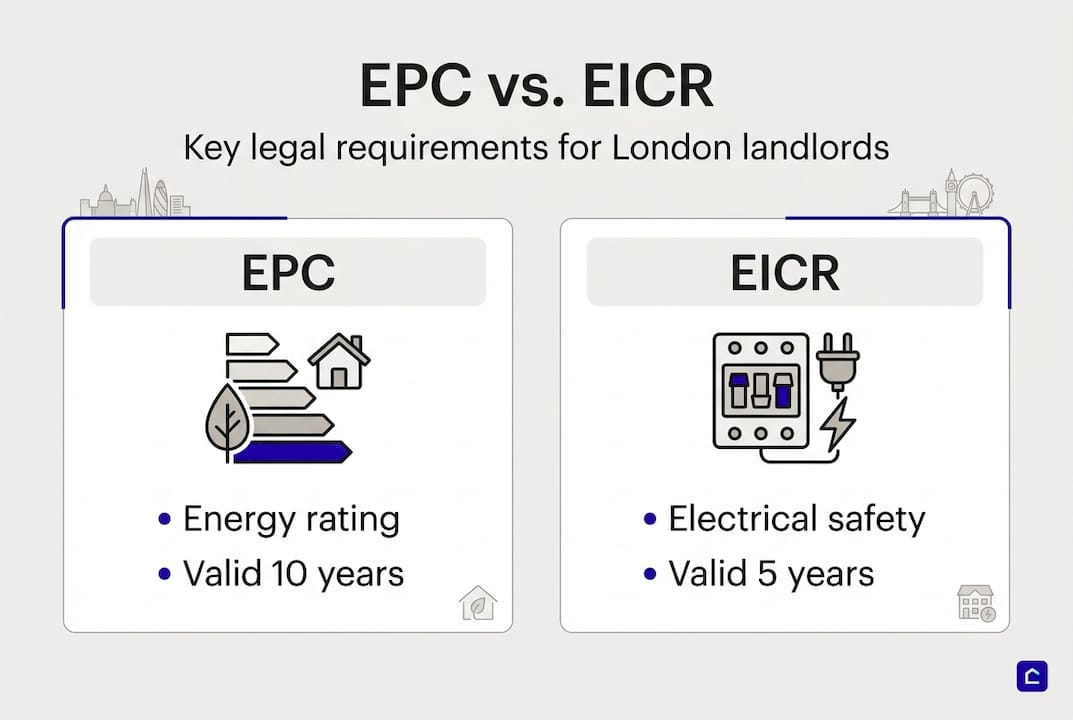
An Energy Performance Certificate (EPC) rates your property’s energy efficiency on a scale from A (most efficient) to G (least efficient). It evaluates insulation, heating systems, glazing, lighting, and renewables using RdSAP software. The result tells tenants and buyers how much the property costs to run and what improvements could reduce those costs.
An Electrical Installation Condition Report (EICR) focuses entirely on safety. It checks all fixed electrical installations against BS 7671 standards and assigns codes to any issues found. C1 means danger present and requires immediate action. C2 means a potentially dangerous fault requiring urgent remedial work. C3 is an improvement recommendation with no immediate safety risk.
| Feature | EPC | EICR |
|---|---|---|
| What it covers | Energy efficiency | Electrical safety |
| Valid for | 10 years | 5 years |
| Rating system | A to G | C1, C2, C3, satisfactory/unsatisfactory |
| Required for | Letting, selling, compliance | Letting, tenancy renewal |
| Carried out by | Accredited energy assessor | Qualified electrician |
You need an EPC when you let or sell a property. You need an EICR to confirm your electrical installations are safe for tenants. Both are non-negotiable for most London landlords. If you own commercial property, commercial EPC certificates follow slightly different rules, and EPC certificates for rentals have their own specific requirements worth reviewing.
Why you need each certificate:
- To legally market and let a residential or commercial property
- To demonstrate energy efficiency compliance to prospective tenants
- To confirm electrical safety before a tenancy begins or continues
- To avoid financial penalties and letting restrictions
- To protect tenants and limit your liability as a landlord
When are EPC and EICR certificates legally required?
Knowing what each certificate is only gets you so far. The law is specific about when you must have them in place.
| Situation | EPC required? | EICR required? |
|---|---|---|
| New tenancy (residential) | Yes, before marketing | Yes, before tenancy starts |
| Tenancy renewal | Only if expired | Yes, if over 5 years old |
| Property sale | Yes | No (but advisable) |
| HMO (House in Multiple Occupation) | Yes | Yes, every 5 years |
| Commercial let | Yes | Yes |
| New build (with valid EIC) | Yes | No, for 5 years |
The minimum EPC standard for a lettable property is a rating of E or above, unless a valid exemption is registered. Properties rated F or G cannot legally be let without an exemption in place.

For EICRs, the legal requirement is clear: obtain one every five years or at the start of each new tenancy, whichever comes first. You must provide a copy to your tenants within 28 days of the inspection, and any C1 or C2 issues must be resolved within 28 days of the report. Failure to comply can result in fines of up to £30,000.
Step-by-step: what to do when letting a property
- Book an accredited EPC assessor and an EICR-qualified electrician before marketing
- Obtain both certificates and review the results carefully
- Share copies with prospective and confirmed tenants in writing
- Address any C1 or C2 electrical faults within 28 days
- Register an EPC exemption if your property qualifies and cannot meet the E rating
- Renew each certificate before it expires and repeat the process
Pro Tip: Always send certificates to tenants by email and keep a read receipt or delivery confirmation. If a dispute arises, written proof that you shared the documents protects you legally.
For a full breakdown of your obligations, the EPC rules for landlords and EPC requirements for London properties pages are worth bookmarking.
Who is exempt? EPC and EICR exceptions in London
Exemptions exist, but they are narrower than many landlords assume. Claiming an exemption incorrectly is itself a compliance risk.
EPC exemptions include:
- Listed buildings, where energy efficiency improvements would unacceptably alter the character or appearance
- Properties with a total floor area of less than 50 square metres
- Buildings scheduled for demolition with relevant planning permission
- Holiday lets that are not rented out for more than four months per year
- Temporary structures intended for use of less than two years
Importantly, EPC exemptions must be formally registered on the PRS Exemptions Register and are valid for five years. You cannot simply decide your property is exempt without registering it.
Many listed buildings are exempt from EPC requirements only where making the required improvements would alter their character or appearance. This is not a blanket exemption for all listed properties, and each case must be assessed individually.
For EICRs, the situation is more straightforward. There is essentially no exemption for landlords, with one narrow exception: new builds or properties that have undergone a complete rewire come with an Electrical Installation Certificate (EIC) that is valid for five years. Once that period ends, a full EICR is required.
Pro Tip: Never assume your property qualifies for an exemption based on age, type, or size alone. Regulations change, and an incorrect assumption can result in a fine. Always verify your position against the current rules before letting or beginning renovation work. The EPC rating E guidance page provides up-to-date detail on minimum standards.
How EPC and EICR are assessed: what to expect during inspections
Many landlords feel uncertain about what actually happens during an assessment. Knowing the process removes that uncertainty and helps you prepare.
EPC assessment process:
- Book an accredited domestic or commercial energy assessor
- The assessor visits the property and inspects insulation, heating systems, windows, lighting, and any renewable energy installations
- Data is entered into RdSAP software, which calculates the energy rating
- The assessor produces a report with the current rating and recommended improvements
- The certificate is lodged on the national EPC register and sent to you, usually within 24 to 48 hours
A typical EPC inspection takes between 45 minutes and two hours, depending on property size and complexity.
EICR assessment process:
- Book a qualified electrician registered with a recognised body such as NICEIC or NAPIT
- The electrician inspects all fixed wiring, consumer units, sockets, switches, and earthing arrangements
- Each element is tested and assigned a code: C1 (danger present), C2 (potentially dangerous), or C3 (improvement recommended)
- A satisfactory or unsatisfactory outcome is recorded in the report
- You receive the completed EICR, which you must share with tenants within 28 days
For guidance on booking your assessment, the how to apply for an EPC in London page walks you through the process, and the EPC compliance checklist helps you confirm you have covered every step.
Costs, timeframes, and potential upgrades
Budgeting accurately for compliance avoids surprises and helps you plan improvements strategically.
Typical costs:
- EPC for a standard residential property: £60 to £120
- EPC for a larger or commercial property: £150 to £400 or more
- EICR for a one-bedroom flat: £100 to £200
- EICR for a larger property or HMO: £200 to £500 or more
- Remedial electrical work following a failed EICR: variable, from £100 for minor fixes to several thousand for rewiring
Prices vary based on property size, age, location within London, and the complexity of the installation or building fabric.
Timeframes:
- EPC results: typically within 24 to 48 hours of inspection
- EICR results: same day or within 48 hours
- EPC validity: 10 years
- EICR validity: 5 years (or sooner if required)
If your EPC rating is below E, you will need to invest in improvements before you can legally let the property. Upgrading to a C rating can cost between £5,000 and £25,000 depending on the work required, but a better rating increases your property’s value and makes it more attractive to tenants. It is also worth noting that 60% of commercial property owners now face tighter energy regulations, making early investment in upgrades a sound financial decision.
Pro Tip: Some energy efficiency improvements qualify for tax relief or government-backed funding schemes. Speak to your accountant and check current grant availability before commissioning work. Explore energy rating improvement steps and the MEES EPC regulations for further detail on what upgrades are most cost-effective.
Common pitfalls and how to avoid them
Even experienced landlords make avoidable mistakes. These are the most common ones we see, and how to sidestep them.
Most frequent oversights:
- Letting a property with an expired EPC or EICR without realising the certificate has lapsed
- Assuming an exemption applies without formally registering it on the correct government register
- Failing to provide copies of certificates to tenants within the required timeframe
- Using unqualified or unaccredited assessors, which renders the certificate invalid
- Not completing C1 or C2 remedial work within the 28-day deadline
- Overlooking EICR requirements when renewing a tenancy rather than starting a new one
The scale of the problem is significant. 32% of landlords are at risk due to missing or uncertain EICRs, and 21% are unaware that non-compliance can lead to a fine. These are not small numbers.
Only accredited professionals registered with bodies such as NICEIC, NAPIT, or an approved EPC accreditation scheme should carry out your inspections. An invalid certificate from an unqualified assessor offers you no legal protection whatsoever.
Pro Tip: Set calendar reminders six weeks before each certificate expires. Keep digital copies of every certificate, every tenant communication, and every remedial work invoice in a dedicated folder. A simple compliance checklist reviewed at each tenancy change will catch most issues before they become costly problems.
Get expert help with London EPC and EICR compliance
Compliance does not have to be complicated when you work with the right professionals. At Complete EPC, our accredited assessors handle EPC and EICR requirements for residential and commercial properties across London, giving you accurate results, fast turnaround, and the lowest prices in the UK market. Whether you are understanding EPCs in London for the first time or need to renew an existing certificate, we make the process straightforward. You can read more about the EPC assessment process or go straight to booking by visiting completeepc.co.uk for a fast, no-obligation quote. Stay compliant, protect your tenants, and protect your investment.
Frequently asked questions
Do I need both an EPC and EICR to let my London property?
Yes, both certificates are mandatory for landlords letting residential properties in England, unless a specific and formally registered exemption applies to your property.
What happens if my property fails an EICR?
You must complete all remedial work for C1 or C2 faults within 28 days and obtain written confirmation from the electrician before the tenancy can continue or begin.
How long do EPC and EICR certificates last?
An EPC is valid for 10 years, while an EICR must be renewed every five years or at the start of a new tenancy, whichever comes sooner.
Can I do an EPC or EICR inspection myself?
No. Both inspections must be carried out by appropriately accredited professionals, and a self-conducted inspection carries no legal validity and offers no protection against enforcement action.
Recommended
- EPC Certificates Explained: What London Homeowners Need to Know – Complete EPC
- Understanding EPCs: Your Guide to Energy Performance Certificates in London – Complete EPC
- What does an EPC involve? Essential guide for London
- Landlord EPC requirements guide for London properties
- New test certificates are now compulsory