
You lower an energy bill by cutting the kilowatt-hours you use, not by chasing the unit price alone. Ofgem’s price cap for 1 October to 31 December 2026 is £1,723 a year for a typical household paying by Direct Debit, and the quickest way to bring your own figure down is to find where your building loses heat and wastes power. An energy performance certificate (EPC) does exactly that: it rates the property from A to G and lists the improvements that matter most. If you own, let or run a property in London, we can produce a domestic EPC or a commercial EPC with recommendations you can act on.
TL;DR
- Ofgem’s price cap for 1 October to 31 December 2026 is £1,723 a year for a typical Direct Debit household. It changes every quarter, so check the live table.
- Heating is the biggest lever: turning your thermostat down by 1°C could save up to £73 a year, and insulation and draught-proofing cut the heat you lose.
- Small habits add up: Energy Saving Trust puts its ten quick actions at up to £313 a year in Great Britain, though results vary by household.
- Landlords and businesses should start with an EPC, because it ranks the upgrades for your specific building and covers the legal side too.
Table of Contents
- What the price cap means for your bill
- Start with heating: the largest part of most bills
- Stop the heat escaping
- Small habits worth keeping
- If you run a business or let commercial space
- Tariffs, smart meters and solar
- Why an EPC is the sensible first step
- How we help London owners, landlords and businesses
- Our view: measure first, then spend
- Frequently asked questions
- Sources
What the price cap means for your bill
The price cap is the maximum suppliers can charge per unit of energy on standard variable tariffs in England, Scotland and Wales. It does not cap your total bill. What you pay is the unit rate multiplied by what you use, plus a daily standing charge.
For 1 October to 31 December 2026, Ofgem’s published figures for Direct Debit customers are 26.32p per kWh for electricity and 7.97p per kWh for gas, with daily standing charges of 54.83p and 29.68p. Ofgem reviews the cap every three months, driven by wholesale costs and other supply costs, so these figures are for that quarter only. Read your own bill against the live Ofgem table rather than relying on any number quoted in an article.
Two things follow from this:
- Standing charges are fixed. You cannot reduce them by using less, so the saving comes from the units.
- Gas is cheaper per kWh than electricity. Where heating dominates your usage, reducing heat loss pays back most.
That is why the biggest wins sit in the building itself, not in the tariff.
Start with heating: the largest part of most bills
Heating and hot water account for the bulk of energy use in most British homes and in many small offices, shops and rented flats. Work on these first.
Turn the thermostat down by a degree
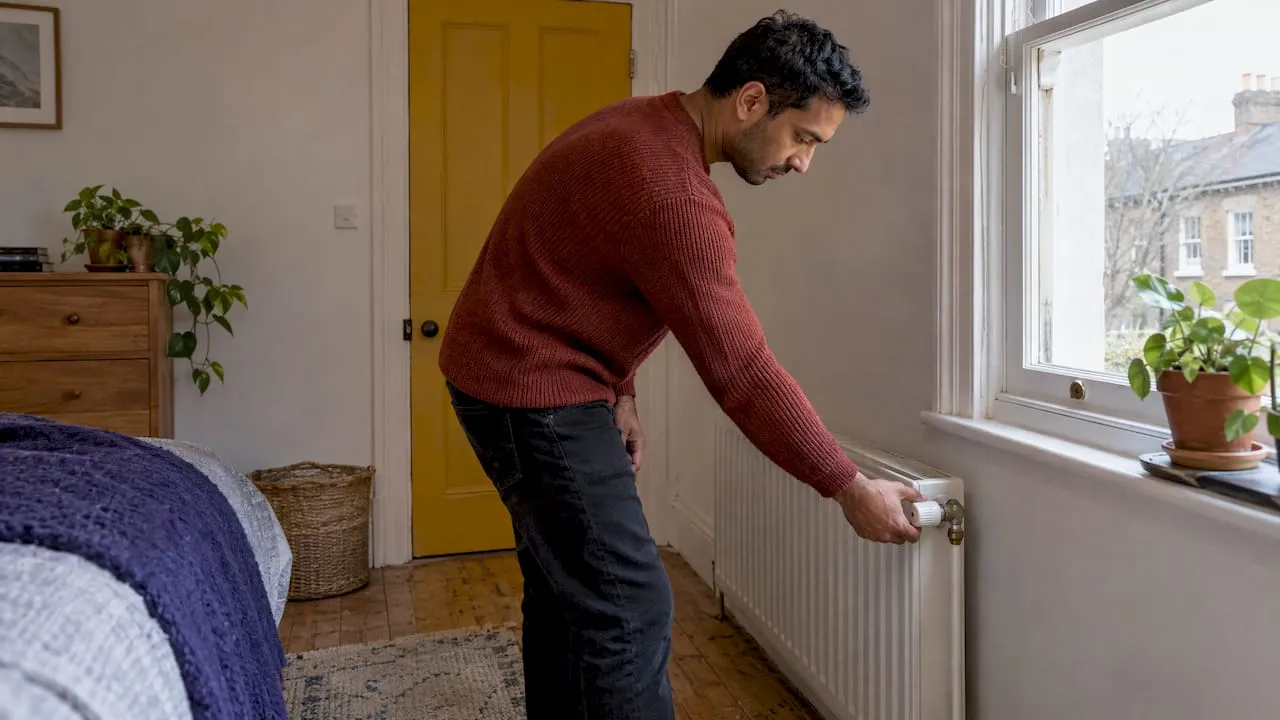
The International Energy Agency says lowering the thermostat by 1°C can save about 7% of heating energy. The Centre for Sustainable Energy puts the saving at up to £73 a year for a UK household. The same advice carries a safety point: older people, people who are ill and households with small children should not go below 18°C.
For offices and shops, the government’s business energy guide recommends heating set to 19°C and cooling to 24°C or higher, with heating off at weekends and bank holidays where appropriate.
Use your timer properly
A programmer set to match when you are actually home does more than constant manual adjustment. The IEA says setbacks to 15°C while asleep and 10°C while a home is empty can cut heating bills by up to 10% a year. Treat that as a ceiling: the real figure depends on how well the building holds heat.
The “30-minute heating rule” that readers ask about is simply a timing tip. Citizens Advice suggests turning the heating on about 30 minutes before you need it and off about 30 minutes before you stop needing it, because a home takes time to warm up and cool down. If your home is slow to heat, allow longer. It is a way to avoid heating an empty room, not a guaranteed percentage saving.
Heat the rooms you use
Shut doors to rooms you are not using and turn radiators down there. In a typical London flat, with its mix of period conversions and 1960s blocks, this takes seconds and costs nothing.
Stop the heat escaping
Turning the thermostat down only works comfortably if the building holds its heat. This is where London’s housing stock matters: solid-walled Victorian and Edwardian terraces, converted flats with single-glazed sash windows and old commercial units above shops all lose heat faster than a modern build.
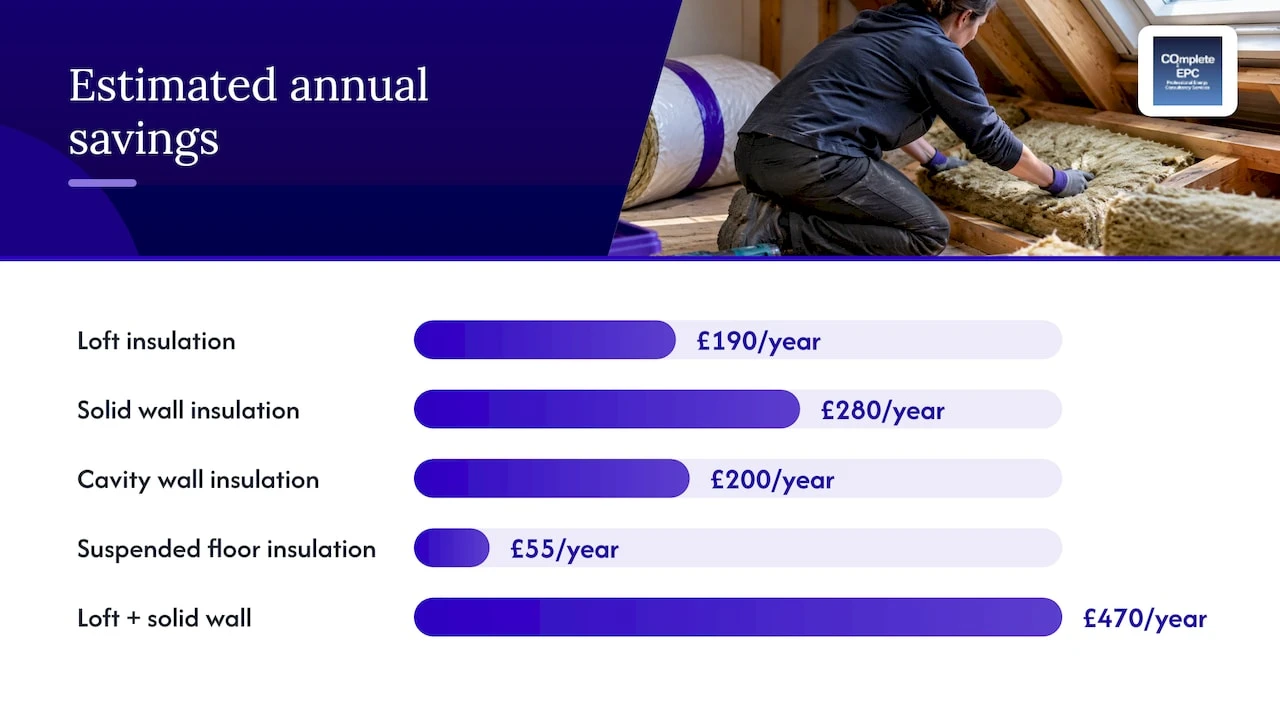
Energy Saving Trust’s winter guide gives annual savings estimates for Great Britain:
| Measure | Estimated annual saving |
|---|---|
| Cavity wall insulation | £200 |
| Solid wall insulation (internal or external) | £280 |
| Loft insulation, 0mm up to 270mm | £190 |
| Suspended timber floor insulation | £55 |
| Hot water cylinder jacket, 25mm up to 80mm | £45 |
| Pipe insulation | about £6 |
The same trust says professional draught-proofing of windows and doors could save about £55 a year in Great Britain, and a chimney draught excluder about £45. These are estimates for typical homes, so your own saving will differ. The point is the order: loft and walls first, then draughts, then smaller items.
A worked example: a mid-terrace Victorian house in east London with an uninsulated loft and solid walls. Using the Energy Saving Trust figures above, the loft top-up is estimated at £190 a year and solid wall insulation at £280 a year. Together that is an estimated £470 a year, before draught-proofing. Your house will differ, which is exactly why the next step is to have it assessed.
Small habits worth keeping
Habits will not transform a bill, but they cost nothing. Energy Saving Trust says its ten quick actions could save up to £313 a year in Great Britain, with savings varying by household. Among them:
- Shorter showers. Four-minute showers could save about £45 a year.
- Standby. Switching appliances off standby could save about £45 a year in Great Britain.
- Lights in empty rooms. Easy to forget, and it matters far more in commercial premises (see below).
Do not expect every tip to add up neatly: a shower saving and a standby saving are estimates for different households.
If you run a business or let commercial space
Commercial energy use follows different patterns. The government’s business guide says nearly half of business electricity use occurs outside standard operating hours, which is why switching off lights and unused equipment in empty areas can materially reduce costs. Its other recommendations for businesses include:
- assessing your energy use first, so you know where the money goes
- fitting a smart meter and comparing tariffs
- draught-proofing and maintaining boilers
- scheduling heating and cooling around occupancy
- upgrading to LED lighting, which the guide says can deliver significant savings with an average payback of under three years
If your premises have air conditioning, cooling is a running cost you can control. The IEA advice is to turn it off when no one is there, set it 1°C warmer and cool only occupied rooms, which can reduce cooling bills by up to 10%. There is no universal rule about leaving AC running all day: results depend on the building, insulation and equipment. A regular inspection of the system shows whether it is running efficiently, and we carry out TM44 air conditioning inspections for London premises.
Tariffs, smart meters and solar
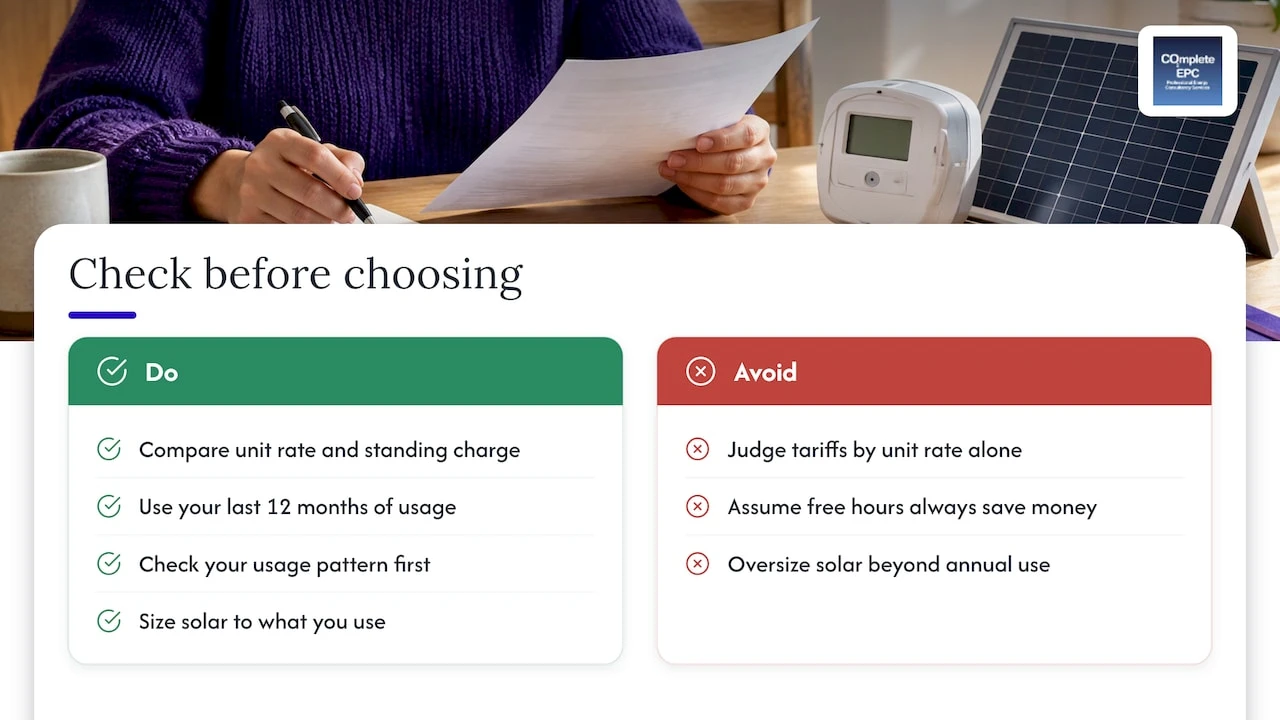
Checking your tariff is worth doing once a year, but it is a pricing decision and not an efficiency one. Compare the unit rate and the standing charge together, using your last 12 months of usage, because a tariff that looks cheaper per unit can cost more overall if its standing charge is higher.
Time-of-use tariffs reward you only if you can actually shift usage. South Australia’s Energy and Water Ombudsman makes this point about free-hour offers: a free midday offer may cost more overall if you cannot move your usage into it. The principle applies anywhere: work out your own usage pattern first.
Solar works on the same logic. California’s regulator notes that most solar savings come from using the power you generate yourself, and that a system larger than your annual use may not be worthwhile. For a flat or a shaded terrace in London, reduce demand first, then size any generation to what you use.
Why an EPC is the sensible first step
Every list above gives averages. Your building is not average. An EPC gives you the specifics: a rating from A to G, an estimate of running costs, and a list of recommended improvements with their likely effect. In practice you can use it as a priority list: loft first, then glazing, then heating controls, in the order that suits your property.
For landlords it is also a legal document. You need a valid EPC to let a property in England and Wales, and the minimum standard is rising. The government’s response on private rented homes confirms a target of EPC C for all tenancies by 2030, with a maximum investment of £10,000 per property. Landlords with an existing EPC C will be able to show compliance until it expires or is replaced. Planning upgrades now means you spread the work, and your tenants benefit from lower bills along the way.
How to read the result:
- Look at the rating and the cost figures. They show where you stand against the standard that applies to your property.
- Read the recommendations in order. They are ranked by what they will do for the rating and the running cost.
- Cost them. Get quotes for the top two or three measures and compare against the estimated saving.
- Re-assess after the work. A new EPC records the improvement, which matters when you let or sell.
For a fuller explanation of how those recommendations are produced, see our guide to what a recommendation report for an EPC contains.
How we help London owners, landlords and businesses
Complete EPC provides energy performance certificates for domestic and commercial properties across London. Our qualified assessors produce detailed reports with recommendations for improving efficiency, and we back our pricing with a UK lowest-rate guarantee. We serve property owners, landlords, estate agents and solicitors.
- Homes, flats and landlord lettings: domestic EPC
- Offices, shops and other business premises: commercial EPC
- New builds, conversions and extensions: SAP calculations
- Air conditioning in commercial premises: TM44 inspections
- Overheating in new or converted flats: TM52 and TM59 assessments
To book an assessment or ask which one fits your property, start from our home page.
Our view: measure first, then spend
Most people try to lower their bill by guessing. They buy a smart plug, swap a few bulbs and hope. Those steps are fine, but they come before the question that decides everything: where does this particular building lose its energy?
We think the assessment comes first. An EPC gives a landlord or owner an independent, structured picture of the property and the improvements worth considering, so the money goes to the measures that matter rather than the ones that happen to be advertised.
For landlords the argument is stronger still. The rating you hold affects whether you can let the property, and the government’s direction of travel is toward EPC C. A report that ranks improvements now lets you plan the work in stages instead of in a rush.
For businesses it is the same logic at a larger scale. Lighting, cooling, heating schedules and the fabric of the building all sit in one set of recommendations, and that is what a commercial EPC is for.
That is why we offer our services across London with a lowest-rate guarantee: an assessment should be an easy decision, not a barrier to saving.
Danny
Frequently asked questions
Does turning off lights really save electricity?
Yes, though the amount depends on the bulbs and how long they would otherwise stay on. In business premises it counts for more: the government’s business guide says nearly half of business electricity use happens outside standard operating hours. Switching to LEDs and turning lights off in empty areas are the two easiest steps.
What is the 30-minute heating rule?
It is a timing tip: set the heating to come on about 30 minutes before you need it and go off about 30 minutes before you leave or go to bed. Citizens Advice gives this as a starting point. Homes that heat slowly need longer, so adjust it to your own property.
How much can I save by turning the thermostat down?
The Centre for Sustainable Energy says up to £73 a year for each 1°C, and the IEA estimates about 7% of heating energy. Keep the home at 18°C or above if anyone in it is elderly, ill or a small child.
Will an EPC lower my energy bill by itself?
The certificate does not cut the bill, but its recommendations show which upgrades are likely to. It lists improvements and estimated running costs for your property, so you can prioritise the work that suits it. Landlords also need a valid one to let a property.
Is the energy price cap my bill?
No. It limits the unit rate and standing charge a supplier can charge on a standard variable tariff, and Ofgem updates it every quarter. Your bill depends on how much you use, so the figure to compare is your own usage against the live Ofgem table.
Sources
- Ofgem: energy price cap unit rates and standing charges
- International Energy Agency: saving energy
- Centre for Sustainable Energy: tips for lower energy bills
- Citizens Advice: save money heating your home
- Energy Saving Trust: five things to prepare your home for winter
- Energy Saving Trust: quick tips to save energy at home
- UK government: energy advice for businesses
- UK government: improving the energy performance of privately rented homes, government response
- Energy and Water Ombudsman SA: Solar Sharer Offer
- California Public Utilities Commission: solar consumer protection guide