

Cutting your energy bill comes down to three areas: heating controls, draught-proofing, and smarter appliance habits. Together, these can save a typical UK household several hundred pounds a year without major building work. Start today by turning your boiler flow temperature down to around 60°C, switching off devices on standby, and only boiling the water you need. This week, check your thermostat schedule and draught-proof your letterbox and front door. This month, book a boiler service and check your eligibility for a grant via Gov.
Key savings at a glance:
- Heating controls and insulation: the largest opportunity, often £100–£300+ per year
- Standby and appliance habits: up to around £45 per year from switching off standby alone
- Shorter showers: roughly £45 per year for a four-minute limit
- Line-drying instead of tumble drying: approximately £50 per year
Key takeaways
Heating and hot water account for more than half of a typical UK household’s energy bill, so improving heating controls and insulation delivers the largest and most durable savings of any category.
| Point | Details |
|---|---|
| Start with heating controls | Lowering boiler flow temperature and programming your thermostat can save £75–£150 a year with no upfront cost. |
| Quick wins add up fast | Switching off standby, limiting showers to four minutes, and line-drying clothes can together save several hundred pounds a year. |
| Insulate before upgrading | Draught-proofing and loft insulation top-ups pay back within one to two years and are often grant-eligible under ECO4 or the Great British Insulation Scheme. |
| Use your EPC to prioritise | Your EPC lists property-specific recommendations with estimated costs and savings — sort by payback period to act in the right order. |
| Completeepc for a tailored plan | A domestic EPC from Completeepc (from £34.95) gives you a ranked, costed improvement list specific to your property. |
This article is general information, not a substitute for advice from a qualified financial advisor. Consult a qualified financial professional about your own circumstances before acting on anything here.
Table of Contents
- 1. Zero- or low-cost actions you can do right now
- 2. Heating and hot water: where the biggest savings are
- 3. Insulation, draught-proofing, and stopping heat from escaping
- 4. Where electricity goes and how to cut appliance and lighting costs
- 5. Everyday behaviour changes that add up — and myths to avoid
- 6. Smart meters, tariffs, and switching: reducing the bill from the supplier side
- 7. Grants and schemes: Help to Heat, ECO, Warm Home Discount, and more
- 8. How to use your EPC to prioritise improvements
- 9. Renewable energy options for homeowners: solar panels and solar water heating
- 10. Energy monitors and apps: understanding your consumption patterns
- What I’d prioritise in a typical UK semi-detached home
- A personalised EPC from Completeepc gives you a property-specific plan
- Sources
- FAQ
1. Zero- or low-cost actions you can do right now
The fastest ways to reduce your energy bill cost nothing at all. These habits take minutes to form and pay back immediately.
- Only boil what you need. Filling the kettle to the top for one cup wastes energy every single time. Fill it to the cup line only.
- Switch off standby. Televisions, games consoles, and phone chargers left on standby draw power continuously. Switching them off at the wall can save around £45 a year.
- Wash at 30°C. Modern detergents work well at lower temperatures. Dropping from 40°C to 30°C uses roughly a third less energy per cycle.
- Run full dishwasher loads. A half-empty dishwasher uses almost the same energy as a full one. Use the eco cycle where your machine has one.
- Limit showers to four minutes. Energy Savers Week guidance puts the saving at approximately £45 per year per person.
- Air-dry clothes. Line-drying can save a noticeable amount annually compared with regular tumble-dryer use.
- Close curtains at dusk. Thick curtains pulled across windows at dusk noticeably reduce heat loss through glass overnight.
Statistic to note: Energy Saving Trust estimates that combining everyday quick wins — avoiding the tumble dryer, reducing shower time, and switching off standby — can add up to several hundred pounds a year for many households.
Pro Tip: Pair a new habit with something you already do. Put a sticky note on the kettle to remind you to check the water level, and set your phone’s shower timer the first week until four minutes feels natural.
2. Heating and hot water: where the biggest savings are
Heating and hot water account for more than half of a typical household’s energy bill, which is why getting your heating system right delivers the largest long-term savings of anything on this list.
Here are the most effective steps, in order of impact:
- Lower your boiler flow temperature. For combi boilers, set the flow temperature to 60°C or below (many are factory-set at 80°C). For systems with a hot-water cylinder, keep the cylinder thermostat at 60°C to prevent legionella but no higher. A lower flow temperature means the boiler runs more efficiently, particularly if you have a modern condensing boiler.
- Programme your thermostat. Set heating to come on 30 minutes before you wake and go off 30 minutes before you leave. Every degree you reduce your room thermostat by can cut your heating bill by around 10%.
- Fit thermostatic radiator valves (TRVs). TRVs let you heat rooms to different temperatures. Turn them down in rooms you use less — a spare bedroom does not need the same warmth as a living room.
- Bleed your radiators. Cold spots at the top of a radiator mean trapped air is reducing efficiency. Bleeding takes five minutes and costs nothing.
- Insulate your hot-water cylinder. A British Standard jacket (80mm thick) on an uninsulated cylinder can save a meaningful amount each year and typically pays back within months.
- Service your boiler annually. A well-maintained boiler runs more efficiently and is less likely to break down in winter. Use a Gas Safe registered engineer.
- Install a smart thermostat. Devices such as those from Nest or Hive learn your schedule and adjust heating automatically, reducing waste when you are out.
| Action | Typical annual saving | Upfront cost | Timescale |
|---|---|---|---|
| Lower boiler flow temperature | £50–£100+ | None | Immediate |
| Programme thermostat | £75–£150 | None–low | Immediate |
| Fit TRVs | £50–£100 | Low | Days |
| Bleed radiators | Small but measurable | None | Immediate |
| Hot-water cylinder jacket | £50 | Low | Days |
| Smart thermostat | £75–£150 | Medium | Weeks |
| Annual boiler service | Preserves efficiency | Low–medium | Book this month |
Safety note: Never adjust gas components yourself. Boiler flow temperature can usually be changed via the boiler’s own controls, but if you are unsure, contact a Gas Safe registered engineer. Do not set your hot-water cylinder below 60°C, as lower temperatures create a legionella risk.
3. Insulation, draught-proofing, and stopping heat from escaping
Heat loss through walls, roofs, floors, and gaps around doors and windows is a constant drain on your bill. Addressing it is one of the best practices for energy efficiency because the savings repeat every year with no ongoing effort.
Where heat escapes most:
- Loft insulation is often the highest-value improvement. An uninsulated or under-insulated loft (less than 270mm of mineral wool) is one of the biggest sources of heat loss in a typical UK home.
- Cavity wall insulation suits most homes built after the 1920s. It is injected by a professional and typically pays back within a few years.
- Solid wall insulation (internal or external) suits older properties with solid brick walls. It costs more and takes longer to pay back, but the savings are substantial.
- Draught-proofing is the quickest win. Gaps around letterboxes, keyholes, skirting boards, and loft hatches can all be sealed with low-cost draught excluders or foam tape.
- Double glazing reduces heat loss significantly compared with single-glazed windows. If you cannot yet afford new windows, secondary glazing film or heavy curtains provide a meaningful interim benefit.
Pro Tip: Sequence your improvements by payback period, not by size. Draught-proofing and loft insulation top-ups come first — they are cheap, quick, and often grant-eligible. Save solid wall insulation and glazing for when you have grant support or are planning a renovation anyway.
4. Where electricity goes and how to cut appliance and lighting costs
Lighting and appliances account for a significant share of electricity use, and the choices you make about how you run them matter more than most people realise.
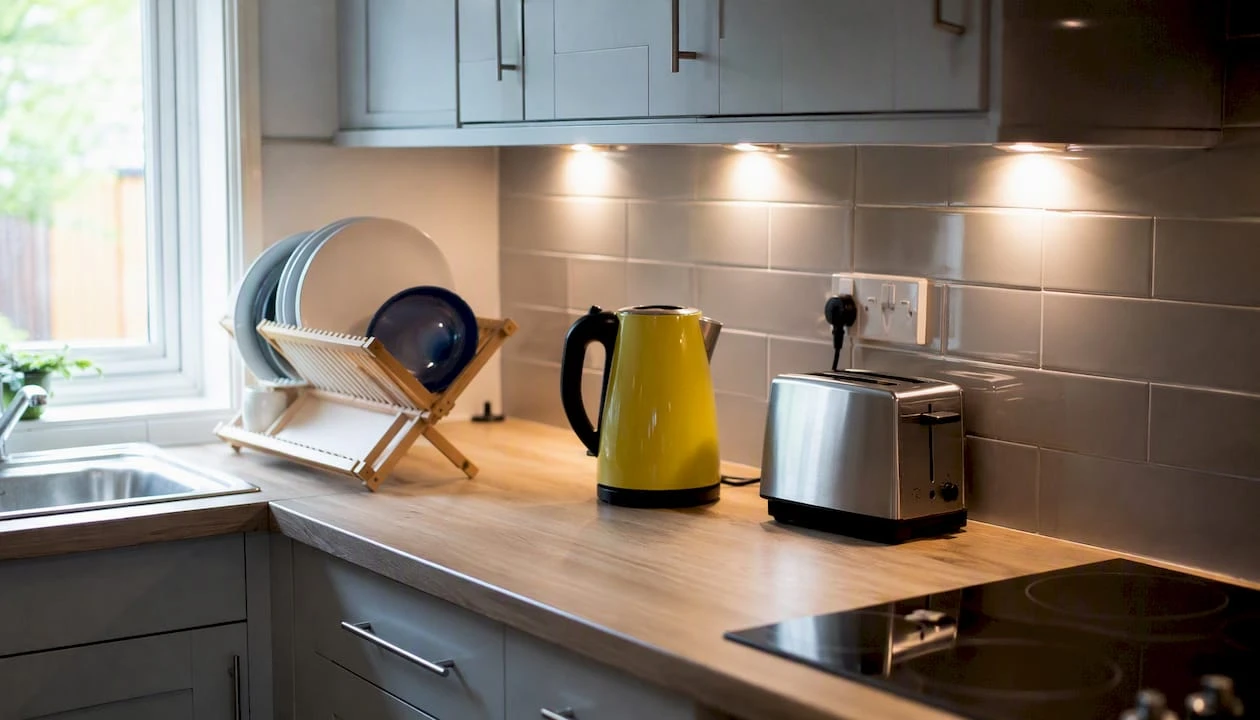
Energy labels and kWh: read the number, not just the letter. An A-rated appliance from ten years ago may use more electricity than a D-rated model launched this year, because the rating scale has changed. Always check the annual kWh figure on the label — that is the number that translates directly into your bill.
Best-practice appliance use:
- Use a microwave, air fryer, or slow cooker for single meals rather than heating a full oven. These smaller appliances typically use considerably less energy than a conventional oven for the same task.
- Defrost your freezer regularly. Ice build-up forces the motor to work harder, increasing electricity use.
- Run the dishwasher on its eco cycle — it uses less water and less energy, even if the cycle takes longer.
- Dry clothes outdoors or on a covered heated airer in a ventilated room rather than in a tumble dryer.
Lighting: Switching to LED bulbs is one of the simplest ways to minimise electricity costs. If you still have halogen spotlights in the kitchen or bathroom, replacing them with LED equivalents is a straightforward weekend task with a payback period of under a year.
Choosing new appliances: When replacing a fridge, washing machine, or dishwasher, compare the annual kWh figures across models at the same capacity. A more efficient model typically costs a little more upfront but saves money every year for its entire lifespan.
5. Everyday behaviour changes that add up — and myths to avoid
Small habits, repeated daily, produce real savings. They also prevent common mistakes that quietly inflate bills.
- Switch lights off when you leave a room. It sounds obvious, but it is one of the most consistently overlooked habits in busy households.
- Do not dry clothes on radiators. This forces your boiler to work harder to maintain room temperature and traps moisture that can lead to damp and mould. A covered heated airer in a ventilated space is a better option when outdoor drying is not possible.
- Ventilate briefly after showering. Opening a bathroom window for ten minutes after a shower removes moisture efficiently without losing significant heat, and it prevents the damp that leads to costly mould remediation.
- Keep your thermostat between 18°C and 21°C. Energy Savers Week guidance supports this range as comfortable and efficient for most households.
- Use the right-sized pan on the right-sized hob ring. A small pan on a large ring wastes heat around the sides.
Common myths, corrected:
- “Leaving heating on low all day is cheaper than heating on demand.” For most UK homes with modern controls, heating on demand (timed to when you need it) uses less energy than a constant low background temperature.
- “Smart bulbs always save energy.” Smart bulbs that remain connected to your Wi-Fi on standby draw a small but continuous load. If you use them only for convenience and leave them on standby most of the time, the saving over a standard LED is minimal.
- “A full freezer is always more efficient.” A well-stocked freezer does retain cold better than an empty one, but an overfilled freezer with poor air circulation can actually work harder. Keep it reasonably full, not packed solid.
Pro Tip: Stack your habit changes. Set a reminder on your phone for the first two weeks to check standby devices before bed. After two weeks, it becomes automatic — and the saving runs indefinitely.
6. Smart meters, tariffs, and switching: reducing the bill from the supplier side
Your energy supplier and tariff choice can make a meaningful difference to what you pay, independent of how much energy you use.
Smart meters give you real-time consumption data via an in-home display, making it far easier to spot waste and understand which appliances cost the most to run. Smart Energy GB notes that seeing usage in pounds and pence in real time prompts immediate behavioural changes for many households. Smart meters also make switching suppliers simpler, because accurate meter readings transfer automatically.
Tariff types to understand:
- Standard variable tariff (SVT): the default if you have never switched. Usually the most expensive option.
- Fixed-rate tariff: locks in a unit rate for a set period (typically 12–24 months). Useful when rates are expected to rise.
- Economy 7 / time-of-use tariffs: offer cheaper electricity at off-peak hours (usually overnight). Worth considering if you have storage heaters, an electric vehicle, or can shift appliance use to night-time.
How to compare and switch:
- Find your current unit rate and standing charge on a recent bill.
- Use Ofgem’s accredited comparison services or a price comparison website to check available tariffs.
- Check the exit fees on your current tariff before switching.
- Once you choose a new supplier, they handle the switch — you do not need to contact your current supplier first.
- The switch typically completes within 21 days, and your supply is never interrupted.
Ofgem’s guidance on saving money on your energy bill also covers smart meters and switching rights in plain language.
Suppliers such as Octopus Energy offer time-of-use tariffs that reward households for shifting consumption to off-peak periods — worth exploring if you have a smart meter already installed.
7. Grants and schemes: Help to Heat, ECO, Warm Home Discount, and more
Financial support is available for many of the improvements covered in this guide. The key is knowing which scheme applies to your situation.
Main UK schemes:
- ECO4 (Energy Company Obligation): funded by energy suppliers, this scheme pays for insulation and heating upgrades for households on qualifying benefits or with a low EPC rating. Apply via your energy supplier or local council.
- Warm Home Discount: a one-off annual discount (currently £150) on electricity bills for eligible low-income households. Check eligibility on GOV.UK.
- Help to Heat / Great British Insulation Scheme: targets homes with poor insulation (EPC D or below) and offers funded or part-funded insulation measures. Check via GOV.UK.
- Boiler Upgrade Scheme: provides a grant (currently £7,500) towards the cost of a heat pump for eligible properties. Administered by Ofgem.
- Warm Homes Plan: the government’s longer-term programme to upgrade inefficient housing stock. GOV.UK’s Warm Homes Plan page sets out the direction of future support.
| Scheme | Typical support | Who qualifies | Where to apply |
|---|---|---|---|
| ECO4 | Full or part-funded insulation/heating | Benefits recipients, low EPC | Energy supplier / local council |
| Warm Home Discount | £150 bill credit | Low-income households | GOV.UK / supplier |
| Great British Insulation Scheme | Funded insulation | EPC D or below | GOV.UK |
| Boiler Upgrade Scheme | £7,500 grant | Replacing gas/oil boiler | Ofgem / installer |
Quick next step: visit GOV.UK’s energy efficiency page and use the eligibility checker. It takes around five minutes and tells you which schemes you qualify for based on your property and household circumstances.
8. How to use your EPC to prioritise improvements
An Energy Performance Certificate is more than a compliance document. It contains a ranked list of recommended improvements for your specific property, each with an estimated cost band and a likely annual saving — making it the most practical prioritisation tool available to a homeowner.
How to read and act on your EPC:
- Find your current EPC. Search the national register at GOV.UK using your postcode. EPCs are valid for ten years.
- Read the recommendations table. Each measure is listed with a typical installation cost (low/medium/high) and an estimated annual saving in pounds.
- Sort by payback period. Divide the estimated cost by the annual saving to get a rough payback in years. Prioritise measures with payback periods under five years.
- Check grant eligibility. Cross-reference your EPC rating with the schemes listed above — ECO4 and the Great British Insulation Scheme both use EPC rating as an eligibility criterion.
- Get quotes. Use the EPC recommendations as a brief for tradespeople so you are comparing like-for-like quotes.
What a typical EPC recommendation looks like:
A semi-detached home rated D might show loft insulation top-up (estimated cost: low; estimated saving: £200/year) and a smart thermostat (estimated cost: low; estimated saving: £75/year). Acting on those two measures alone could save £275 a year, with both paying back within two years.
Pro Tip: If your EPC is more than five years old, the recommendations may not reflect current energy prices or newer grant schemes. A fresh assessment gives you updated figures and may reveal measures that have become cost-effective since your last certificate.
If you do not yet have an EPC, booking one is the logical first step before spending money on improvements.
9. Renewable energy options for homeowners: solar panels and solar water heating
Renewable technologies can cut your bills significantly over the long term, though they require a higher upfront investment than the measures covered so far.
Solar photovoltaic (PV) panels generate electricity from daylight and can cover a meaningful share of a typical household’s electricity use. A 4kWp system (suitable for a three-bedroom semi-detached) costs roughly £5,000–£8,000 installed. Savings depend on how much of the generated electricity you use directly rather than export, but many households see annual savings of £400–£600 once the system is running. The Smart Export Guarantee (SEG) pays you for surplus electricity you export to the grid — your energy supplier must offer an SEG tariff if they have more than 150,000 customers.
Solar water heating uses roof-mounted collectors to heat water in a cylinder. It typically covers around a third of a household’s hot-water demand over a year, with greater contribution in summer. Installation costs are lower than solar PV (roughly £3,000–£5,000), and the technology works well alongside a conventional boiler that tops up the temperature when solar gain is insufficient.
This effectively reduces the cost of installation by a fifth compared with the pre-2022 position.
Is it worth it? Solar PV makes most sense for households with south-facing roof space, high daytime electricity use, and the ability to fund the upfront cost. Payback periods typically run 8–12 years, after which the electricity generated is effectively free. Combining solar PV with a battery storage system shortens the effective payback by increasing self-consumption, though battery costs add to the initial outlay.
10. Energy monitors and apps: understanding your consumption patterns
A smart meter’s in-home display is a good start, but dedicated energy monitors and apps give you a more granular picture of where your electricity goes.
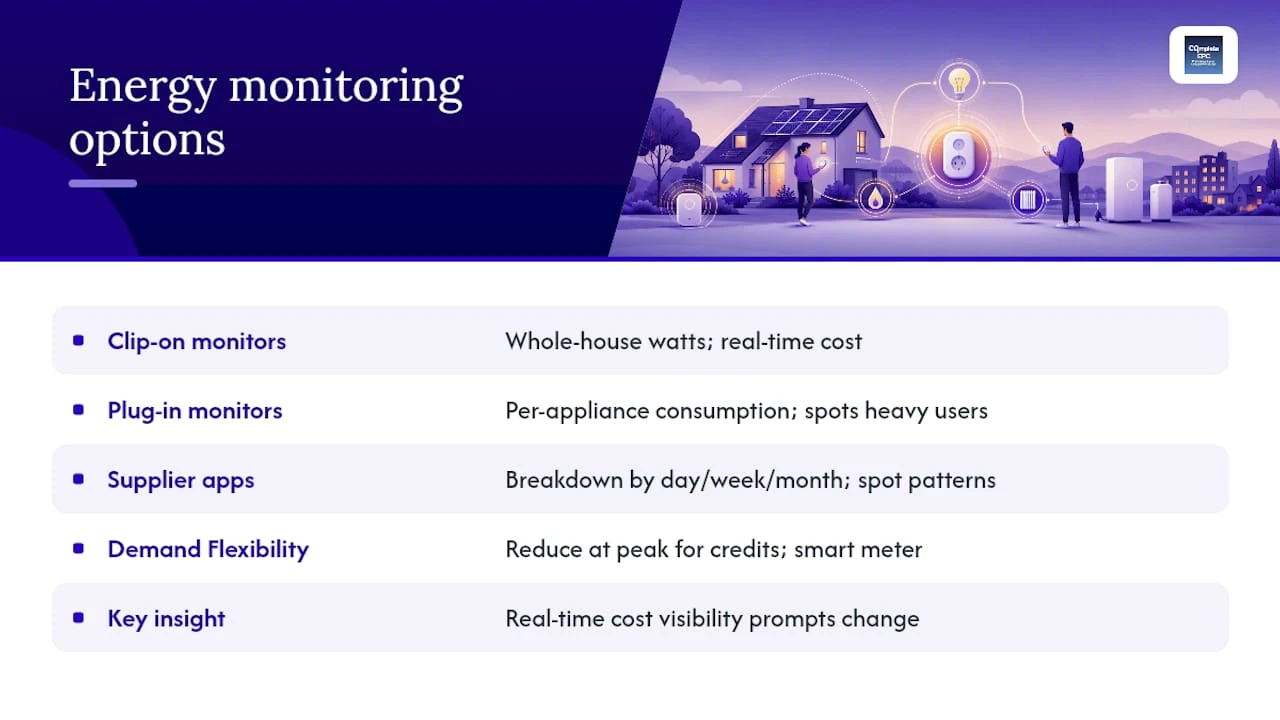
Clip-on energy monitors (such as those from Efergy or OWL) attach to your electricity meter’s supply cable and send real-time consumption data to a handheld display or smartphone app. They show total household draw in watts and estimated cost per hour, making it straightforward to identify which appliances are the heaviest users. Plug-in energy monitors (such as the Energenie MiHome plug) go further by measuring individual appliance consumption, which is useful for identifying old fridges, freezers, or televisions that are drawing far more than expected.
Apps and supplier platforms: Several energy suppliers, including Octopus Energy, provide consumption dashboards that break down your usage by day, week, and month. These are particularly useful for spotting seasonal patterns or identifying a sudden increase that might indicate a faulty appliance or a change in household behaviour.
The key insight from monitoring: Smart Energy GB’s guidance highlights that making consumption visible in real time prompts immediate changes in behaviour for many households. Seeing the cost of leaving a tumble dryer running for an hour displayed in pounds and pence is often more motivating than any general advice. Installing a monitor before making larger investments is a practical way to confirm where your money is actually going, so you can target improvements accurately.
National Grid’s demand flexibility: National Grid’s Demand Flexibility Service, available to households with smart meters and willing suppliers, pays you to reduce consumption during peak periods. Octopus Energy’s Saving Sessions is one example. These schemes do not require any hardware beyond a smart meter and can generate small but real credits on your bill.
What I’d prioritise in a typical UK semi-detached home
Most energy-saving advice treats every home the same. A typical UK semi-detached built between the 1930s and 1980s has specific characteristics that shape which actions pay back fastest: cavity walls (usually insulation-eligible), a loft that may be under-insulated, and a gas boiler that is often set too hot.
This week: Lower the boiler flow temperature to 60°C, programme the thermostat to match your actual schedule, and spend an afternoon draught-proofing the front door, letterbox, and any obvious gaps around skirting boards. These three steps cost nothing or very little and can reduce heating costs noticeably from the next billing period.
This month: Book a boiler service with a Gas Safe registered engineer, check your loft insulation depth (the target is 270mm of mineral wool), and visit GOV.UK to check grant eligibility. If your EPC is missing or out of date, book a fresh assessment — the recommendations it contains are specific to your property and will tell you exactly which measures offer the best return.
This year: Act on the top two or three EPC recommendations, starting with loft insulation top-up and cavity wall insulation if not already done. If grant funding is available, these may cost you nothing. Consider solar PV if your roof faces south and your electricity use is high.
The pattern I see repeatedly is that homeowners skip the free steps (thermostat programming, boiler temperature, draught-proofing) and go straight to asking about solar panels or heat pumps. The free steps often save more in the first year than a £5,000 technology investment, and they make the larger investments more effective when you do make them.
A personalised EPC from Completeepc gives you a property-specific plan
Generic tips get you started, but a property-specific EPC tells you exactly which improvements will save the most in your home, ranked by cost and likely return. Completeepc provides domestic EPC assessments across London, carried out by qualified assessors with extensive industry experience. The certificate you receive includes a ranked list of recommended measures with estimated costs and annual savings — turning the advice in this guide into a costed checklist for your specific property. Pricing starts from £34.95, with a lowest-rate guarantee across the UK market.
If you are ready to move from general guidance to a tailored plan, book your domestic EPC with Completeepc and get the property-specific roadmap you need to prioritise confidently.
Sources
- Quick tips to save energy at home from the experts – Energy Saving Trust
- Save money on your energy bill | Ofgem
- Gov
- Energy Savers Week – Energy Saving Trust
FAQ
What uses the most electricity in a typical home?
After that, the largest electricity draws are usually wet appliances (washing machines, dishwashers, tumble dryers), refrigeration, and cooking.
What is the simplest change to cut your electricity bill quickly?
Switching off devices on standby and only boiling the water you need in the kettle are the two fastest habits to form. Together with limiting showers to four minutes, these three changes can save well over £100 a year for many households.
What is the 4pm rule on heating?
The “4pm rule” is a common shorthand for pre-programming your heating to come on before you arrive home rather than leaving it on all day. Setting your thermostat to heat the home from around 4pm (or whenever you return) rather than running it continuously is more energy-efficient for most households with modern controls.
Does turning the kettle off at the wall save electricity?
A kettle draws power only when it is actively boiling, so switching it off at the wall between uses saves a negligible amount compared with, say, a television left on standby. The real saving with a kettle comes from only boiling the water you need rather than filling it to the top each time.
How do I know which home improvements to prioritise?
Your Energy Performance Certificate lists property-specific recommendations ranked by estimated cost and annual saving. Sorting those recommendations by payback period (cost divided by annual saving) gives you a clear order of priority. If your EPC is missing or more than five years old, booking a fresh assessment is the logical first step.