

TL;DR:
- London landlords need to understand EPC ratings and upcoming legal standards for compliance.
- Improvements like insulation and efficient heating significantly boost energy performance scores.
- Early assessment and thorough documentation help ensure compliance before 2030 regulations tighten.
Most London landlords already know an Energy Performance Certificate (EPC) is a legal requirement, but a surprising number still aren’t clear on what the ratings actually mean, how scores are calculated, or what’s about to change. With penalties up to £30,000 per breach under the Minimum Energy Efficiency Standards (MEES), and a looming 2030 deadline requiring most private rented properties to reach at least a C rating, the stakes have never been higher. This guide cuts through the confusion, explains how ratings work in practice, and gives you clear steps to achieve compliance and improve your property’s efficiency.
Table of Contents
- What is a property energy rating and how is it measured?
- Current legal requirements for London landlords
- How energy ratings are calculated: SAP, RdSAP, and upcoming changes
- Exemptions, cost caps, and common compliance pitfalls
- The future of property energy ratings: trends and practical improvement steps
- A practical perspective: What EPC ratings don’t tell you and what smart landlords are doing
- Get expert support for your property’s energy rating
- Frequently asked questions
Key Takeaways
| Point | Details |
|---|---|
| Legal compliance deadlines | Landlords must achieve at least an EPC E now and C by 2030 or risk heavy fines. |
| Accurate ratings matter | Understanding how energy ratings and SAP scores are calculated helps you avoid simple errors and penalties. |
| Prioritise fabric upgrades | Insulation and draught-proofing are the most effective ways to improve your property energy rating. |
| Know your exemptions | If you cannot comply, registering for a valid exemption could protect you from fines. |
| Prepare for HEM changes | From 2027, new EPC assessment methods mean being proactive is more important than ever. |
What is a property energy rating and how is it measured?
A property energy rating tells you how energy efficient a building is, based on its construction, heating systems, insulation, and fuel type. In the UK, this rating is expressed through an Energy Performance Certificate, which every landlord and seller is legally required to obtain before marketing or letting a property.
The rating follows an A to G scale based on SAP (Standard Assessment Procedure) scores:
| EPC rating | SAP score range | Typical property characteristics |
|---|---|---|
| A | 92 and above | New builds, Passivhaus, excellent insulation and renewables |
| B | 81 to 91 | Modern builds, high-spec insulation, efficient heating |
| C | 69 to 80 | Well-insulated, efficient boiler, double glazing |
| D | 55 to 68 | Average UK property, cavity walls, standard boiler |
| E | 39 to 54 | Older property, partial insulation, ageing heating |
| F | 21 to 38 | Poor insulation, inefficient heating system |
| G | 1 to 20 | Unimproved older stock, solid walls, no insulation |
The SAP score itself is calculated using two main methods. For new builds, assessors use the full SAP process, which models the entire building’s energy demand from design specifications. For existing properties, assessors use RdSAP (Reduced data Standard Assessment Procedure), which uses on-site measurements, age-band defaults, and standardised conventions.
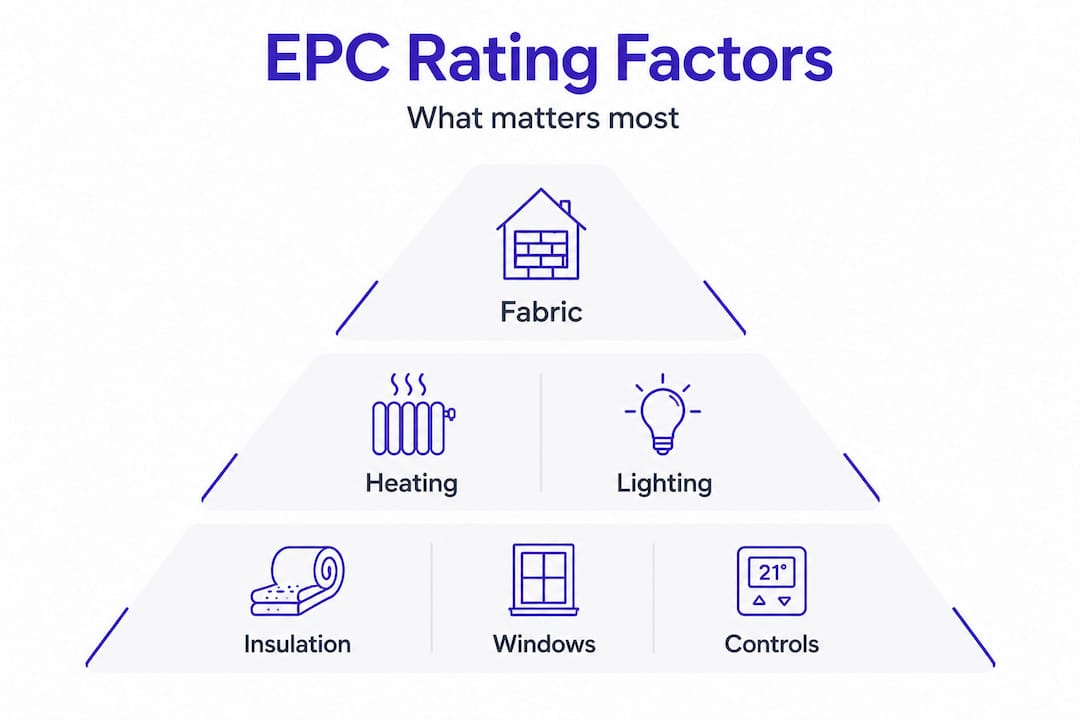
Key factors that influence your SAP score include:
- Wall construction and insulation type (cavity, solid, or insulated)
- Roof and floor insulation levels
- Window glazing type and condition
- Boiler age, type, and efficiency rating
- Hot water system and cylinder insulation
- Presence of renewable energy systems such as solar panels or heat pumps
- Heating controls like thermostats and programmers
Each factor carries a different weight in the calculation. A property with a modern condensing boiler but poor roof insulation can still score surprisingly low. Understanding this helps you target the most impactful upgrades.
Current legal requirements for London landlords
Once you understand the rating scale, it’s crucial to know which legal standards must be met to avoid penalties. London landlords in the private rented sector are subject to MEES, which sets minimum EPC standards for all tenancies.
Here’s a comparison of current and upcoming requirements:
| Requirement | Current standard | Future standard |
|---|---|---|
| Minimum EPC rating | E (in force since April 2020) | C (by 1 October 2030) |
| Cost cap for works | £3,500 per property | £10,000 per property |
| Enforcement | Local authority fines | Local authority fines |
| Maximum penalty | £30,000 per breach | £30,000 per breach |
The steps every London landlord should be aware of right now are:
- Confirm your current EPC rating. Check the national EPC register to see your existing certificate and its expiry date.
- Identify whether your rating meets the E minimum. If not, you are already in breach and need to act immediately.
- Plan for the C-rating requirement by 2030. This affects all tenancies, not just new lets, so the clock is already running.
- Assess how much improvement is needed. Properties rated D or E may need significant investment to reach C.
- Budget for potential costs within the updated £10,000 cost cap.
The scale of the challenge is significant. While approximately 60% of homes are rated C or above across England as of 2024, a substantial proportion of private rented properties still fall below the forthcoming C standard. In London specifically, older Victorian and Edwardian housing stock makes achieving a C rating particularly challenging without targeted investment.
Key fact: The median EPC score in England currently sits at 69, which is the very bottom of the C band. For many PRS properties, even small improvements could tip a D-rated property into compliance, making targeted assessment especially valuable.
It is also worth noting that enforcement is handled by local authorities, and councils are actively increasing inspection activity as the 2030 deadline approaches. Fines are not theoretical. Landlords have already faced financial penalties for non-compliance, and the upcoming changes will only intensify scrutiny.
How energy ratings are calculated: SAP, RdSAP, and upcoming changes
With knowledge of your obligations, understanding the assessment process itself will help you plan upgrades and avoid mistakes. The assessor who visits your property is working through a structured process that produces your SAP score and, ultimately, your EPC rating.
For existing dwellings, assessors use RdSAP with age-band defaults and on-site measurements, rather than full design-stage data. This means the assessor will record:
- Floor dimensions and ceiling heights to calculate the total heated floor area
- Wall, roof, and floor construction types and any evidence of insulation
- Glazing type and estimated age of windows
- Primary and secondary heating systems, including boiler model and fuel type
- Hot water provision and whether the cylinder is insulated
- Any renewable or low-carbon technologies installed
Where data is missing or unclear, RdSAP uses standardised defaults based on the property’s construction era. This is an important point for landlords. If you have installed insulation but have no documentary evidence, the assessor may have to apply a default that doesn’t reflect the actual improvement. This can pull your score down unnecessarily.
Pro Tip: Before your assessment, gather documentation for every energy improvement ever made to the property, including invoices, installer certificates, and photographs. Providing this evidence can meaningfully increase your recorded SAP score.
Looking further ahead, the current RdSAP methodology is due to be replaced. A new Home Energy Model (HEM) is planned for the second half of 2027, which will replace RdSAP with a dynamic half-hourly energy simulation. Instead of a single SAP score, properties will be assessed across four metrics: fabric performance, heating system efficiency, smart readiness, and energy cost. The new MEES will be based on a combined primary fabric metric and a secondary metric covering either heating or smart readiness. This is a significant shift, and properties upgraded now should be assessed with HEM in mind, not just current RdSAP scoring.
Exemptions, cost caps, and common compliance pitfalls
Not all properties will meet the new standards straightforwardly. Here’s what to do if compliance proves challenging or impossible.
Valid grounds for exemption currently include the following scenarios:
- High cost exemption. If the cost of recommended improvements exceeds the cap (currently £3,500, rising to £10,000), you may register an exemption, provided you have obtained at least three quotes as evidence.
- All improvements made. If all relevant recommended improvements have been carried out but the property still does not meet the minimum standard, an exemption is available.
- Devaluation. Where a qualified surveyor confirms that energy improvements would reduce the market value of the property by more than 5%, an exemption can be granted.
- Third-party consent withheld. Where improvements require consent from a leaseholder, freeholder, or planning authority and that consent has been refused.
Exemptions must be registered on the PRS Exemptions Register with appropriate supporting evidence. Simply believing you are exempt is not sufficient. You must actively register and document your position.
“Fabric-first upgrades are prioritised under new metrics and cost caps.” This means that solid wall insulation, floor insulation, and roof improvements are likely to count towards the future higher cost threshold before heating system changes.
Common pitfalls that landlords fall into include:
- Assuming an old EPC is sufficient. EPCs last ten years, but a certificate issued in 2015 may not reflect current standards or recent changes to your property. If works have been carried out, a fresh assessment is worth commissioning.
- Relying on unregistered exemptions. Verbal quotes or informal estimates do not satisfy the evidence requirements. You need formal written documentation.
- Overlooking leasehold restrictions. In London’s high concentration of leasehold flats, many landlords discover they cannot install certain improvements without freeholder consent. Identifying this early saves time and prevents enforcement action.
- Ignoring the deadline because it feels distant. With assessors and contractors already seeing increased demand ahead of 2030, waiting risks both higher costs and limited availability.
Pro Tip: Commission a new EPC assessment well before the 2030 deadline, ideally in 2026 or 2027, so you have time to plan works, obtain quotes, and register exemptions if needed without rushing.
The future of property energy ratings: trends and practical improvement steps
Understanding exemptions is vital, but proactive improvement is usually the best way to stay compliant and maintain property value.

The direction of travel is clear. Fabric-first upgrades such as insulation and draught-proofing are now prioritised under the new metrics and cost caps, while fossil fuel boilers will carry an increasingly heavy penalty under the HEM framework. Heat pumps and solar installations will contribute positively to secondary metrics, but they work best on a well-insulated fabric. Fitting a heat pump in a property with poor insulation does not deliver the rating benefit many landlords expect.
Practical steps to improve your property’s energy rating include:
- Loft insulation is the single most cost-effective improvement in most London properties, often boosting a D to a C without additional works
- Cavity wall insulation where the construction type allows it, typically properties built between 1920 and 1995
- Solid wall insulation (internal or external) for Victorian and Edwardian terraces, which represent a large share of London’s rental stock
- Replacing an old boiler with a modern condensing boiler improves both rating and running costs for tenants
- Upgrading to double or triple glazing from single glazing delivers noticeable SAP score gains
- Installing smart heating controls which will become increasingly important under the HEM smart readiness metric
- Adding solar photovoltaic panels to reduce modelled energy costs and support the secondary metric
Record-keeping matters enormously here. Every invoice, every installer certificate, and every photograph should be stored securely. When the transition to HEM arrives in 2027, assessors will be working with more detailed modelling tools. Properties where owners can demonstrate a comprehensive improvement history will be better positioned under the new system.
Pro Tip: Think of your EPC not as a one-off compliance tick but as a living document. Reassess after every significant upgrade to capture improvements in your rating and update your compliance position ahead of the 2030 deadline.
A practical perspective: What EPC ratings don’t tell you and what smart landlords are doing
EPCs are useful legal documents, but they have real limitations that every experienced landlord should understand. Studies have repeatedly flagged that EPCs are not fit for purpose in fully representing a building’s real-world running costs or occupant comfort, yet improving the stock remains a genuine policy objective.
In practice, a property rated C under RdSAP might have cold bridging, damp issues, or poor ventilation that the certificate simply doesn’t capture. Conversely, some very comfortable, low-cost-to-heat properties rate lower than expected because of how defaults are applied to unusual construction types. The rating is a modelled estimate, not a measured outcome.
This matters for landlords because chasing the minimum legal grade can lead to poor investment decisions. A landlord who spends the full £10,000 cost cap on a new boiler alone may reach a C rating on paper while leaving significant fabric weaknesses unaddressed, weaknesses that will become even more visible under HEM’s more granular assessment in 2027.
The smarter approach, one we consistently see working well for landlords who plan ahead, is to prioritise fabric improvements first, document everything meticulously, and view the 2030 deadline not as a finish line but as a checkpoint. Properties that achieve a B rating today command stronger rental demand, lower void periods, and better resale values. The energy efficiency premium in London’s rental market is growing, not shrinking.
Smart landlords are also treating the upcoming HEM transition as an opportunity, not a threat. Properties improved to genuine fabric standards will translate well into the new four-metric framework. Properties that scraped a minimum rating on paper under RdSAP may find themselves unexpectedly non-compliant when the new methodology is applied. Starting early gives you the flexibility to address this without financial pressure.
Get expert support for your property’s energy rating
Navigating EPC requirements, planning cost-effective upgrades, and staying ahead of the 2030 MEES changes is much more straightforward with the right professional support. At Complete EPC, our qualified assessors work exclusively across London, combining deep knowledge of the capital’s diverse housing stock with up-to-date expertise on current and forthcoming regulations. Whether you need a fresh EPC assessment, guidance on your compliance position, or help understanding your options before the C-rating deadline arrives, we are here to assist. Explore our EPC guide for London for a full overview of requirements, review our detailed EPC rating guide to understand what your current score means, or learn exactly what to expect from our EPC assessment process. Acting now gives you the time to plan, budget, and comply with confidence.
Frequently asked questions
What SAP score do I need for a C-rated EPC?
A C rating requires a SAP score of between 69 and 80 under current UK EPC standards. Scores of 68 or below fall into the D band or lower.
Are all properties legally required to have an EPC?
Most properties being sold or rented in England require a valid EPC, with private rented properties needing at minimum an E rating currently. Exemptions apply to certain listed buildings, temporary structures, and properties awaiting demolition.
How do I apply for a PRS exemption?
You must register your exemption on the PRS Exemptions Register and supply supporting evidence such as written quotes from installers or a surveyor’s devaluation report.
How long does an EPC last?
A domestic EPC is valid for ten years from the date of issue, although commissioning a new assessment after significant energy improvements is advisable to capture any rating gains.
What upgrades have the biggest effect on my rating?
Fabric-first improvements such as loft insulation, wall insulation, and draught-proofing deliver the greatest SAP score increases for most London properties, with heat pumps and solar panels adding further benefit as secondary metric contributions.