

Many London landlords assume all government support for renewable heating has quietly disappeared. That assumption is costing some of them money. The Renewable Heat Incentive is a government support scheme rewarding renewable heat generation, and while it is closed to new applicants, thousands of property owners across the UK are still receiving payments under existing accreditations. This guide separates fact from fiction. You will learn how the scheme works, who still qualifies for ongoing payments, what your obligations are as a current participant, and what options exist if you are starting fresh with renewable heating in 2026.
Table of Contents
- What is the Renewable Heat Incentive and how does it work?
- Who qualified for RHI support and what are the ongoing obligations?
- Scheme payments, tariffs, and what happens for existing participants
- Technical standards, special rules and changes to the RHI landscape
- A property expert’s view: The real impact of RHI for London landlords
- Take the next step in improving your property’s energy rating
- Frequently asked questions
Key Takeaways
| Point | Details |
|---|---|
| RHI scheme closure | The Renewable Heat Incentive is closed to new applications, but existing recipients keep receiving payments if compliant. |
| Ongoing responsibilities | If your property receives RHI, maintaining compliance and reporting is essential to keep payments flowing. |
| Alternative support | New installations should look to current schemes like the Boiler Upgrade Scheme for heat pump funding. |
| Technical and legal standards | Meeting standards for technology, emissions, and EPCs is key to maximising benefits from any incentive. |
What is the Renewable Heat Incentive and how does it work?
With confusion about whether RHI still exists, let’s clarify exactly what it is and how it has supported renewable heat adoption.
The Renewable Heat Incentive was introduced by the UK government to encourage property owners to move away from fossil fuel heating and adopt low-carbon alternatives. The core idea was straightforward: install an eligible renewable heating system, and receive regular financial payments in return for the heat you generate. This made technologies that carry a higher upfront cost far more financially attractive over time.
The scheme split into two distinct tracks:
- Domestic RHI: Designed for individual homes, including privately rented properties. Landlords could apply on behalf of their tenants’ heating systems, or apply directly for properties they owned and occupied.
- Non-Domestic RHI: Aimed at businesses, public sector buildings, and larger sites such as blocks of flats or commercial premises.
Eligible technologies included air source heat pumps, ground source heat pumps, solar thermal panels, and biomass boilers. Each technology carried its own tariff rate, and payments were made quarterly by Ofgem.
The RHI encourages renewable heat by making payments for heat generated, rather than simply rewarding installation. This ongoing payment model was what made the scheme so financially significant for landlords.
For homes, payments were calculated against an estimated heat demand figure drawn from your EPC certificate and SAP calculations. This is why having an accurate, up-to-date EPC was not just a legal formality under RHI. It directly affected how much money you received.
The domestic scheme closed to new applications in March 2022. The non-domestic scheme followed. However, anyone already accredited before closure continues to receive payments for the full duration of their agreed term. For homes, that is seven years from the date of accreditation. For businesses, it can be up to 20 years.
Who qualified for RHI support and what are the ongoing obligations?
Now that we know who the RHI was designed to benefit, let’s drill into exactly who was eligible, and what ongoing participants should still be doing to keep receiving payments.
Eligibility involved MCS-certified technology, a valid EPC, and meeting specific insulation standards before installation. MCS stands for Microgeneration Certification Scheme, and it was the quality benchmark used to verify that both the installer and the equipment met the required standard.
Here is a summary of the main eligibility requirements that applied:
- The heating system had to be installed by an MCS-certified contractor.
- The property needed a valid EPC issued no more than 24 months before the application date.
- Loft and cavity wall insulation had to be in place where recommended by the EPC (for domestic applicants).
- The system had to be the primary source of space heating or hot water.
- Landlords applying for rented properties needed to confirm the system served the property as its main heating source.
If you are a current participant, existing accreditations still pay owners who comply with scheme rules. Compliance is not passive. You must notify Ofgem of any changes to your system, your circumstances, or the property. This includes selling the property.

When a property with an active RHI accreditation is sold, payments do not automatically transfer. You must formally notify Ofgem, and the new owner must accept the obligations. Reviewing the London EPC checklist before a sale is a practical step to ensure your energy documentation is in order. It is also worth understanding EPC exemption regulations if your property has unusual characteristics that affect compliance.
Pro Tip: If you are selling a property with an active RHI accreditation, notify Ofgem before completion. Leaving it until after the sale can result in payment suspension that is difficult to reverse.
Scheme payments, tariffs, and what happens for existing participants
Eligibility and compliance are crucial for getting and keeping RHI payments. But what exactly are these payments, and how do they vary?
Payment calculations are based on heat output, with tariffs fixed for each scheme at the point of accreditation. For domestic participants, payments are based on the estimated heat demand of the property, capped at a set figure. For non-domestic participants, actual metered output is used, which means businesses with higher heat demand can receive substantially larger payments.
| Technology | Domestic tariff (pence per kWh) | Non-domestic tariff (pence per kWh) |
|---|---|---|
| Air source heat pump | 10.85 | 2.91 |
| Ground source heat pump | 21.16 | 9.87 |
| Biomass boiler | 6.97 | 4.40 |
| Solar thermal | 21.16 | Not applicable |
Note: Tariffs shown are indicative 2025-26 figures for existing accreditations. New accreditations are no longer possible.
Ofgem publishes quarterly reports on RHI scheme payments and rates, which means you can track exactly how the scheme is performing and verify your own payments against published benchmarks. This is particularly useful for non-domestic participants managing multiple sites.
Key compliance actions for current participants:
- Submit meter readings on time if you are on a metered scheme.
- Keep your EPC valid and updated. An expired EPC can trigger a compliance query. Your EPC rating guide explains what affects your rating and how to maintain it.
- Report any system changes, fuel source changes, or property alterations to Ofgem promptly.
- Understand how energy efficiency impact assessments can affect your property’s ongoing compliance profile.
Non-compliance is treated seriously. Ofgem can suspend or permanently withdraw payments if you fail to report changes or submit required information. For landlords managing several properties, setting calendar reminders for submission deadlines is a simple but effective safeguard. Review business scheme tariffs directly on the Ofgem website to confirm your current rates.
Technical standards, special rules and changes to the RHI landscape
As payments and compliance can feel daunting, it is also important to get the technical details and new support options right.
Biomass systems must meet specific emissions and fuel standards under RHI. This is not optional. Biomass boilers must use approved fuels, and operators must hold valid emissions certificates. Using non-approved fuel, even occasionally, can result in payment suspension. This rule catches many landlords off guard, particularly those who assumed any wood-based fuel would be acceptable.
The picture is slightly different in Northern Ireland. NI operates its own RHI scheme with separate rules and tariffs. Importantly, the Northern Ireland non-domestic scheme is scheduled to close in 2026, so NI-based property owners should act quickly if they need to review their obligations or transfer accreditations.
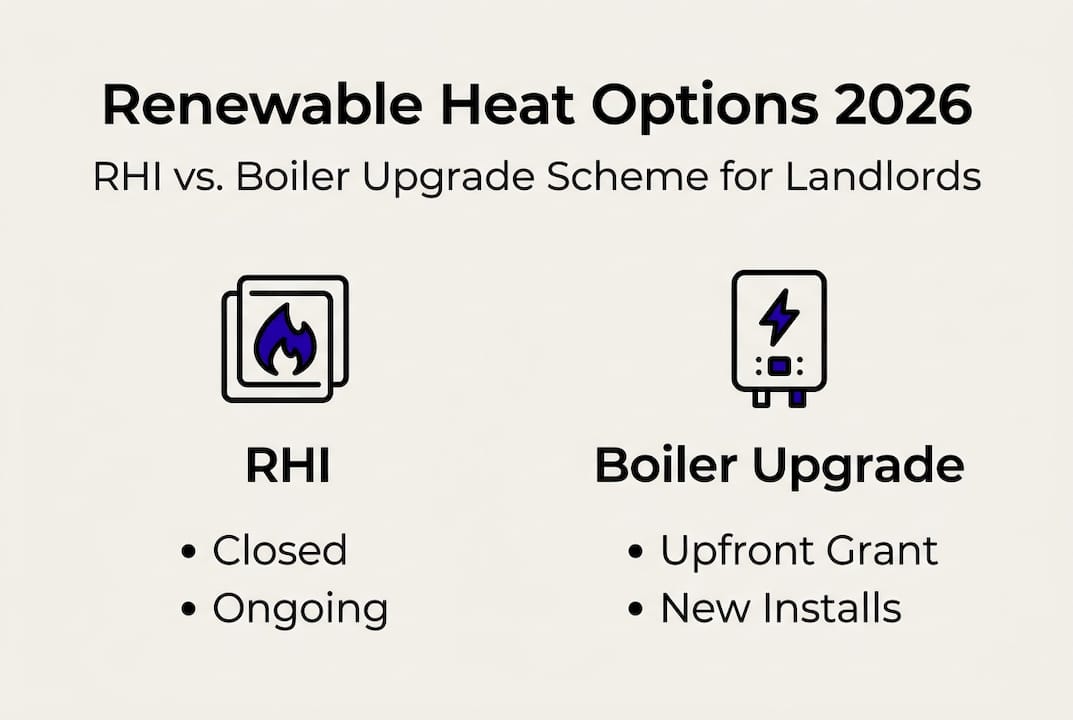
Here is a comparison of the main support routes available to property owners today:
| Feature | RHI (existing participants) | Boiler Upgrade Scheme |
|---|---|---|
| Open to new applicants | No | Yes |
| Payment structure | Quarterly, over 7 to 20 years | One-off upfront grant |
| Technologies covered | Heat pumps, biomass, solar thermal | Heat pumps, biomass boilers |
| Managed by | Ofgem | Ofgem |
| Requires valid EPC | Yes | Yes |
RHI closure has given way to the Boiler Upgrade Scheme for new applicants. The BUS offers upfront grants of up to £7,500 for air source heat pumps and up to £5,000 for biomass boilers, making it a strong option for landlords planning new installations. Unlike RHI, you receive the benefit immediately rather than over several years.
Pro Tip: If you are planning a new renewable heating installation, pair it with a review of your ventilation heat recovery options and explore all energy saving measures available. Combining technologies often improves your EPC rating more than any single upgrade alone. You can also review biomass plant standards if you are considering larger commercial biomass installations.
A property expert’s view: The real impact of RHI for London landlords
Beyond the technical details, let’s look at what actually works in practice for London landlords and property owners.
The RHI was genuinely valuable, but it was also genuinely complicated. Many London landlords rushed to install heat pumps and biomass systems in the early years of the scheme, attracted by the promise of long-term payments. A significant number then lost those payments, not because their systems failed, but because they missed compliance steps or failed to notify Ofgem of routine changes.
The landlords who benefited most were those who treated RHI not as a passive income stream but as an active obligation. They kept records, updated their EPCs regularly, and understood that the scheme rewarded diligence as much as it rewarded installation.
The lesson for 2026 is this: the incentive landscape has shifted, but the principle has not. Whether you are managing an existing RHI accreditation or exploring the Boiler Upgrade Scheme, your EPC is still the foundation of everything. Understanding EPC regulations insights for London properties is not just useful background knowledge. It is the practical starting point for every energy-related decision you make as a landlord.
Don’t treat energy compliance as a box-ticking exercise. The property owners who link incentive uptake to long-term efficiency planning are the ones who see real financial returns.
Take the next step in improving your property’s energy rating
If you are ready to take action or want expert help with your next step in energy efficiency, here is where to begin.
Whether you are an existing RHI participant keeping your accreditation compliant or a landlord exploring new routes like the Boiler Upgrade Scheme, an up-to-date EPC is your essential starting point. At Complete EPC, we provide fast, accurate EPC assessments across London, carried out by qualified assessors with extensive experience in both domestic and commercial properties. Our EPC assessment guide walks you through exactly what to expect, step by step. If you want a broader overview before booking, our guide to understanding EPCs covers everything you need to know about ratings, compliance, and improving your score. Get in touch today to book your assessment at the lowest rates in the UK.
Frequently asked questions
Can new applicants still join the Renewable Heat Incentive in 2026?
No. The domestic RHI closed to new applications in 2022, and the non-domestic scheme has also closed. Ongoing payments continue only for previously accredited systems.
What happens to RHI payments if I buy a property with an accredited system?
Payments may transfer to the new owner on property sale, but you must notify Ofgem and formally accept all scheme obligations before payments can continue in your name.
Are there alternatives to RHI for London property owners?
Yes. New projects can access the Boiler Upgrade Scheme for upfront grants on heat pumps and biomass boilers, making it the primary route for new renewable heating installations in 2026.
What compliance steps must current RHI participants take?
Ongoing compliance and reporting are required. Participants must keep EPCs updated, report any system or property changes to Ofgem promptly, and ensure all technology certifications remain valid throughout the payment period.
Recommended
- Cut Building Energy Costs 25%: London Efficiency Guide 2026
- Unlocking Energy Savings in London: Your Guide to EPC Certificates – Complete EPC
- Achieving a Higher Energy Rating: EPC Insights for London Residents – Complete EPC
- London’s Ultimate Guide to Energy Performance Certificates: Enhance Your Property’s Efficiency – Complete EPC