

TL;DR:
- Water certificates confirm a property’s water fittings meet efficiency standards, impacting legal and energy compliance.
- Accurate calculations require detailed manufacturer datasheets, site plans, and proper documentation before starting.
- Maintaining and updating certificates with any fitting changes ensures ongoing compliance and smooth property transactions.
Imagine you’re days from completing a sale or finalising a tenancy, and the deal stalls because a water certificate is missing or incorrectly calculated. It happens more often than most London property owners and agents expect. Water certificate calculations sit at the intersection of Building Regulations and energy performance compliance, and errors here can block EPC issuance, delay legal sign-off, and create unexpected costs. This guide gives you a clear, structured path through the entire process, including preparation checklists, step-by-step calculation guidance, verification tips, and an FAQ, so you can approach compliance with confidence.
Table of Contents
- What is a water certificate and why does it matter?
- What you need before starting: Key documents and data
- Step-by-step: Calculating your water certificate
- Verification and common pitfalls to avoid
- Maintaining compliance for future transactions
- A professional’s perspective: Why detail and preparation are everything
- Get expert help with water certificates and energy compliance
- Frequently asked questions
Key Takeaways
| Point | Details |
|---|---|
| Critical for compliance | Getting the water certificate right is essential for property sales, rentals, and EPCs in London. |
| Know the flow rates | You must record and use correct flow rates for all fittings to pass the 110L target. |
| Document everything | Always keep datasheets and certificates accessible for at least 6 years to avoid issues. |
| Update after changes | Update your certificate every time you swap fittings to ensure ongoing compliance. |
| Get expert help | Professional support can save you time, avoid delays, and reduce unexpected costs. |
What is a water certificate and why does it matter?
A water certificate is a document that confirms a property’s water fittings meet the efficiency targets set out under Building Regulations Part G. It is not about measuring live water flow on site. Rather, it is a paper-based assessment of the specifications of every water fitting installed, or planned for installation, in a property.
The certificate is required for new builds, certain refurbishments, and properties undergoing transactions where energy performance compliance must be demonstrated. Without it, building inspectors cannot sign off legally, and an EPC may not be issued. For landlords and estate agents, that means a delayed tenancy or a stalled sale.
Key fittings assessed include:
- WC cisterns (maximum flush volume 6/4 litres dual flush)
- Showers (maximum flow rate 8 litres per minute)
- Bath taps (maximum flow rate 8 litres per minute)
- Basin taps (maximum flow rate 6 litres per minute)
- Kitchen taps (maximum flow rate 12 litres per minute)
- Washing machines and dishwashers (rated water consumption per cycle)
As the building regulations Part G compliance guidance confirms, these fitting types and their standard rates form the foundation of every water certificate calculation.
Important: The water certificate tests what is specified on paper, not what flows through the pipes on the day of inspection. If you change a fitting after certification without recalculating, your certificate becomes invalid.
A common misconception is that the certificate is only relevant to brand-new properties. In fact, any refurbishment that introduces new or replacement water fittings may trigger the need for a fresh calculation. For London landlords managing older stock, this is a practical compliance point worth noting early.
What you need before starting: Key documents and data
With the role and significance of water certificates clear, ensure you have all necessary documents in hand before starting calculations. Rushing into the calculation without the correct data is one of the most avoidable mistakes.
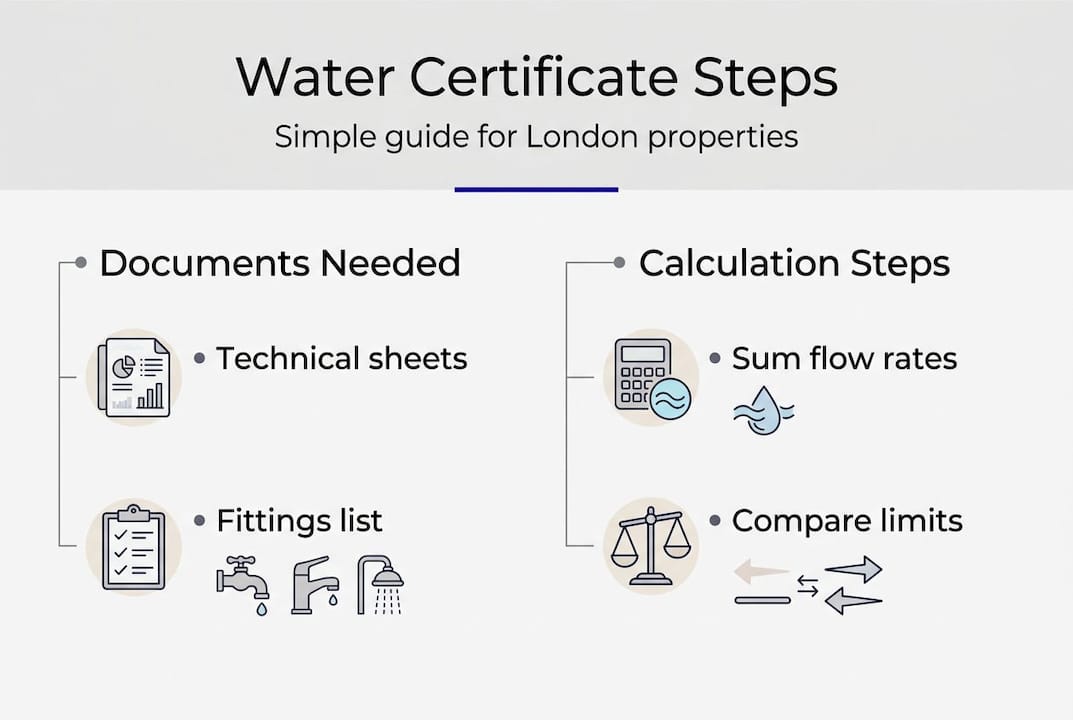
Here is what you need to gather:
- A full list of water fittings in the property, including WCs, showers, baths, taps, and water-fed appliances
- Manufacturer datasheets for each fitting, confirming rated flow rates or flush volumes
- Site plans or schematics, showing the layout and number of bathrooms, kitchens, and utility rooms
- Current EPC documentation, if the water certificate is being prepared to support an energy assessment
- Building Regulations targets, which currently set the limit at 110 litres per person per day for new dwellings
The following table summarises typical fitting types and their standard maximum rates, which underpin the calculation process as outlined in the Part G calculator guide:
| Fitting type | Maximum rate |
|---|---|
| WC (dual flush) | 6/4 litres per flush |
| Shower | 8 litres per minute |
| Bath taps | 8 litres per minute |
| Basin taps | 6 litres per minute |
| Kitchen taps | 12 litres per minute |
| Dishwasher | Manufacturer rated litres per cycle |
| Washing machine | Manufacturer rated litres per cycle |
Pro Tip: Do not rely on what is printed in a brochure. Download the official technical datasheet directly from the manufacturer’s website, as marketing materials sometimes quote lower figures than the rated maximum. Using the wrong figure could give you a falsely compliant result that fails at inspection.
Having these documents organised before you begin saves time and prevents you from having to redo calculations halfway through because a flow rate figure was missing or estimated.
Step-by-step: Calculating your water certificate
Once you have assembled your documents, it is time to work through the calculation with a structured approach. Each step builds on the last, so follow the sequence carefully.
- List every water fitting in the property. Include all WCs, showers, baths, basin taps, kitchen taps, and water-fed appliances. Note the quantity of each.
- Record the manufacturer’s rated flow rate or flush volume for each fitting from the datasheet you have gathered.
- Open the Part G water efficiency calculator, the government-backed tool used for Building Regs Part G compliance. Input each fitting’s rated value and quantity.
- Sum the total estimated daily water consumption for a typical occupant. The calculator applies standard usage assumptions (such as number of WC flushes and shower minutes per day) to produce a litres-per-person-per-day figure.
- Compare your total to the 110 litre target. If you are under 110L per person per day, the property is compliant. If you exceed it, identify which fittings are contributing most and consider product swaps.
- Produce and file the final certificate along with all supporting datasheets. This is the document your building inspector or EPC assessor will review.
| Compliance threshold | Target |
|---|---|
| Standard new dwelling | Under 110 litres per person per day |
| Optional higher standard | Under 80 litres per person per day |
Pro Tip: If your initial calculation shows you are close to the 110L limit, switching to a lower-flow shower head (for example, 6L/min rather than 8L/min) can bring you comfortably within target without significant cost.
Key figure: The 110 litre per person per day limit applies to all new homes in England under Part G of the Building Regulations. Properties in water-stressed areas, including parts of London, may face tighter local requirements.
Verification and common pitfalls to avoid
After the calculation, avoid letting simple errors derail compliance by using these checks and taking note of the most common pitfalls.
Start by cross-referencing every flow rate and flush volume you entered in the calculator against the original manufacturer datasheets. A single transposed number, for example entering 0.8 instead of 8.0 litres per minute, can produce a wildly inaccurate result. Small arithmetic errors can push you past the compliance limit without you realising it.
Common pitfalls to avoid:
- Using estimated or assumed flow rates instead of confirmed manufacturer data
- Forgetting to include appliances such as dishwashers and washing machines, which contribute meaningfully to daily consumption
- Failing to update the certificate after last-minute on-site fitting changes, for instance swapping one basin tap model for another with a higher flow rate
- Mismatching the installed fitting with the specified fitting. As the compliance guidance confirms, a mismatch between specifications and installed items is one of the most common reasons for failed compliance.
- Not retaining supporting documents. Keep all certificates, datasheets, and calculation outputs for at least 6 years, as inspectors may request evidence during future transactions or audits.
Checklist reminder: Before submitting, confirm that every fitting listed in the certificate matches what is physically installed. If a site change occurs after submission, recalculate immediately.
If your calculation reveals non-compliance, the most cost-effective fix is usually to replace high-flow fittings with water-efficient alternatives before finalising the build or refurbishment. Low-flow tap aerators and aerated shower heads are inexpensive solutions that can bring a calculation back under the 110L threshold quickly.
Maintaining compliance for future transactions
Finally, ensure ongoing compliance and stress-free transactions by maintaining your certificates and processes over time. Obtaining a water certificate is not a one-off task. It requires ongoing management, especially for landlords or developers with active property portfolios.
Here is how to stay on top of it:
- Keep digital and paper copies accessible. Store your water certificate alongside your EPC, gas safety certificate, and electrical installation report so everything is in one place when an agent or solicitor requests it.
- Review whenever a fitting changes. Any new kitchen, bathroom refurbishment, or even the addition of an outdoor tap may trigger a recalculation. As confirmed by Part G compliance guidance, changing fittings later can invalidate the original certificate if the calculation is not updated.
- Share the certificate early in any sale or let process. Providing it upfront to buyers, tenants, or their solicitors avoids last-minute requests and helps transactions proceed smoothly.
- Align certificate reviews with EPC renewal cycles. When you commission a new EPC for a major refurbishment, treat it as a trigger to review and update your water certificate at the same time.
Pro Tip: Create a simple property compliance folder (physical or digital) containing your EPC, water certificate, and key fitting datasheets. When you instruct an agent to market the property, hand over the folder immediately. It signals preparedness and avoids delays.
For London landlords managing multiple properties, a consistent record-keeping system makes future compliance reviews far less time-consuming.
A professional’s perspective: Why detail and preparation are everything
Having worked with hundreds of London property owners, landlords, and agents, one pattern stands out clearly. The water certificate calculations that clear compliance smoothly are almost always those where the owner, agent, and assessor were involved from the earliest planning stages, not at the last minute.
Cutting corners, or assuming that a product’s marketing specification is the same as its rated maximum, leads to rushed recalculations and costly delays at the worst possible time in a transaction. The certificates that fail or require resubmission are nearly always those prepared reactively.
Our practical advice is this: build water certificate checks into your overall compliance workflow from day one of planning, treating it alongside your understanding EPCs process rather than as a separate afterthought. When preparation is thorough and documentation is in order, the calculation itself is straightforward. Being meticulous upfront saves money, avoids stress, and removes the risk of costly legal delays when it matters most.
Get expert help with water certificates and energy compliance
If the calculation process feels involved or you want the reassurance of expert sign-off, Complete EPC can support you at every stage. We handle water certificate calculations, EPCs, and broader energy compliance for London properties, working through the paperwork so you can focus on your transaction. Our qualified assessors understand the detail that building inspectors and solicitors look for, and we offer rapid turnaround to keep your timelines on track. Whether you are new to the EPC assessment process or managing a complex refurbishment, contact Complete EPC today for tailored compliance support built around your property.
Frequently asked questions
Who needs a water certificate in London?
Anyone building or selling a new property, or refurbishing with new fittings, needs a water certificate to prove compliance with Building Regulations. The certificate is required for new builds and eligible refurbishments in London.
What are the main flow rate limits for water fittings in London?
The maximum WC flush is 6/4 litres dual flush, shower flow is 8 litres per minute, basin taps 6 litres per minute, and kitchen taps 12 litres per minute. These standard flow rates are set out in the Part G calculator.
How is water use calculated for the certificate?
You sum the daily use of all fittings using each fitting’s stated flow rate, then check whether the total falls under the 110 litre per person per day target. The Part G calculator applies standard usage assumptions to produce this figure.
Do I need a new certificate if I replace a tap or shower?
Yes. Any change to water fittings means you should recalculate and update your water certificate to remain compliant. Changing fittings after certification without updating your calculation can invalidate the original document.
How long should I keep water certificate records?
Keep all certificates and supporting documents for at least 6 years for compliance checks or future property transactions. Inspectors may request supporting evidence during audits or when a property changes hands.