

TL;DR:
- An EPC rating assesses a building’s energy efficiency on a scale from A to G, guiding legal compliance and property value.
- It includes current and potential scores, with the latter indicating achievable improvements and associated cost savings.
An Energy Performance Certificate (EPC) rating is a standardised measure of a building’s energy efficiency, expressed on a scale from A (most efficient) to G (least efficient). Every property sold or let in England, Wales, and Northern Ireland requires a valid EPC under current legislation. The certificate is produced by an accredited assessor using SAP (Standard Assessment Procedure) software and includes both a current rating and a potential rating showing what the property could achieve after improvements. Understanding what does the EPC rating mean for your specific property is the first step towards managing costs, meeting legal obligations, and protecting long-term value.
What does the EPC rating mean: the A to G scale explained
The EPC rating combines a letter band and a numerical score on a scale from A to G, where A covers scores of 92 to 100 and G covers scores of 1 to 20. The full breakdown is as follows:
| Band | Score range | Typical property type |
|---|---|---|
| A | 92–100 | New-build with solar panels and high insulation |
| B | 81–91 | Modern well-insulated home, heat pump fitted |
| C | 69–80 | Post-2000 semi-detached, cavity wall insulation |
| D | 55–68 | 1980s detached, gas boiler, partial insulation |
| E | 39–54 | Pre-1970s terrace, limited insulation |
| F | 21–38 | Victorian end-of-terrace, solid walls, old boiler |
| G | 1–20 | Unimproved period property, no insulation |
The numerical score is calculated by SAP or RdSAP (Reduced Data SAP) software, which models heat loss through walls, roofs, and floors, alongside heating system efficiency, glazing, lighting, and any renewable energy sources. A mid-terrace Victorian home, for example, might carry a current score of 52 (E) and a potential score of 74 © once loft insulation, cavity wall fill, and a modern boiler are installed.
The two scores on every certificate serve distinct purposes. The current rating reflects the property as assessed today. The potential rating shows what is realistically achievable within the building’s physical constraints, giving owners a clear target for investment. Assessors assign the potential rating based on the recommended measures listed in the advisory section of the certificate, so the two figures should always be read together.
Understanding the band boundaries matters because the difference between a D and a C is not merely cosmetic. It affects mortgage eligibility for green products, rental legality, and resale value in ways that a single letter can obscure.
Why does the EPC rating matter legally and financially?
EPCs are legally required for sale or letting and remain valid for ten years. Failing to provide one at the point of marketing can result in a £200 penalty per property. Typical assessment costs range from £65 to £120, making compliance one of the most cost-effective legal obligations a property owner faces.
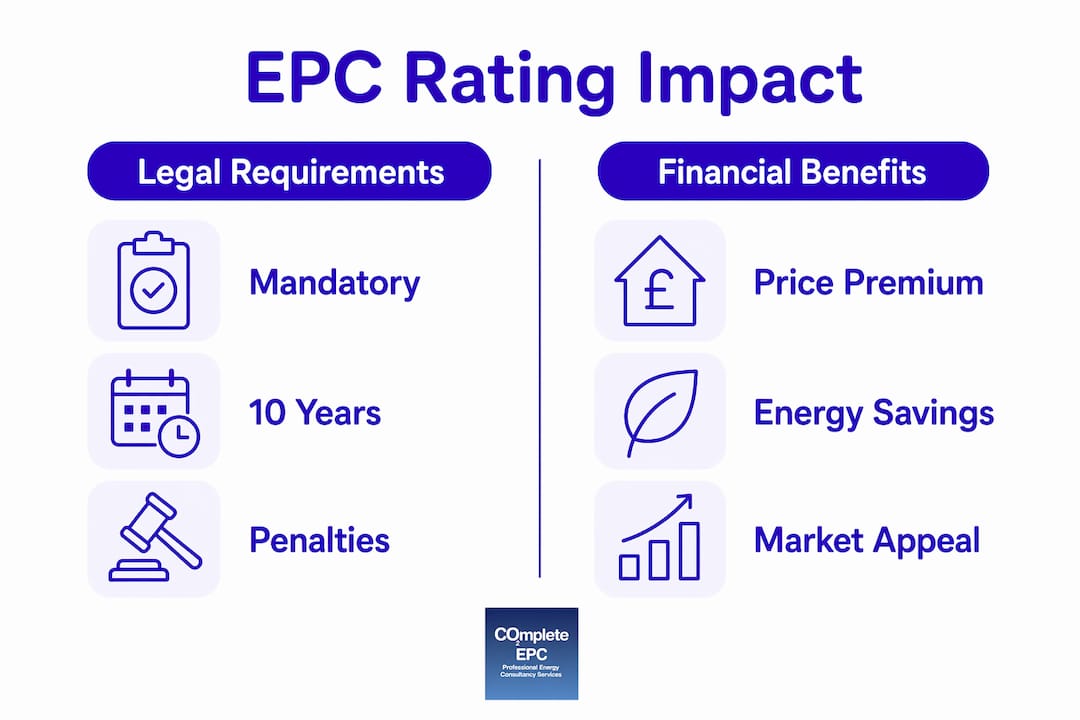
The financial stakes extend well beyond the fine. Properties rated A or B command a price premium of 5% to 14% over D-rated equivalents. Moving a property from E to C can add between £8,000 and £20,000 to its market value. That is a return that most cosmetic refurbishments cannot match. Approximately 19 million UK homes were rated D or below as of May 2026, which means the majority of the housing stock sits in territory where upgrades carry measurable financial upside.
For landlords, the picture is sharper still. Under current Minimum Energy Efficiency Standards (MEES), rental properties in England and Wales must meet a minimum EPC band. Energy-efficient properties achieve measurable rental premiums and lower void periods, particularly in London and the South East, where tenant demand for lower energy bills is strongest. RICS standards now require surveyors to integrate EPC ratings directly into valuations, so the rating is no longer a footnote on a sales brochure. It is a material factor in how a property is priced.
Pro Tip: Treat your EPC as a risk management document, not just a compliance tick-box. A low rating today signals future capital expenditure, potential rental restrictions, and reduced buyer appetite. Addressing it proactively is cheaper than reacting under pressure.
“EPCs serve as compliance tools but also strategic risk management documents for landlords, requiring active interpretation beyond the rating.”
What are the limitations of EPC ratings?
The EPC rating is a modelled, theoretical score. It does not capture actual occupant behaviour or real energy consumption. A household that heats every room to 23°C around the clock will spend far more than the certificate suggests, while a careful occupant in the same property may spend considerably less. The score tells you about the building’s fabric and systems, not how people use them.
Assessors also rely on conservative default assumptions when physical evidence is absent. If an assessor cannot confirm the type of insulation in a cavity wall, they will apply the worst-case default, which lowers the score. Providing installation photos or invoices at the time of assessment can prevent this and may raise the rating by one full band in some cases.
This is where retrofit assessments offer something the standard EPC cannot. A retrofit assessment costs between £150 and £400 and provides a detailed upgrade pathway with technical specifications, costings, and sequencing advice. The comparison below illustrates the key differences:
| Feature | Standard EPC | Retrofit assessment |
|---|---|---|
| Cost | £65–£120 | £150–£400 |
| Legal validity | Yes (10 years) | No |
| Actual usage modelled | No | Partial |
| Upgrade recommendations | Generic | Detailed and costed |
| Technical specifications | No | Yes |
| Useful for grant applications | Limited | Yes |
Retrofit assessments are particularly valuable for older properties rated E, F, or G, where the gap between current and potential ratings is large and the upgrade decisions are complex. They complement the EPC rather than replace it. For straightforward modern properties, the standard certificate is usually sufficient.
Pro Tip: Before your assessor visits, gather any documentation for improvements already made: boiler installation certificates, insulation guarantees, and window energy ratings. Handing these over at the start of the assessment prevents conservative defaults and gives you the most accurate rating possible.
How to use your EPC rating to improve efficiency and value
Reading your EPC correctly means looking beyond the letter grade. The advisory section lists specific recommended measures, each with an estimated cost range, potential saving, and the impact on your current and potential scores. These recommendations are the starting point for any upgrade plan.
A practical approach to prioritising improvements follows this sequence:
- Address the heating system first. Replacing an old gas boiler with a modern condensing boiler or a heat pump typically delivers the largest single score improvement for most D and E-rated homes.
- Insulate before you ventilate. Loft insulation and cavity wall fill are low-cost, high-impact measures. Solid wall insulation costs more but is often necessary for pre-1920s properties.
- Upgrade glazing strategically. Moving from single to double glazing improves comfort and score, but the return on investment is slower than insulation measures.
- Add renewables last. Solar photovoltaic panels and battery storage push scores into B and A territory, but they perform best on a well-insulated building.
- Update lighting. Switching to LED throughout is inexpensive and contributes to the score, particularly in larger properties. Commercial lighting upgrades follow similar principles for non-domestic buildings.
Government support is available to reduce the cost of these works. The Warm Homes Plan prioritises retrofit investment for older homes rated D or below, with grants and subsidised loans accessible through local authorities and energy suppliers. Checking eligibility before commissioning works can significantly reduce out-of-pocket costs.
Two common misconceptions are worth addressing directly. First, the cheapest recommended measure is not always the best one. Compliance-driven recommendations and those that genuinely future-proof a property are not always the same thing. Second, a C rating is not a ceiling. Many owners stop at C because it satisfies current rental requirements, but moving to B or A unlocks green mortgage products and stronger resale premiums.
For properties with high retrofit potential, a phased improvement plan spread over two to three years is often more financially manageable than attempting everything at once, and it allows you to capture grant funding as schemes evolve.
Key takeaways
An EPC rating is a legal requirement and a financial signal: understanding it fully determines whether you comply, save money, and protect your property’s value.
| Point | Details |
|---|---|
| EPC scale runs A to G | Scores range from 1 to 100, with A (92–100) being most efficient and G (1–20) least. |
| Two ratings on every certificate | The current rating reflects today’s state; the potential rating shows what upgrades can achieve. |
| Legal and financial stakes are high | Non-compliance carries a £200 penalty; A or B-rated homes command up to 14% price premiums. |
| EPCs have real limitations | Modelled scores exclude occupant behaviour; retrofit assessments provide deeper, costed guidance. |
| Evidence improves accuracy | Providing invoices and installation records at assessment prevents conservative defaults. |
EPCs are more useful than most owners realise
Most property owners treat the EPC as a form to obtain before a sale or letting. That is understandable, but it leaves a significant amount of value on the table. In my experience working with London properties across a wide range of ages and types, the owners who get the most from their EPC are those who read the advisory section carefully and treat the potential rating as a project brief rather than a theoretical number.
The gap between current and potential ratings is where the real story lives. A property sitting at E with a potential of C is not just a compliance problem. It is a property where £8,000 to £20,000 of value is waiting to be unlocked, often through measures that qualify for government grant support. The Warm Homes Plan has made this more accessible than at any point in the past decade.
One thing I would caution against is treating all EPC recommendations as equal. The certificate lists measures in order of cost-effectiveness for the score, not in order of what is best for the building or the occupant. A landlord who installs the cheapest measure to reach band C and stops there may find themselves back in non-compliance territory if minimum standards tighten further. Thinking one band ahead of current requirements is a far more resilient strategy.
The interaction with your assessor also matters more than most people appreciate. Assessors are not trying to produce a low rating. They are constrained by what they can verify. Arriving at an assessment with a folder of boiler certificates, insulation guarantees, and window energy ratings is not pedantic. It is the single most cost-free action you can take to get an accurate result.
— Danny
Get your EPC assessment right with Completeepc
Completeepc provides professional EPC assessments for domestic and commercial properties across London, carried out by qualified assessors with extensive field experience. Whether you need a certificate for a sale, a letting, or a planned upgrade programme, the EPC assessment process is straightforward and priced competitively. For a full overview of what an EPC covers and how it applies to your property, the London EPC guide from Completeepc covers legal requirements, rating scales, and improvement strategies in detail. If you want to understand how your current rating compares and what improvements could do for your property’s value, explore the EPC rating service to get started.
FAQ
What is an EPC rating and why do I need one?
An EPC rating measures a property’s energy efficiency on a scale from A (most efficient) to G (least efficient) using a numerical score from 1 to 100. It is legally required for any property being sold or let in England, Wales, and Northern Ireland.
How long is an EPC valid for?
An EPC is valid for ten years from the date of issue. A new assessment is only required if the certificate expires or if significant energy-related improvements have been made and you wish to update the rating.
Can I improve my EPC rating before selling or letting?
Yes. The advisory section of your EPC lists specific measures, such as loft insulation, boiler replacement, or double glazing, that will raise your score. Completing these works and obtaining a new assessment will reflect the improvements in your rating.
What is the difference between the current and potential EPC rating?
The current rating reflects the property’s energy efficiency as assessed today. The potential rating shows the score achievable after all recommended improvements are made, giving owners a realistic target for planned upgrades.
What happens if I do not have a valid EPC?
Failing to provide a valid EPC when marketing a property for sale or let can result in a £200 penalty. Estate agents and letting agents are also legally obliged to include the EPC rating in property listings.