
TL;DR:
- A domestic energy assessor is a trained professional responsible for inspecting residential properties and producing legally recognized Energy Performance Certificates. Their qualifications and accreditation ensure the accuracy of EPCs, which are essential for legal compliance, property value, and energy efficiency assessments. The upcoming transition to the Home Energy Model in late 2027 will require assessors to update their practices, potentially affecting EPC standards and ratings.
If you own or rent out property in the UK, you have almost certainly encountered the term “domestic energy assessor” without fully understanding what one actually does or why it matters. A domestic energy assessor, formally known as a DEA, is a trained and accredited professional responsible for evaluating the energy efficiency of residential properties and producing legally recognised Energy Performance Certificates. Many landlords assume an EPC is simply a bureaucratic box to tick, but the assessor behind that certificate, and the quality of their work, has real consequences for your compliance, your costs, and your property’s value.
Table of Contents
- Key takeaways
- What is a domestic energy assessor and why do landlords need one?
- Qualifications and accreditation explained
- How an energy assessment is conducted
- Why assessor expertise directly affects your EPC
- Practical tips for working with an assessor
- My perspective on assessor quality
- How Completeepc can help with your assessment
- FAQ
Key takeaways
| Point | Details |
|---|---|
| DEA role defined | A domestic energy assessor inspects properties and produces legally required Energy Performance Certificates. |
| Qualifications matter | DEAs must hold a Level 3 qualification and belong to an accredited scheme to practise legally. |
| Legal compliance | Private rented properties in England and Wales must hold a valid EPC before marketing or letting. |
| Assessment accuracy | Incomplete property information forces assessors to use default assumptions, reducing EPC reliability. |
| Methodology changing | The RdSAP system is transitioning to the Home Energy Model from late 2027, affecting how EPCs are produced. |
What is a domestic energy assessor and why do landlords need one?
A domestic energy assessor is a qualified professional who conducts domestic energy assessments on residential buildings. Their primary output is the Energy Performance Certificate, a document that rates a property’s energy efficiency on a scale from A (most efficient) to G (least efficient). This certificate is not optional. Private rented homes in England and Wales must hold a valid EPC before they can be marketed or let, and the minimum standard requires a rating of band E or above unless a formal exemption applies.
The domestic energy assessor role sits at the intersection of technical expertise and legal compliance. DEAs are not energy efficiency advisors in a general sense, though they do provide improvement recommendations as part of the EPC report. Their core function is to gather standardised data about your property, analyse it using approved software, and produce a certificate that meets government requirements.
Here is what a DEA is responsible for in practice:
- Conducting a site visit to inspect the property’s physical characteristics
- Collecting data on insulation, heating systems, windows, and building materials
- Using approved calculation software to determine an energy rating
- Producing an EPC report that includes a current rating and a potential rating if recommended improvements are made
- Lodging the completed certificate on the national EPC register
Geographic variations also apply. In Scotland, the rules are administered separately, and assessors must meet additional requirements specific to Scottish regulations. England and Wales operate under a shared framework, but Scotland’s accreditation scheme has its own distinct structure and oversight body. If your property portfolio spans different nations, this distinction is worth understanding before you book an assessment.
Qualifications and accreditation explained
Not everyone who shows up to inspect your property is qualified to produce a legally valid EPC. To practise as a DEA, an individual must complete a Level 3 qualification in Domestic Energy Assessment. This is a nationally recognised vocational qualification that covers the technical knowledge and practical skills required to assess residential buildings accurately.
Beyond the qualification itself, DEAs must join an accreditation scheme. These schemes are managed by government-approved bodies and serve as the professional gatekeepers for the industry. Accreditation involves several stages:
- Completing the required Level 3 training and passing formal assessments
- Submitting an application to an accreditation scheme, which includes a DBS (Disclosure and Barring Service) check
- Demonstrating competence through practical assessment exercises
- Maintaining active membership, which requires ongoing professional development and adherence to a code of conduct
- Passing periodic audits of completed EPC work to confirm consistent quality
In Scotland, the process is more prescriptive. Scottish EPC assessors must be members of the Scottish EPC Accreditation Scheme and belong to an Approved Organisation, known as an AO. These AOs are responsible for ensuring their member assessors are fit, proper, and competent to practise. They oversee ongoing quality assurance and professional development, giving the Scottish system a structured layer of oversight that benefits both assessors and property owners.
Pro Tip: Before booking an assessment, ask the assessor which accreditation scheme they belong to and verify their membership directly on that scheme’s website. This takes two minutes and protects you from unqualified practitioners.
The importance of energy assessors being properly accredited cannot be understated. An EPC produced by an unaccredited individual has no legal standing. It cannot be lodged on the national register, and it offers you no protection if your compliance is ever questioned.
How an energy assessment is conducted
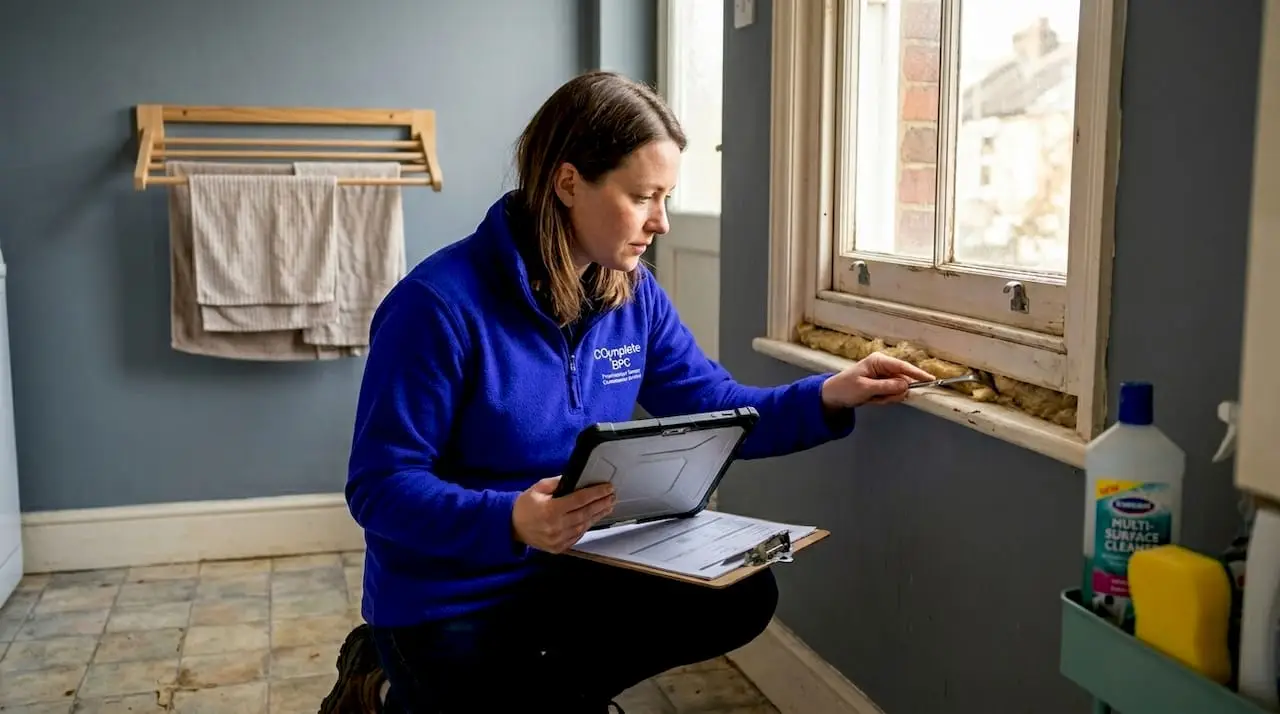
When a DEA visits your property, the process is non-invasive. They are not there to take things apart or carry out any form of structural investigation. Instead, they conduct a systematic visual inspection of every element that affects energy performance.

EPC data collection covers insulation in the roof, walls, and floors, as well as the heating system, hot water provision, windows and glazing, and the overall construction of the building. The assessor takes measurements, photographs, and notes. They look for evidence of cavity wall insulation, the type and age of the boiler, the presence of double or triple glazing, and any renewable energy installations such as solar panels.
All of this information is then fed into software called RdSAP, which stands for Reduced Data Standard Assessment Procedure. The software calculates the property’s energy consumption and carbon emissions, translating those figures into the familiar A to G rating.
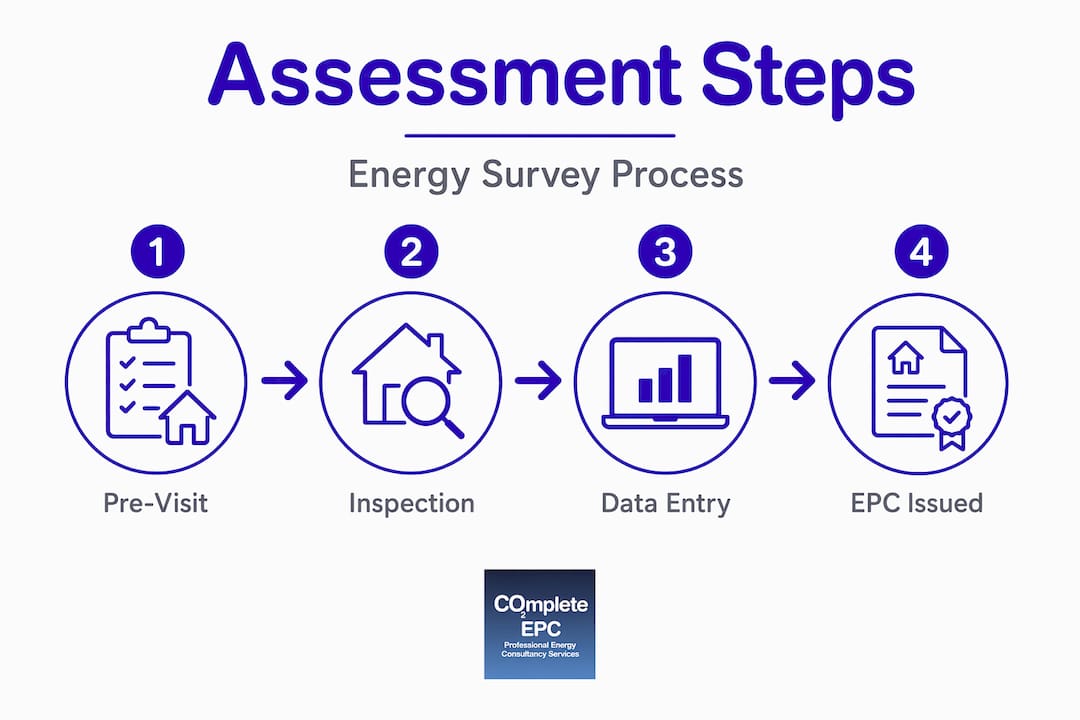
The table below outlines the key stages of a typical assessment visit:
| Stage | Activity | Output |
|---|---|---|
| Pre-visit | Assessor reviews property type and access arrangements | Prepared checklist and equipment |
| Site inspection | Visual survey of insulation, glazing, heating, and building fabric | Measurement data and photographs |
| Data entry | Information entered into RdSAP software | Draft energy rating and calculations |
| EPC production | Certificate generated with current and potential ratings | Completed EPC report |
| Lodgement | Certificate submitted to national EPC register | Legally valid, searchable EPC |
One significant change is on the horizon. The RdSAP to Home Energy Model transition is scheduled to begin in late 2027, with both systems running concurrently until at least October 2029. The Home Energy Model, or HEM, will produce more detailed and accurate assessments, but it will also require assessors to undergo retraining and adopt new software. For landlords, this means EPCs commissioned near the transition period may be assessed differently than those produced today.
Pro Tip: If you are planning property upgrades alongside an EPC, time your assessment strategically. Commissioning an EPC immediately after installing new insulation or a heat pump, rather than before, will reflect those improvements in your rating and potentially push you into a higher band.
Why assessor expertise directly affects your EPC
Here is something many property owners do not realise: the accuracy of your EPC depends significantly on the quality of the individual assessor, not just the software they use. When an assessor cannot verify a particular feature of your property through visual inspection, perhaps because insulation is not visible or documentation is unavailable, they are required to input a default assumption. These defaults are conservative, and they tend to pull your energy rating down.
Missing or incomplete data forces assessors to rely on assumptions that may not reflect your property’s actual performance, reducing the reliability of the final certificate. A property with excellent cavity wall insulation, for example, might not receive credit for it if the assessor cannot visibly confirm it and you have no installation certificate to hand.
Quality assurance measures exist to address this risk. Accreditation schemes require assessors to submit a proportion of their completed EPCs for audit, which can include on-site inspections. Approved Organisations in Scotland maintain specific quality assurance procedures to keep EPC standards consistent and trustworthy. Ongoing training is also mandatory across accreditation bodies in all regions.
Government research confirms that assessor data quality is one of the most significant factors affecting EPC outcomes and the effectiveness of energy efficiency policy overall.
For landlords, a poor quality EPC is not just an inconvenience. If your property is incorrectly rated below the minimum band E requirement, you may face unnecessary costs trying to improve a rating that was already achievable. Conversely, an inflated rating could create compliance risk if the property is ever reassessed.
Practical tips for working with an assessor
Knowing how to prepare for an assessment, and how to choose the right professional, makes a genuine difference to the quality of your EPC. These steps will help you get the most from the process:
- Gather your documentation in advance. Boiler manuals, installation certificates for insulation, window guarantees, and any retrofit invoices help the assessor confirm property features rather than relying on defaults. This alone can improve your rating.
- Verify the assessor’s accreditation. Use the relevant scheme’s online register to confirm they are currently active members in good standing. Do not simply take their word for it.
- Time the assessment well. If you are planning any energy improvements, complete them before the assessment visit, not after. Upgrades installed after an EPC is lodged will not appear on that certificate.
- Read the recommendations section. The EPC report includes a list of suggested improvements and their estimated impact on your rating. This is genuinely useful for planning future upgrades and understanding where your property currently loses the most energy.
- Keep the certificate accessible. Landlords must provide a copy of the valid EPC to prospective tenants before they sign. Keep digital and physical copies organised by property.
With the methodology shift to HEM approaching, it is also worth speaking to your assessor about timing if your EPC is due for renewal close to 2027. An EPC is valid for ten years, so a certificate produced now under RdSAP will remain valid until it expires, regardless of the new system.
My perspective on assessor quality
In my experience, the conversation around EPCs almost always centres on the certificate itself, and very rarely on the person producing it. I have seen landlords shop purely on price, booking the cheapest available assessor without checking their credentials or experience. That approach consistently creates problems down the line.
What I have learned is that a thorough, experienced DEA is worth paying for. The difference between a generic default assumption and a properly evidenced data point might be the difference between a D and a C rating. That difference matters enormously as energy efficiency standards tighten across the private rental sector.
The upcoming transition to the Home Energy Model adds another layer of complexity. I think landlords who are planning multiple assessments or significant property upgrades over the next few years should be talking to their assessors now about how timing affects their compliance strategy. The best assessors are already having those conversations with their clients. The ones who are not may leave you exposed as the regulatory environment shifts.
My advice is simple: treat your DEA as a professional partner, not a commodity service. The quality of that relationship directly affects the quality of your EPC, and your EPC directly affects your legal standing as a landlord.
— Danny
How Completeepc can help with your assessment
Completeepc provides accredited domestic energy assessments for property owners and landlords across London, handled by qualified DEAs with hands-on industry experience. Whether you need an EPC for a sale, a let, or a compliance review, the team makes the process straightforward and the results reliable.
You can find a detailed breakdown of what to expect on the EPC assessment guide page, which walks through each stage of the process for London properties. For a broader understanding of what EPCs mean for your property and obligations, the guide to energy performance certificates is a practical starting point. Completeepc also offers guidance on how working with a qualified energy assessor can support both compliance and long-term property value.
FAQ
What does a domestic energy assessor do?
A domestic energy assessor conducts a visual inspection of a residential property, collects data on insulation, heating, glazing, and building materials, and uses approved software to produce an Energy Performance Certificate.
What qualifications does a domestic energy assessor need?
DEAs must hold a Level 3 qualification in Domestic Energy Assessment and maintain active membership with an approved accreditation scheme, which includes ongoing audits and professional development.
How long is an EPC valid for?
An Energy Performance Certificate is valid for ten years from the date of issue and must be renewed before that period expires if the property is sold or re-let.
What happens if my EPC rating is too low to rent legally?
Properties in England and Wales rated F or G cannot legally be let without a registered exemption. Landlords must commission improvements to reach at least band E before marketing the property.
Will EPC assessments change in the future?
Yes. The RdSAP methodology currently used to produce EPCs is transitioning to the Home Energy Model from late 2027, with both systems running concurrently until at least October 2029, requiring assessors to retrain and adopt updated software.