

TL;DR:
- A good EPC rating in the UK is widely considered to be band C, which signifies a property is energy-efficient and cost-effective. Ensuring your property meets this standard is essential for legal compliance and market competitiveness, especially with upcoming regulations requiring rental properties to achieve it by 2030. Simple, inexpensive measures like insulation and LED lighting can often improve ratings without significant investment, helping property owners prepare efficiently.
If you own or rent a property in London, understanding what is a good EPC rating is no longer just useful knowledge. It directly affects your energy bills, your legal obligations, and the market value of your home. EPC ratings run from A to G, with A being the most efficient and G the least. Most people know their rating exists on their certificate, but far fewer understand what it actually means or what standard they should be aiming for. This guide covers what defines a good rating, why band C has become the benchmark that matters most, and how you can realistically achieve it.
Table of Contents
- Key takeaways
- What is a good EPC rating?
- Why band C is considered a good EPC score
- Common misconceptions about EPC ratings
- How to improve your EPC rating in London
- My take on EPC compliance in London
- Get expert EPC support from Completeepc
- FAQ
Key takeaways
| Point | Details |
|---|---|
| Band C is the target | The government requires all rental properties to achieve a minimum EPC band C rating by 2030. |
| Average UK home falls short | The average rating in England and Wales is band D, meaning most properties need improvement. |
| Penalties are significant | Landlords who let below EPC rating E face fines of up to £30,000 per property under current MEES rules. |
| Cheap fixes often work best | Simple measures like loft insulation and LED lighting frequently push a D-rated home into band C. |
| New metrics are coming | Government proposals will add four headline metrics beyond the traditional A to G scale, changing how performance is assessed. |
What is a good EPC rating?
An Energy Performance Certificate, or EPC, is a formal assessment of how energy efficient a property is. It rates your building on a scale from A to G based on SAP (Standard Assessment Procedure) points, and every property bought, sold, or rented in England and Wales legally requires one.
Here is how the bands break down:
| Band | SAP points | Description |
|---|---|---|
| A | 92 to 100 | Most efficient |
| B | 81 to 91 | Very efficient |
| C | 69 to 80 | Good |
| D | 55 to 68 | Average |
| E | 39 to 54 | Below average |
| F | 21 to 38 | Poor |
| G | 1 to 20 | Least efficient |
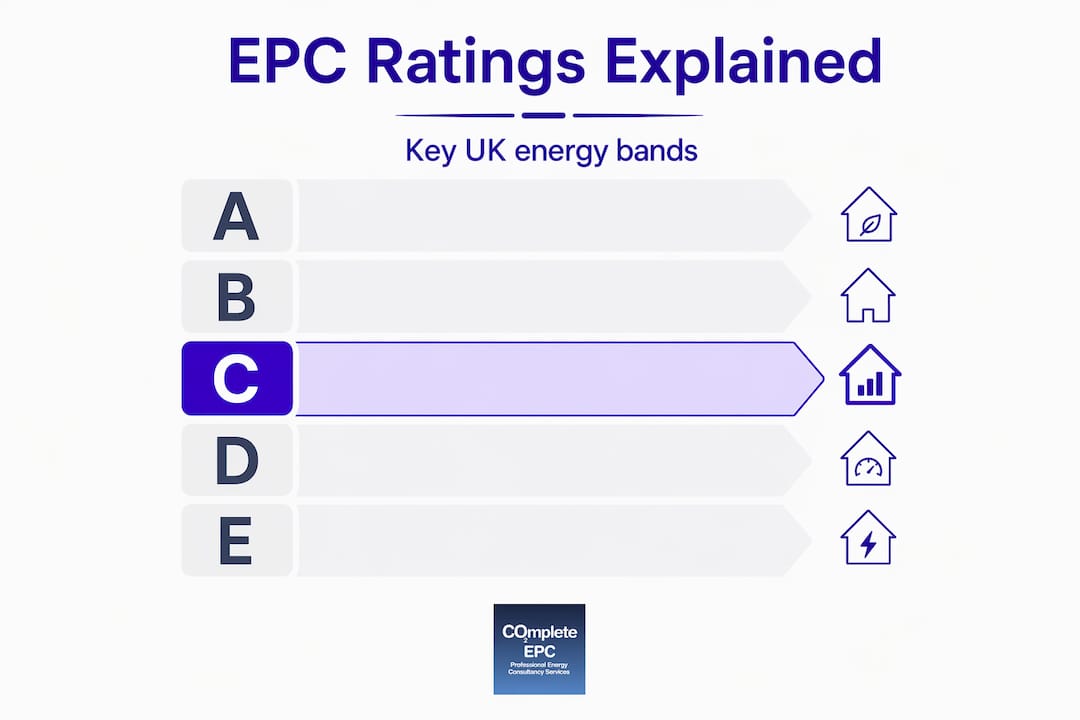
So, what is a good EPC score? Band C, spanning 69 to 80 SAP points, is widely accepted as the standard that defines a good rating. Properties in bands A and B are excellent, but they represent a small proportion of UK housing stock. Band C is the realistic and legally significant target for most property owners today.
Understanding EPC ratings also means understanding where the legal floor currently sits. Under the Minimum Energy Efficiency Standards (MEES), landlords cannot legally let residential properties rated below band E. That threshold will rise significantly by 2030, which is why acting now makes practical and financial sense.
Why band C is considered a good EPC score
Band C has become the defining benchmark, and not by accident. The government’s 2030 rental minimum requires all privately rented properties to achieve at least a band C rating. With 2.8 million rental properties currently rated D or below in the UK, the scale of required upgrades is substantial.
A typical band C home has cavity wall insulation, loft insulation, a modern condensing boiler, and costs approximately £900 to £1,200 per year to heat. That is a meaningful saving compared to band D or E properties, where annual heating bills can run considerably higher for a similarly sized home.

The market implications are also clear. Properties below band C increasingly attract value discounts as buyers and tenants factor running costs into their decisions. With energy prices remaining elevated, tenants in London are actively comparing EPC ratings when choosing between properties. A band D flat sitting next to a band C flat at the same rent is at a real disadvantage.
Here is what achieving band C typically means for your property:
- Annual energy costs of roughly £900 to £1,200, compared to £1,500 or more for band D or E
- Compliance with the 2030 MEES mandate for rental properties
- Stronger appeal to prospective tenants and buyers in a competitive London market
- Lower carbon emissions contributing to sustainability goals
“Band C is rapidly becoming the market baseline. Rising energy costs mean that tenants and buyers are no longer treating energy efficiency as a bonus. They are treating it as a requirement.” — industry analysis
Common misconceptions about EPC ratings
Many property owners assume that fitting the latest heating technology will always push their rating up. That is not necessarily true. Switching to some alternative heating systems, such as biomass boilers, can sometimes lower an EPC rating because the SAP calculation methodology favours well-established, efficient systems rather than newer alternatives in certain configurations.
Another common misunderstanding is that the EPC rating reflects the actual comfort or warmth of a property. It does not. The rating is calculated under standardised occupancy assumptions. A well-insulated period conversion in Islington and a brand-new flat in Canary Wharf might both sit at band C, but their real-world energy performance can differ based on occupant behaviour, window quality, and thermal bridging that the standard assessment does not fully capture.
Four common misconceptions worth addressing:
- “A high EPC rating means low bills guaranteed.” The rating predicts costs under standard conditions. Actual bills depend on your usage, the number of occupants, and energy tariffs.
- “Expensive heating upgrades are the fastest route to a better rating.” The most effective improvements are often inexpensive fabric measures, not boiler replacements.
- “My EPC is valid forever.” EPCs are valid for ten years, but if you carry out significant improvements, getting a new assessment sooner reflects your current rating accurately.
- “Band E is fine for now.” With the 2030 compliance deadline approaching, band E properties need a plan in place well before the mandate kicks in.
The regulatory picture is also evolving. Government proposals aim to add four new headline metrics beyond the traditional A to G scale, covering fabric performance, heating efficiency, smart readiness, and energy cost. This shift towards broader building evaluation signals that property owners should think about performance holistically, not just as a letter on a certificate.
Pro Tip: If your property sits at 65 to 68 SAP points, you are very close to band C. Request a copy of your current EPC report and review the recommended measures listed on it. An assessor can often identify one or two low-cost changes that would push you over the threshold.
How to improve your EPC rating in London
The good news is that reaching band C is often more achievable than many landlords expect. Many D-rated London properties are only a few SAP points away from the threshold, and targeted improvements can close that gap without major expenditure.
Your EPC report already contains a list of recommended measures ranked by cost-effectiveness. Start there. The report is your roadmap, and the measures listed are specific to your property’s construction type, heating system, and current insulation levels. Following these recommendations is far more efficient than guessing.
The improvements that consistently deliver the strongest SAP gains include:
- Loft insulation: Adding or topping up loft insulation to 270mm is one of the single most cost-effective measures available, with payback periods often under three years for London properties.
- Cavity wall insulation: Many 1930s to 1990s London properties have unfilled cavities. Filling them can add five to ten SAP points at a relatively modest cost.
- LED lighting: Replacing all fixed lighting with LEDs is quick, inexpensive, and contributes measurable SAP points because the calculation accounts for lighting energy use.
- Boiler upgrade: If your boiler is over fifteen years old, replacing it with an A-rated condensing boiler typically delivers a significant rating improvement. This is more expensive but often worth it for properties that are currently at band E or F.
- Smart heating controls: Adding a programmer and room thermostat where none currently exists can contribute to your SAP score and reduce actual energy consumption.
SAP scoring accounts for fabric performance, heating efficiency, and lighting, among other factors. Understanding which components are dragging your score down allows you to prioritise spend effectively rather than investing in upgrades that make little difference to the calculated rating.
Pro Tip: Several government grant schemes, including the Great British Insulation Scheme, may cover part or all of the cost of insulation improvements for eligible properties. Check eligibility before paying full price for works your EPC report recommends.
Cost and payback are naturally front of mind for London landlords managing multiple properties. Loft and cavity wall insulation typically cost between £300 and £900 depending on property size, with payback in energy savings achievable within a few years. LED lighting across a whole property can cost under £200. These measures sit at a very different investment level from a full heat pump installation, which may cost £8,000 or more and, as noted above, does not always deliver a proportionate rating improvement under current SAP methodology.
For a clearer view of what your specific property needs, a professional EPC assessment will give you an accurate current rating and a prioritised list of recommended improvements. This is the most reliable starting point, particularly if your existing certificate is several years old or if you have already carried out some works since it was issued. You can learn more about the EPC assessment process if you want to understand exactly what an assessor reviews during a visit.
My take on EPC compliance in London
I have worked with a large number of London property owners over the years, and one pattern I see repeatedly is the assumption that reaching band C will require disruptive and expensive building works. In the majority of cases I encounter, that simply is not true.
A terrace house in Lewisham rated at band D with untreated cavities and older lighting can often reach band C with insulation work and LED replacements costing less than £1,000 in total. That is genuinely achievable for most landlords well ahead of the 2030 deadline, and it delivers real savings on energy bills at the same time.
Where I think people go wrong is by looking at the problem backwards. They see “band C” on a regulation notice and immediately think about heat pumps or whole-house retrofits. The smarter approach is to look at your existing EPC report, identify your current SAP score, and calculate exactly how many points you need to gain. Often, it is fewer than ten points, and the cheapest measures on your report will get you there.
My other strong recommendation is to get a fresh assessment if your EPC is more than five years old. Properties change, assessors refine their methodologies, and a rating from 2017 may not reflect works you have since completed. I have seen properties sitting on outdated band D ratings that, once reassessed, came out comfortably at band C with no additional works needed at all.
The regulatory direction of travel is clear. Whether you are a landlord preparing for the 2030 mandate or an owner-occupier looking to understand the benefits of an EPC, now is the right time to know exactly where your property stands.
— Danny
Get expert EPC support from Completeepc
If you are a London property owner or landlord looking to understand your current rating and what it will take to reach band C, Completeepc can help. The team provides professional EPC assessments across London using qualified, experienced assessors, delivering accurate reports with clear improvement recommendations. Whether you need a new certificate for a property transaction, a compliance check ahead of the 2030 deadline, or straightforward advice on prioritising improvements, Completeepc offers a reliable, cost-effective service. Start with a full EPC rating guide to see how your property can be assessed and improved in 2026. You can also explore the complete London EPC guide for detailed guidance on how the process works from start to finish.
FAQ
What EPC rating is considered good in the UK?
Band C, covering 69 to 80 SAP points, is widely considered a good EPC rating and is the government’s target minimum for all rental properties by 2030. Bands A and B are better still, but band C represents a strong and legally significant standard.
What is the minimum EPC rating required for landlords?
Under current Minimum Energy Efficiency Standards, landlords cannot legally let residential properties below EPC band E. This minimum will rise to band C for all rental properties by 2030, with penalties of up to £30,000 per property for non-compliance.
How can I improve my EPC rating cheaply?
The most cost-effective improvements are usually loft insulation, cavity wall insulation, and LED lighting. These can add several SAP points at relatively low cost and are often sufficient to move a D-rated property into band C without major works.
How long does an EPC last?
An EPC is valid for ten years. However, if you carry out significant improvements to your property, it is worth commissioning a new assessment sooner so your certificate accurately reflects your current rating.
Will the EPC rating system change?
Government proposals published in 2026 outline plans to add four new headline metrics beyond the A to G scale, covering fabric performance, heating efficiency, smart readiness, and energy cost. Property owners should monitor these changes as they will affect how performance is assessed and reported.