

TL;DR:
- Achieving an EPC C rating is the practical compliance target for landlords by 2030, with fines for non-compliance exceeding £30,000.
- The best EPC rating is one that meets legal requirements efficiently through targeted improvements rather than aiming solely for the highest grade.
If you own or let property in the UK, you have almost certainly asked what is the best EPC rating you can achieve and whether it actually matters. The answer is more nuanced than most guides admit. An Energy Performance Certificate rates a building’s energy efficiency on a scale from A to G, and while an A grade looks impressive on paper, it is rarely the most practical goal for the majority of landlords. What matters far more is understanding where your property sits today, what the law currently requires, and what regulations will demand by 2030.
Table of Contents
- Key takeaways
- The EPC rating scale explained
- Regulatory standards and landlord obligations
- What actually makes a rating the “best” for you
- The Home Energy Model and what it changes
- My honest view on EPC ratings as an investment tool
- Get expert EPC support from Completeepc
- FAQ
Key takeaways
| Point | Details |
|---|---|
| Rating C is the compliance target | Landlords must achieve a minimum EPC C rating for rental properties by 2030 or face fines up to £30,000. |
| Context defines “best” | The best rating is one that meets legal requirements cost-effectively, not necessarily the highest possible grade. |
| Low-cost wins exist | Targeted improvements like loft insulation can add meaningful EPC points without large capital outlay. |
| New methodology arriving | The Home Energy Model replaces the single letter grade from late 2027, introducing four separate performance metrics. |
| Documentation protects your score | Keeping invoices and photos of improvements lets assessors use actual data rather than conservative assumptions. |
The EPC rating scale explained
Before deciding what the best energy performance certificate looks like for your property, you need to understand what the grades actually represent. The EPC rating scale runs from A at the top to G at the bottom. Each band corresponds to a numeric score, and those scores reflect estimated energy costs, carbon emissions, and overall fabric efficiency.
| Rating | Score range | Typical annual energy cost | Carbon emissions |
|---|---|---|---|
| A | 92–100 | Very low | Minimal |
| B | 81–91 | Low | Low |
| C | 69–80 | Moderate | Moderate |
| D | 55–68 | Above average | Above average |
| E | 39–54 | High | High |
| F | 21–38 | Very high | Very high |
| G | 1–20 | Extremely high | Extremely high |
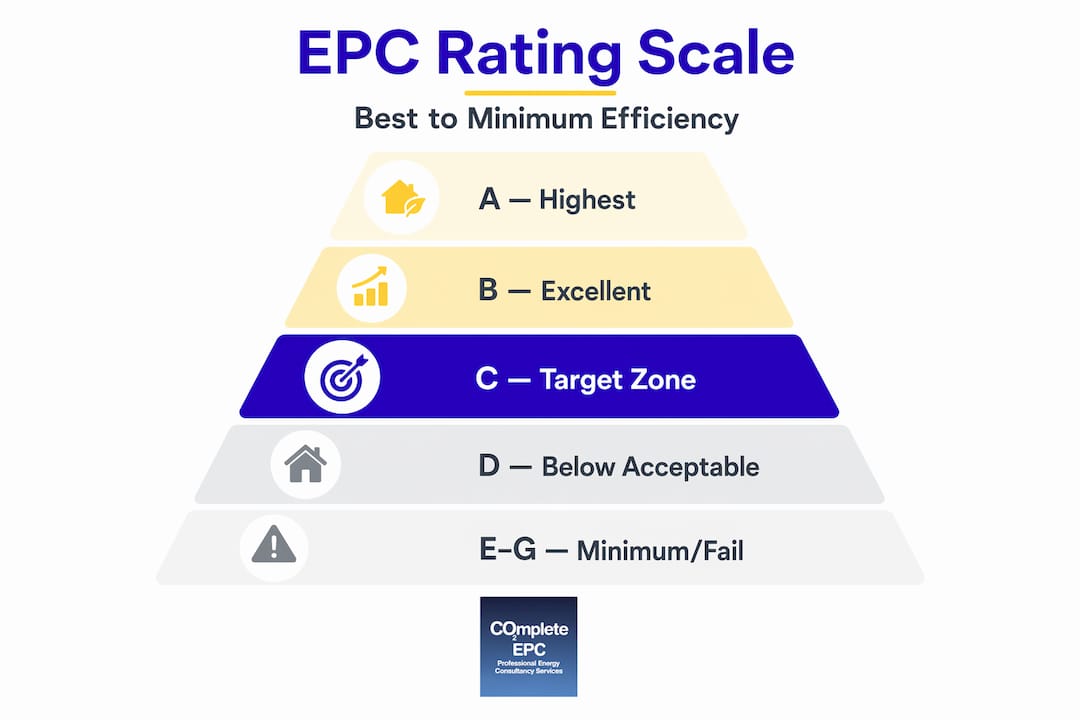
Rating A (92–100) represents the highest efficiency, but C (69–80) is widely accepted as the practical good standard for most residential properties. The difference between a D and a C on a tenant’s heating bill is significant. Moving from an E to a C can reduce annual fuel costs noticeably, which directly affects how attractive your property is to prospective tenants.
Properties rated D or below now face real financial consequences. EPC band D properties face market discounts of up to 14%, while energy bills have increased 60% since 2021, meaning tenants are acutely aware of running costs. A higher EPC rating is not simply a regulatory formality. It is a marketable feature with measurable value.
One point that often gets overlooked: the top epc rating criteria are not purely about the heating system. The model assesses the building fabric (walls, roof, windows, floor), the heating and hot water systems, lighting, and ventilation together. You can have an efficient boiler and still score poorly if the walls are uninsulated.
Regulatory standards and landlord obligations
Understanding the legal framework is non-negotiable for any landlord. Here is what the current and forthcoming rules require:
- Current minimum standard. The minimum EPC rating for rental properties is E. Letting a property with an F or G rating is a criminal offence in most circumstances.
- The 2030 deadline. The minimum rises to C by 2030, and over 33% of rental properties currently fail this standard. That is a significant portion of the private rented sector facing mandatory upgrades.
- Financial penalties. Landlords who let non-compliant properties can face fines up to £30,000, making the cost of inaction far greater than the cost of upgrading.
- Cost cap and exemptions. The government has set a cost cap of £10,000 per property, with investments potentially reaching £15,000 for harder-to-treat properties. Exemptions exist where works are not technically feasible or where a valid exemption has been registered on the PRS Exemptions Register.
- Mortgage lending pressures. Lenders are increasingly factoring EPC ratings into mortgage affordability calculations. Buyers and lenders favour homes with minimum EPC C, which means a below-C rating can affect your ability to refinance or sell.
Pro Tip: Start planning your upgrade route now rather than waiting until 2029. Getting an up-to-date assessment gives you a clear picture of exactly how many points you need to gain and which measures will deliver them most cost-efficiently.
The market signal is equally clear. A or B rated buy-to-let properties are worth over 12% more than comparable D-rated homes. Compliance is the floor, not the ceiling.

What actually makes a rating the “best” for you
Here is where most landlords go wrong. They assume the best EPC rating is simply the highest one they can achieve. In practice, the best rating is the one that satisfies compliance, supports your investment return, and is reached through targeted, verifiable improvements rather than expensive overhauls that deliver diminishing returns.
Consider the maths. Loft insulation adds roughly 4.9 EPC points, while room-in-roof insulation adds around 9.91 points. These are among the most cost-effective measures available. Compare that to a biomass boiler, which many landlords assume is a strong eco-friendly upgrade. Despite its environmental credentials, biomass boilers score fewer points than standard gas condensing boilers under the current EPC methodology. The rating system rewards running cost reduction, not environmental intent alone.
The practical upshot: always model the improvement pathway before committing budget. Here are the most cost-effective measures to consider:
- Loft insulation. Low cost, high point yield, and fast to install. An uninsulated loft is the single easiest win for most properties.
- Cavity wall insulation. Suitable for post-1920s solid brick or cavity-wall construction, this can add several points and meaningfully reduce heat loss.
- LED lighting. A minor but quick gain. Replacing all fixed lighting with LEDs costs very little and registers on the EPC assessment.
- Heating controls. Adding a programmable thermostat or smart controls counts toward your score and costs under £300 in most cases.
- Hot water cylinder insulation. Frequently overlooked. An insulated hot water jacket is inexpensive and adds measurable points in the SAP calculation.
Pro Tip: Choosing upgrades purely by aiming for the highest rating can lead to inefficient spending. Focus on verifiable, impactful improvements first, then assess whether further investment makes financial sense for your specific property type.
There is also the question of renewable energy upgrades such as solar photovoltaic panels or heat pumps. These can push a property from C to B or even A. However, the cost must be weighed against the actual point gain, your property’s existing fabric performance, and whether your tenants will benefit from the reduced bills directly.
The Home Energy Model and what it changes
The EPC framework you are familiar with today will not be the one you navigate in 2030. The Government is replacing the existing methodology with a new system called the Home Energy Model, or HEM, and the transition timeline matters for any landlord planning upgrade works now.
HEM will replace the single letter grade with four distinct metrics from late 2027. Legacy EPCs remain valid until October 2029, but new assessments from late 2027 onwards will report under the new system.
| HEM metric | What it measures |
|---|---|
| Fabric Performance | Insulation, windows, thermal mass, airtightness |
| Heating System | Efficiency and type of heating and hot water installation |
| Smart Readiness | Ability to respond to smart grid signals and flex energy use |
| Annual Energy Cost | Estimated running cost under standardised occupancy conditions |
The HEM’s four metrics break down property performance more granularly than the legacy EPC, which is both useful and more demanding. Under HEM, landlords must meet standards across multiple metrics simultaneously rather than achieving a single composite score. A property with excellent insulation but an ageing boiler may pass on fabric performance but fail on heating system.
The practical implication: if you are planning significant works in 2026 or 2027, assess them against the HEM criteria, not just the current SAP point system. Improvements that score well today may perform differently under the new model. Engaging a qualified assessor who understands both frameworks is worth the investment.
My honest view on EPC ratings as an investment tool
I’ve seen landlords spend significant sums chasing an A rating on a Victorian terrace when a well-evidenced C would have cost a fraction of the price and met every regulatory requirement comfortably. The obsession with the headline letter can genuinely cost you money.
What I’ve learned from working across London’s residential property sector is that the best EPC rating is the one you can prove, not just claim. Assessment accuracy depends on what evidence you present. Landlords with invoices and photos of completed improvements consistently achieve better scores than those who assume the assessor will take the most favourable view. If you installed cavity wall insulation three years ago and cannot produce documentation, the assessor defaults to conservative assumptions. That missing paperwork could cost you several points.
My take on the HEM transition is that it is actually good news for landlords who engage early. Four separate metrics means four separate opportunities to demonstrate targeted investment. It rewards property owners who think strategically about fabric, heating, and smart technology rather than those who try to game a single composite score.
I’d encourage you to treat your EPC not as a one-off compliance exercise but as a living record of your property’s performance. Get professional guidance on your assessment process before works begin, document everything meticulously, and revisit your EPC after each phase of improvement. The landlords I see getting this right are not chasing the highest possible grade. They are making smart, evidenced, sequenced improvements that build value year on year.
— Danny
Get expert EPC support from Completeepc
If you manage property in London and need clarity on your current rating, compliance obligations, or the most cost-effective route to achieving EPC C or above, Completeepc is ready to help. Our qualified assessors provide accurate, evidence-based assessments for domestic and commercial properties across London, with pricing that is guaranteed to be among the lowest in the UK market.
Whether you are preparing for a new tenancy, planning upgrade works ahead of the 2030 deadline, or simply want to understand the benefits of a strong EPC for your portfolio, we give you the information you need to act with confidence. Start with our full EPC guide for London or book an assessment directly. The sooner you know where you stand, the more options you have.
FAQ
What is the best EPC rating a property can achieve?
The highest possible EPC rating is A, corresponding to a score of 92 to 100. However, for most landlords and property owners, achieving a C rating (69 to 80) represents the practical and regulatory target under current and forthcoming rules.
What is the minimum EPC rating required for rental properties?
The current legal minimum for rental properties in England and Wales is E. This rises to a minimum of C by 2030, with fines of up to £30,000 for non-compliant landlords.
What are the average EPC ratings for UK homes?
The majority of UK homes fall within the D band. Achieving C or above already puts a property ahead of much of the existing housing stock, which is why the 2030 deadline represents a significant uplift challenge for many landlords.
Does a higher EPC rating increase property value?
Yes. Properties with an A or B rating are worth over 12% more than equivalent D-rated homes in the buy-to-let market, and homes rated D or below can face market price discounts of up to 14%.
What is the Home Energy Model and how does it affect EPC ratings?
The Home Energy Model (HEM) replaces the existing single letter EPC grade from late 2027 with four separate metrics: Fabric Performance, Heating System, Smart Readiness, and Annual Energy Cost. Landlords will need to meet standards across all four metrics rather than achieving a single composite score.