

Most british homeowners are surprised to learn that an Energy Performance Certificate can impact a property’s value by up to 14 percent according to government data. As new regulations reshape the market in London and across the United Kingdom, understanding your home’s efficiency rating is no longer optional. This guide unpacks what an EPC survey really means for properties, with practical advice every british property owner needs to make smarter, more profitable decisions.
Table of Contents
- What Is an EPC Survey and Why It Matters
- Types of EPC: Domestic Versus Commercial
- EPC Assessment Process Step by Step
- Legal Duties for London Property Owners
- Costs, Timeframes, and Common Mistakes
Key Takeaways
| Point | Details |
|---|---|
| Importance of EPC | An Energy Performance Certificate (EPC) evaluates a property’s energy efficiency, impacting market value and informing buyers and landlords of potential improvements. |
| Types of EPC | Domestic EPCs assess residential properties, while Commercial EPCs focus on non-residential buildings, using tailored methodologies for each type. |
| Assessment Process | The EPC assessment involves a detailed property survey, followed by data analysis to generate an energy efficiency rating, typically completed within hours. |
| Legal Obligations | London property owners must ensure EPC compliance while marketing properties, with specific legal requirements and penalties for non-compliance. |
What Is an EPC Survey and Why It Matters
An Energy Performance Certificate (EPC) represents a critical evaluation of a property’s energy efficiency and environmental impact. This comprehensive assessment provides property owners, landlords, and potential buyers with crucial insights into a building’s energy consumption and potential carbon emissions.
The EPC survey involves a professional assessor conducting a detailed inspection of your property’s key energy-related characteristics. During this process, the surveyor examines factors such as insulation quality, heating systems, lighting efficiency, and windows to determine the property’s overall energy performance. A government investigation reveals that EPC ratings significantly influence property values, with more energy-efficient homes often commanding higher market prices.
Ratings on an EPC range from A (most efficient) to G (least efficient), providing a clear visual representation of a property’s energy performance. These ratings are not merely academic exercises but have tangible financial implications. Research by Oxford Economics demonstrates that energy-efficient homes rated A or B can sell at a premium, reflecting increasing buyer preferences for sustainable properties with lower ongoing energy costs.
Key aspects evaluated during an EPC survey include:
- Thermal insulation quality
- Heating and hot water systems
- Lighting efficiency
- Windows and external wall construction
- Potential recommendations for energy improvements
Beyond immediate financial considerations, an EPC survey plays a pivotal role in London’s broader sustainability objectives. By providing clear, actionable insights into a property’s energy performance, these certificates encourage property owners to invest in energy-efficient upgrades, ultimately contributing to reduced carbon emissions and more environmentally responsible urban development.
Types of EPC: Domestic Versus Commercial
Energy Performance Certificates (EPCs) are essential assessment tools that differentiate between two primary property categories: domestic and commercial. While both types share the fundamental goal of evaluating energy efficiency, they employ distinct methodologies tailored to each property’s unique characteristics and usage patterns.
Domestic EPCs focus on residential properties such as houses, flats, and apartments. The government’s technical guidelines mandate comprehensive evaluations of residential buildings, assessing aspects like thermal insulation, heating systems, and living space energy consumption. These certificates provide homeowners and tenants with critical insights into their property’s energy performance, potential improvements, and estimated running costs.

Commercial EPCs target non-residential buildings including offices, retail spaces, warehouses, and industrial facilities. The assessment process examines a building’s size, construction, and energy systems with a more complex approach that considers factors like industrial equipment, specialised ventilation systems, and commercial-scale energy infrastructure. These certificates are particularly crucial for businesses seeking to understand and optimise their energy expenditure.
Key differences between domestic and commercial EPCs include:
- Assessment methodology
- Complexity of energy systems evaluated
- Scope of recommended improvements
- Relevance to property type and usage
Ultimately, both domestic and commercial EPCs serve a critical function in London’s broader sustainability strategy. Commercial EPC requirements for property investors play a significant role in driving energy efficiency across different property sectors, encouraging building owners to invest in more sustainable infrastructure and reduce carbon emissions.
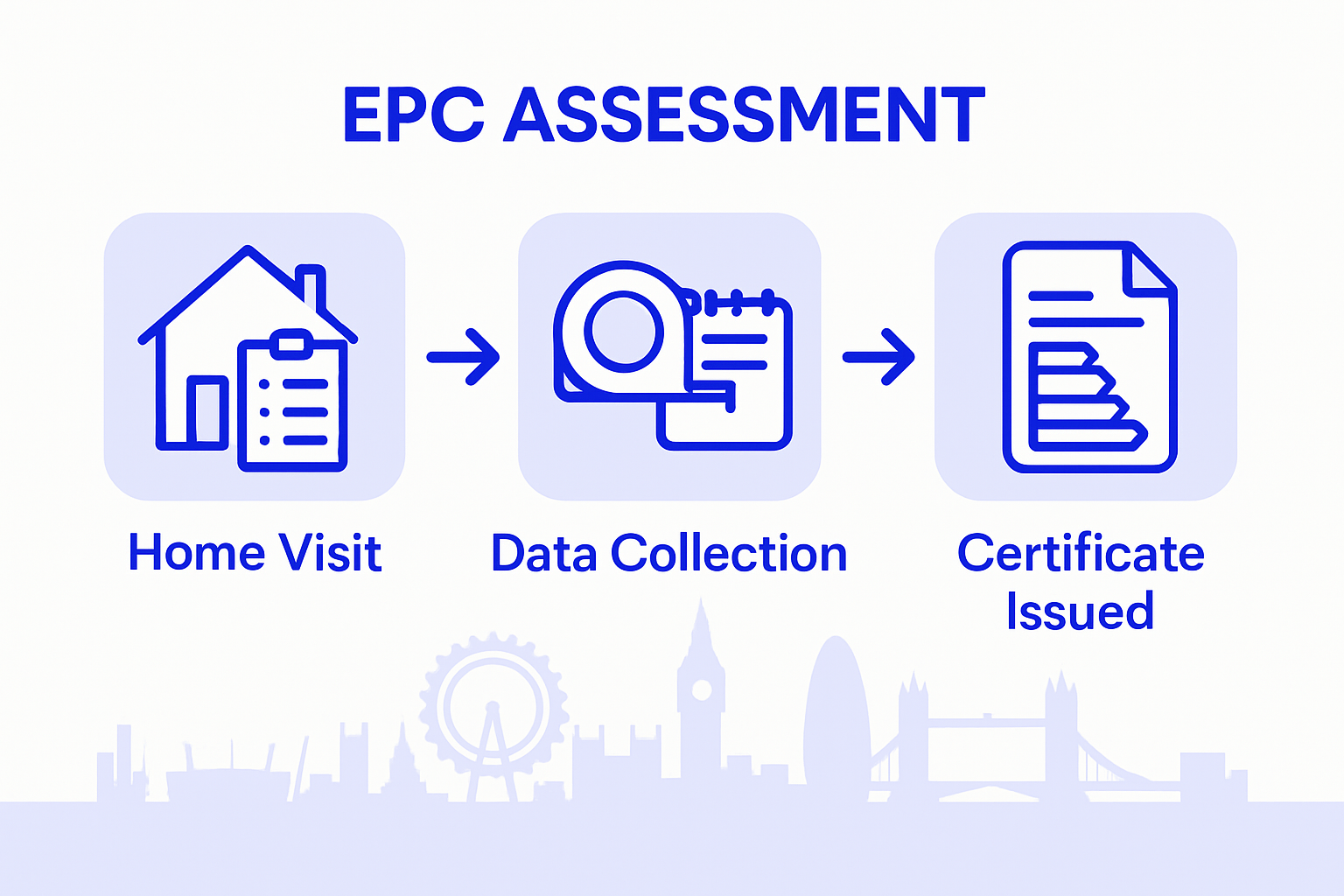
EPC Assessment Process Step by Step
The Energy Performance Certificate (EPC) assessment is a structured process designed to evaluate a property’s energy efficiency systematically. A qualified Domestic Energy Assessor conducts a comprehensive property inspection, typically requiring approximately one hour to complete and resulting in a certificate issued within ten days.
Step-by-Step EPC Assessment Process:
- Initial Property Booking
- Contact a certified energy assessor
- Provide property details and schedule an inspection
- Comprehensive Property Survey
The assessment records detailed information about the building’s specific characteristics, including:
- Building size and layout
- Construction materials
- Insulation quality
- Heating and ventilation systems
- Lighting infrastructure
- On-Site Inspection
- Assessor evaluates physical property attributes
- Measures room dimensions
- Checks wall, roof, and floor insulation
- Examines heating system efficiency
- Photographs key energy-related features
- Data Analysis and Calculation
- Assessor inputs collected data into standardised software
- Calculates energy efficiency rating
- Generates recommendations for potential improvements
- Certificate Issuance
- EPC rating produced (A-G scale)
- Report detailing energy performance delivered
- Recommendations for energy efficiency improvements provided
The EPC assessment process for property sales represents a critical step in understanding and potentially improving a property’s energy performance, offering valuable insights for property owners, buyers, and investors alike.
Legal Duties for London Property Owners
Property owners in London face specific legal obligations regarding Energy Performance Certificates (EPCs), which are critical for maintaining regulatory compliance and supporting the city’s broader sustainability objectives. In England and Wales, property owners must provide an EPC when a building is constructed, sold, or let, ensuring transparent communication about a property’s energy efficiency.
Key Legal Requirements for Property Owners:
- Obtain a valid EPC before marketing a property for sale or rent
- Ensure the EPC is less than 10 years old
- Display the EPC rating prominently when selling or renting
- Provide the EPC to potential buyers or tenants free of charge
- Maintain the property’s energy efficiency standards
Property transactions in London require comprehensive EPC documentation, with legal consequences for non-compliance. Landlords, in particular, must meet stringent requirements, including:
- Minimum Energy Efficiency Standards (MEES)
- Prohibition of renting properties with an EPC rating below E
- Potential fines for failing to provide a valid EPC
- Mandatory energy efficiency improvements
Commercial and residential property owners must understand that EPCs are not merely bureaucratic documents but essential tools for tracking and improving energy efficiency regulations. Non-compliance can result in significant financial penalties, ranging from £500 to £5,000 depending on the property type and duration of the breach.
Understanding and proactively managing these legal duties is crucial for London property owners. Compliance tips for property owners can help navigate these complex regulations, ensuring both legal adherence and potential energy cost savings.
Costs, Timeframes, and Common Mistakes
Obtaining an Energy Performance Certificate (EPC) involves a structured process with specific cost implications and potential pitfalls that property owners in London must carefully navigate. The typical assessment ranges between £60 and £120, with the entire process taking approximately one hour to complete and resulting in a certificate issued within ten days.
Cost Breakdown for EPC Assessment:
- Standard domestic property assessment: £60 – £120
- Commercial property assessment: £120 – £250
- Additional survey complexity: Potential extra charges
- Validity period: 10 years from issue date
Common Mistakes to Avoid:
- Not verifying the assessor’s accreditation
- Providing incomplete or inaccurate property information
- Failing to prepare documentation in advance
- Overlooking recent property improvements
- Neglecting potential energy efficiency upgrades
Thorough property inspections require accurate information to ensure the most precise EPC rating. Property owners should prepare by gathering relevant documentation such as:
- Building construction plans
- Recent renovation records
- Heating system specifications
- Insulation details
- Window and door installation certificates
Timely preparation can significantly reduce assessment duration and potential additional costs. Property investors can leverage EPC insights to make informed decisions about energy efficiency improvements, potentially increasing property value and reducing long-term energy expenditure.
Simplify Your EPC Survey Needs with Complete EPC
Navigating the complex requirements of EPC surveys in London can be overwhelming. Whether you are a property owner, landlord, or investor, understanding legal duties such as obtaining valid certificates before selling or letting your property and complying with Minimum Energy Efficiency Standards is critical. Avoid costly penalties and missed opportunities by partnering with experts who deliver precise, reliable energy assessments that empower you with clear recommendations for improvements.
At Complete EPC, we specialise in providing fast, affordable, and accurate Energy Performance Certificates for both domestic and commercial properties throughout London. Our qualified assessors bring extensive industry knowledge to every survey ensuring your property meets legal standards while maximising energy efficiency and market value. Don’t wait until your next transaction to secure compliance. Discover how our streamlined process saves you time and money now by visiting Complete EPC and take the first step towards smarter energy management for your property. Learn more about how we support EPC compliance for property owners and energy efficiency regulations to protect your investment today.
Frequently Asked Questions
What is an EPC survey?
An EPC survey is an assessment of a property’s energy efficiency and environmental impact conducted by a qualified energy assessor. It evaluates key characteristics such as insulation, heating systems, and lighting to provide insights into energy consumption and carbon emissions.
How is an EPC rating determined?
An EPC rating is determined through a comprehensive property survey, where the assessor collects data on various energy-related factors. This data is then analysed using standardised software to calculate the property’s energy efficiency, resulting in a rating from A (most efficient) to G (least efficient).
What legal requirements do property owners have regarding EPCs?
Property owners must obtain a valid EPC before marketing a property for sale or rent, ensuring it is less than 10 years old. They must also display the EPC rating prominently and provide it to potential buyers or tenants free of charge.
How much does an EPC assessment cost and how long does it take?
The cost of an EPC assessment typically ranges from £60 to £120 for standard domestic properties and £120 to £250 for commercial properties. The survey takes about one hour to complete, and the certificate is usually issued within ten days.
Recommended
- Understanding EPCs in London: Why They Matter for Property Owners – Complete EPC
- EPC Requirements in London: What You Need to Know – Complete EPC
- London’s Ultimate Guide to Energy Performance Certificates: Enhance Your Property’s Efficiency – Complete EPC
- EPC Costs in London: What Should You Expect? – Complete EPC
- Diesel Engine Emissions Control Guide for 2025: Tools and Best Practices – My WordPress