

Most British property owners are now facing stricter energy rules than ever before, with new standards set to impact both sellers and landlords across London. Compliance with Energy Performance Certificate regulations has become a legal necessity, not just a box to tick. With fines reaching an eye-watering £35,000 for missed deadlines, understanding these requirements can protect your investment and keep you ahead of costly mistakes.
Table of Contents
- EPC Compliance Deadlines And Legal Basics
- Domestic Versus Commercial EPC Requirements
- Key EPC Validity Periods And Trigger Events
- Penalties For Missed EPC Deadlines In London
- Ensuring Timely Assessments And Common Pitfalls
Key Takeaways
| Point | Details |
|---|---|
| EPC Compliance Deadline | Property owners must obtain an EPC before marketing their property, with a minimum rating of C required for new rentals from April 2025. |
| Assessment Differences | Domestic EPCs focus on residential features, while commercial EPCs require detailed evaluations of complex systems, affecting compliance requirements. |
| Validity Period | EPCs are valid for 10 years; however, significant property modifications may require an earlier reassessment to ensure compliance with current regulations. |
| Penalties for Non-Compliance | Fines for failing to meet EPC requirements can reach £35,000, with potential cumulative penalties for repeated infractions impacting property transactions. |
EPC Compliance Deadlines and Legal Basics
Navigating the complex landscape of Energy Performance Certificate (EPC) regulations requires property owners and landlords in London to stay informed about critical compliance deadlines. The Energy Performance of Buildings Regulations establish clear legal requirements that mandate obtaining an accurate and current EPC when selling or renting a property.
Under current UK legislation, property owners must secure an EPC before marketing their property for sale or rent. The certificate provides crucial information about a building’s energy efficiency, rated on a scale from A (most efficient) to G (least efficient). Critically, from April 2025, newly rented properties will be required to achieve a minimum EPC rating of C, which represents a significant upgrade from the previous minimum rating of E. Non-compliance with these regulations can result in substantial financial penalties, potentially reaching up to £30,000 for violations.
Property owners should be aware of specific compliance timelines and requirements. For domestic and commercial properties, the EPC must be obtained and made available to potential buyers or tenants before the property is marketed. The certificate remains valid for 10 years, after which a new assessment becomes necessary. Landlords must ensure their properties meet the evolving energy efficiency standards, with upcoming regulations pushing towards more stringent environmental performance targets.
Pro Tip: Plan your EPC assessment at least 3 months before your property goes on the market or rental listing to allow sufficient time for any recommended energy efficiency improvements and to avoid potential legal complications.
Domestic Versus Commercial EPC Requirements
Understanding the nuanced differences between domestic and commercial Energy Performance Certificates (EPCs) is crucial for property owners in London. While both certificate types serve the fundamental purpose of assessing energy efficiency, they involve distinct assessment methodologies and regulatory requirements. Commercial EPC requirements differ significantly from residential property evaluations, reflecting the complex energy systems found in business premises.
Domestic EPCs typically assess residential properties like houses and flats, focusing on elements such as insulation, heating systems, and general building construction. These assessments are relatively straightforward, examining standard residential features like wall cavities, roof insulation, and domestic heating mechanisms. Commercial EPCs, by contrast, involve much more intricate evaluations that consider sophisticated building systems, including complex heating, ventilation, air conditioning (HVAC) networks, lighting infrastructures, and specialised industrial equipment that significantly impact overall energy consumption.
The scope of assessment varies dramatically between domestic and commercial properties. Residential EPCs primarily rate properties on a standardised scale from A to G, considering factors like heat loss, potential energy savings, and typical household energy use. Commercial assessments, however, require more granular analysis, often incorporating detailed computational models that simulate energy performance across different operational scenarios. These assessments must account for variable usage patterns, multiple occupancy configurations, and sophisticated mechanical systems that are absent in residential settings.
Pro Tip: When preparing for an EPC assessment, businesses should compile comprehensive documentation of all building systems, energy consumption records, and recent upgrades to streamline the commercial property evaluation process and ensure the most accurate energy efficiency rating possible.
Here is a summary of key EPC compliance aspects for London property owners:
| Aspect | Domestic Properties | Commercial Properties |
|---|---|---|
| Assessment Focus | Insulation, heating, construction | HVAC, lighting, equipment systems |
| Rating Method | Standard A–G scale | Detailed computational modelling |
| Key Documents Needed | Renovation, heating details | Energy systems, consumption logs |
| Main Trigger Events | Sale, new tenancy, renovation | Sale, tenancy, major modifications |
| Minimum Standard (2025) | C rating for new rentals | Expected to align, subject to changes |
Key EPC Validity Periods and Trigger Events
Understanding the validity periods and critical trigger events for Energy Performance Certificates (EPCs) is essential for property owners and managers in London. Official government guidance clearly stipulates that an EPC remains valid for a standard period of 10 years from its initial date of issue. This timeframe applies consistently across both residential and commercial property types, providing a uniform framework for energy efficiency documentation.
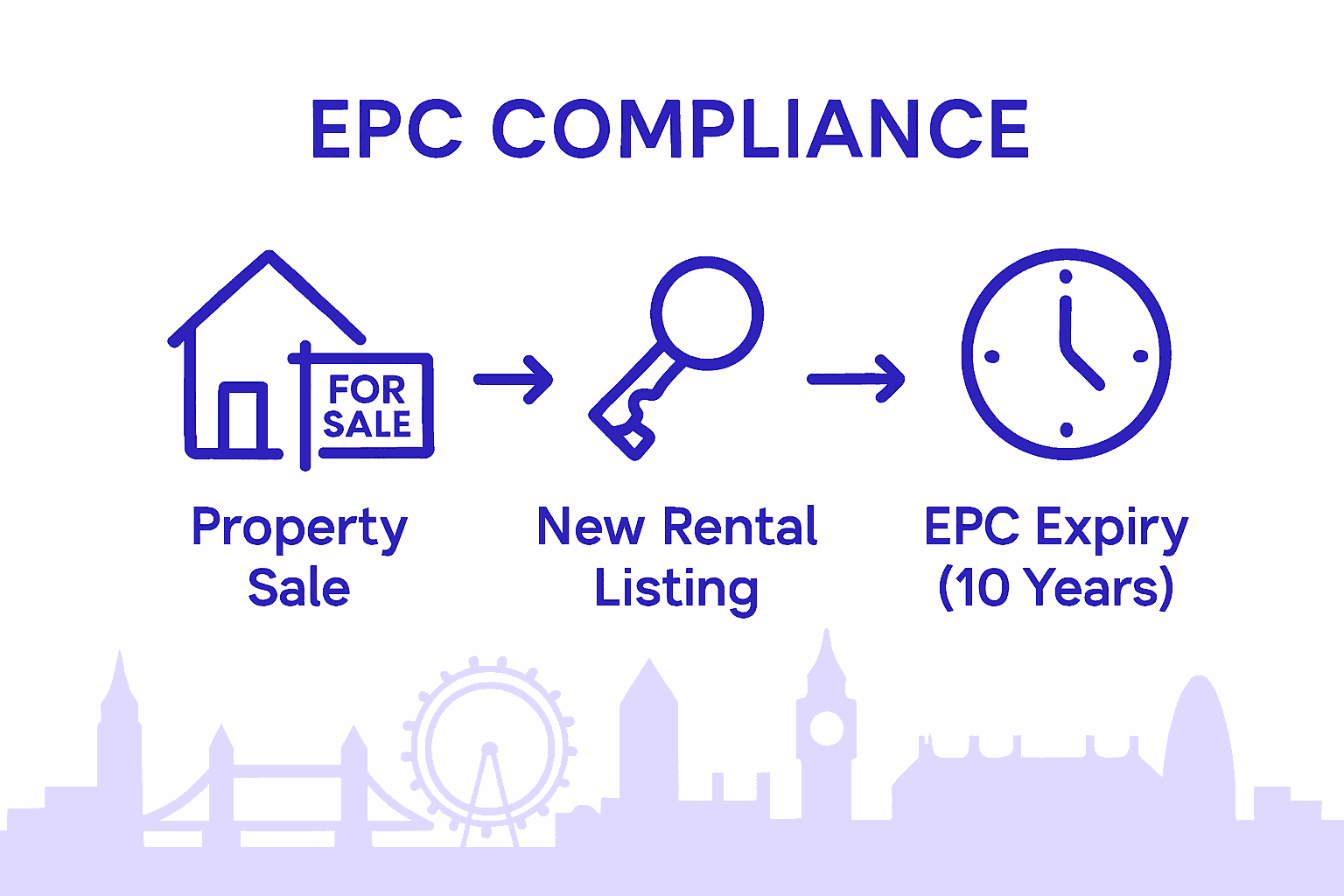
Several specific trigger events necessitate obtaining a new or updated Energy Performance Certificate. These primary events include property construction, complete property sale, and new rental agreements. Whenever a property changes ownership or tenancy, the seller or landlord must ensure a current EPC is available to potential buyers or prospective tenants. The certificate must be presented at the earliest opportunity during marketing or before any contractual negotiations commence, ensuring transparency regarding the property’s energy performance characteristics.
The 10-year validity period does not mean property owners can remain passive about energy efficiency. Significant property modifications, such as substantial renovations, installation of new heating systems, or major insulation upgrades, might warrant an earlier EPC reassessment. These improvements could potentially enhance the property’s energy rating, offering financial and environmental benefits. Additionally, upcoming regulatory changes, particularly those targeting minimum energy efficiency standards, may require proactive updates to maintain compliance with evolving legal requirements.
Pro Tip: Maintain a digital and physical record of your EPC, setting a calendar reminder six months before its expiration to ensure timely renewal and continued legal compliance with energy certification requirements.
Penalties for Missed EPC Deadlines in London
Property owners in London must understand the serious financial consequences of failing to comply with Energy Performance Certificate (EPC) regulations. Homeowners across the UK can face substantial fines reaching up to £35,000 for neglecting their legal obligations. Trading standards officers are empowered to enforce these penalties, with the exact fine calculated based on the property’s rateable value and the severity of the violation.

The penalty structure for missed EPC deadlines is designed to be progressively punitive. Initial infractions might result in fixed penalties or warning notices, but repeated non-compliance can trigger significantly larger financial sanctions. For landlords, the stakes are particularly high. A recent case highlighted the potential severity, where a landlord was fined £34,500 by Tewkesbury Council for renting properties that failed to meet minimum energy efficiency standards, demonstrating the increasingly stringent approach to enforcement.
Penalties are not limited to monetary fines. Property owners who repeatedly fail to obtain or display a valid EPC may face additional legal consequences, including potential restrictions on renting or selling their property. Local authorities have the power to issue enforcement notices, prevent property transactions, and in extreme cases, pursue legal action that could impact a property owner’s ability to conduct real estate transactions. Moreover, these penalties extend beyond one-time infractions, with potential cumulative penalties for continued non-compliance.
Below is a reference table outlining EPC penalties and enforcement processes:
| Violation Type | Maximum Penalty | Possible Additional Actions |
|---|---|---|
| No valid EPC available | £30,000–£35,000 | Trading restrictions, enforcement notice |
| Repeated non-compliance | Cumulative fines | Legal action, rental/sale ban |
| Missing EPC in marketing | Up to £5,000 | Warning notice, transaction delay |
Pro Tip: Create a comprehensive compliance calendar that tracks EPC expiration dates, setting reminders at least six months in advance to prevent unintentional breaches and potential financial penalties.
Ensuring Timely Assessments and Common Pitfalls
Navigating the complexities of Energy Performance Certificate (EPC) assessments requires meticulous attention to detail and proactive planning. Landlords must understand the critical requirements for obtaining and presenting EPCs before marketing their properties. Timing is crucial, as the assessment must be completed and the certificate obtained prior to any property listing or tenant viewing, ensuring full legal compliance and transparency.
Several common pitfalls can trip up property owners and managers during the EPC assessment process. These include failing to schedule assessments with sufficient lead time, neglecting to include energy ratings in property advertisements, and not making the certificate readily available during property viewings. Many property owners underestimate the complexity of preparing for an assessment, overlooking essential documentation such as previous renovation records, heating system specifications, and building modification details that can significantly impact the energy efficiency rating.
The assessment process involves a comprehensive evaluation of the property’s energy performance, requiring access to multiple areas of the building. Property owners should prepare by ensuring unobstructed access to heating systems, loft spaces, wall cavities, and other critical infrastructure areas. Assessors will need detailed information about the property’s construction, insulation types, heating mechanisms, and any energy-efficient upgrades. Incomplete or inaccessible information can lead to delayed assessments, potentially causing marketing disruptions or legal complications.
Pro Tip: Compile a comprehensive property file in advance of your EPC assessment, including building plans, recent renovation documentation, heating system specifications, and a detailed floor plan to streamline the assessment process and ensure a smooth, efficient evaluation.
Stay Ahead of EPC Compliance Deadlines and Protect Your Property Investment
Missing critical Energy Performance Certificate deadlines can lead to heavy fines and legal headaches, especially with the upcoming April 2025 minimum EPC rating of C for new rentals in London. Property owners and landlords face increasing pressure to ensure timely, accurate assessments that comply with all legal requirements. From understanding domestic versus commercial EPC nuances to preparing for mandatory reassessments after property modifications, the challenge can feel overwhelming.
Complete EPC is here to simplify that burden. With expert assessors who know London’s legal landscape and detailed, reliable energy efficiency reports, we help you avoid penalties and costly delays. Whether you manage domestic or commercial properties, our streamlined service guarantees the lowest prices and quick turnaround. Take control now by visiting Complete EPC’s main website to arrange your professional assessment. For a deeper dive into the specific needs of commercial EPC requirements in London, explore our dedicated resources and make sure your property meets all future standards. Secure your property’s compliance today and prevent legal risks by choosing trusted expertise at Complete EPC.
Frequently Asked Questions
What are the compliance deadlines for obtaining an EPC in London?
Property owners must secure an EPC before marketing their property for sale or rent. The certificate must be obtained and made available to prospective buyers or tenants prior to listing the property.
What are the minimum EPC ratings required for rented properties from April 2025?
From April 2025, all newly rented properties must achieve a minimum EPC rating of C. This is a significant change from the previous minimum rating of E, and landlords must ensure compliance to avoid penalties.
What are the penalties for failing to comply with EPC regulations?
Non-compliance with EPC regulations can result in fines reaching up to £30,000 for properties without a valid EPC. The penalties increase for repeated violations, and there can be additional legal consequences such as restrictions on renting or selling properties.
How long is an EPC valid once obtained?
An EPC remains valid for a period of 10 years from its initial date of issue. Property owners need to ensure that they renew their EPCs before expiration, especially if there are changes in ownership or significant property modifications.