

An EPC rating A property signals exceptional theoretical energy efficiency, yet many London property owners discover their actual energy bills and carbon emissions tell a different story. This disconnect between certification and reality has sparked debate among industry professionals about what EPC ratings truly measure. This guide clarifies what EPC rating A actually means, examines its practical limitations, and explains how to interpret these assessments meaningfully in 2026’s evolving regulatory landscape for London properties.
Table of Contents
- Understanding EPC Rating A: Definition And Assessment Criteria
- The Limitations And Criticisms Of EPC Rating A In Real-World Performance
- Comparing EPC Rating A With Other Grades: Energy Use And Compliance Implications
- Practical Steps For London Property Owners To Understand And Improve Their EPC Rating A
- Explore Expert EPC Services For London Properties
Key takeaways
| Point | Details |
|---|---|
| Theoretical efficiency | EPC rating A reflects modelled energy performance, not guaranteed low bills or emissions |
| Assessment variability | Different assessors can produce varying ratings for identical properties due to methodology limitations |
| Behaviour matters | Occupant usage patterns significantly impact actual energy consumption beyond EPC predictions |
| Compliance value | Rating A offers strong regulatory compliance and market appeal despite practical limitations |
| Improvement focus | Strategic upgrades with proper evidence documentation yield best rating enhancements under RdSAP 10 |
Understanding EPC rating A: definition and assessment criteria
The EPC rating scale runs from A (most efficient) to G (least efficient), with rating A representing properties scoring 92 or above on the energy efficiency index. This top tier classification indicates a building theoretically requires minimal energy for heating, lighting, and hot water under standardised conditions. However, understanding how assessors determine this rating reveals important nuances about what the score actually measures.
The RdSAP 10 methodology governs most domestic EPC assessments in England and Wales. RdSAP 10 updates introduced in 2025 improve assessment accuracy but may lower some scores without additional evidence, particularly for properties with recently installed energy efficiency measures. Assessors evaluate multiple physical characteristics during their inspection, then input this data into standardised software that calculates the theoretical energy performance.
Key factors influencing whether a property achieves rating A include:
- Wall, loft, and floor insulation quality and coverage
- Window glazing type and thermal performance
- Heating system efficiency and controls sophistication
- Renewable energy installations like solar photovoltaic panels
- Hot water system efficiency and storage
- Ventilation and air tightness characteristics
Technological advances particularly impact ratings. Properties with solar PV systems combined with battery storage can achieve rating A more readily, as the methodology credits on-site renewable generation. Similarly, heat pumps paired with underfloor heating and comprehensive insulation typically score higher than traditional gas boiler systems, even when actual running costs might be comparable.
Pro Tip: Collect and retain all installation certificates, warranties, and technical specifications for energy efficiency measures. RdSAP 10 requires documentary evidence for many features, and missing paperwork can result in assessors defaulting to lower assumed values that reduce your rating.
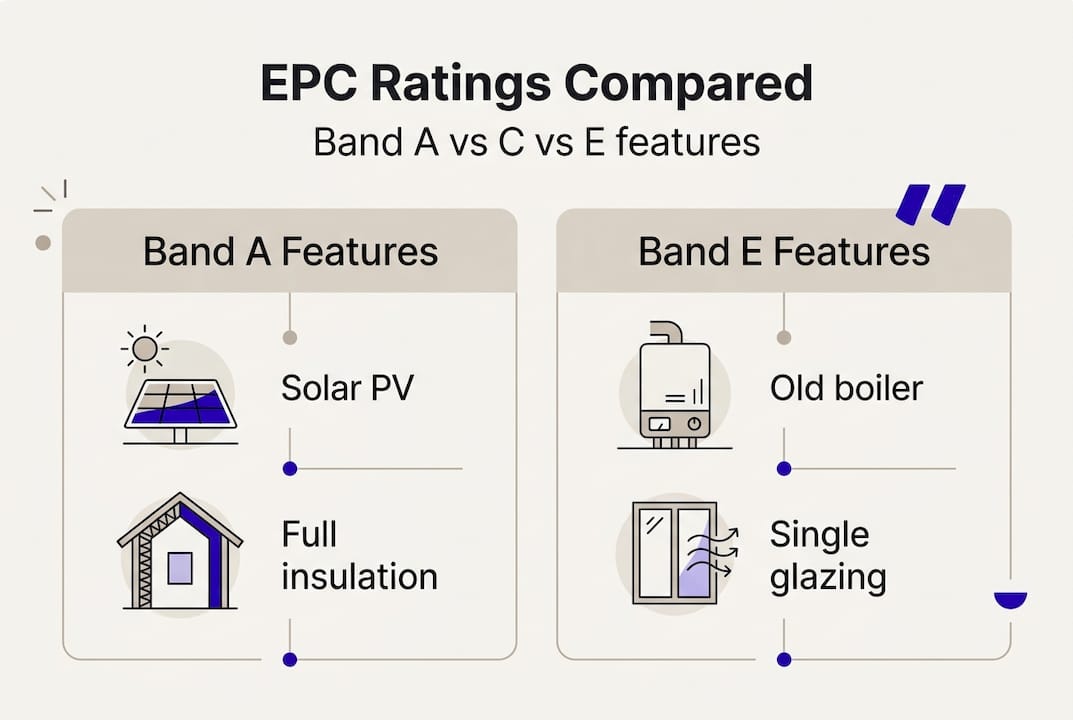
The table below shows typical features found in rating A properties versus lower bands:
| Feature | Rating A | Rating C | Rating E |
| — | — | — |
| Wall insulation | Full cavity or external | Partial cavity | Uninsulated solid walls |
| Glazing | Triple glazed throughout | Double glazed | Mix of single and double |
| Heating | Heat pump or high-efficiency condensing boiler with smart controls | Standard condensing boiler | Older non-condensing system |
| Renewables | Solar PV with battery storage | Solar thermal or small PV array | None |
Crucially, energy performance certificates in London measure theoretical efficiency based on standardised assumptions about occupancy and usage patterns. The assessment does not account for how many people actually live in the property, their heating preferences, appliance usage habits, or lifestyle factors. This standardisation enables property comparison but creates the gap between certified ratings and real-world performance.
The limitations and criticisms of EPC rating A in real-world performance
Whilst EPC rating A suggests minimal energy consumption, research reveals significant discrepancies between these theoretical predictions and actual performance. EPC ratings often fail to predict real electricity consumption or carbon emissions accurately, showing inconsistencies across properties with same ratings. Properties with identical A ratings can demonstrate vastly different actual energy usage and associated costs.

Occupant behaviour represents the primary factor driving this performance gap. A household maintaining temperatures at 22°C throughout winter will consume substantially more energy than neighbours keeping rooms at 18°C, regardless of identical EPC ratings. Similarly, families with multiple occupants using hot water frequently, running numerous appliances, and preferring bright lighting will see higher bills than single occupants with modest usage patterns. The standardised EPC methodology cannot capture these behavioural variations.
Assessment quality issues compound these limitations. EPC assessments suffer from assessor variability and can yield different ratings for the same property depending on which professional conducts the survey. Some assessors conduct thorough inspections, carefully measuring dimensions and verifying installation specifications. Others rely on quick visual checks and default assumptions, potentially missing efficiency features or incorrectly recording property characteristics.
The importance of hiring a qualified EPC assessor becomes evident when considering these quality variations. Industry insiders have raised concerns about surveys completed without proper site visits, assessors accepting homeowner descriptions without verification, and certificates issued based on inadequate information. Such practices undermine the reliability of the entire rating system.
Current methodology limitations include:
- Visual inspection only, with no measurement of actual energy consumption or thermal performance
- Reliance on standardised assumptions about heating patterns and occupancy
- Limited consideration of building orientation, shading, or microclimate factors
- Difficulty accurately assessing concealed features like wall cavity insulation
- Software calculations that may not reflect real-world equipment performance
One industry expert summarised the situation bluntly:
The gap between EPC predictions and reality has become so pronounced that the certificates risk losing credibility entirely. We’re seeing properties with rating A consuming more energy than well-managed C-rated homes, purely due to occupant behaviour and assessment inconsistencies.
These limitations do not render EPCs worthless, but they demand realistic interpretation. Understanding EPC rating scales requires recognising them as comparative tools showing relative theoretical efficiency rather than precise consumption forecasts. Property owners should view rating A as indicating excellent potential for low energy use, contingent on appropriate occupant behaviour and proper system operation.
Comparing EPC rating A with other grades: energy use and compliance implications
EPC grades span from A (92-100 points) through B (81-91), C (69-80), D (55-68), E (39-54), F (21-38), to G (1-20). Each band represents progressively lower theoretical energy efficiency and higher projected running costs under standardised conditions. However, the relationship between bands and actual emissions proves less straightforward than the scale suggests.
EPC A/B properties do not always have significantly lower actual CO2 emissions than lower bands due to behaviour and assumptions in assessments. Real-world monitoring has revealed rating C properties with energy-conscious occupants sometimes achieving lower emissions than rating A properties with high consumption lifestyles. This counterintuitive finding highlights how occupant factors can override building fabric advantages.
The table below compares typical characteristics across selected EPC bands:
| Aspect | Rating A | Rating C | Rating E |
| — | — | — |
| Energy efficiency score | 92-100 | 69-80 | 39-54 |
| Typical annual cost estimate | £200-£400 | £600-£900 | £1,200-£1,600 |
| CO2 emissions estimate | Very low | Moderate | High |
| Common features | Renewables, heat pump, comprehensive insulation | Good insulation, efficient boiler, double glazing | Basic insulation, older heating, some single glazing |
| Market perception | Premium efficiency | Good standard | Below modern expectations |
Regulatory requirements create practical distinctions between bands. The Minimum Energy Efficiency Standards prohibit letting properties rated F or G unless exemptions apply. Whilst rating A exceeds these requirements substantially, landlords face increasing pressure to improve properties toward higher bands. Government consultations have explored mandating rating C for rental properties by 2030, though implementation timelines remain under review in 2026.
Rating A properties offer several market advantages:
- Enhanced appeal to environmentally conscious buyers and tenants
- Lower regulatory risk as efficiency standards tighten
- Potential premium pricing due to perceived running cost savings
- Reduced likelihood of requiring costly upgrades for compliance
- Positive signalling about property maintenance and modernisation
Pro Tip: When planning efficiency improvements, prioritise measures offering the best cost-to-benefit ratio for rating upgrades. Loft insulation and boiler replacement typically deliver strong returns, whilst some expensive measures like external wall insulation may not shift ratings enough to justify costs unless required for other reasons.
The benefits of improving energy ratings extend beyond compliance. Properties moving from rating E to C often see tangible value increases, as buyers increasingly factor energy performance into purchase decisions. However, improvements from rating B to A may yield diminishing returns, with costs potentially exceeding value gains unless the property targets a premium sustainability-focused market segment.
Understanding these band comparisons helps property owners make informed decisions about whether pursuing rating A justifies the investment, or whether achieving a solid B or C rating provides sufficient compliance and market positioning at lower cost.
Practical steps for London property owners to understand and improve their EPC rating A
Interpreting an EPC certificate meaningfully requires looking beyond the headline rating to understand the underlying assessment details and recommendations. The certificate’s recommendations page lists potential improvements ranked by cost effectiveness, showing estimated implementation costs and potential rating gains. Property owners should review these suggestions critically, considering their specific circumstances rather than treating them as mandatory requirements.
RdSAP 10 updates provide improved accuracy but require detailed evidence for upgrades like PV and insulation, making documentation crucial for achieving optimal ratings. Assessors cannot credit efficiency features without proper verification, so maintaining comprehensive records becomes essential for properties approaching or maintaining rating A status.
Follow these steps to maximise your EPC rating:
- Gather all documentation for existing efficiency measures including installation certificates, product specifications, and warranty information before the assessment.
- Ensure the assessor can access all property areas including lofts, basements, and exterior walls to accurately record insulation and construction details.
- Highlight any recent upgrades that might not be immediately visible, such as cavity wall insulation or upgraded heating controls.
- Request the assessor explain their findings and any assumptions made where direct evidence was unavailable.
- Review the completed certificate carefully, checking that all efficiency features are correctly recorded and challenging any obvious errors promptly.
- Prioritise recommended improvements based on your budget, focusing on measures offering substantial rating gains relative to costs.
- Obtain multiple quotes for planned works and verify installers’ qualifications to ensure improvements meet standards that assessors will recognise.
- Retain all paperwork from completed improvements to support future reassessments.
The EPC assessment process in London typically takes 45-90 minutes for domestic properties, depending on size and complexity. Assessors measure room dimensions, inspect construction types, examine heating and hot water systems, check glazing specifications, and review insulation coverage. They also photograph key features and record details about lighting, ventilation, and renewable installations.
EPC certificates remain valid for 10 years unless the property undergoes significant alterations affecting energy performance. The EPC renewal process requires a fresh assessment, which may yield different results even without physical changes due to methodology updates or assessor variations. Properties approaching their renewal date should consider timing the reassessment after completing any planned efficiency improvements to capture maximum benefit.
Pro Tip: If your property narrowly misses rating A, investigate whether providing additional evidence for existing features might close the gap without physical works. Missing installation certificates or unrecorded upgrades frequently cost properties several rating points that better documentation could recover.
Balancing improvement costs against benefits requires realistic expectations. Achieving rating A typically demands substantial investment in multiple efficiency measures. For properties currently rated C or D, the expenditure required to reach A might exceed £20,000-£40,000 depending on property size and existing condition. Property owners should evaluate whether this investment aligns with their financial situation, property plans, and likely value enhancement.
Understanding your current EPC rating provides the foundation for informed decisions about whether pursuing rating A makes practical sense or whether optimising performance within a lower band offers better value for your specific circumstances.
Explore expert EPC services for London properties
Navigating EPC requirements and optimising your property’s energy performance demands specialist knowledge of current regulations, assessment methodologies, and practical improvement strategies. Complete EPC offers comprehensive support for London property owners seeking to understand, achieve, or maintain high energy ratings including rating A status in 2026’s evolving regulatory environment.
Our qualified assessors bring extensive experience with the latest RdSAP 10 standards, ensuring accurate assessments that properly credit all efficiency features when supported by appropriate evidence. We provide clear explanations of your certificate results and practical guidance on cost-effective improvement pathways tailored to your property and objectives.
Key benefits of our services include:
- Expert assessment by qualified professionals familiar with London property types
- Comprehensive compliance support for rental and sales requirements
- Up-to-date knowledge of 2026 regulations and methodology changes
- Competitive pricing with transparent fee structures
- Practical improvement advice balancing costs and rating gains
Whether you need an initial energy performance certificate in London, guidance on the EPC assessment process, or strategic advice on achieving optimal ratings, our team provides the expertise to support your property goals. Contact us to discuss how we can help you navigate EPC requirements effectively and make informed decisions about your property’s energy performance in 2026.
Frequently asked questions
What does EPC rating A mean for energy bills?
EPC rating A indicates excellent theoretical energy efficiency, suggesting the property should require minimal energy for heating, lighting, and hot water under standardised conditions. However, actual bills depend heavily on occupant behaviour, heating preferences, and usage patterns. A rating A property occupied by a large family maintaining high temperatures throughout may see higher bills than a rating C property with energy-conscious occupants, as the EPC methodology cannot account for lifestyle variations.
How often must an EPC certificate be renewed in London?
EPC certificates remain valid for 10 years from the assessment date, after which property owners must obtain a new certificate if selling or letting the property. Properties undergoing major renovations affecting energy performance should consider earlier reassessment to ensure the certificate reflects current conditions. The EPC renewal process requires a fresh assessment that may yield different results due to methodology updates or changes in the property’s condition.
Can EPC ratings impact property value in London?
Higher EPC ratings including rating A can enhance market appeal and potentially increase property values, particularly as buyers become more conscious of energy costs and environmental performance. Research suggests properties with strong ratings may command modest premiums, though the effect varies by location and market segment. The impact of EPC ratings on property value becomes more pronounced as regulatory standards tighten and energy costs remain elevated.
Why might properties with EPC rating A still have high carbon emissions?
Occupant behaviour significantly impacts actual emissions beyond what EPC assessments predict through standardised assumptions. Studies show inconsistent correlation between EPC bands and real emissions due to occupant behaviour and assumptions in assessment. Properties with rating A can produce substantial emissions if occupants maintain high temperatures, use energy-intensive appliances frequently, or operate heating systems inefficiently. Additionally, methodology limitations and assessment variability contribute to the gap between theoretical ratings and real-world performance.