

Energy performance certificates can feel like just another regulatory hurdle, but for landlords in London, they represent both a legal obligation and an opportunity to enhance property value. The requirement for a minimum ‘E’ rating affects your ability to let properties and influences tenant demand. This guide walks you through the essential EPC compliance steps, from understanding your legal duties to preparing your property, navigating the assessment process, and identifying practical improvements that benefit both your bottom line and your tenants’ comfort.
Table of Contents
- Key takeaways
- Understanding landlord EPC obligations in London
- Preparing your property for EPC assessment
- Step-by-step EPC assessment and application process
- Maintaining compliance and improving your EPC rating
- Explore Complete EPC’s services for London landlords
- Frequently asked questions
Key Takeaways
| Point | Details |
|---|---|
| Legal EPC obligation | Landlords must hold a valid Energy Performance Certificate for rental properties in London, with a minimum rating of E for new or renewed tenancies. |
| Minimum rating E | The minimum standard applies to new and renewed tenancies and affects whether you can market and let the property. |
| EPC boosts value | A higher rating can improve marketability and allow higher rents by attracting more desirable tenants. |
| Proactive assessment planning | Schedule EPC assessments well in advance of renewals or new lettings to avoid delays and compliance issues. |
| Accredited assessors essential | Only accredited Domestic Energy Assessors registered with approved schemes can legally issue EPCs in London. |
Understanding landlord EPC obligations in London
An Energy Performance Certificate measures how efficiently your property uses energy, rating buildings from A (most efficient) to G (least efficient). For landlords, this isn’t merely informational. Landlords must provide a valid EPC with at least an ‘E’ rating for new or renewed tenancies in London, making it a fundamental requirement before marketing or letting any residential property.
The certificate does more than satisfy legal requirements. It directly influences your property’s marketability and rental income potential. Prospective tenants increasingly prioritise energy-efficient homes due to rising utility costs, and properties with better ratings command higher rents whilst attracting quality tenants more quickly. The EPC also provides a roadmap for improvements, showing which upgrades deliver the best return on investment.
Failing to meet these obligations carries serious consequences. Landlords without valid EPCs or those letting properties below the minimum ‘E’ standard face financial penalties that can reach £5,000 per property. Beyond monetary fines, non-compliance creates legal vulnerabilities in tenancy agreements and damages your reputation with letting agents and tenants. Local authorities actively enforce these standards, and trading standards officers can investigate complaints.
Your landlord EPC checklist compliance guide should include:
- Obtaining a valid EPC before marketing any property for rent
- Ensuring the rating meets or exceeds the minimum ‘E’ standard
- Providing the certificate to prospective tenants at the earliest opportunity
- Registering the EPC on the national database within specified timeframes
- Keeping records of all certificates and improvement works undertaken
Pro Tip: Schedule EPC assessments well before tenancy renewals or new lettings. Last-minute bookings risk delays that could prevent you from legally proceeding with tenancy agreements, potentially losing prospective tenants.
Preparing your property for EPC assessment
Thorough preparation streamlines the assessment process and helps assessors provide accurate ratings. Start by gathering comprehensive property information including construction year, wall types, roof insulation details, heating system specifications, and window glazing. Assessors need access to loft spaces, boiler cupboards, and all rooms, so ensure these areas are accessible and safe.
Selecting the right assessor matters significantly. Only accredited Domestic Energy Assessors registered with approved schemes can legally issue EPCs in London. Verify credentials through the official EPC register before booking, and choose assessors familiar with London property types. Period properties, conversions, and buildings with unusual features require experienced professionals who understand local construction methods.
Proper preparation can streamline the EPC assessment and highlight opportunities for improving energy efficiency. Compile documentation such as building control certificates for recent improvements, boiler service records, and details of any insulation or glazing upgrades. These records help assessors accurately credit efficiency measures you’ve already implemented, potentially improving your rating.
Common obstacles that delay assessments include:
- Inaccessible loft spaces or boiler cupboards requiring clearance
- Missing or incomplete heating system documentation
- Uncertainty about insulation specifications in walls and floors
- Occupied properties where tenant cooperation is needed
- Incomplete building works affecting energy performance
Pro Tip: Photograph your property’s key energy features before the assessment, including boiler model numbers, insulation in accessible areas, and window types. These images serve as reference points and can expedite the process if assessors need additional information later.
Address obvious deficiencies before assessment when cost-effective. Simple measures like replacing inefficient light bulbs with LEDs or ensuring heating controls function properly can marginally improve ratings without significant investment. However, avoid major works without professional advice, as the EPC assessment process guide London explains that some improvements deliver better value than others.

Step-by-step EPC assessment and application process
The assessment journey begins with booking a qualified assessor. Contact accredited professionals directly or through Complete EPC’s network, providing basic property details including address, type, size, and preferred assessment dates. Most assessments for standard residential properties take 45 to 90 minutes, though larger or more complex buildings require additional time.
During the on-site inspection, assessors systematically evaluate:
- Building fabric including wall construction, insulation levels, and roof type
- Heating systems covering boiler efficiency, controls, and radiator specifications
- Hot water systems including cylinder insulation and heating methods
- Glazing specifications for all windows and doors
- Lighting types throughout the property
- Renewable energy installations such as solar panels or heat pumps
Assessors measure room dimensions, photograph key features, and record technical specifications. They don’t conduct invasive investigations but rely on visible evidence and your documentation. An organised assessment process ensures EPC compliance and helps landlords plan energy improvements effectively.
| Assessment Stage | Timeframe | Landlord Action Required |
|---|---|---|
| Booking | 1-3 days | Provide property details and access arrangements |
| On-site inspection | 45-90 minutes | Ensure property access and documentation available |
| Report generation | 24-48 hours | Review draft findings if offered |
| Certificate issuance | 72 hours | Receive final EPC and recommendations |
| Registration | Immediate | Assessor registers on national database |
Following inspection, assessors input data into approved software that calculates energy efficiency and environmental impact ratings. You receive a certificate showing current and potential ratings, plus a detailed recommendations report. This report prioritises improvements by cost-effectiveness, helping you identify quick wins versus longer-term investments.
Pro Tip: Request a pre-assessment consultation if your property has unusual features or you’re uncertain about likely ratings. Experienced assessors can provide informal guidance on probable outcomes and suggest preparatory improvements, though they cannot guarantee specific ratings before formal assessment.
The certificate automatically registers on the national EPC database, making it publicly accessible. You can retrieve copies anytime using your property’s postcode, useful when providing certificates to multiple prospective tenants or managing several properties across London.
Maintaining compliance and improving your EPC rating
EPCs remain valid for 10 years, but proactive landlords review them regularly rather than waiting for expiry. Renew earlier if you’ve completed significant improvements, as updated certificates reflecting better ratings enhance marketing appeal. Properties undergoing major renovations or extensions require new assessments, as structural changes affect energy performance calculations.
Common compliance mistakes include:
- Letting properties without checking EPC expiry dates
- Assuming old certificates remain valid after property modifications
- Failing to provide certificates to tenants at legally required stages
- Neglecting to update EPCs after completing improvement works
- Marketing properties before obtaining valid certificates
Practical improvements vary widely in cost and impact. Improving EPC ratings can increase rental appeal and reduce energy costs, benefiting landlords and tenants alike. Loft insulation typically offers the best return, costing £300 to £500 for standard properties whilst significantly reducing heat loss. Cavity wall insulation follows closely, particularly effective in London’s abundant Victorian and Edwardian housing stock.
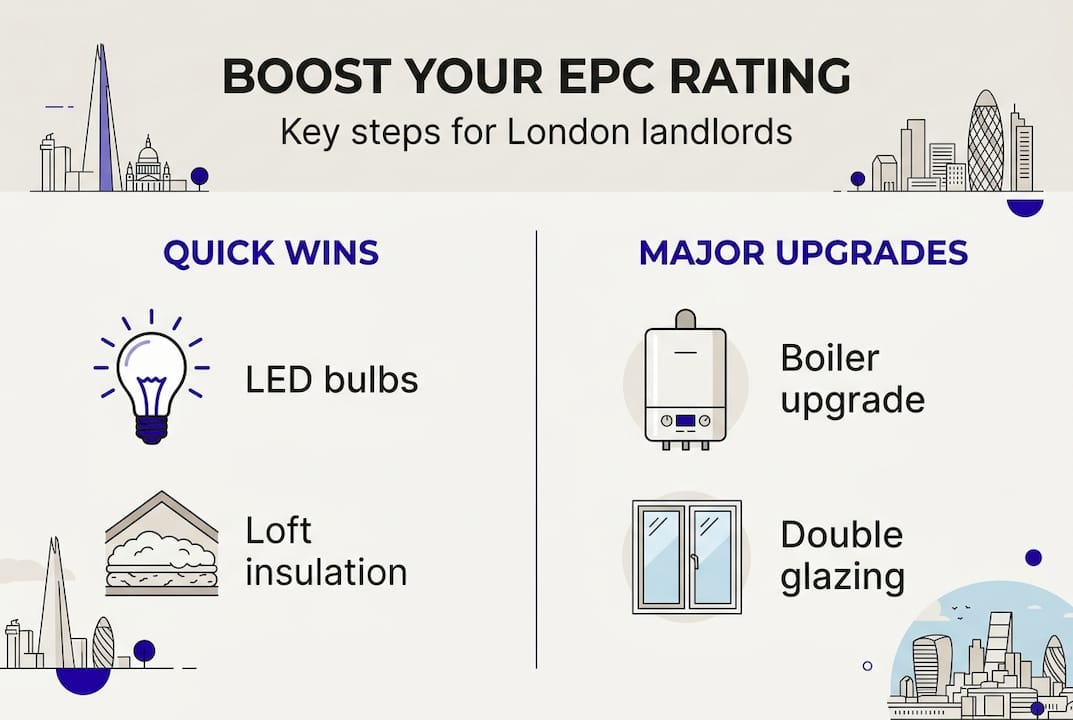
Heating system upgrades deliver substantial rating improvements. Replacing inefficient boilers with modern condensing models improves efficiency from around 65% to 90% or higher. Installing smart thermostats and thermostatic radiator valves enhances control, reducing energy waste without major capital expenditure. These measures also appeal to environmentally conscious tenants who prioritise sustainability.
| Improvement Measure | Typical Cost | Rating Impact | Payback Period |
|---|---|---|---|
| Loft insulation (270mm) | £300-£500 | +2-5 points | 2-3 years |
| Cavity wall insulation | £500-£1,500 | +5-10 points | 3-5 years |
| Condensing boiler replacement | £2,000-£3,500 | +5-15 points | 5-8 years |
| Double glazing (full property) | £4,000-£8,000 | +3-8 points | 10-15 years |
| LED lighting throughout | £100-£300 | +1-2 points | 1-2 years |
| Solar panels (3-4kW system) | £5,000-£7,000 | +10-20 points | 8-12 years |
Window improvements present a more complex calculation. Whilst double glazing reduces heat loss and improves comfort, the high upfront cost means longer payback periods. Prioritise windows in poor condition or single-glazed units in properties otherwise well-insulated, as the marginal benefit increases when other efficiency measures are already in place.
Consider your landlord EPC improvement tips better ratings strategy holistically. Sequential improvements often deliver better value than isolated upgrades. For instance, installing loft and wall insulation before upgrading heating ensures the new system isn’t oversized for actual requirements, reducing capital costs whilst maintaining comfort. The EPC renewal step by step guide helps you time improvements strategically around assessment cycles.
Explore Complete EPC’s services for London landlords
Navigating EPC requirements demands expertise, and Complete EPC provides comprehensive support tailored to London landlords. Our accredited assessors understand the unique characteristics of London properties, from period conversions to modern developments, ensuring accurate assessments that reflect your property’s true performance. We offer competitive pricing with transparent quotes and guaranteed lowest rates across the UK market.
Beyond basic certification, we provide strategic advice on improvement priorities, helping you identify cost-effective upgrades that maximise rating improvements within your budget. Our detailed reports go beyond regulatory minimums, offering actionable recommendations ranked by return on investment. Whether you manage a single property or an extensive portfolio, our understanding EPCs guide London resources and EPC assessment process guide London support keep you informed and compliant. Access our landlord EPC checklist compliance guide for ongoing compliance management and peace of mind.
Frequently asked questions
What is an EPC, and why is it important for landlords?
An Energy Performance Certificate measures how efficiently a property uses energy, rating it from A (most efficient) to G (least efficient). For landlords, EPCs are legally required for all rental properties and must show a minimum ‘E’ rating to let or renew tenancies. The certificate informs prospective tenants about energy costs and helps landlords identify improvement opportunities that reduce bills and increase property value.
When must landlords provide an EPC in London?
Landlords must have a valid EPC available when marketing a property for rent and must provide it to prospective tenants at the earliest opportunity. The certificate is required before completing any tenancy agreement, whether new or renewed. Properties cannot be legally let without a valid EPC meeting the minimum ‘E’ rating standard, so obtain certificates well before marketing to avoid delays.
How can landlords improve their EPC rating affordably?
Start with cost-effective measures like loft insulation, LED lighting upgrades, and heating controls, which deliver significant rating improvements for modest investment. Cavity wall insulation offers excellent value in older London properties, whilst boiler servicing and thermostat upgrades improve efficiency without major expenditure. Prioritise improvements based on your property’s specific weaknesses identified in the EPC recommendations report, focusing on measures with shortest payback periods first.
How often must EPCs be renewed?
EPCs remain valid for 10 years from the assessment date, but landlords should renew earlier if they complete significant energy efficiency improvements or if property modifications affect performance. Regulations may also change during the certificate’s lifespan, potentially requiring updated assessments to demonstrate compliance with new standards. Review your EPC status annually as part of routine property management to avoid last-minute compliance issues.
What are the penalties for non-compliance with EPC requirements?
Landlords letting properties without valid EPCs face fines up to £5,000 per property, depending on rateable value and severity of non-compliance. Letting properties below the minimum ‘E’ rating carries separate penalties and potential legal action from local authorities. Beyond financial penalties, non-compliance creates vulnerabilities in tenancy agreements and damages professional reputation, making proactive compliance essential for sustainable landlord businesses.