

TL;DR:
- London landlords must ensure all rental properties have a minimum EPC rating of E or higher.
- Compliance involves checking, improving, or registering exemptions before tenancy starts or certificates expire.
- Proactive upgrades and expert support help avoid costly fines and boost property marketability.
Failing to meet your EPC obligations as a London landlord can result in fines of up to £5,000, lost tenants, and serious legal complications. Enforcement is tightening, and the rules are changing fast. With new multi-metric EPC formats arriving in October 2026 and a minimum EPC C standard expected for all private rented sector properties by 2030, the pressure to act is real and growing. This guide walks you through exactly what you need to know and do, from understanding your legal duties to improving your property’s rating and accessing financial support.
Table of Contents
- Understanding your EPC obligations as a landlord
- Step-by-step process to achieve compliance
- Improving your property’s EPC rating: Methods and costs
- Navigating exemptions and funding options
- Common mistakes and how to avoid them
- Why EPC compliance is more than a legal tick-box
- Simplify EPC compliance with expert support
- Frequently asked questions
Key Takeaways
| Point | Details |
|---|---|
| EPCs are mandatory | All privately rented homes in London must meet EPC standards to avoid hefty penalties. |
| Act before 2026 changes | New EPC rules and tougher enforcement mean landlords should upgrade soon to avoid future risks. |
| Invest for higher ratings | Upgrades like insulation and efficient boilers not only ensure compliance but raise property value and tenant appeal. |
| Exemptions and funding available | If upgrades aren’t feasible, exemptions and grants can ease the compliance burden. |
| Avoid costly mistakes | Stay proactive and organised to sidestep common pitfalls and fines. |
Understanding your EPC obligations as a landlord
An Energy Performance Certificate, or EPC, is a legally required document that rates a property’s energy efficiency on a scale from A (most efficient) to G (least efficient). For landlords, it is not optional. Landlords must ensure their properties hold a minimum EPC rating of E for all new and existing tenancies, or register a valid exemption on the PRS Exemption Register.
This standard is set under the Minimum Energy Efficiency Standards, commonly known as MEES. You can read a full breakdown of how these regulations apply to your property in our MEES regulations overview. The rules apply to virtually all domestic private rented properties in England and Wales, including those in London.
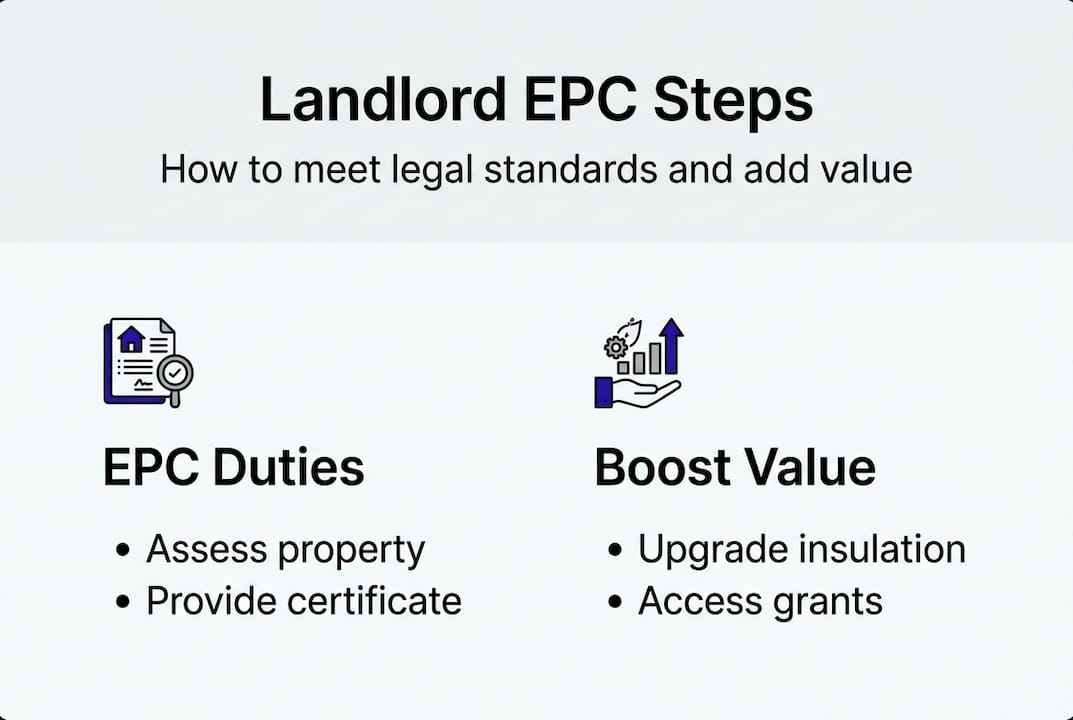
The regulatory landscape is shifting. From October 2026, new EPCs will adopt a multi-metric format, and by 2030, all private rented sector properties must meet an equivalent standard of EPC C. That is a significant uplift for many older London properties, which often sit at D or below.
Here is a quick summary of the key standards:
| Standard | Applies from | Minimum rating |
|---|---|---|
| Current MEES | Now | E |
| New EPC format | October 2026 | Multi-metric |
| Future MEES target | 2030 | C (equivalent) |
Key obligations you must meet right now:
- Hold a valid EPC for every rented property
- Ensure the rating is E or above, or register an exemption
- Provide a copy of the EPC to tenants at the start of a tenancy
- Renew the EPC before it expires (valid for 10 years)
“Landlords who cannot achieve the minimum standard must register an exemption or risk enforcement action by their local authority.”
Our EPC rating E guide explains in detail what this rating means in practice and how to confirm whether your property qualifies. For a broader compliance checklist, our EPC checklist guide is a practical starting point.
Step-by-step process to achieve compliance
Knowing your obligations is the foundation. Acting on them systematically is what keeps you on the right side of the law.
- Check your current EPC. Search your property’s postcode on the official GOV.UK EPC register to find your certificate and its expiry date. If no valid EPC exists, you must commission one immediately.
- Interpret your rating. If your property is rated E or above, you are currently compliant. If it is F or G, you must act before letting the property.
- Plan improvements. If the rating is below E, identify which upgrades will move the needle most efficiently. Your EPC report includes a recommendations section that lists suggested measures and their likely impact.
- Register an exemption if needed. If improvements are not feasible, register on the PRS Exemption Register with supporting evidence. Exemptions are time-limited and must be renewed.
- Provide the EPC to your tenant. Fines of up to £5,000 apply if you fail to obtain a valid EPC, improve to E, or share the certificate promptly with tenants.
- Keep records. Store copies of your EPC, any improvement invoices, and exemption documentation securely.
Pro Tip: Set a calendar reminder 12 months before your EPC expires. This gives you enough time to arrange an assessment, act on recommendations, and avoid a compliance gap between tenancies.
Here is a quick comparison to help you decide your next step:
| Property rating | Action required |
|---|---|
| A to E | Confirm EPC is valid and share with tenant |
| F or G | Improve rating or register exemption before letting |
| No EPC | Commission an assessment immediately |
Our EPC renewal guide takes you through the renewal process in detail, and our EPC compliance checklist helps you track every requirement in one place.
Improving your property’s EPC rating: Methods and costs
Once you know your property’s rating, the focus shifts to choosing the right improvements. Not all upgrades are equal in terms of cost or impact, so a strategic approach matters.

The fabric-first principle is the most effective starting point. This means addressing the building’s structure before investing in mechanical or renewable systems. Here is why: insulating walls, floors, and lofts reduces heat loss at the source, making every other system more efficient.
Priority improvements and their typical costs:
- Loft insulation: £300 to £600. One of the highest-impact, lowest-cost measures available.
- Cavity wall insulation: £500 to £1,500. Effective for properties built after 1920.
- Boiler upgrade (A-rated condensing boiler): £1,500 to £3,500. Replaces inefficient older systems.
- Double or triple glazing: £3,000 to £8,000 depending on the number of windows.
- LED lighting throughout: Under £200. Small cost, measurable EPC impact.
- Draught-proofing doors and windows: £100 to £300. Often overlooked but genuinely effective.
For more substantial upgrades, key improvement methods such as heat pumps, solar panels, and smart heating controls can significantly lift a rating, though reaching EPC C from a lower band may cost between £5,000 and £15,000 in total.
Statistic: Upgrading from EPC E to C can reduce annual energy bills for tenants by hundreds of pounds, making your property more attractive in a competitive rental market.
Pro Tip: Ask your assessor which single measure will give you the biggest rating improvement for the lowest spend. In many London flats, this is loft insulation or a boiler swap, not a full heat pump installation.
For window-related upgrades, energy efficient window treatments can complement glazing improvements at a fraction of the cost. Our guides on EPC recommendations and energy efficiency upgrades offer further detail on prioritising measures for your specific property type. You can also find targeted advice in our improvement tips for better ratings.
Navigating exemptions and funding options
Sometimes upgrades are not immediately possible. Whether due to listed building status, tenant refusal, or cost constraints, exemptions and funding options give landlords a structured alternative.
The main types of exemption available include:
- High cost exemption: Improvements would cost more than the current cost cap to implement.
- All improvements made exemption: All recommended measures have been installed but the property still falls below the minimum standard.
- Listed building or conservation area exemption: Upgrades would unacceptably alter the character of a protected building.
- Third-party consent refused: A tenant, freeholder, or planning authority has refused permission for works.
- Devaluation exemption: A surveyor confirms the improvements would reduce the property’s value by more than 5%.
Exemptions must be registered on the PRS Exemption Register with supporting evidence. Most exemptions last five years, after which you must reassess and either carry out improvements or re-register.
| Exemption type | Duration | Evidence required |
|---|---|---|
| High cost | 5 years | Three contractor quotes |
| All improvements made | Permanent | EPC and installation records |
| Listed building | 5 years | Planning or surveyor confirmation |
| Consent refused | 5 years | Written refusal from third party |
For funding, several routes are available. The ECO (Energy Company Obligation) scheme provides grants for eligible low-income households. Local authority grants vary by borough, so it is worth checking with your council. The Green Deal allows landlords to finance improvements through savings on energy bills, though uptake has been limited.
Funding options including ECO and local grants can significantly reduce the out-of-pocket cost of reaching EPC C, particularly for landlords with multiple properties. Practical window upgrades, such as those covered in this guide on efficient window covering solutions, can also support your overall energy strategy at lower cost.
Our EPC exemptions guide explains each route clearly, and our energy upgrade funding page outlines which options are most accessible for London landlords.
Common mistakes and how to avoid them
Even experienced landlords make avoidable errors when it comes to EPC compliance. Knowing what to watch for saves time, money, and potential legal trouble.
Leaving renewal too late. An EPC is valid for 10 years, but many landlords lose track of expiry dates. A lapsed certificate at the start of a new tenancy puts you immediately in breach. Check your certificate’s expiry date today.
Failing to share the EPC with tenants. EPCs must be provided within 7 days of a request, and enforcement in London is tightening, with fines reaching £5,000 for non-compliance. Always provide a copy at the start of a tenancy and keep proof of delivery.
Using unverified contractors. Improvements only count toward your EPC if they are carried out properly and recorded. Always use accredited installers and retain all invoices and certificates.
Relying on outdated guidance. The EPC format is changing in October 2026. Guidance issued before this date may not reflect the new multi-metric system. Always check the latest government guidance before making decisions.
Missing exemption and funding opportunities. Many landlords assume they must fund all improvements themselves. In reality, grants and exemptions are available and underused.
Pro Tip: Keep a dedicated compliance folder for each property containing the EPC certificate, tenant acknowledgement, improvement records, and any exemption documentation. This makes enforcement checks straightforward.
“Proactive landlords who stay ahead of compliance deadlines avoid the stress and cost of last-minute action.”
Our guide on reasons to upgrade your EPC outlines the broader benefits of staying ahead of the compliance curve.
Why EPC compliance is more than a legal tick-box
Many landlords treat EPC compliance as an administrative burden, something to manage and forget. We think that is the wrong way to look at it. An improved EPC rating is a measurable asset. It makes your property more attractive to quality tenants, reduces void periods, and supports a higher asking rent in a market where energy costs are front of mind for renters.
London’s older housing stock is both the biggest challenge and the biggest opportunity here. Properties that achieve EPC C ahead of the 2030 deadline will stand out in a market where many landlords are still scrambling to reach E. The landlords who invest now are not just avoiding fines; they are positioning their portfolios for long-term value. Understanding your property’s energy saving potential is a practical first step toward making that case financially.
Proactivity is the real competitive advantage. The regulations will only tighten further, and the cost of reactive compliance is always higher than planned improvement.
Simplify EPC compliance with expert support
Navigating EPC obligations, improvement priorities, exemptions, and funding can feel like a lot to manage alongside the day-to-day demands of being a landlord. That is where expert support makes a genuine difference. At Complete EPC, we work with London landlords to make compliance straightforward, from initial assessments to tailored advice on reaching the right rating efficiently.
Our EPC guide for London landlords is a practical resource covering everything from the basics to the 2026 format changes. If you need help with exemptions, our EPC exemption support page walks you through eligibility and registration. Get in touch today to find out how we can help you stay compliant and protect the value of your property.
Frequently asked questions
What is the penalty for not having a valid EPC as a landlord in London?
Local authorities enforce EPC rules and can issue fines of up to £5,000 initially, with higher penalties for prolonged non-compliance. Repeated or serious breaches may attract additional enforcement action.
Do I need a new EPC for every tenancy or just once every 10 years?
A valid EPC lasts 10 years and must be in place at the start of every new tenancy or renewal, but you do not need to renew it unless the certificate has expired.
How do I check my property’s current EPC rating?
You can search your property’s postcode on the official GOV.UK EPC register to find your current certificate, its rating, and its expiry date at no cost.
What improvements offer the highest impact for EPC upgrades?
Loft and cavity insulation, A-rated boilers, and glazing typically deliver the greatest rating improvements relative to their cost, making them the priority measures for most London properties.
Am I eligible for an EPC exemption if my property is a listed building?
Yes. If a surveyor confirms that energy upgrades would devalue the property by over 5%, you may register a listed building exemption on the PRS Exemption Register for up to five years.
Recommended
- 7 Reasons to Upgrade Your EPC Rating as a Landlord
- Landlord EPC Checklist: Step-by-Step Compliance Guide – Complete EPC
- Energy efficiency upgrades: boost property value and compliance
- London’s Guide to EPC: What You Need to Know to Boost Property Value – Complete EPC
- 7 Smart Sustainable Home Improvements for Modern Living
- Energetische Dachsanierung: Mehr Effizienz und Förderung