

TL;DR:
- Most London property professionals recognize the importance of EPCs but often overlook what the ratings truly indicate and how upcoming regulatory changes will impact property values. The methodology and quality of evidence used in assessments significantly influence EPC scores, especially with the transition to the more accurate Home Energy Model in late 2026. Understanding and improving your EPC can ensure legal compliance, enhance marketability, and future-proof property investments amid evolving standards.
Most property professionals in London know they need an EPC. Far fewer understand what the rating actually tells them, what drives the score behind the letter, and why the system is fundamentally changing in late 2026. Whether you are a landlord checking compliance, an estate agent advising clients, or an owner planning improvements, the letter on a certificate is only the starting point. The methodology, the quality of evidence collected during the assessment, and the incoming regulatory overhaul all affect what your EPC means in practice and what it will mean for your property’s value and lettability in the years ahead.
Table of Contents
- What is an EPC rating and why does it matter?
- How EPC ratings are calculated: SAP, RdSAP, and the coming HEM
- EPC bands explained: what the letters and scores mean
- Minimum requirements, legal duties, and London benchmarks
- Improving EPC ratings: recommendations, real value, and common oversights
- The real EPC challenge: why methodology and evidence are as vital as letter bands
- Take the next step: expert EPC support for London properties
- Frequently asked questions
Key Takeaways
| Point | Details |
|---|---|
| EPCs impact compliance | Your property’s EPC band affects legal lettability and must meet minimum energy standards. |
| Calculation methods matter | How an EPC is calculated (SAP, RdSAP, HEM) can change your score and future compliance. |
| Scores shape property value | Higher EPC ratings attract buyers and tenants, boosting value and marketing appeal. |
| Regulations are tightening | EPC minimums and benchmarks are rising and London landlords should plan for stricter standards. |
| Recommendations drive improvements | Following EPC recommendations can help you upgrade your band and potentially increase property value. |
What is an EPC rating and why does it matter?
An Energy Performance Certificate (EPC) is an official document that assesses how energy-efficient a property is, graded on a scale from A to G. Band A is the most efficient and Band G the least. Every EPC also includes a current score and a potential score, along with a set of recommended improvements. The certificate is legally required when a property is built, sold, or let.
The rating matters for several interconnected reasons. First, it directly affects whether you can legally rent a property. Under the Minimum Energy Efficiency Standards (MEES), minimum EPC requirements for landlords mean that private rented properties must generally achieve at least Band E to be legally lettable, unless a valid exemption is registered. Properties rated F or G cannot be let without that exemption.
Second, EPC bands influence buyer and tenant perception. Households increasingly factor energy costs into their decisions, so a higher band signals lower bills and a greener property. Third, the certificate gives you a roadmap. The recommendations and potential rating show what your property could achieve if improvements are made, and reading an EPC certificate correctly reveals how raising the band can support marketing and positively influence buyer and tenant perception due to lower running costs and reduced emissions.
Key reasons EPC ratings matter for London property professionals:
- Legal compliance: Band E is the minimum for most private rentals; falling short without an exemption is a criminal offence.
- Lettability and saleability: Higher bands attract tenants and buyers who prioritise running costs and sustainability.
- Financial planning: The potential rating signals which improvement works offer the most uplift.
- Mortgage and insurance implications: Some lenders now factor EPC ratings into lending decisions or offer preferential terms for energy-efficient properties.
- Rental yield protection: As standards tighten, maintaining a higher band now avoids costly emergency upgrades later.
By the numbers: England’s median EPC score is 69, which sits at the start of Band C. London’s older and more varied housing stock means many properties fall below this, making proactive management of ratings especially important in the capital.
You can also explore general room rental resources for broader context on how energy efficiency fits into the wider rental market landscape.
How EPC ratings are calculated: SAP, RdSAP, and the coming HEM
Understanding the importance of the EPC means knowing how it is measured. Let us break down the core methodologies and what will change soon.

Two primary methodologies currently underpin EPC calculations. The Standard Assessment Procedure (SAP) is used for newly built dwellings and requires detailed, verified construction data. The Reduced Data SAP (RdSAP) is used for existing properties and works from a site survey, filling in gaps with default values where certain information is unavailable. Both are approved calculation methodologies, but they differ significantly in how they handle evidence and defaults.
When a surveyor cannot verify a specific element, such as the type of wall insulation or the specification of glazing, the methodology forces a default value. These defaults are typically conservative, meaning they assume poor performance. A property with cavity wall insulation that was not installed to current standards, or where the assessor could not access build-up evidence, may receive a lower score than its actual performance warrants. This is one of the most common sources of rating disputes.
| Feature | SAP | RdSAP | HEM (from 2026) |
|---|---|---|---|
| Primary use | New dwellings | Existing dwellings | Both new and existing |
| Evidence required | Full construction data | Site survey plus defaults | More granular real-world data |
| Strengths | High accuracy for new builds | Practical for occupied homes | Improved accuracy and consistency |
| Limitations | Not suited to existing stock | Defaults can lower scores | Still in transition phase |
| When introduced | Long-established | Long-established | Expected 2H 2026 |
The shift to the Home Energy Model (HEM) is significant. Government consultations confirm that SAP and RdSAP will be replaced by HEM, with the transition expected in the second half of 2026. HEM is designed to be more accurate, more consistent, and better aligned with actual energy use. For London property owners, this means that scores calculated under current methodologies may not translate directly once the new model is adopted.
Pro Tip: Before commissioning works based on your EPC recommendations, confirm which methodology your certificate used. If it was RdSAP and several defaults were applied, you may benefit from a new assessment with better evidence before spending money on improvements.
EPC bands explained: what the letters and scores mean
With methodology covered, let us turn to what the letters and scores on your EPC actually indicate for your property and competitive positioning.
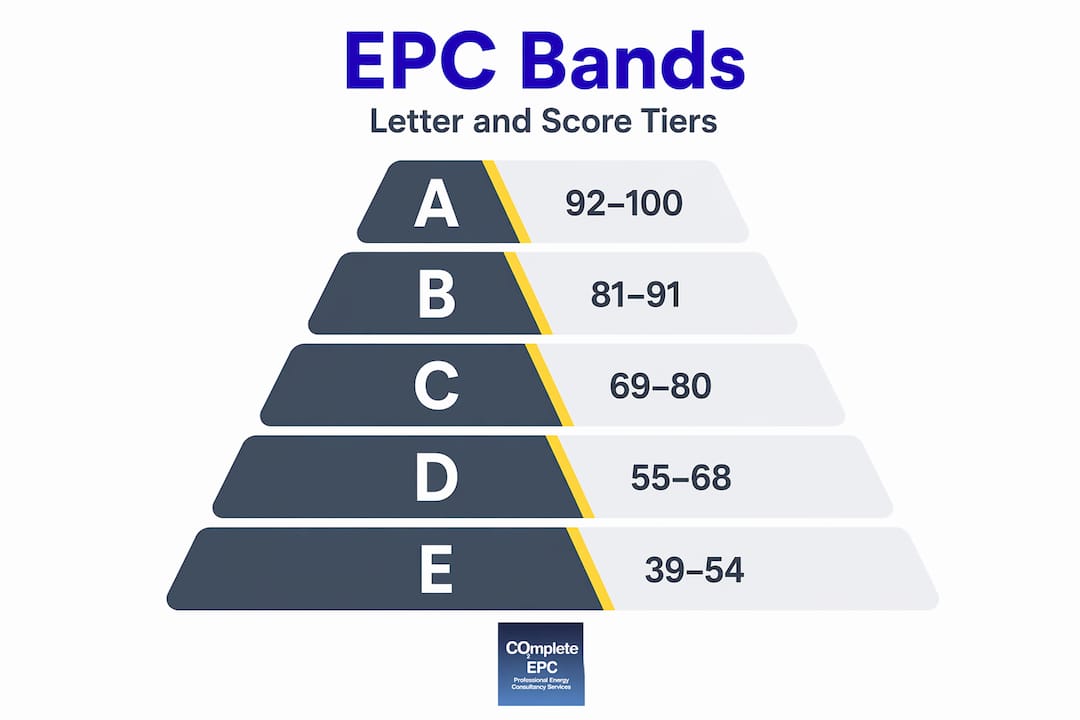
The EPC rating scale runs from A to G, with each band corresponding to a numerical score range:
| Band | Score range | Energy efficiency | Compliance and value implication |
|---|---|---|---|
| A | 92–100 | Excellent | Highest value; rare in London’s older stock |
| B | 81–91 | Very good | Strong marketing asset; above average |
| C | 69–80 | Good | England’s median starts here; competitive for rentals |
| D | 55–68 | Average | Lettable but below national median; improvement worthwhile |
| E | 39–54 | Below average | Minimum for legal lettings; borderline compliance |
| F | 21–38 | Poor | Cannot be let without a registered exemption |
| G | 1–20 | Very poor | Cannot be let; immediate action required |
Many London properties, particularly Victorian and Edwardian terraces, converted flats, and period buildings, tend to cluster in the D and E bands due to solid walls, older boilers, and single-glazed windows. Here is what distinguishes a typical Band D property from one sitting in Band C:
Typical features of a Band D property in London:
- Gas central heating with a standard (non-condensing) boiler
- Partial or no loft insulation
- Single-glazed or early double-glazed windows
- No renewable energy systems
- Solid or unfilled cavity walls
Typical features of a Band C property in London:
- Modern condensing boiler with programmer and thermostatic radiator valves
- 100mm or more of loft insulation
- Modern double or triple glazing
- Some draught-proofing and hot water cylinder insulation
- Potentially a solar PV panel or improved heating controls
Moving from D to C is achievable for most London properties with targeted improvements and is increasingly expected as regulatory standards evolve.
Minimum requirements, legal duties, and London benchmarks
Knowing what your rating means is half the story; the other half is understanding your legal responsibilities and preparing for imminent policy changes.
The current legal framework for private rented properties is governed by the Minimum Energy Efficiency Standards, widely known as MEES. Under these rules, properties rated F or G cannot lawfully be let unless a valid exemption is registered with the relevant authority. The minimum standard for a legally lettable property is Band E. This applies to both new tenancies and existing ones.
Here is what landlords in London need to do to manage their compliance effectively:
- Check your current certificate: Log in to the national EPC register, confirm your property’s rating, and note the expiry date. Certificates are valid for ten years but may not reflect improvements you have made.
- Assess whether an exemption applies: If your property is currently below Band E, check whether you qualify for an exemption, such as a listed building exemption or a cost cap exemption where the required improvements would exceed the permitted spend.
- Plan for upgrades: If you do not qualify for an exemption and your property is below Band E, you must carry out improvements to bring it up to standard before letting.
- Prepare for future tightening: Government policy direction is moving towards stricter minimum standards, with proposals for higher bands becoming the new baseline in coming years.
Most London landlords who are currently at Band E should treat that as a staging post, not a destination. The direction of travel is clearly towards Band C as the eventual minimum for private rented properties, and acting now is significantly more cost-effective than reacting under pressure later.
For a broader view on managing rental obligations, reviewing rental compliance pricing from property management resources can help you factor in the full cost of compliance planning.
Improving EPC ratings: recommendations, real value, and common oversights
With legal obligations and current and future standards outlined, it is time to focus on what you can actually do to boost your EPC and add value.
Every EPC contains two important sections beyond the current rating: the recommendations list and the potential rating. The potential rating shows the band your property could achieve if all listed measures were implemented. The recommendations are prioritised by cost-effectiveness and impact, giving you a clear starting point for planning works.
Common improvements recommended on London EPC certificates include:
- Loft insulation: One of the most cost-effective upgrades available, particularly in older terraced properties with accessible loft space.
- Cavity wall insulation: Where cavity walls exist and are suitable for filling, this can provide a significant uplift.
- Condensing boiler replacement: Upgrading from a G-rated or older boiler to a modern A-rated condensing boiler improves the heating efficiency score substantially.
- Heating controls: Adding or upgrading a programmer, room thermostat, and thermostatic radiator valves often costs little but can improve a rating by several points.
- Double glazing: Replacing single-glazed windows with modern double or triple glazing reduces heat loss and improves the fabric score.
- Solar photovoltaic panels: Where roof orientation and planning permissions allow, solar PV can push a property from Band C into Band B.
- Air source heat pumps: Increasingly recommended as a low-carbon replacement for gas boilers, though installation costs remain significant.
Understanding how to read EPC recommendations helps you avoid a very common oversight: treating the potential rating as a guaranteed outcome. It is not. The potential band assumes ideal implementation of every recommended measure under standardised conditions. In practice, real-world constraints including fabric condition, listed building consents, leasehold restrictions, tenant access, and installation quality mean the actual uplift can differ from what the certificate projects.
There is also a quality dimension to consider. Government consultations on EPC reform explicitly address the need to improve EPC accuracy by strengthening assessor training and introducing sanctions for poor practice. This confirms that not all EPCs are created equal, and the quality of evidence gathered during the survey directly affects the reliability of the rating.
Pro Tip: If you are planning significant works based on your EPC’s potential rating, commission a new assessment with a qualified and experienced assessor once those works are complete. This ensures your certificate reflects the actual improvements rather than leaving value on the table with an outdated rating.
For broader context on how property value insights connect to energy improvements, exploring property-specific resources can help you frame the investment case for upgrades.
The real EPC challenge: why methodology and evidence are as vital as letter bands
Here is something most landlord guides and property portals understate: the letter band on your EPC is only as reliable as the methodology and evidence that produced it. Two identically performing properties can receive different ratings simply because one assessor had access to better evidence. And with the transition to HEM on the horizon, the score you hold today may not compare directly with scores issued from late 2026 onwards.
For landlords and estate agents, this has practical consequences. Confirm whether your certificate used SAP or RdSAP and consider whether evidence gaps, such as unverified insulation build-ups or assumed glazing types, may have forced defaults that pushed the rating down. In a dispute, in a re-let situation, or ahead of a sale, this detail matters far more than most people realise.
The same logic applies to forward planning. Because the UK is moving towards HEM and changing how metrics are produced and reported, EPC interpretation and future comparability may shift over time. An estate agent using today’s Band C as a long-term selling point without flagging the methodology transition is potentially misleading clients, even unintentionally.
In 2026 and beyond, the smartest London property professionals will ask not just what band, but how it was calculated, and with what evidence.
The most effective approach is to treat your EPC as a living document rather than a fixed result. Review it when circumstances change, commission fresh assessments after improvements, and ensure your assessor is experienced enough to gather the evidence that avoids unnecessary defaults. That discipline protects your compliance position, strengthens your negotiating power, and future-proofs your property’s value against the regulatory changes ahead.
Take the next step: expert EPC support for London properties
If you are ready to upgrade your score, ensure compliance, or unlock your property’s full value, practical help tailored for London is available now. At Complete EPC, we work with landlords, estate agents, and property owners across the capital to deliver accurate, reliable assessments that stand up to scrutiny. Whether you need to understand your current position or plan for the 2026 methodology transition, our qualified assessors are here to guide you. Start with our comprehensive EPC guide to build a solid foundation, review the EPC assessment process to know exactly what to expect, or explore our EPC rating guide to understand where your property sits and what it will take to improve. We offer the most competitive rates in the UK with no compromise on quality or accuracy.
Frequently asked questions
How often do EPC ratings need to be renewed in London?
EPCs are valid for 10 years across England and Wales, including London, but you should commission a new assessment sooner if you carry out significant energy improvements so the certificate reflects the current state of the property.
What is the difference between SAP and RdSAP assessments?
SAP is used for new dwellings and requires full construction data, while RdSAP is used for existing properties and works from a site survey, using standard default values where specific evidence is not available.
What is the minimum EPC rating to legally let a property in London?
Under MEES, most private rentals require at least a Band E rating to be legally let, and properties rated F or G require a registered exemption or improvement works before they can be placed on the rental market.
Is it possible to improve my EPC rating and does it really add value?
Yes, implementing the improvements listed on your EPC can boost your rating, and raising your EPC band genuinely supports marketing, increases buyer and tenant confidence, and can positively influence perceived and actual property value.
Will EPC rules or ratings change after 2026?
Yes, SAP and RdSAP will be replaced by the Home Energy Model in the second half of 2026, which may alter how ratings are calculated and compared, making it important for property owners to stay informed and review their certificates after the transition.