

TL;DR:
- EPC ratings from A to G assess property energy efficiency and impact legal, financial, and environmental factors.
- London landlords must improve properties to EPC E or higher before letting, with future standards reaching a minimum of C by 2030.
- Proactive upgrades like insulation, new boilers, and solar panels enhance property value, attract tenants, and ensure compliance.
From April 2025, landlords who ignore EPC requirements face fines exceeding £5,000 per breach, yet surveys consistently show that a significant number of London property owners still misunderstand what their EPC rating actually means. An EPC is not simply a box-ticking exercise. It directly affects your legal standing, your rental income, and your property’s market value. With tighter minimum standards on the horizon and enforcement becoming more rigorous, the cost of confusion is rising fast. This guide explains what EPC ratings mean, what the law currently requires, how exemptions work, and what practical steps you can take to improve your rating and protect your investment.
Table of Contents
- What is an EPC rating and why does it matter?
- EPC rating requirements and legal obligations in London
- Navigating exemptions and special cases
- How to improve your EPC rating in London
- Why a proactive approach to EPC ratings gives London property owners an edge
- Get expert help with EPC ratings and property compliance
- Frequently asked questions
Key Takeaways
| Point | Details |
|---|---|
| Legal compliance is essential | London landlords must ensure their properties meet the required EPC rating or face significant penalties. |
| Improvements increase value | Boosting your EPC rating can make your property more attractive to tenants and buyers, often raising market value. |
| Early action is best | Preparing now for future EPC changes can save money and ensure smoother compliance for London property owners. |
| Know your exemptions | Check if your property qualifies for an EPC exemption but always complete the official registration if so. |
What is an EPC rating and why does it matter?
An Energy Performance Certificate (EPC) is an official document that measures how energy efficient a property is. It covers everything from wall insulation and heating systems to windows and lighting. The rating runs on a scale from A to G, where A is the most efficient and G is the least. Most London properties fall somewhere in the middle of that scale.
The assessment is carried out by an accredited domestic energy assessor who visits the property, collects data on its construction, heating, and ventilation, and feeds that information into approved software. The result is a score between 1 and 100, which maps to one of the seven letter bands. The certificate also includes a list of recommended improvements and an estimate of potential energy costs.
Why does this matter for London property owners? Here are the key reasons:
- Legal requirement: EPCs are legally required for the sale or letting of properties and are valid for ten years.
- Financial impact: A poor rating can reduce the sale price and make a property harder to let.
- Tenant demand: Prospective tenants increasingly factor energy costs into their decisions, especially given recent energy price rises.
- Environmental compliance: Properties with higher ratings contribute less to carbon emissions, which aligns with London’s broader sustainability targets.
To put the numbers in context, the England median EPC score sits at 69, which is the start of the C band. Many older London properties, particularly Victorian and Edwardian terraces, score well below this.
| EPC band | Score range | Typical property type |
|---|---|---|
| A | 92 to 100 | New build, passivhaus |
| B | 81 to 91 | Modern well-insulated homes |
| C | 69 to 80 | Post-2000 average homes |
| D | 55 to 68 | Mid-century semi-detached |
| E | 39 to 54 | Older properties, some flats |
| F | 21 to 38 | Poor insulation, old heating |
| G | 1 to 20 | Unimproved period properties |
An EPC gives you a snapshot of your property’s energy performance today and a roadmap for where it could be tomorrow.
Understanding where your property sits on this scale is the starting point for every compliance and improvement decision you will make as a London landlord or owner.
EPC rating requirements and legal obligations in London
Now that the meaning and purpose of EPC are clear, it is critical to understand the rules London landlords and owners must follow.
The current legal framework is governed by the Minimum Energy Efficiency Standards (MEES). Under these rules, landlords must achieve at least an EPC rating E before letting a property in the private rented sector. Properties rated F or G cannot legally be let without a registered exemption. Fines reach up to £5,000 or more for breaches, and local authorities have powers to investigate and enforce.
Looking ahead, the government’s trajectory points to a minimum rating of C for all new tenancies by 2030. That is a significant shift. Many London landlords with older stock will need to invest in improvements well before that deadline to avoid being locked out of the rental market.
Compliance checklist for London landlords:
- Check your current EPC rating and expiry date.
- If your rating is F or G, commission improvements immediately.
- Register any valid exemption on the PRS Exemptions Register before letting.
- Keep records of all improvement works and costs.
- Renew your EPC before it expires or when you carry out significant works.
- Aim for a C rating now, even if the 2030 deadline feels distant.
Pro Tip: Do not wait for your EPC to expire before reviewing it. If you have made improvements such as a new boiler or loft insulation, a fresh assessment may push you into a higher band and strengthen your letting position today.
Comparison: current vs. proposed minimum standards
| Requirement | Current (2026) | Proposed (2030) |
|---|---|---|
| Minimum band for new lets | E | C |
| Fine for non-compliance | Up to £5,000+ | Expected to increase |
| EPC validity | 10 years | 10 years |
| Exemption register | Required | Required |
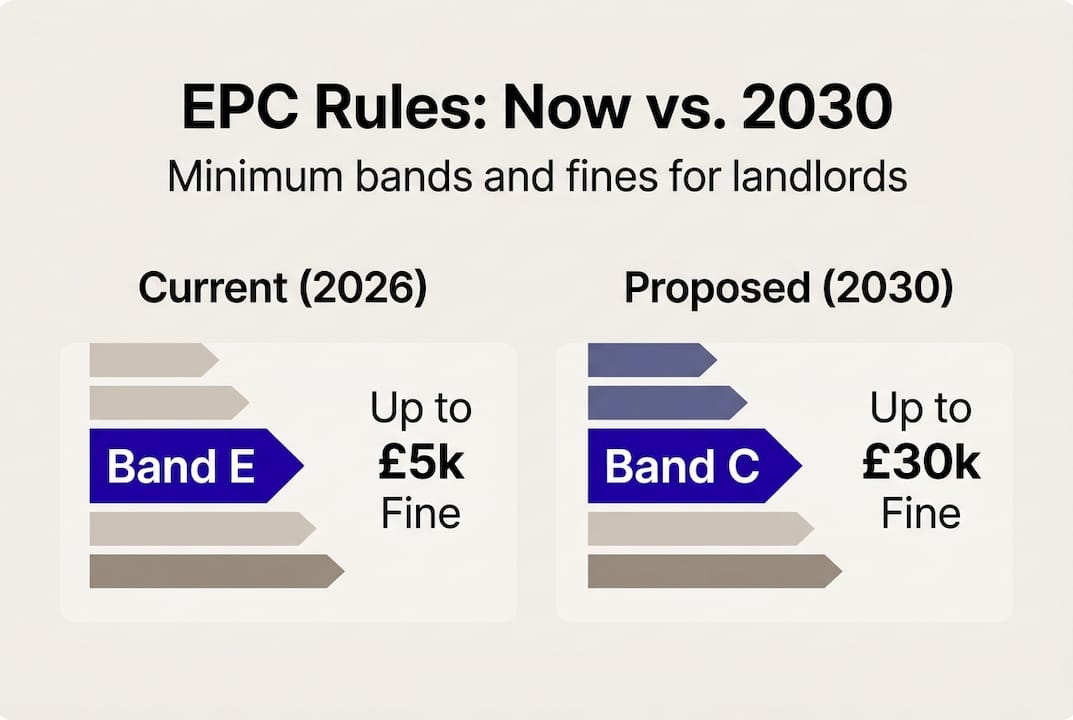
The gap between E and C may sound modest, but for many properties it represents thousands of pounds in upgrades. Planning early gives you options; leaving it late gives you pressure.

Navigating exemptions and special cases
Even with strict rules, there are legitimate ways some properties may not have to meet EPC minimums. Here is how to check if you qualify and what to do.
Not every property can realistically achieve an E or C rating. The government recognises this and has built a set of exemptions into the MEES framework. However, these exemptions are not automatic. You must actively register them and provide supporting evidence.
Key exemptions include:
- Listed buildings and heritage properties: Exempt if energy improvements would unacceptably alter the character of the building. This is not a blanket exemption. You need a specialist assessment and must demonstrate the specific harm.
- Cost cap exemption: If the cost of reaching the minimum standard exceeds £3,500 (including any grants), you may register an exemption after making all improvements that fall within that cap.
- Consent not obtained: If a tenant refuses access for works, or a freeholder or local authority withholds consent, an exemption may apply.
- All improvements made: If you have already carried out every recommended improvement and still cannot reach the minimum band, you can register this exemption.
To claim any exemption, you must register on the PRS Exemptions Register before letting the property. Exemptions typically last five years, after which you must reassess and re-register if still applicable.
Pro Tip: Many landlords assume that owning a listed building automatically means they are exempt. It does not. You still need to demonstrate that specific improvements would cause unacceptable harm to the building’s character. Get a qualified assessor involved early to build your case properly.
A common mistake is treating exemptions as a permanent solution. They are temporary measures while circumstances prevent compliance. If your situation changes, such as a tenant leaves or a new grant becomes available, you may be required to make improvements and re-let under the standard rules.
How to improve your EPC rating in London
With exemptions clarified, let’s focus on how you can take positive action to raise your EPC and future-proof your property.
Improving your EPC rating is not just about compliance. It is about making your property more attractive, more valuable, and cheaper to run. The good news is that many improvements deliver a meaningful rating boost without requiring a full renovation.
Steps to take before, during, and after an EPC assessment:
- Before: Review your current EPC recommendations report. Every EPC includes a list of suggested improvements ranked by cost and impact.
- Before: Address quick wins first. Loft insulation, draught-proofing, and LED lighting are low-cost measures that can shift your score noticeably.
- During: Ensure the assessor has full access to all areas, including the loft, boiler cupboard, and any outbuildings. Missing data leads to conservative assumptions that lower your score.
- After: Use the updated EPC recommendations to apply for grant funding. The Energy Company Obligation (ECO) scheme can cover significant costs for eligible properties, and higher EPC bands can boost property values in both sale and rental markets.
Improvements that deliver the best rating uplift:
- Cavity wall or solid wall insulation
- Upgrading to a modern condensing boiler
- Installing a heat pump (particularly effective for detached properties)
- Double or triple glazing
- Solar panels, which also improve solar panel efficiency and long-term running costs
- Smart heating controls and thermostats
The EPC recommendations report is one of the most underused tools available to London landlords. Treat it as a prioritised action plan, not a formality.
Pro Tip: Focus on improving your EPC rating in order of impact per pound spent. Insulation and heating upgrades typically move the needle far more than cosmetic changes. Check top EPC tips for a prioritised breakdown specific to London property types.
Higher-rated properties consistently attract better tenants, command higher rents, and sell faster. The financial case for proactive improvement is strong, even before factoring in compliance obligations.
Why a proactive approach to EPC ratings gives London property owners an edge
Most landlords treat EPC compliance as a reactive task. They wait for a certificate to expire, or for an enforcement notice to arrive, before taking action. That approach is becoming increasingly costly.
The landlords who benefit most from the current regulatory environment are those who treat EPC improvement as a long-term investment strategy, not a legal obligation to manage at the last minute. Early upgrades mean you access grant funding before it is oversubscribed. You avoid the premium pricing that comes with rushed contractor bookings. And you position your property ahead of the market before the 2030 C-band deadline forces everyone else to act at once.
There is also a rental premium to consider. Properties with strong EPC ratings command higher rents and attract tenants who stay longer, because lower energy bills make the overall cost of living in the property more manageable. Understanding how EPC affects rent in London is a genuine competitive advantage that most landlords overlook entirely. The mindset shift from compliance to strategy is where the real value lies.
Get expert help with EPC ratings and property compliance
For those ready to act on these insights, specialist guidance is the surest way to smooth compliance and maximise returns. At Complete EPC, we work with London landlords and property owners every day, helping them navigate the full EPC rating process with confidence. Whether you need a straightforward assessment, advice on the EPC assessment process, or a clear explanation of what your current certificate means for your letting strategy, our qualified assessors are ready to help. We offer competitive pricing, local expertise, and a fast turnaround. Start with our guide to understanding EPCs in London and take the first step towards full compliance today.
Frequently asked questions
What does each EPC rating band mean?
EPC bands run from A (most efficient) to G (least efficient), with each band reflecting a specific range of energy efficiency scores based on your property’s construction, heating, and insulation. The EPC scale from A to G determines both your legal standing and your property’s running costs.
How long is an EPC valid for?
An EPC is valid for 10 years from the date of issue. You will need a new one if the current certificate has expired or if you carry out significant energy improvements that change the property’s performance profile.
Are all listed buildings exempt from EPCs?
No. Listed buildings are only exempt if specific energy improvements would unacceptably alter their character, and you must provide evidence and register the exemption formally. Ownership of a listed building alone does not grant automatic exemption.
What is the cost of not complying with EPC regulations?
Failing to meet the minimum EPC standard can result in fines exceeding £5,000 per breach. Local authorities can investigate complaints and issue civil penalty notices, making non-compliance a serious financial and reputational risk.