

TL;DR:
- London landlords must ensure their private rental properties meet EPC band C by October 2030 to avoid fines. Implementing low-cost measures like LED lighting and loft insulation can improve ratings efficiently, while accurate documentation and timely assessments are essential. Exemptions are limited and require thorough evidence; early planning ensures compliance and better property performance.
Energy rating guidelines define the minimum energy efficiency standards that privately rented properties must meet to remain legally lettable. For London landlords, the stakes have never been higher. All privately rented homes in England and Wales must achieve at least an Energy Performance Certificate (EPC) band C by 1 october 2030, replacing the previous band E minimum. The formal industry term is the Minimum Energy Efficiency Standard (MEES), and understanding it is the first step to protecting your rental income and avoiding significant financial penalties.
What are the energy rating guidelines for privately rented properties?
Energy rating guidelines set the legal floor for how energy efficient a rented property must be before a landlord can let it. The current framework is governed by the MEES Regulations, enforced by local authorities across England and Wales. The EPC scale runs from A (most efficient) to G (least efficient), with band C now the target for all private landlords.

The guidelines cover three core areas: the required EPC band, the compliance deadline, and the financial penalties for non-compliance. Landlords who breach the standard after 2030 face penalties up to £30,000 per property. That figure represents a sixfold increase on the previous maximum fine of £5,000, which signals how seriously the government is treating this round of enforcement.
The EPC itself is the document that records a property’s energy performance criteria. It scores a property using the Standard Assessment Procedure (SAP), which accounts for insulation, heating systems, glazing, and air tightness. A home energy assessment carried out by an accredited assessor produces the certificate, which is then lodged on the national register.
What are the key compliance deadlines and standards?
The compliance framework for 2030 is more structured than many landlords realise. The key dates and provisions are:
- 1 october 2030: Single compliance date for all privately rented properties in England and Wales to hold a valid EPC band C or above.
- Grandparenting provision: Properties that achieve EPC band C under the existing Energy Efficiency Rating (EER) before 1 october 2029 are treated as compliant until that EPC expires. This incentivises early action.
- Dual-metric standard: By 2030, properties must satisfy a fabric performance standard plus either a heating system metric or a smart readiness metric. Meeting the EPC band C score alone will not be sufficient.
- £10,000 cost cap: The maximum a landlord is required to spend on improvements before qualifying for an exemption. This cap covers EPC assessments, improvement works, and associated fees over a 10-year period.
- Exemption register: Landlords who cannot meet the standard must register on the official government Exemptions Register. Registered exemptions typically last five years, after which reassessment is required.
The dual-metric standard is the detail most landlords overlook. A property can score band C on the EPC but still fail the fabric or heating metric. Checking both dimensions early prevents costly surprises close to the deadline.
Which energy conservation measures raise an EPC rating most effectively?
Raising a property’s EPC band is a structured process. Start with low-cost measures, then move to higher-impact upgrades once the quick wins are exhausted.
- LED lighting upgrade: Replacing all bulbs with LED equivalents typically adds 1–4 SAP points. The cost is low and the work causes no disruption to tenants.
- Loft insulation top-up: Topping up loft insulation to 270mm adds 5–10 SAP points. This is one of the highest-return measures available for properties with accessible roof spaces.
- Smart heating controls: Installing a smart thermostat and thermostatic radiator valves adds 3–4 SAP points. Advice on maximising heating efficiency shows that controls alone can reduce energy waste significantly without replacing the boiler.
- Boiler replacement: Upgrading to a modern condensing boiler delivers a larger SAP point gain than controls alone. This is a higher-cost measure and should follow the low-cost steps.
- Wall insulation: Cavity or solid wall insulation produces substantial SAP gains and addresses the fabric performance metric directly. It is the most impactful single upgrade for older London properties.
Pro Tip: Commission a home energy assessment before starting any works. The assessor’s report will rank improvements by SAP point gain and cost, so you spend money where it counts most.
The table below summarises typical improvement costs and SAP point gains:
| Measure | Typical SAP point gain | Approximate cost |
|---|---|---|
| LED lighting upgrade | 1–4 points | £100–£300 |
| Loft insulation top-up | 5–10 points | £300–£600 |
| Smart heating controls | 3–4 points | £200–£500 |
| Boiler replacement | 10–20 points | £2,000–£4,000 |
| Cavity wall insulation | 8–15 points | £500–£1,500 |
Typical upgrade costs to move a property from band E or D to band C average around £5,400. Prioritising lower-cost, high-impact measures first reduces that figure considerably.
How do exemptions work under the energy rating guidelines?
Exemptions exist for landlords who genuinely cannot reach band C after spending up to the cost cap. They are not a way to avoid compliance indefinitely. The £10,000 cost cap includes EPC assessment fees, improvement works, and associated professional fees, calculated over a 10-year period. A review of the cap is planned every five years after 2030.
Permitted exemption types include:
- All improvements made: The landlord has spent up to £10,000 but the property still cannot reach band C.
- Property devaluation: A qualified surveyor confirms that the required works would reduce the property’s market value by more than 5%.
- Negative impact on fabric: The works would cause structural damage or harm the building’s fabric, confirmed by a relevant expert.
- Third-party consent refused: The landlord cannot obtain consent from a freeholder, planning authority, or mortgage lender to carry out the works.
- Temporary exemption: Applies for six months when a landlord inherits a non-compliant tenancy.
Exemptions must be registered on the official Exemptions Register with supporting evidence. They typically last five years. After that period, the landlord must reassess whether improvements are now feasible.
Pro Tip: Keep all quotes, invoices, and surveyor reports in a single folder. The EPC exemption process requires documentary evidence for every claim, and missing paperwork is the most common reason applications are rejected.
What is the EPC assessment process for compliance?
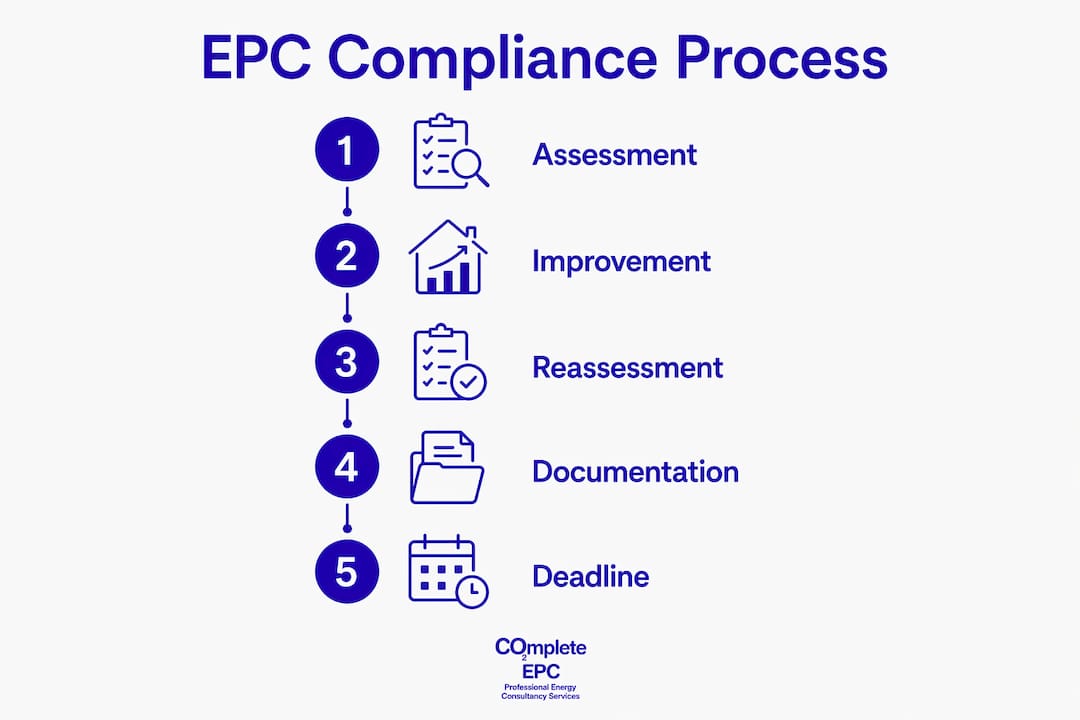
The assessment process has a specific sequence that landlords must follow to protect their compliance position.
- Pre-improvement EPC: Commission a new-format EPC before starting any works if your property is currently rated below band C. This establishes the baseline and confirms which improvements the assessor recommends.
- Complete the works: Carry out the improvements in the order recommended by the assessor. Keep all receipts, contractor invoices, and photographic evidence of the work completed.
- Post-improvement EPC: Commission a new EPC immediately after works are finished. Do not wait for the existing certificate to expire. The new certificate is the official record of compliance.
- Count EPC costs towards the cap: Both the pre-improvement and post-improvement EPC fees count towards the £10,000 cost cap. Record these costs alongside improvement expenditure.
- Lodge and retain documentation: The new EPC is automatically lodged on the national register. Retain your own copies of all certificates, invoices, and correspondence for at least 10 years.
The timing of the post-improvement assessment matters more than most landlords expect. Commissioning the EPC immediately after works are complete banks the improved rating as official evidence. Waiting risks enforcement action if an inspection occurs before the new certificate is in place.
The EPC assessment process in London typically takes one to two hours for a standard residential property. Accredited assessors use SAP calculation software on-site and submit results directly to the national register. You receive the certificate within 24–48 hours in most cases.
Landlords managing multiple properties should stagger assessments and improvements by property condition rather than by portfolio size. Properties closest to band C require the least investment and should be addressed first to reduce overall expenditure.
Key takeaways
Meeting the 2030 EPC band C requirement demands early action, accurate documentation, and a clear understanding of both the dual-metric standard and the exemption process.
| Point | Details |
|---|---|
| Compliance deadline | All privately rented homes must hold EPC band C by 1 october 2030 or register a valid exemption. |
| Dual-metric standard | Properties must meet a fabric performance standard plus a heating or smart readiness metric, not just the EPC band score. |
| Start with low-cost measures | LED lighting, loft insulation, and smart controls can add 9–18 SAP points at a fraction of the cost of major works. |
| Exemptions are time-limited | Registered exemptions last five years and require full documentary evidence; they are not a permanent solution. |
| Post-improvement EPC is critical | Commission a new certificate immediately after works to bank the improved rating as official compliance evidence. |
What I have learned from working with London landlords on EPC compliance
The landlords who struggle most with energy rating compliance are not the ones with the worst-performing properties. They are the ones who wait. I have seen portfolios where a single pre-improvement assessment, carried out two years before the deadline, would have identified a straightforward loft insulation job that costs under £500. Instead, those landlords face rushed contractor quotes, inflated prices, and the stress of chasing compliance in the final months before enforcement begins.
The dual-metric standard catches people off guard. A property can pass the EPC band C threshold on paper but still fail the fabric or heating metric. That is not a technicality. It reflects a genuine shift in how the government defines energy efficiency ratings. The old approach rewarded quick fixes. The new approach rewards properties that actually perform well thermally over time.
Documentation is where I see the most avoidable failures. Maintaining accurate records of receipts, EPC reports, and photographic evidence is as important as the physical improvements themselves. An assessor cannot credit work that cannot be verified. Regulators will not accept verbal assurances. A well-organised folder of evidence is worth as much as the upgrades it records.
Exemptions have a legitimate role, but relying on them as a default strategy is a mistake. The shift to a dual-metric standard signals that the government intends to raise the bar further after 2030. Landlords who invest in genuine fabric improvements now are better positioned for whatever comes next. Those who register exemptions and do nothing are simply deferring a larger problem.
Plan early, document everything, and treat the 2030 deadline as a starting point for a better-performing portfolio, not a finish line.
— Danny
How Completeepc helps London landlords meet the standard
Completeepc works with London landlords at every stage of the compliance process. Whether you need a domestic EPC assessment for a property currently rated below band C, or guidance on registering an exemption with the correct supporting evidence, Completeepc’s accredited assessors handle the process from start to finish. The team stays current with regulatory updates, including the 2030 dual-metric requirements, so you receive advice that reflects the actual standard you need to meet. Completeepc also supports landlords managing multiple properties, helping prioritise assessments by improvement potential to reduce overall spend. Certificates are lodged on the national register within 24–48 hours of assessment.
FAQ
What is the minimum EPC rating for rented properties from 2030?
All privately rented homes in England and Wales must hold at least an EPC band C from 1 october 2030. Properties that fail to meet this standard without a registered exemption face penalties of up to £30,000 per property.
How is an EPC rating calculated?
An EPC rating is calculated using the Standard Assessment Procedure (SAP), which scores a property based on insulation, heating systems, glazing, and air tightness. An accredited assessor carries out the home energy assessment on-site and submits results to the national register.
What does the £10,000 cost cap cover?
The £10,000 cost cap covers EPC assessment fees, improvement works, and associated professional fees, calculated over a 10-year period. If a landlord spends up to this amount and the property still cannot reach band C, an exemption can be registered.
How long does an EPC exemption last?
Exemptions registered on the government Exemptions Register typically last five years. After that period, the landlord must reassess whether improvements are now feasible and either carry out works or re-register with updated evidence.
When should I commission a new EPC after completing improvements?
Commission a new EPC immediately after works are finished, not when the existing certificate expires. The post-improvement certificate is the official compliance record and counts towards the £10,000 cost cap for exemption purposes.