

Most London landlords assume a Band C or D rating is perfectly acceptable. It is not the worst, after all. But here is the reality: properties with A or B ratings command up to £137,000 more in London alone, and incoming regulatory deadlines mean that settling for average is becoming a costly strategy. Understanding what the best energy efficiency rating actually means, how it is measured, and what it takes to achieve it could be the most valuable thing you do for your property portfolio this year.
Table of Contents
- Understanding energy efficiency ratings: what do they measure?
- What is the best energy efficiency rating and who achieves it?
- Why does the best rating matter? Value, compliance, and incentives
- How to get a top EPC rating: key upgrades and expert strategies
- Recent changes and future outlook: EPCs and energy efficiency trends
- Get expert support for your EPC and energy rating goals
- Frequently asked questions
Key Takeaways
| Point | Details |
|---|---|
| Band A is best | Band A is the highest energy efficiency rating, extremely rare and indicating exceptional performance. |
| Higher EPC boosts value | A/B rated properties command significant price premiums and lower running costs, particularly in London. |
| Compliance matters | From 2030, Band C becomes the practical benchmark for London property landlords. |
| Proof is critical | Always document upgrades and provide certificates to ensure your EPC accurately reflects improvements. |
| New rules impact ratings | 2026 EPC rule updates mean properties may need reassessment to ensure accurate, up-to-date energy ratings. |
Understanding energy efficiency ratings: what do they measure?
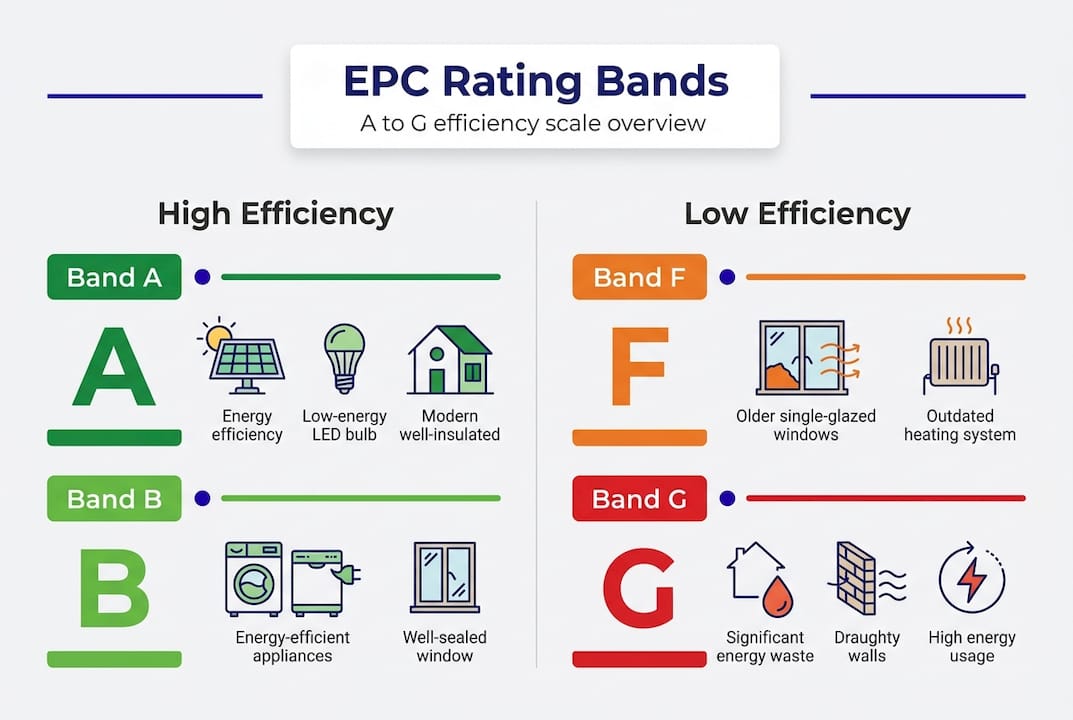
An Energy Performance Certificate (EPC) scores a property on a scale from A to G, where A is the most efficient and G is the least. Think of it like a fuel economy label on a car: it tells you how much energy the building consumes relative to its size and use. The higher the band, the lower the running costs and the smaller the carbon footprint.
The scoring relies on two main methods. What EPC ratings mean explains that existing dwellings use RdSAP (Reduced Data Standard Assessment Procedure), which involves a visual inspection with some default assumptions, while new builds use full SAP, which models heat loss, heating efficiency, renewables, and primary energy factors through government-approved software. The distinction matters because defaults can undervalue real improvements you have already made.
Each band corresponds to a specific range of SAP points:
| EPC band | SAP point range | Typical description |
|---|---|---|
| A | 92 to 100 | Exemplary, very low running costs |
| B | 81 to 91 | Highly efficient |
| C | 69 to 80 | Good standard |
| D | 55 to 68 | Average UK home |
| E | 39 to 54 | Below average |
| F | 21 to 38 | Poor |
| G | 1 to 20 | Very poor, high running costs |
You can explore the full breakdown in our EPC rating scales guide. The assessor evaluates wall insulation, roof insulation, floor insulation, glazing type, heating system efficiency, hot water provision, and any renewable energy sources. Understanding the difference between SAP vs EPC assessments is particularly useful if you are planning new builds or major refurbishments.
One critical point many landlords miss: if you have installed upgrades but cannot provide certificates or installation records, the assessor may apply conservative defaults. That can drag your score down unfairly. Always keep documentation for every improvement.
Key factors assessed in an EPC:
- Wall, roof, and floor insulation levels
- Glazing specification (single, double, or triple)
- Heating system type and efficiency rating
- Hot water system and controls
- Renewable energy sources such as solar PV
- Ventilation and airtightness
- Lighting efficiency
What is the best energy efficiency rating and who achieves it?
Band A is the pinnacle. Scoring between 92 and 100 SAP points, it represents a property with exemplary energy performance and very low running costs. We are talking about homes that are so well insulated and efficiently heated that they barely lose energy at all.
Here is the surprising part: Band A is exceptionally rare, found in only the top 2 to 10% of UK homes. In London, where the housing stock skews older, Victorian terraces and Edwardian semis dominate the landscape. These properties face genuine structural challenges in reaching Band A, though Band B is often achievable with the right investment.
“The best energy efficiency rating on UK EPCs is Band A (92 to 100 SAP points), representing exemplary performance with very low running costs.”
Typical London properties cluster around Bands C and D. Newer builds in areas like Nine Elms or Stratford are more likely to hit Band B or even A, having been designed with modern fabric standards from the outset. Older properties in conservation areas face additional constraints: listed building status can limit the interventions permitted, though EPC exemptions are available in genuine cases.

How London properties typically compare:
| Property type | Typical EPC band | Notes |
|---|---|---|
| New build (post-2016) | A to B | Designed to current Part L standards |
| 1990s to 2000s build | B to C | Often cavity wall insulated |
| 1970s to 1980s build | C to D | Mixed insulation, older heating |
| Victorian or Edwardian | D to F | Solid walls, single glazing common |
| Listed or protected | E to G | Restricted upgrade options |
Understanding the meaning of band A in the context of your specific property type is the first step. What is achievable for a 2020s flat in Canary Wharf is very different from what is realistic for a Georgian townhouse in Islington.
Why does the best rating matter? Value, compliance, and incentives
Let us be direct about the financial case. A and B rated homes command an average value premium of £57,000 across the UK, rising to £137,000 in London, representing an uplift of between 5% and 14%. For a landlord with a portfolio of five properties, that is a significant cumulative gain.
Running costs tell an equally compelling story. A Band A property typically costs around £500 to £700 per year in energy bills. A Band G property can exceed £1,400 annually. That difference directly affects tenant satisfaction, void periods, and the attractiveness of your rental to quality tenants who are increasingly energy-cost conscious.
Five reasons top EPC ratings matter for London landlords:
- Higher sale and rental values driven by documented energy savings
- Better mortgage products as lenders increasingly favour efficient properties
- Stronger tenant demand particularly from professional and corporate renters
- Regulatory compliance ahead of the proposed Band C minimum by 2030
- Future-proofed investment as energy costs and carbon targets tighten
Pro Tip: Even if Band A feels out of reach for your property, moving from Band E to Band C can still unlock significant value and keep you on the right side of upcoming legislation. Use our EPC value guide to model the potential uplift for your specific property.
The regulatory picture is sharpening. The government has signalled that most landlords will need to reach at least Band C by 2030. Failing to comply could mean being unable to let the property legally. That makes EPC improvement not just a financial opportunity but a legal necessity for many London landlords.
How to get a top EPC rating: key upgrades and expert strategies
Achieving Band A is not a single action. It is a sequence of targeted improvements, each building on the last. The most effective approach follows a fabric-first strategy, which means addressing heat loss through the building envelope before touching the heating system.
Fabric-first upgrades to prioritise:
- External or internal wall insulation for solid-walled properties
- Loft insulation to at least 270mm depth
- Floor insulation beneath suspended timber or concrete ground floors
- Triple glazing or high-performance secondary glazing
- Draught-proofing of doors, windows, and service penetrations
- Airtightness measures to reduce uncontrolled ventilation
Once the fabric is addressed, heating system upgrades deliver the next largest gains. Air source or ground source heat pumps are the gold standard for EPC scoring. Pair them with MVHR (mechanical ventilation with heat recovery) to maintain air quality without losing heat, and add solar photovoltaic panels to generate on-site renewable electricity. Our energy rating improvements guide walks through each step in detail.
Step-by-step upgrade pathway for London landlords:
- Commission a current EPC to establish your baseline score
- Review the recommendations section of the EPC report
- Address fabric issues first: insulation, glazing, airtightness
- Upgrade heating to a heat pump or high-efficiency system
- Install solar PV and battery storage if roof orientation allows
- Gather all certificates and installation records
- Commission a new EPC assessment to confirm the improved rating
Pro Tip: Always request that your assessor uses actual measured data rather than defaults wherever possible. Providing installation certificates for insulation, boiler upgrades, and glazing can add several SAP points to your score without any additional physical work. See our tips for better EPC for a checklist of documents to prepare.
For properties where Band A is not cost-effective, Band C remains the practical priority. Our home efficiency steps guide helps you identify the most cost-effective route to compliance. And for London-specific considerations, our London EPC insights resource covers planning constraints, conservation area rules, and local grant availability.
One common mistake: landlords invest in improvements but fail to update their EPC. An outdated certificate will not reflect your upgrades, meaning you lose both the compliance benefit and the marketing advantage. Book a reassessment promptly after any significant works.
Recent changes and future outlook: EPCs and energy efficiency trends
The EPC landscape is not static. The introduction of RdSAP 10 in 2026 represents the most significant methodology update in years. As our guide on types of EPC ratings explains, post-2026 EPCs now assess multiple metrics alongside the traditional A to G score, including fabric performance, heating system type, and smart readiness indicators.
This matters for two reasons. First, some properties will see their band change simply because the new methodology is more accurate. A property that previously scraped into Band C might now sit firmly in Band D, or vice versa. Second, the additional metrics give lenders, tenants, and buyers a richer picture of a property’s true performance.
What the 2026 EPC changes mean for landlords:
- Older EPCs may no longer accurately reflect your property’s current performance
- Smart heating controls and demand-response technology now contribute to scoring
- Fabric efficiency is assessed more granularly, rewarding solid wall insulation
- Properties with recent upgrades may benefit from reassessment under the new methodology
- The A to G band remains the headline metric but is now supported by sub-scores
Pro Tip: If your EPC was issued before 2025 and you have made improvements since, a reassessment under RdSAP 10 could improve your band and your compliance position simultaneously. Check our better efficiency steps resource for a checklist of qualifying upgrades.
Regulatory deadlines are also firming up. The proposed Band C minimum for rental properties by 2030 is widely expected to become law. Landlords who plan upgrades now, rather than rushing in 2029, will benefit from lower contractor costs, better access to grants, and a smoother compliance journey. The EPC methodology update from 2026 also signals that standards will only tighten further, making early action the strategically sound choice.
Get expert support for your EPC and energy rating goals
Navigating EPC requirements, upgrade pathways, and regulatory deadlines is genuinely complex, particularly for London landlords managing older or mixed-use stock. Complete EPC provides specialist assessments across London, carried out by qualified assessors who understand both the technical requirements and the practical realities of London’s diverse property types. Whether you need a straightforward certificate or bespoke advice on reaching Band C or beyond, our team can help. Start with our understanding EPCs in London guide to get your bearings, explore the full EPC rating guide to understand your options, or find out whether your property qualifies for EPC exemptions if structural or planning constraints apply. We offer the lowest rates in the UK market with no compromise on accuracy or expertise.
Frequently asked questions
How is the energy efficiency rating on EPCs calculated?
EPC ratings use SAP or RdSAP software to assess property fabric, heating systems, and renewables, producing a score from A to G. New builds use full SAP; existing homes use RdSAP with a visual inspection.
What specific features help a property achieve a Band A EPC?
Band A is typically achieved through advanced insulation, high airtightness, heat pumps, MVHR systems, and solar PV arrays working together. No single measure is sufficient on its own.
Do EPC ratings affect property value in London?
Yes. Properties rated A or B can achieve a value uplift of up to £137,000 in London, making energy efficiency one of the most financially significant property attributes.
Is achieving Band A always necessary for compliance?
Not currently. The compliance target for 2030 for most landlords is Band C, not Band A. Band A maximises value but is not a legal requirement.
How often should a property’s EPC be reassessed?
Every 10 years as a minimum, but reassess sooner after significant upgrades or following regulatory methodology changes to ensure your certificate reflects your property’s true performance.