

TL;DR:
- London property owners must measure and report emissions, especially Scope 3 from tenants and supply chains.
- Accurate data collection from tenants and primary sources is essential for credible carbon footprint assessments.
- Compliance involves addressing complex standards, data verification, and focusing on whole-life carbon reduction.
Carbon footprint is not just a concern for large corporations or heavy industry. If you own or manage a property in London, your building’s emissions profile directly affects your compliance obligations, running costs, and long-term asset value. Many property owners are surprised to learn that their buildings may already fall under reporting requirements they were not aware of. This guide covers everything you need to know: what a carbon footprint is, how to measure it accurately, what the three emission scopes mean in practice, and how London-specific compliance frameworks apply to your property.
Table of Contents
- What is a carbon footprint and why does it matter?
- How are carbon footprints measured for properties?
- The three scopes explained: Where emissions really come from
- London compliance and sustainability: Standards, templates, and key challenges
- Our experience: Why focusing on Scope 3 and data quality sets you apart
- Next steps: Enhance compliance and energy performance in your London property
- Frequently asked questions
Key Takeaways
| Point | Details |
|---|---|
| Carbon footprint affects compliance | Knowing your property’s carbon impact is essential for meeting London’s energy rules and future-proofing your assets. |
| Measurement is structured | Gathering activity data and applying standard factors gives an accurate picture of your emissions. |
| Scope 3 is critical | Tenant and value chain emissions usually dominate, requiring landlord-tenant collaboration for data. |
| London has unique standards | BS EN 15978, RICS and GLA requirements shape property owners’ carbon footprint responsibilities. |
| Quality data brings rewards | Verifying accurate data enhances both compliance and property value in a competitive market. |
What is a carbon footprint and why does it matter?
A carbon footprint is the total volume of greenhouse gases produced, directly or indirectly, by a person, organisation, or building. For property owners, it captures everything from the gas burned in your boiler to the electricity your tenants consume. The main gases involved are carbon dioxide (CO2), methane, and nitrous oxide, all measured in tonnes of CO2 equivalent (tCO2e) to allow fair comparison.
What surprises many property managers is that the calculation goes beyond what happens on-site. It includes direct emissions from fuel burned in your building, indirect emissions from the electricity you purchase, and a much broader category covering your supply chain, tenant activity, and even embodied carbon in materials. This third category, known as Scope 3, is where most of the impact lies for managed properties.
Understanding your carbon footprint matters for several practical reasons:
- Regulatory compliance: Energy efficiency regulations are tightening, and failure to comply can result in financial penalties and restrictions on letting.
- Tenant demand: Commercial and residential tenants increasingly expect low-carbon buildings, particularly in London’s competitive market.
- Running costs: Buildings with high emissions tend to be energy-inefficient, meaning higher utility bills for you or your tenants.
- Asset value: Properties with poor energy and carbon performance are increasingly discounted by buyers and lenders.
- Reputation: Demonstrating credible sustainability credentials protects your reputation with investors, tenants, and regulators.
The GHG Protocol provides the globally accepted framework for measuring emissions. It organises emissions into three scopes: Scope 1 (direct emissions from owned sources), Scope 2 (indirect emissions from purchased electricity or heat), and Scope 3 (all other indirect emissions across the value chain). Critically, Scope 3 accounts for 70 to 95% of total emissions for most property-related activities.
This is a significant figure. It means that even if you upgrade your boiler and switch to a green electricity tariff, you may still be responsible for the vast majority of your building’s carbon impact through tenant energy use and supply chain activity. Understanding how energy statements and emissions interact is therefore essential for any property owner serious about compliance.
How are carbon footprints measured for properties?
Measuring your property’s carbon footprint follows a clear methodology. The core calculation multiplies activity data (such as kilowatt-hours of gas or electricity consumed) by published emission factors, then sums the results across all three scopes. The process sounds straightforward, but getting it right requires careful boundary-setting and consistent data collection.
Here is the sequential process a property manager should follow:
- Define your boundary. Decide whether you are measuring a single building, a portfolio, or your entire organisation. Be consistent year on year.
- Set a baseline year. Choose a reference year against which future progress will be measured. 2019 is commonly used as a pre-pandemic baseline.
- Collect activity data. Gather gas bills, electricity invoices, water consumption records, transport logs, and tenant energy data.
- Apply emission factors. Use the UK Government’s published conversion factors, updated annually, to convert activity data into tCO2e.
- Sum across scopes. Total your Scope 1, 2, and 3 figures separately, then combine for an overall footprint.
- Review and verify. Cross-check figures against energy benchmarking data to spot anomalies before reporting.
The table below summarises what data you need for each scope:
| Scope | Data inputs required | Typical sources |
|---|---|---|
| Scope 1 | Gas consumption, oil, on-site vehicle fuel | Meter readings, fuel invoices |
| Scope 2 | Electricity purchased for common areas | Electricity bills, smart meter data |
| Scope 3 | Tenant energy use, materials, waste, transport | Tenant reporting, supplier data |
For London properties, two additional nuances apply. First, Scope 2 reporting often requires a dual approach: a location-based figure using the national grid average, and a market-based figure reflecting any renewable energy contracts you hold. Second, multi-tenant buildings make Scope 3 collection complex, as you rely on tenants sharing their own consumption data. SAP calculations in London and EPC regulations provide a useful starting point for understanding your building’s modelled energy performance before you begin live data collection.

Pro Tip: Always use primary data (actual meter readings) rather than estimated figures wherever possible. Estimated data introduces error and can undermine the credibility of your report with regulators and investors.
The three scopes explained: Where emissions really come from
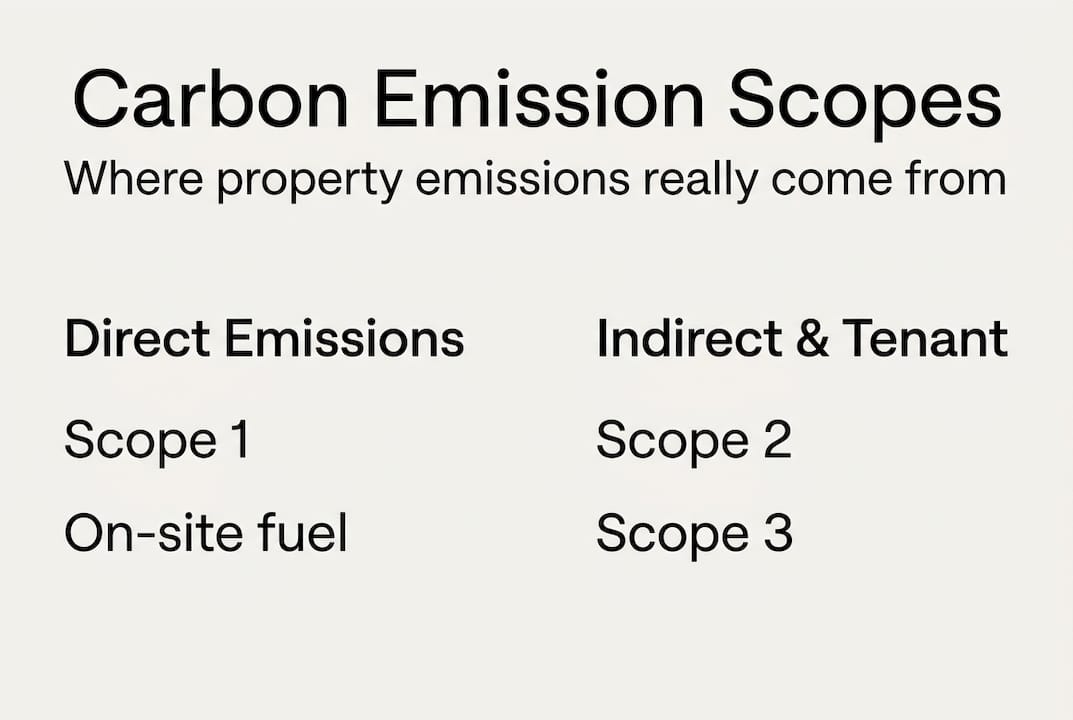
The GHG Protocol’s scope framework is the foundation of all credible carbon reporting. Per the GHG Protocol, Scope 1 covers direct emissions from sources you own or control, Scope 2 covers purchased electricity and heat, and Scope 3 covers all other indirect emissions across your value chain, often the most significant category.
Here is how each scope translates into real property scenarios:
| Scope | Definition | Property examples |
|---|---|---|
| Scope 1 | Direct, on-site emissions | Gas boilers, diesel generators, owned vehicles |
| Scope 2 | Purchased energy | Common area electricity, district heating |
| Scope 3 | Value chain emissions | Tenant energy use, embodied carbon, waste disposal |
For most managed commercial properties in London, Scope 3 is the dominant category. Tenant energy consumption alone can represent the majority of a building’s total footprint. This is why commercial EPC requirements are only part of the picture. An EPC tells you about the building’s energy efficiency, but your carbon footprint report needs to capture what actually happens inside it.
Emission sources London property managers should include in their reporting:
- Gas and oil consumption in landlord-controlled areas
- Electricity for lifts, lighting, and shared facilities
- Tenant energy use (heating, cooling, plug loads)
- Waste generated and disposed of from the building
- Embodied carbon from any refurbishment or fit-out works
- Transport associated with building management and maintenance
Pro Tip: Engage tenants early and make data sharing part of lease agreements. Green lease clauses that require tenants to provide energy consumption data are becoming standard in London’s commercial property market and significantly improve your Scope 3 accuracy.
Understanding where emissions really come from changes your priorities. Many property owners invest heavily in Scope 1 and 2 improvements, such as boiler upgrades and LED lighting, only to find their overall footprint barely moves because Scope 3 remains unaddressed. The energy statements and emissions framework helps you see the full picture and target the right interventions.
London compliance and sustainability: Standards, templates, and key challenges
London has some of the most demanding carbon reporting requirements in the UK. The Greater London Authority (GLA) uses specific templates aligned with BS EN 15978 and RICS standards, requiring all buildings to be modelled for certain planning applications and major developments. These frameworks go beyond simple energy use, requiring whole-life carbon assessments that include embodied carbon and operational emissions.
For property managers, the key compliance steps and common obstacles include:
- Data collection: Obtaining complete, verified energy data from all tenants is the single biggest challenge. Many tenants are reluctant or unable to share consumption data.
- Verification: Regulators and major investors now expect third-party verified data. Self-reported figures without verification carry less weight.
- Boundary consistency: Changing what you include year on year makes progress impossible to demonstrate. Stick to your defined boundary.
- Net Zero Carbon (NZC) targets: London’s NZC ambitions go beyond offsetting. They require genuine reductions in operational and embodied carbon, not just purchasing carbon credits.
- Staying current: Standards and carbon accounting standards evolve regularly. What was acceptable reporting in 2023 may not meet 2026 requirements.
You can use the EPC checklist for Londoners as a practical starting point for understanding your building’s current energy status before moving into full carbon reporting.
Only verified, high-quality data is accepted for major compliance submissions and investor-grade reporting. Buildings that cannot demonstrate data integrity risk penalties, restricted transactions, and reputational damage in London’s increasingly scrutinised property market.
Scope 3 remains the defining challenge. When tenant emissions can represent up to 95% of your building’s total footprint, a carbon report that ignores them is not credible. London’s compliance environment is moving firmly in the direction of whole-value-chain accountability, and property managers who prepare now will be far better positioned as requirements tighten.
Our experience: Why focusing on Scope 3 and data quality sets you apart
Most property owners we work with focus their sustainability efforts on what they can directly control: insulation upgrades, boiler replacements, LED retrofits. These are worthwhile improvements. But in our experience, they rarely move the needle on overall compliance because Scope 3 remains unaddressed.
The property managers who genuinely stand out in London’s market are those who treat tenant data collection as a core management function, not an afterthought. They build data-sharing requirements into leases, invest in sub-metering, and engage tenants in shared sustainability goals. The result is not just better compliance. It is lower risk at asset disposal, stronger relationships with institutional tenants, and a credible sustainability story that holds up under scrutiny.
Data quality is now a competitive differentiator. Investors and lenders are sophisticated enough to spot inflated or estimated figures. A well-documented, verified carbon footprint built on primary data and aligned with energy statement best practices is worth far more than a polished report built on assumptions. Our view is simple: get the data right first, then focus on reducing what you can measure.
Next steps: Enhance compliance and energy performance in your London property
Understanding your carbon footprint is the essential first step, but acting on that knowledge is what protects your asset and keeps you ahead of tightening regulations. At Complete EPC, we support London property owners through the full journey, from initial assessments to detailed compliance guidance. Explore the London EPC assessment process to see how a professional assessment fits into your broader sustainability strategy. If you are new to energy certificates, our guide to understanding EPCs is the right place to start. For those ready to go further, our energy efficiency metrics resource helps you benchmark performance and identify the improvements that will have the greatest impact on both compliance and costs.
Frequently asked questions
What are the main sources of carbon emissions in London properties?
Emissions come from onsite fuel use such as gas boilers, purchased electricity for shared areas, and tenant energy consumption. Scope 3 emissions from tenant activity often represent 70 to 95% of a property’s total footprint.
How do I gather accurate carbon footprint data for my property?
Collect actual meter readings, fuel invoices, and request energy use data directly from tenants. Primary data sources are always preferable to estimates, as they produce more credible and defensible reports.
Are carbon footprint calculations required by law for London property owners?
Compliance is increasingly required under GLA templates and BS EN 15978 for certain buildings, planning applications, and major transactions, with requirements expected to expand further in 2026.
What is the difference between Scope 1, 2, and 3 emissions?
Scope 1 covers direct onsite emissions such as gas or diesel, Scope 2 covers purchased electricity and heat, and Scope 3 covers the wider value chain including tenant energy use. Full definitions are set out in the GHG Protocol framework.