

Owning property in Greater London means keeping up with changing legal standards and ever-rising utility costs. For many landlords and property owners, understanding what an energy audit actually involves has become as important as finding reliable tenants. A thorough energy audit is more than just a box-ticking exercise—it provides objective evidence of compliance and uncovers real opportunities to improve efficiency. By focusing on clear, systematic evaluation, energy auditing transforms your approach to regulatory demands and offers practical solutions that help you save money while raising your property’s value. For those aiming to meet legal obligations and make smart upgrades, energy performance certificates hold the key to measurable savings and peace of mind.
Table of Contents
- Energy Auditing: Definition And Key Concepts
- Types Of Energy Audit For UK Properties
- How The Energy Auditing Process Works
- Legal Requirements And EPC Obligations
- Costs, Savings, And Common Mistakes
Key Takeaways
| Point | Details |
|---|---|
| Importance of Energy Auditing | Energy auditing is essential for property owners in Greater London to ensure regulatory compliance and identify cost-saving opportunities. |
| Types of Audits | Different methodologies, such as RdSAP and SAP, cater to various property types and goals, with the Home Energy Model offering enhanced accuracy for modern assessments. |
| Legal Obligations | Obtaining a valid Energy Performance Certificate (EPC) is mandatory for property transactions, with landlords needing to meet Minimum Energy Efficiency Standards (MEES). |
| Cost-Benefit of Improvements | While energy efficiency upgrades require upfront investment, they lead to significant long-term savings on energy bills and increase property value. |
Energy auditing: definition and key concepts
Energy auditing is an independent, systematic process that evaluates whether a building’s energy systems and controls are working effectively. Think of it as a health check for your property—it examines how much energy you’re using, where it’s being wasted, and what standards your building meets. Unlike a simple inspection, which might just check that equipment exists and functions, an energy audit assesses broader systems and reviews processes in detail, resulting in comprehensive reports with specific recommendations for improvement.
For property owners and landlords in Greater London, understanding energy auditing is crucial because it sits at the heart of regulatory compliance and cost savings. Energy Performance Certificates represent a standardised evaluation of how efficiently your building uses energy, and they form part of the broader Energy Performance of Buildings regime. These evaluations provide measurable insights into your property’s energy characteristics and support the UK’s commitment to reaching net-zero emissions by 2050. When you commission an energy audit, you receive objective evidence about your building’s compliance with relevant standards, whether that’s current Building Regulations, energy efficiency targets, or sustainability goals.
The key concepts within energy auditing revolve around three main areas. First, there is the assessment of energy performance, which involves measuring how much energy your property consumes relative to its size, age, and usage patterns. Second, you have identification of inefficiencies, where auditors spot where heat escapes, where systems run inefficiently, or where outdated equipment is costing you money unnecessarily. Third comes recommendations for corrective action, meaning the audit doesn’t just identify problems but also suggests practical solutions, prioritised by cost-effectiveness and impact. This three-part approach transforms an audit from merely a compliance requirement into a practical tool for reducing your energy bills. When you understand why your property scores a particular rating on its EPC, you gain actionable intelligence about where to invest in improvements and which changes will deliver the fastest return on investment.
Pro tip: When requesting an energy audit, ask the assessor to prioritise recommendations by payback period—focus first on improvements that will save you money within 2-3 years, as these deliver immediate value whilst you plan longer-term investments like insulation or heating system upgrades.
Types of energy audit for UK properties
The UK employs different methodologies for energy audits depending on your property type and what you want to achieve. For existing homes, assessments typically use Reduced Data Standard Assessment Procedures (RdSAP), which rely on on-site inspections combined with limited input data about your property’s construction and systems. If you own a new-build property, assessors use the Standard Assessment Procedure (SAP), which incorporates detailed architectural and construction information to provide a more comprehensive picture of energy performance. The government is introducing the Home Energy Model (HEM) to make assessments even more accurate, moving beyond simple energy cost predictions to include fabric performance metrics, heating system efficiency, and smart readiness analysis that reflects how modern properties actually operate.
Beyond these standardised methodologies, energy audits vary considerably in scope and focus depending on your needs. A walk-through or preliminary audit provides a quick overview of your property’s energy characteristics, ideal if you want a baseline understanding without detailed investment. A detailed facility audit goes much deeper, examining specific building aspects such as fabric efficiency (insulation quality, air leakage, thermal bridges), heating and hot water systems, lighting efficiency, and potential renewable energy technology installations. Some audits focus on particular concerns—for instance, if your London property has poor heating efficiency or high summer cooling costs, an assessor can concentrate on those specific systems rather than reviewing everything. Different audit scopes support various goals, whether you’re planning retrofitting work, ensuring regulatory compliance, or developing a targeted efficiency improvement plan tailored to your building’s specific weaknesses.
Choosing the right audit type depends on your situation and budget. If you’re selling or letting a property, you’ll need a standard EPC assessment (either RdSAP for existing homes or SAP for new builds) because this is a legal requirement. If you’re planning renovations or wanting to understand where your money’s going on energy bills, a detailed facility audit gives you far more actionable intelligence about which improvements will deliver the biggest savings. The audit type also affects cost and timescale—a preliminary walk-through might take a few hours, whilst a comprehensive detailed audit could require a full day or more depending on your property’s size and complexity. For landlords managing multiple properties in Greater London, some find it cost-effective to commission detailed audits on their highest-consumption buildings first, then use those findings to inform decisions about other properties in their portfolio.
The trend in UK energy auditing is moving towards greater accuracy and specificity. Rather than applying generic assumptions about how buildings perform, newer methods like the Home Energy Model use actual fabric performance data and real heating system specifications to provide more realistic energy predictions. This means the recommendations you receive from a modern audit are more likely to reflect genuine opportunities for savings in your specific property, rather than generic suggestions that may or may not apply.
Here is a quick reference for the main UK energy audit types and how they differ:
| Audit Type | Typical Use Case | Data Required | Level of Detail |
|---|---|---|---|
| RdSAP | Existing homes, standard EPCs | On-site basics, limited inputs | Moderate, standardisation |
| SAP | New builds, compliance assessments | Full construction & system data | High, comprehensive results |
| Home Energy Model (HEM) | Modern assessments, higher accuracy | Detailed fabric & system data | Very high, real performance |
| Walk-through Audit | Initial review, budget assessments | Visual observations | Low, headline insights |
| Detailed Facility Audit | Planning renovations, in-depth analysis | On-site, in-depth measurements | Very high, tailored advice |
Pro tip: If you’re unsure which audit type you need, start by clarifying your primary goal—are you meeting a legal requirement, planning major renovation work, or trying to reduce energy bills? Discuss this with your assessor before booking, as they can recommend the most cost-effective audit type that actually serves your purpose.
How the energy auditing process works
The energy auditing process follows a clear, structured approach designed to give you accurate insights into your property’s energy performance. It begins with preparation and scope definition, where the assessor discusses your specific situation and determines what needs examining. Are you selling a property and need an EPC for legal compliance? Planning renovations and wanting detailed recommendations? Or trying to understand why your heating bills are so high? This clarity shapes the entire audit. Once the scope is set, the assessor moves into evidence gathering, which involves a thorough on-site inspection combined with data collection about your building’s fabric, heating systems, and other energy-related features. For residential properties, this typically involves measuring insulation levels, checking window quality, inspecting heating and hot water systems, identifying air leakage points, and photographing key areas. The assessor documents everything from your property’s age and construction type to the age and efficiency of your boiler and whether you have any renewable energy installations.
The heart of the auditing process involves evaluation and analysis of the collected data. Auditors measure fabric performance, heating systems, and smart readiness to score your property against standardised criteria. They input your property’s specifications into assessment software (whether RdSAP for existing homes or the newer Home Energy Model) which calculates estimated energy consumption, carbon emissions, and running costs. This isn’t guesswork—the software applies actual performance data about how buildings behave, considering factors like your property’s orientation, local weather patterns, and the efficiency ratings of specific systems installed. The assessor evaluates your property against current Building Regulations and energy efficiency standards, identifying where you meet requirements and where you fall short. This evaluation stage is where recommendations take shape, with the assessor noting which improvements would deliver the greatest energy savings and return on investment.

The final stage is reporting and recommendations, where the assessor compiles findings into your Energy Performance Certificate and detailed audit report. Your EPC displays a simple A to G energy rating that anyone can understand, plus estimated annual energy costs and carbon emissions. But the real value lies in the detailed recommendations section, which outlines specific actions you can take to improve efficiency. These recommendations are prioritised—typically ranging from low cost, quick wins (like thermostatic radiator valves or draught sealing) to major investments (like new heating systems or insulation upgrades). A comprehensive audit report explains why each recommendation matters for your specific property, helping you make informed decisions about where to invest. For landlords in Greater London, this clarity is invaluable when deciding whether to improve properties before letting them, knowing exactly which measures will boost rental value and reduce void periods through improved energy ratings.
What makes the auditing process effective is that it’s systematic and follows documented procedures carried out by competent, qualified assessors. The process takes longer for larger properties or more complex buildings, potentially spanning a full day for comprehensive detailed audits on bigger homes. The result is objective, evidence-based intelligence about your property’s performance rather than generic advice. You receive specific recommendations tailored to your building’s actual characteristics, not assumptions about how similar properties typically behave. This is why energy auditing has become such a powerful tool for compliance, decision-making on upgrades, and identifying genuine cost-saving opportunities.
Pro tip: Book your energy audit early in any renovation planning process, as comprehensive audit recommendations help you prioritise investments logically and avoid costly improvements that deliver minimal energy savings for your specific property.
Legal requirements and EPC obligations
If you own property in the UK, energy performance certification is not optional—it is a legal requirement. Whether you’re selling a property, letting it to tenants, or constructing a new building, UK legislation mandates that you must have a valid Energy Performance Certificate (EPC) in place before the transaction completes or the property becomes occupied. This requirement exists across England, Scotland, Wales, and Northern Ireland, though specific implementation details vary slightly by region. The legal framework stems from the Energy Performance of Buildings Directive, which the UK continues to follow post-Brexit, and it applies to virtually all buildings offered for sale or rent. If you’re selling a house or flat in Greater London, you cannot legally complete the sale without an EPC. Similarly, if you’re letting a property to tenants, you must obtain an EPC before advertising it to potential renters. Breaching these requirements can result in substantial fines—the penalties for failing to provide an EPC when selling or letting can reach thousands of pounds, making compliance non-negotiable.
Beyond the basic requirement to obtain an EPC, landlords in particular face additional obligations through Minimum Energy Efficiency Standards (MEES), which set progressively stricter energy rating thresholds that rental properties must meet. Currently, landlords must ensure their rental properties achieve a minimum EPC rating of E. However, this standard is moving towards a C rating by 2030, with intermediate deadlines creating a clear timeline for upgrades. This means if your London rental property currently achieves an E rating, you have time to plan improvements, but the deadline is approaching. MEES regulations include provisions for cost caps on upgrades—you’re not required to spend unlimited money to meet the standard—but exemptions are limited and becoming rarer. Non-compliance with MEES can result in fines up to £30,000 per property, plus being prevented from letting the property entirely, making early action essential. The regulations also require EPCs to be renewed every ten years or when a property changes hands, ensuring ratings reflect current conditions rather than becoming outdated assessments.
Recent reforms are modernising what EPCs actually measure and report. Rather than focusing solely on estimated energy costs, updated EPC metrics now include fabric performance, heating system efficiency, smart readiness, and comprehensive energy cost analysis. This enhanced information helps enforcement bodies monitor compliance more effectively and gives property owners clearer insight into what’s driving their energy performance. For sellers, this means your EPC will display more detailed information that buyers can use to make informed decisions. For landlords, it clarifies which specific improvements will most effectively improve your rating. Display requirements also apply—when advertising a property for sale or rent, you must include the EPC rating prominently in your listing, helping potential buyers and tenants understand the energy characteristics before they commit time to viewings.
For property owners planning to make changes, understanding your legal obligations helps you prioritise strategically. If you’re undertaking major renovation work that affects more than 25 percent of a property’s surface area, Building Regulations now require you to upgrade the building fabric and systems to meet higher energy standards. If you’re replacing your heating system, you must consider renewable energy options where technically feasible and economically viable. These aren’t optional suggestions—they’re legal requirements that building control will verify. The good news is that understanding these obligations early allows you to plan improvements cost-effectively rather than facing rushed, expensive compliance work closer to deadlines. Many property owners in Greater London find that tackling improvements gradually is far less disruptive and expensive than waiting until they’re forced to act.
Pro tip: Obtain your EPC well before you need it legally—at least two months before selling or letting—so you have time to identify any improvements if your rating is lower than expected, giving you options rather than forcing last-minute decisions.
Costs, savings, and common mistakes
Energy efficiency improvements come with upfront costs, but the savings they generate often justify the investment within a few years. The actual cost varies significantly depending on what you’re upgrading—simple measures like draught sealing or thermostatic radiator valves might cost a few hundred pounds, whilst loft or cavity wall insulation typically ranges from £1,000 to £3,000. Major investments like replacing your boiler with a modern condensing unit can cost £3,000 to £6,000, and solid wall insulation on older Victorian or Edwardian properties in Greater London might reach £10,000 or more. However, you’re not necessarily paying these costs alone. Government support schemes exist to help—the Energy Company Obligation (ECO) requires energy suppliers to fund certain improvements for eligible households, and the Great British Insulation Scheme provides grants and support for qualifying properties. Additionally, cost caps for landlords achieving EPC compliance set expenditure limits at £10,000 per property, meaning you’re not required to spend unlimited amounts to meet regulatory standards.
The savings side of the equation is where energy auditing becomes genuinely valuable. A property with poor insulation and an outdated boiler might spend £2,000 annually on heating alone—upgrading to modern insulation and an efficient heating system could reduce that to £1,200, saving £800 per year. Over five years, that’s £4,000 in savings, easily covering the improvement costs. Beyond energy bill reductions, completed improvements increase your property’s market value and rental appeal. Properties with higher EPC ratings command higher rental yields because tenants increasingly value lower energy costs, and buyers prefer efficiently heated homes. For landlords, improved ratings reduce void periods between tenants—a property with a C rating attracts tenants faster and commands higher rents than an E-rated equivalent. The investment becomes self-financing through these multiple benefits: lower energy bills, higher property value, faster lettings, and increased rental income.
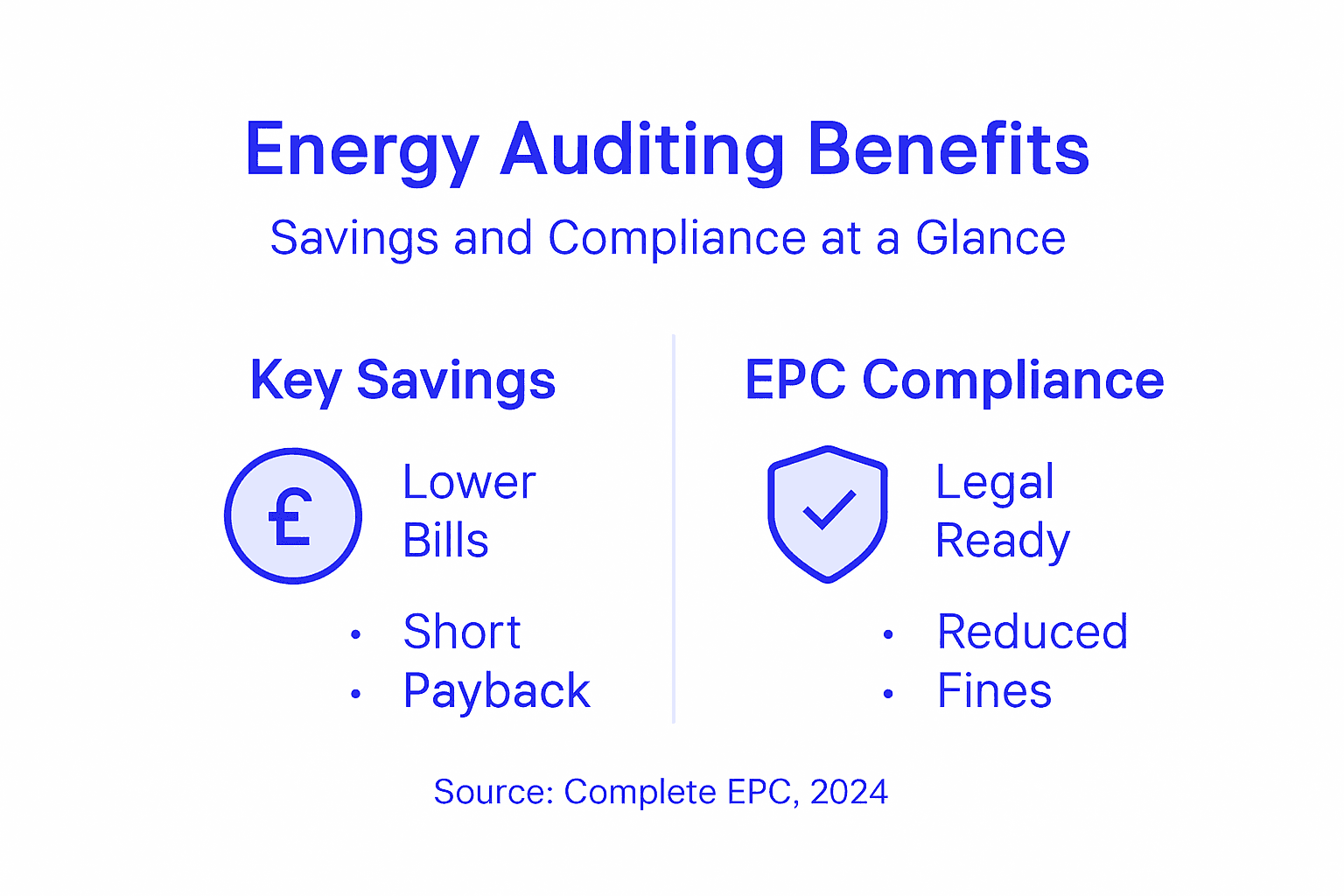
Below is a summary of common energy efficiency improvements, their average costs, and typical annual energy savings in the UK:
| Improvement | Average Upfront Cost | Typical Annual Savings | Payback Period Estimate |
|---|---|---|---|
| Draught sealing & TRVs | £200 – £500 | £40 – £90 | 2-6 years |
| Loft or cavity wall insulation | £1,000 – £3,000 | £200 – £300 | 4-10 years |
| Modern condensing boiler replacement | £3,000 – £6,000 | £350 – £500 | 7-15 years |
| Solid wall insulation | £7,000 – £12,000 | £300 – £450 | 15-25 years |
| Double/triple glazing | £6,000 – £10,000 | £70 – £120 | 15-25 years |
Common mistakes undermine these benefits and must be avoided. The first mistake is underestimating the scope of required improvements. Many property owners assume they need only one or two fixes to meet compliance, but comprehensive energy audits often reveal that multiple measures work together most effectively. Upgrading heating without improving insulation is like installing a powerful engine in a car with a leaking fuel tank—you waste the investment. The second mistake is missing deadlines, particularly with MEES compliance. Landlords sometimes believe they have more time than they actually do, then face rushed decisions and expensive emergency upgrades. The third mistake is failing to explore exemptions properly. Some properties qualify for temporary exemptions if compliance costs exceed set thresholds, but you must document and register these correctly—many landlords miss exemptions simply because they didn’t understand the process. Fourth is ignoring government support schemes. Many property owners pay full cost for improvements when grants, ECO funding, or other support could reduce out-of-pocket expenses significantly.
Another critical mistake is making improvements in the wrong order. Property owners often tackle the most visible or annoying problems first rather than the most cost-effective. You might replace single-glazed windows because they’re draughty, spending £8,000, when loft insulation for £2,000 would save more energy overall. Energy audits prevent this by prioritising recommendations based on cost per kilowatt saved, ensuring your investment delivers maximum benefit. Finally, many property owners fail to commission proper energy audits before planning improvements, instead guessing at what needs fixing. Without an audit, you’re making decisions blindly—you might invest heavily in the wrong measures whilst missing simple, cheap wins that would dramatically improve your rating. Professional guidance and planning reduce these risks substantially, especially given evolving regulations and the complexity of support schemes.
Pro tip: Before spending money on energy improvements, always request a detailed energy audit that prioritises recommendations by cost effectiveness and payback period—this single step prevents expensive mistakes and ensures your investment delivers measurable savings within a defined timeframe.
Take Control of Your Property’s Energy Performance Today
Understanding energy auditing and EPC compliance is essential to avoid costly fines and to unlock real savings on your energy bills. The challenge property owners and landlords face is navigating complex legal requirements like MEES and identifying the most cost-effective improvements for your unique building. With key concepts such as prioritising recommendations by payback period and choosing the right audit type, you need trusted expertise to deliver clear, tailored guidance.
At Complete EPC, we specialise in providing accurate Energy Performance Certificates for domestic and commercial properties across London. Our qualified assessors offer detailed reports that go beyond compliance by highlighting practical steps to boost efficiency, reduce running costs, and increase property value. Don’t wait until deadlines force rushed decisions—benefit now from our competitive pricing and seamless service, helping you make informed choices that support long-term sustainability.
Start your journey to energy compliance and savings with confidence. Visit Complete EPC to book your assessment or learn more about how our expert energy auditing services can empower your property decisions and protect your investments.
Frequently Asked Questions
What is energy auditing?
Energy auditing is a systematic process that evaluates the effectiveness of a building’s energy systems and controls, identifying energy usage patterns, waste, and compliance with energy standards.
Why is an Energy Performance Certificate (EPC) important?
An EPC provides a standardized evaluation of a building’s energy efficiency, helping property owners understand their compliance with regulations and potential areas for improvement, ultimately supporting cost savings and sustainability goals.
How can energy audits save me money?
Energy audits identify inefficiencies and provide recommendations on improvements that can reduce energy costs, such as upgrading insulation or heating systems, often resulting in significant savings on energy bills over time.
What types of energy audits are available?
There are various types of energy audits, including Reduced Data Standard Assessment Procedures (RdSAP) for existing homes, Standard Assessment Procedure (SAP) for new builds, and detailed facility audits that provide comprehensive insights into energy efficiency and specific recommendations.
Recommended
- Why Energy Efficiency Matters for London Properties
- Energy Performance Data Explained: UK Complete Guide – Complete EPC
- Master the Energy Compliance Process for EPC Success
- How to Make Home Energy Efficient: Step-by-Step UK Guide – Complete EPC
- Solar Energy Management – Why It Matters for Central Europe