

Many London landlords view energy audits as a bureaucratic formality, a box to tick for compliance. That’s a costly mistake. Energy audits can boost property value by 5-15% and cut energy bills by up to 30%. Beyond meeting legal requirements, audits reveal practical opportunities to reduce costs, attract tenants, and future-proof your portfolio against tightening regulations. This guide explains what energy audits involve, the UK standards you must meet, the process from start to finish, costs versus savings, common pitfalls, and how to navigate upcoming reforms.
Table of Contents
- What is an energy audit?
- Types of energy audit and UK standards
- How the energy audit process works
- Cost, savings, and property value impact
- Common pitfalls, exemptions, and new reforms for 2026
- Where to get help with energy audits and EPCs in London
- Frequently asked questions
Key Takeaways
| Point | Details |
|---|---|
| More than compliance | Energy audits help you avoid fines, save money, and boost your property’s value at the same time. |
| Multiple audit levels | From a basic EPC to detailed ASHRAE audits, each level delivers higher potential savings and insight. |
| Financial returns | Upgrading to a better EPC rating can cut energy bills by up to 30% and lift property value by 5-15%. |
| 2026 reforms | New Home Energy Model reporting will make assessments more accurate and actionable for landlords. |
What is an energy audit?
An energy audit is a systematic evaluation of how your building uses energy, identifying inefficiencies, waste, and opportunities for improvements to reduce costs and enhance efficiency. It’s not a quick glance at your boiler. Audits examine electricity, gas, heating and cooling systems, insulation, ventilation, and even water use.
The goal is to pinpoint where energy is wasted and recommend cost-effective fixes. For London landlords, this means understanding which upgrades deliver the best return on investment whilst ensuring compliance with Minimum Energy Efficiency Standards (MEES). Audits produce detailed reports with energy conservation measures (ECMs), estimated savings, and payback periods.
Key audit targets include:
- Heating and cooling systems
- Insulation quality and thermal bridging
- Lighting efficiency
- Ventilation and air leakage
- Appliance and equipment energy use
“Energy audits transform vague concerns about high bills into actionable, prioritised improvements that pay for themselves over time.”
In London’s diverse property landscape, audits matter because they help you avoid fines, reduce void periods, and position your properties as energy-efficient, desirable homes. They’re the foundation for smart, data-driven decisions about where to invest in upgrades.
Types of energy audit and UK standards
Not all audits are created equal. Understanding the levels and standards helps you choose the right approach for your property and budget.
Audit levels adapted from ASHRAE:
UK audit levels follow ASHRAE principles: Level 1 (walk-through, 10-15% savings potential), Level 2 (detailed analysis, 15-25% savings), and Level 3 (investment-grade, 20-30% savings). Level 1 suits quick assessments, whilst Level 2 is ideal for most landlords seeking cost-effective improvements. Level 3 is reserved for major refurbishments or commercial portfolios.
UK EPC standards:
For residential properties, EPCs use RdSAP for existing dwellings and SAP for new builds. From 2026, the Home Energy Model (HEM) will replace RdSAP, offering more accurate assessments based on actual building characteristics rather than assumptions.
MEES requirements:
Currently, rental properties must achieve a minimum EPC rating of E. By 2030, this rises to C. Non-compliance can result in fines up to £30,000. Exemptions exist for hard-to-treat properties or where upgrades exceed cost caps (£10,000-£15,000).
Comparison of audit levels:
| Audit level | Scope | Typical savings | Best for |
|---|---|---|---|
| Level 1 | Walk-through, visual inspection | 10-15% | Quick assessment, small portfolios |
| Level 2 | Detailed analysis, utility data | 15-25% | Most landlords, cost-effective upgrades |
| Level 3 | Investment-grade, modelling | 20-30% | Major refurbishments, commercial properties |
Special rules for large non-domestic buildings:
If you own or occupy large non-domestic properties, you may need to comply with the Energy Savings Opportunity Scheme (ESOS), which requires audits every four years. This applies to organisations meeting EU large enterprise criteria.
Understanding these standards helps you plan compliance timelines and budget appropriately. The EPC checklist for Londoners and commercial EPC certificates guide provide further detail on requirements.
How the energy audit process works
Knowing what happens during an audit removes uncertainty and helps you prepare effectively.
1. Preparation and booking
You’ll need to provide recent energy bills, building plans if available, and details of any previous upgrades. Book an accredited assessor who understands London properties and current regulations.
2. Site visit and testing
The assessor conducts a physical inspection, examining insulation, windows, heating systems, and ventilation. Advanced audits may include blower door tests to measure air leakage and infrared imaging to identify thermal bridging.
3. Data analysis
The audit process includes utility bill analysis, interviews with occupants, on-site measurements, and reports prioritising ECMs by payback, costs, and savings. For residential properties, assessors use RdSAP or SAP methodology. From 2026, HEM will provide more granular data based on actual building fabric rather than default assumptions.
4. Results and recommendations
You receive an EPC rating (A to G) and a detailed report listing recommended improvements. Each measure includes estimated costs, annual savings, and payback period. Common recommendations include loft insulation, boiler upgrades, double glazing, and LED lighting.

5. Implementation and verification
Once you’ve completed upgrades, a follow-up assessment verifies improvements and updates your EPC rating. This step is often overlooked but essential for realising promised savings.
Pro Tip: Many landlords rely on default modelling assumptions in RdSAP, which can underestimate performance. Requesting on-site verification of insulation thickness, glazing type, and heating controls often reveals better-than-expected ratings, saving you unnecessary upgrade costs.
The EPC assessment process guide for London walks through each stage in detail. For a deeper understanding of workflow, this energy audit workflow guide offers a step-by-step breakdown.
Cost, savings, and property value impact
The financial case for energy audits rests on three pillars: upfront costs, ongoing savings, and property value uplift.
Audit and upgrade costs:
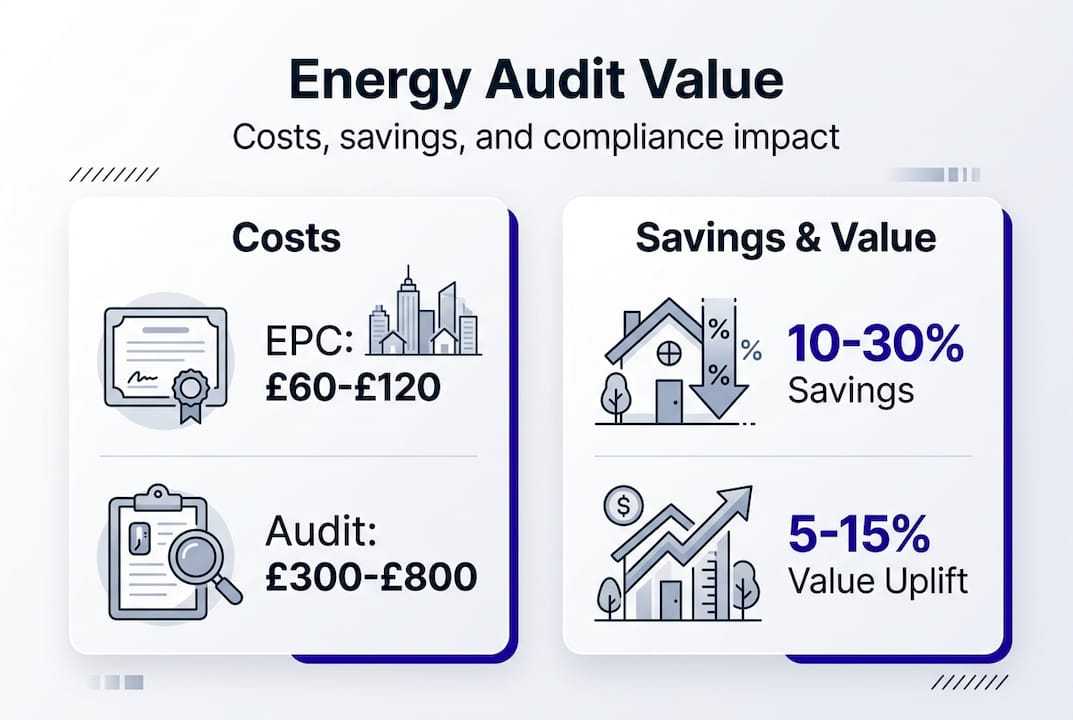
A basic EPC costs £60-£120 for residential properties. Level 2 audits range from £300-£800 depending on property size. Upgrading to EPC C costs £5,400-£6,864 on average, with payback periods of 4-15 years depending on measures chosen.
Energy bill savings:
Typical savings range from 10-30% annually. Insulation upgrades alone can reduce heating costs by up to 40%. For a London rental property with £1,200 annual energy costs, a 20% reduction saves £240 per year, covering audit costs within two years.
Property value increase:
Improved EPCs add 5-15% to property value and reduce void periods by making properties more attractive to tenants. In London’s competitive rental market, energy-efficient homes let faster and command higher rents.
Compliance and fines:
Failing to meet MEES can result in fines up to £30,000. Audits help you avoid penalties whilst planning cost-effective compliance.
Cost-benefit breakdown:
| Measure | Average cost | Annual saving | Payback period |
|---|---|---|---|
| Loft insulation | £300-£500 | £150-£200 | 2-3 years |
| Cavity wall insulation | £500-£1,000 | £200-£300 | 2-4 years |
| Boiler upgrade | £2,000-£3,500 | £300-£400 | 5-9 years |
| Double glazing | £3,000-£6,000 | £100-£150 | 20-40 years |
Pro Tip: Leverage government schemes like ECO4, which subsidises insulation and heating upgrades for eligible properties. This can reduce your upfront costs by 50-100%, dramatically improving payback periods.
“Energy audits aren’t expenses; they’re investments that pay dividends through lower bills, higher rents, and increased property values.”
For more on maximising returns, see energy efficiency savings for landlords and smart home energy strategies. The benefits of EPCs for London properties explores value uplift in detail.
Common pitfalls, exemptions, and new reforms for 2026
Avoiding mistakes and understanding exemptions can save you thousands whilst keeping you compliant.
Common landlord mistakes:
- Ignoring on-site verification: Relying solely on default RdSAP assumptions can underestimate your property’s performance. Request physical checks of insulation and glazing.
- Missing exemption opportunities: Many landlords don’t realise they qualify for exemptions, paying for unnecessary upgrades.
- Delaying compliance: Waiting until 2030 to upgrade to C means competing for limited assessor availability and higher costs.
- Overlooking fabric-first approaches: Focusing on heating system upgrades before addressing insulation wastes money. Fix the building envelope first.
Exemptions and cost caps:
Hard-to-treat properties like solid wall homes and listed buildings may qualify for exemptions or cost caps (£10,000-£15,000 limit for MEES). If upgrades exceed this threshold, you can register an exemption for five years. The process requires evidence of quotes and professional assessments.
Edge cases:
- Listed buildings: Alterations require conservation approval, often making standard upgrades impossible.
- Solid wall properties: External or internal wall insulation is expensive and disruptive, but grants can offset costs.
- Properties with no mains gas: Electric heating systems require different upgrade strategies.
Upcoming EPC reforms:
From 2026, HEM introduces new metrics and more accurate EPCs, moving beyond single-letter ratings to multi-metric reporting. This includes energy use, carbon emissions, and running costs. HEM uses actual building data rather than assumptions, rewarding properties with verified upgrades.
Future-proofing strategies:
- Adopt fabric-first: Prioritise insulation, draught-proofing, and glazing before heating upgrades.
- Plan for 2030 now: Upgrading incrementally spreads costs and avoids last-minute rushes.
- Work with specialists: Accredited assessors familiar with London properties and HEM methodology ensure accurate ratings and cost-effective recommendations.
“The shift to HEM rewards landlords who invest in verified, high-quality upgrades rather than relying on modelled assumptions.”
For compliance guidance, see the landlord EPC checklist and EPC rules for landlords.
Where to get help with energy audits and EPCs in London
Navigating energy audits, compliance, and exemptions requires expertise. Complete EPC specialises in residential and commercial EPC assessments across London, helping landlords achieve compliance whilst maximising property value. Our accredited assessors understand the nuances of London’s diverse building stock, from Victorian terraces to modern flats.
We support you through the exemptions process, provide tailored upgrade recommendations, and keep you ahead of regulatory changes like HEM and the 2030 MEES deadline. Whether you need a straightforward EPC or a detailed Level 2 audit, we deliver accurate assessments and actionable advice that improves your bottom line.
Explore our comprehensive EPC guide for detailed insights, learn about EPC exemptions if you own hard-to-treat properties, or read our energy performance certificate guide to understand the full compliance landscape. Get in touch today to ensure your properties meet current standards and are ready for future regulations.
Frequently asked questions
What’s the difference between an EPC and a full energy audit?
An EPC is a mandatory summary rating using standard methods, whilst a full energy audit analyses actual use and recommends cost-effective upgrades for larger savings. EPCs use RdSAP or SAP, whilst broader audits follow ASHRAE or ESOS for deeper savings.
Are energy audits really worth it for small landlords?
Yes, audits can deliver 10-30% bill savings and improve property value by 5-15%, often covering their own cost within two to three years through reduced energy bills and higher rental appeal.
How do I know if my property is exempt from EPC upgrades?
Hard-to-treat properties and those where upgrades exceed cost caps (£10,000-£15,000) can claim exemptions. You’ll need professional quotes and evidence to register an exemption for five years.
What are the main changes to energy audit rules in 2026?
HEM introduces new metrics and more accurate EPCs as of 2026, moving to multi-metric reporting that includes energy use, carbon emissions, and running costs based on actual building characteristics.
Is post-audit verification really necessary?
Yes, post-audit verification is essential for confirming that recommended measures deliver promised savings and compliance. It updates your EPC rating and provides evidence of improvements for tenants and buyers.