

Many property owners assume that similar buildings consume comparable amounts of energy. Yet data reveals that energy performance can vary dramatically between seemingly identical properties, with some buildings using twice as much energy as their peers. Energy benchmarking provides a systematic approach to measure, compare, and improve your property’s energy efficiency whilst ensuring compliance with London’s evolving regulatory landscape. This guide explains what energy benchmarking entails, the frameworks available, and how to leverage it effectively.
Table of Contents
- Understanding Energy Benchmarking: What It Is And How It Works
- Energy Benchmarking Frameworks And Standards In The Uk And London
- Using Energy Benchmarking To Improve Building Performance And Comply With Regulations
- Practical Steps For London Property Owners: How To Get Started With Energy Benchmarking
- How Complete EPC Supports London Property Owners With Energy Benchmarking And Compliance
Key takeaways
| Point | Details |
|---|---|
| Definition and purpose | Energy benchmarking compares your building’s performance against similar properties to identify inefficiencies and track improvements over time. |
| Legal requirements | London landlords must meet MEES EPC regulations with minimum rating E since 2023, rising to C and B in future. |
| Available frameworks | REEB, CIBSE TM46, TM54, and TM47 provide structured benchmarking tools tailored to different property types and compliance needs. |
| Proven savings | Case studies demonstrate energy reductions of 11% for gas and 22% for water through systematic benchmarking and targeted interventions. |
Understanding energy benchmarking: what it is and how it works
Energy benchmarking involves comparing a building’s energy performance against similar buildings or established benchmarks to identify areas for improvement. At its core, this process transforms raw utility data into actionable insights about where your property stands relative to industry standards.
Energy use intensity (EUI) serves as the primary metric in benchmarking. EUI measures total energy consumption per square metre annually, typically expressed in kilowatt hours per square metre (kWh/m²). This normalised metric enables fair comparisons between buildings of different sizes and functions.
The benchmarking process begins with systematic data collection from utility bills, including electricity, gas, and other fuel sources. You then compare this consumption against energy performance benchmarks specific to your property type, whether office, retail, residential, or mixed use. The comparison reveals whether your building performs above, at, or below typical efficiency levels for similar properties in London.
Key benefits include:
- Identifying specific inefficiencies such as outdated heating systems or poor insulation
- Establishing baseline metrics to track improvement progress over months and years
- Quantifying potential cost savings from targeted energy efficiency upgrades
- Supporting investment decisions with data driven evidence of improvement opportunities
- Demonstrating compliance with regulatory requirements through documented performance
By transforming abstract energy consumption into concrete performance metrics, benchmarking gives property owners the clarity needed to prioritise improvements and measure success.
Energy benchmarking frameworks and standards in the UK and London
Several established frameworks support energy benchmarking across different property types and purposes. Understanding which framework applies to your situation ensures you select appropriate benchmarks and comply with relevant obligations.
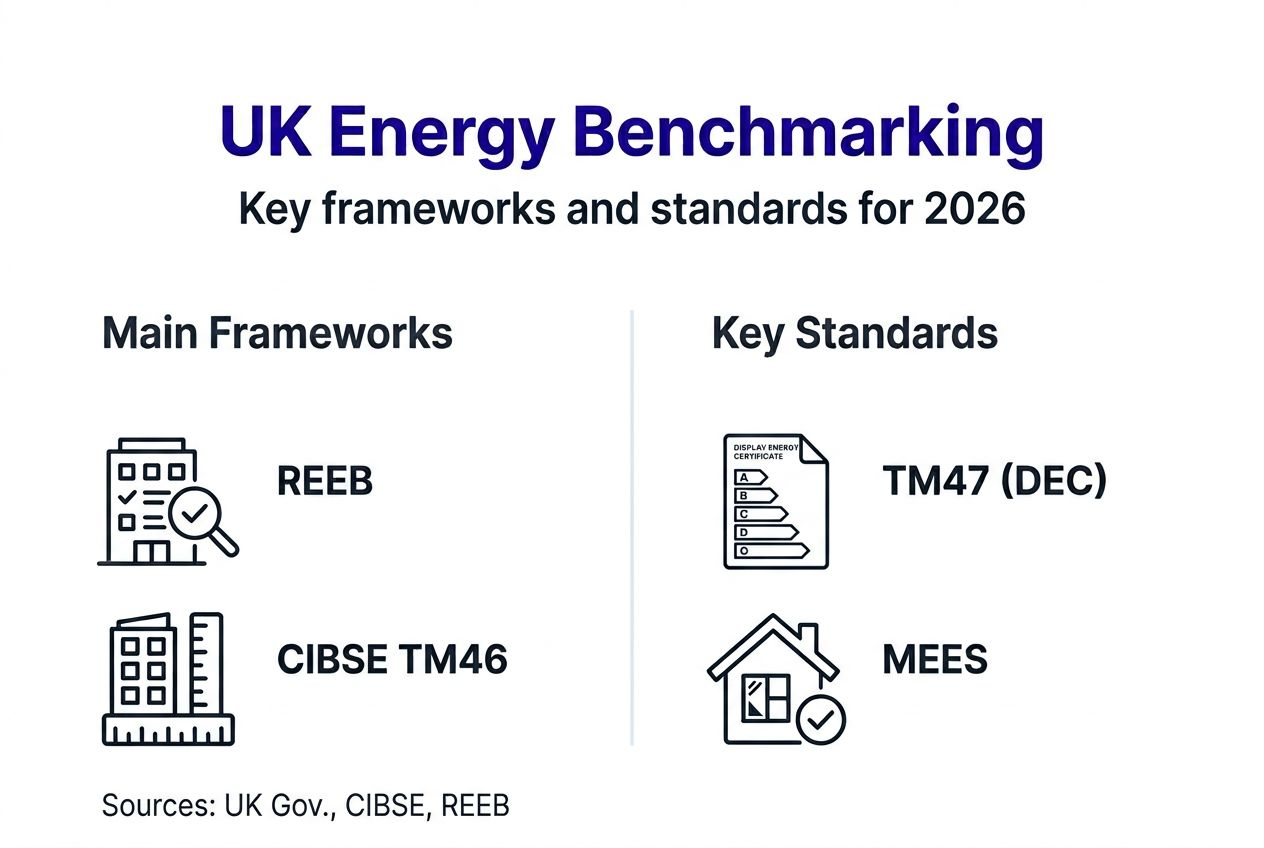
The Real Estate Environmental Benchmark (REEB) provides energy performance benchmarks for various UK commercial properties, drawing from actual building data across multiple sectors. REEB enables landlords to compare their properties against sector specific medians and identify performance quartiles, helping set realistic improvement targets based on peer performance.

CIBSE TM46 provides energy benchmarks for various building types whilst TM54 offers a structured methodology for evaluating operational energy use during design stages. TM46 categorises buildings into detailed types such as general offices, hotels, or schools, each with specific good practice and typical benchmarks. TM54 helps predict actual operational performance from design specifications, addressing the well documented performance gap between predicted and actual consumption.
TM47 provides guidance on Display Energy Certificates (DECs), including legal display requirements and preparation. Public buildings exceeding 1,000 square metres must display DECs prominently, showing actual energy performance alongside an advisory report recommending improvements.
Minimum Energy Efficiency Standards (MEES) establish the legal foundation for rental property energy performance. Since April 2023, landlords cannot lawfully let commercial or residential properties with EPC ratings below E. Future regulations will raise these thresholds to C by 2027 and potentially B by 2030, making benchmarking essential for planning compliance upgrades.
| Framework | Primary Application | Key Features | Update Frequency |
|---|---|---|---|
| REEB | Commercial benchmarking | Sector specific medians from real data | Annual |
| CIBSE TM46 | Building type benchmarks | Good practice vs typical performance | Periodic updates |
| CIBSE TM54 | Design stage evaluation | Operational performance prediction | Methodology based |
| CIBSE TM47 | Display Energy Certificates | Legal compliance for public buildings | Annual renewal |
| NABERS UK | Office performance rating | Tenant and base building separation | Annual certification |
These frameworks complement energy performance benchmarks by providing standardised methodologies tailored to London’s diverse property portfolio.
Using energy benchmarking to improve building performance and comply with regulations
Benchmarking transforms from theoretical exercise to practical tool when applied to identify savings opportunities and demonstrate regulatory compliance. Real world applications show substantial returns on investment through targeted interventions informed by benchmarking data.
Collaborative data led interventions at 20 Fenchurch Street improved energy use by reducing water, gas, and electricity consumption significantly. The building achieved an 11% reduction in gas consumption, 5% decrease in electricity use, and 22% reduction in water consumption through systematic monitoring, tenant engagement, and facilities management improvements. These results demonstrate how regular benchmarking reveals specific opportunities invisible without consistent measurement.
Compliance with MEES represents another critical application. Since 1 April 2023, landlords cannot lawfully let properties with EPC rating below E, and further increases to C and B are planned over the next decade. Benchmarking helps property owners understand current performance gaps and prioritise upgrades needed to meet upcoming thresholds before they become legally binding.
Display Energy Certificates create ongoing benchmarking obligations for qualifying buildings. Public sector buildings must renew DECs annually, providing a built in mechanism for tracking performance trends and demonstrating continuous improvement to building occupants and visitors.
Practical applications include:
- Identifying high consumption periods to optimise heating and cooling schedules
- Comparing similar buildings within a portfolio to replicate best practices
- Validating energy savings following retrofit investments through before and after comparisons
- Supporting tenant negotiations with documented efficiency improvements that reduce operating costs
- Planning capital improvement budgets based on quantified savings potential
Pro Tip: Combine annual benchmarking reviews with regular occupant engagement sessions. Building users often identify operational inefficiencies such as equipment running outside occupied hours, providing low cost improvement opportunities that complement capital investments. Engaged tenants become partners in achieving efficiency targets rather than obstacles to performance improvements.
Effective benchmarking requires commitment to ongoing measurement rather than one time assessments. Quarterly reviews identify emerging issues before they compound, whilst annual comparisons track long term trends and validate improvement strategies. This disciplined approach ensures you maximise both cost savings and regulatory compliance.
Practical steps for London property owners: how to get started with energy benchmarking
Implementing effective energy benchmarking follows a systematic process accessible to property owners regardless of technical expertise. Following these steps ensures you generate reliable insights whilst avoiding common pitfalls.
-
Collect accurate energy consumption data and relevant building information. Gather at least 12 months of utility bills covering all energy sources including electricity, gas, oil, and district heating. Record total floor area, building type, occupancy patterns, and operating hours. Incomplete data produces unreliable benchmarks, so ensure you capture seasonal variations through full year coverage.
-
Select benchmark frameworks relevant for your property type. Match your building to appropriate REEB categories or CIBSE TM46 classifications. Office buildings might use NABERS UK whilst hotels reference hospitality specific benchmarks. Selecting the right comparison group ensures meaningful insights rather than inappropriate comparisons.
-
Engage qualified energy assessors or consultants for analysis and modelling. Professional assessors bring expertise in data normalisation, weather correction, and building specific factors affecting consumption. They can conduct detailed EPC assessments that integrate benchmarking insights with regulatory compliance requirements, providing comprehensive understanding of your property’s performance.
-
Interpret benchmarking results to prioritise energy efficiency upgrades. Results typically highlight specific systems or operational patterns driving excess consumption. Focus first on measures offering quick payback such as LED lighting upgrades or heating controls optimisation, then plan longer term investments like fabric improvements or plant replacement based on financial capacity and regulatory timelines.
-
Implement improvements, monitor outcomes, and update benchmarks regularly. Track actual savings against predictions to validate assumptions and refine future planning. Update your benchmarks quarterly or annually to capture the impact of interventions and identify new opportunities as building use evolves or additional efficiency technologies become viable.
Pro Tip: Calibrated energy models integrating real consumption data provide more accurate predictions than generic assessments. Calibration adjusts theoretical models to match actual performance, revealing specific deviations from expected behaviour that indicate operational issues or occupancy pattern changes. This validation step significantly improves the reliability of savings projections and investment decisions.
Begin with buildings where you have complete data access and straightforward occupancy patterns. Success with initial properties builds confidence and expertise before tackling more complex mixed use or partially tenanted buildings. This phased approach delivers early wins whilst developing internal capabilities for broader portfolio application.
Regular benchmarking becomes increasingly valuable over time as you accumulate historical data revealing trends invisible in single year comparisons. Three to five years of consistent measurement enables sophisticated analysis of improvement rates, seasonal variations, and the relationship between occupancy changes and energy consumption patterns.
How Complete EPC supports London property owners with energy benchmarking and compliance
Navigating energy benchmarking requirements and translating data into actionable improvements requires specialist expertise. Complete EPC provides comprehensive support for London property owners seeking to understand and improve EPC ratings whilst ensuring full regulatory compliance.
Our qualified assessors deliver detailed EPC assessments that incorporate benchmarking insights specific to your property type and location within London. We explain how your current performance compares to legal requirements and peer buildings, then recommend prioritised improvements aligned with your budget and compliance timelines.
We help landlords navigate MEES regulations by identifying the most cost effective pathway to meet minimum standards and prepare for future threshold increases. Our assessment process combines regulatory compliance with practical energy efficiency advice, ensuring you achieve both legal obligations and operational cost reductions through strategic improvements.
FAQ
What buildings require energy benchmarking in London?
Public buildings over 1,000 square metres must display DECs annually, showing actual energy performance. Commercial and residential rental properties must comply with MEES EPC minimum standards, currently rating E or above. Whilst benchmarking itself is not legally mandated for all properties, it provides the analytical foundation for meeting these compliance obligations effectively.
How often should energy benchmarking be updated?
Review benchmarking data quarterly to identify emerging trends and operational issues requiring immediate attention. Display Energy Certificates must be renewed every 12 months for qualifying buildings. Annual benchmarking updates suit most commercial properties, providing sufficient data to track meaningful performance changes whilst avoiding excessive administrative burden. Update benchmarks immediately following major retrofits to capture improvement impacts accurately.
What are the benefits of energy benchmarking for landlords?
Benchmarking identifies specific inefficiencies reducing operating costs, with proactive facilities management yielding significant energy savings as demonstrated at 20 Fenchurch Street. Improved efficiency enhances tenant comfort through better environmental control whilst reducing service charges, making properties more attractive in competitive rental markets. Better performing buildings command higher valuations and rental premiums, delivering tangible returns on energy cost savings investments.
How does energy benchmarking relate to EPC ratings?
Benchmarking informs the energy consumption metrics that determine EPC ratings, providing the performance data underlying certificate assessments. Understanding EPCs requires recognising that ratings reflect both building fabric quality and operational efficiency captured through benchmarking. Landlords must meet minimum EPC rating E since 2023 with expected future increases to C and B for commercial properties, making ongoing benchmarking essential for planning compliance upgrades before regulatory deadlines.
Recommended
- Energy Performance Benchmarks: Complete Guide for London
- Achieving a Higher Energy Rating: EPC Insights for London Residents – Complete EPC
- Decoding Energy Performance Certificates in London: A Complete Guide – Complete EPC
- Energy performance metrics explained for London property owners
- BRCKS | Construction Project Communication Software