

Many London landlords mistakenly equate EPC scores directly with actual energy bills, creating confusion when monthly costs don’t align with their certificate ratings. Understanding energy performance metrics is essential for compliance with evolving regulations and making informed efficiency investments. This guide demystifies SAP calculations, EPC bands, and MEES requirements, equipping you with the knowledge to navigate legal obligations whilst maximising property value and reducing operational costs.
Table of Contents
- Introduction To Energy Performance Metrics
- Understanding Core Energy Performance Metrics
- Regulatory Impact Of Energy Performance Metrics In London
- Common Misconceptions And Accuracy Challenges
- Comparison Of Energy Metrics Across Property Types
- Linking Metrics To Value And Efficiency Improvements
- Applying Energy Performance Insights To Property Management
- How Complete EPC Helps London Property Owners With Energy Performance
- Frequently Asked Questions
Key takeaways
| Point | Details |
|---|---|
| Energy metrics drive compliance | SAP and EPC ratings determine whether London rental properties meet legal standards and avoid penalties. |
| MEES sets minimum standards | Rental properties must achieve at least EPC band E to comply with current regulations in 2026. |
| Modelled vs actual performance | EPC ratings reflect standardised assumptions, not real-world consumption patterns influenced by occupant behaviour. |
| Strategic upgrades boost value | Improving energy ratings reduces costs, enhances marketability, and increases property valuations across London. |
| Reports guide improvements | EPC assessments identify cost-effective retrofit opportunities tailored to your property’s specific characteristics. |
Introduction to energy performance metrics
Energy performance metrics provide standardised measurements of how efficiently buildings use energy and generate carbon emissions. For London property owners, these metrics form the backbone of legal compliance, tenant expectations, and financial planning. They translate complex building characteristics into actionable ratings that influence everything from rental yields to sale prices.
The Standard Assessment Procedure (SAP) is the UK government’s methodology for assessing dwelling performance. This calculation considers building fabric, heating systems, ventilation, lighting, and renewable technologies. RdSAP, the reduced data version, applies the same principles to existing homes using streamlined inputs. Both feed into EPC ratings, the familiar A to G scale.
These metrics matter because they determine regulatory compliance under energy performance requirements. Landlords face legal obligations to obtain certificates before marketing properties. Estate agents must display ratings in advertisements. Solicitors verify compliance during transactions.
Key metrics include:
- SAP scores ranging from 1 to 100+ indicating theoretical energy efficiency
- EPC bands translating scores into letter grades for easy comparison
- Environmental impact ratings measuring carbon dioxide emissions
- Estimated energy costs projecting annual expenditure under standard conditions
- Improvement recommendations prioritising upgrades by cost-effectiveness
Understanding these measures helps you interpret assessment reports, plan strategic improvements, and communicate value to prospective tenants or buyers. They connect building physics to business outcomes in measurable terms.
Understanding core energy performance metrics
SAP methodology calculates energy performance by modelling heat loss through walls, roofs, floors, and windows against heat generated by systems. It accounts for solar gains, air tightness, thermal bridging, and renewable contributions. SAP scores range from 1 to 100+, with higher values indicating superior efficiency. Modern Passivhaus designs can exceed 100, whilst poorly insulated Victorian conversions often score below 30.
RdSAP simplifies this process for existing residential properties. Assessors gather observable data during site visits rather than detailed design specifications. They measure room dimensions, identify construction types, inspect heating systems, and note improvements like double glazing. Software then applies standardised assumptions about hidden elements such as wall cavity insulation.

EPC ratings translate numerical scores into letter bands. Band A (92 to 100+) represents the highest efficiency. Band G (1 to 20) indicates the poorest performance. Most London properties fall between bands C and E. The conversion follows government-defined thresholds that remain consistent across England and Wales.
Higher scores reflect lower running costs and reduced carbon emissions. A band B property typically costs half as much to heat as a band E equivalent. This mathematical relationship makes ratings powerful comparison tools when evaluating portfolios or investment opportunities.
Pro Tip: Focus on the recommendations page of your EPC report, which lists improvements ranked by cost-effectiveness. The top three suggestions usually offer the best return on investment whilst delivering noticeable rating improvements.
Key scoring factors include:
- Building fabric thermal performance measured by U-values
- Heating system efficiency and fuel type
- Hot water system configuration and controls
- Lighting technology and proportion of low-energy fittings
- Renewable energy generation from solar panels or heat pumps
Understanding how SAP calculations work helps you anticipate which upgrades will shift your rating most effectively. Small improvements in multiple areas often outperform single expensive interventions.
Regulatory impact of energy performance metrics in London
Minimum Energy Efficiency Standards (MEES) prohibit letting properties below band E since 2018 for new tenancies and 2020 for existing agreements. This regulatory floor transforms energy ratings from advisory metrics into legal requirements with financial consequences. London enforcement has intensified, with councils issuing fines up to £5,000 for non-compliant landlords.
Legal responsibilities extend beyond obtaining certificates. You must provide valid EPCs to prospective tenants before viewings and display ratings in marketing materials. Certificates expire after 10 years, requiring renewal even if property conditions haven’t changed. Estate agents face separate obligations to include ratings in advertisements and property listings.
Penalties for non-compliance stack quickly. Missing EPCs incur fines of £200 for dwellings. Letting sub-band E properties triggers penalties up to £4,000 per property annually. Trading Standards and local authorities coordinate enforcement, increasingly using register data to identify violations systematically.
Anticipated regulatory changes by 2027 include raising minimum standards to band C for new tenancies. This pending shift makes current band D properties vulnerable to compliance costs. Forward-thinking landlords are upgrading proactively to avoid retrofit expenses under tighter deadlines.
Compliance priorities for London landlords:
- Verify all rental properties hold valid, in-date EPCs
- Confirm ratings meet or exceed band E thresholds
- Register certificates on the national EPC register within specified timeframes
- Budget for upgrades if properties approach minimum standards
- Monitor regulatory developments affecting future requirements
- Maintain improvement records demonstrating compliance efforts
Staying ahead of evolving efficiency regulations protects rental income streams whilst positioning properties competitively in increasingly environmentally conscious markets.
Common misconceptions and accuracy challenges
The most persistent misunderstanding treats EPC ratings as precise predictors of energy bills. In reality, certificates model performance under standardised occupancy patterns and heating schedules. Actual consumption varies dramatically based on household size, lifestyle preferences, and heating habits. A family maintaining 22°C throughout winter will spend far more than the EPC estimate assumes.
Occupant behaviour creates 30% to 50% variation between modelled and actual energy use. Someone working from home runs heating longer than standard profiles assume. Frequent cooking, multiple hot baths, and leaving appliances on standby all increase real costs beyond EPC projections. Conversely, minimal occupancy or frugal heating practices can deliver bills well below certificate estimates.
EPC limitations as financial predictors stem from their compliance focus. The methodology prioritises consistent comparison between properties over accurate cost forecasting. It assumes fixed internal temperatures, standardised hot water usage, and typical appliance loads. These assumptions enable fair benchmarking but disconnect ratings from individual consumption realities.
Combining EPC data with smart metre readings provides better decision-making intelligence. Track your actual usage patterns against certificate estimates to identify discrepancies. Significant gaps often reveal opportunities for behavioural changes or system optimisations not captured in standard assessments.
Research consistently shows 20% to 40% divergence between EPC-projected costs and actual utility bills, with occupant behaviour accounting for the majority of variation in otherwise identical properties.
Understanding these limitations helps you use ratings appropriately:
- Compare properties on equivalent efficiency terms
- Identify technical improvement opportunities through recommendations
- Demonstrate compliance with regulatory minimums
- Avoid treating estimates as precise budget forecasts
Pro Tip: Request energy bills from previous occupants when purchasing property. This real-world data complements EPC ratings, revealing actual running costs and highlighting any performance gaps requiring investigation.
Comparison of energy metrics across property types
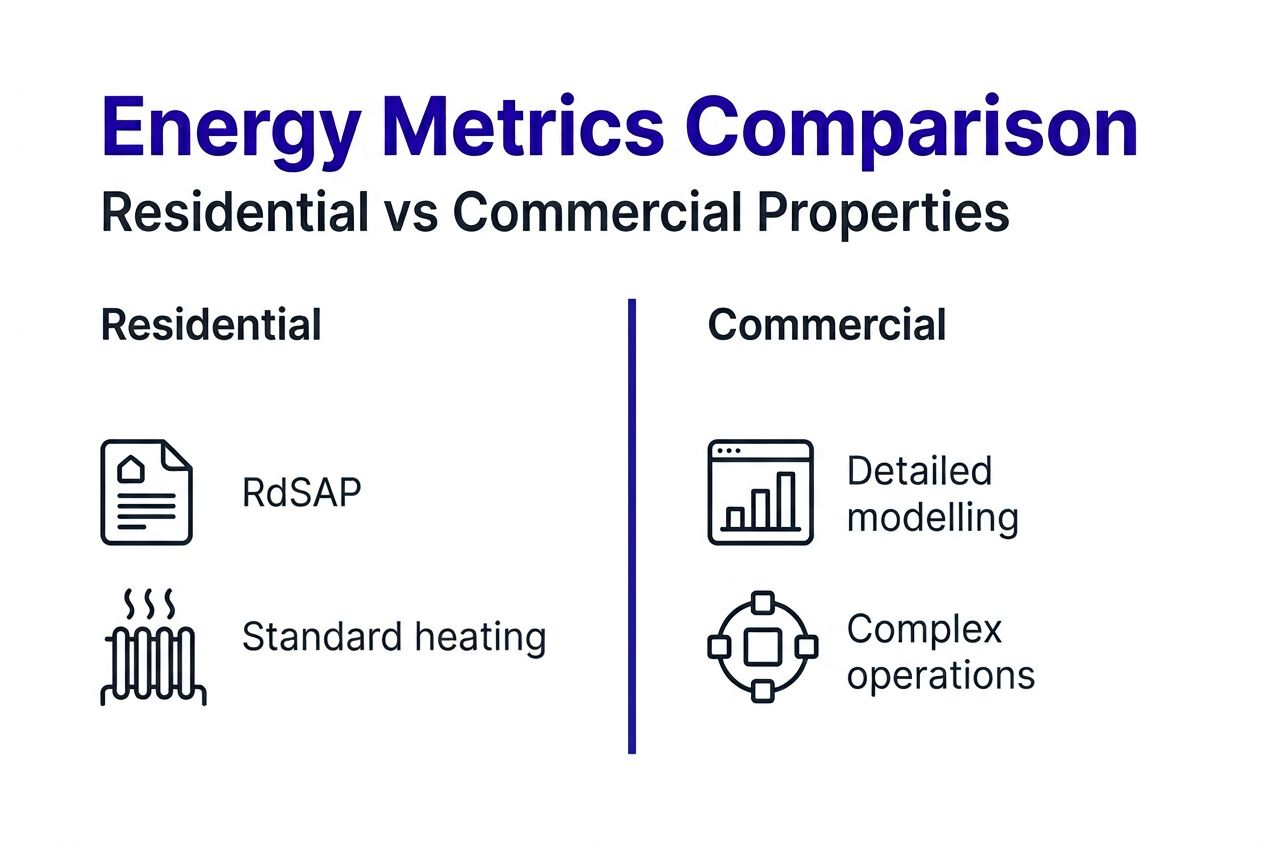
Domestic EPCs rely on RdSAP methodology, focusing on residential building characteristics and standard heating patterns. Assessors evaluate fabric, systems, and controls visible during site visits. The process suits houses and flats where occupancy patterns follow predictable residential norms. Scoring emphasises thermal performance and heating efficiency.
Commercial EPCs employ more complex modelling accounting for diverse operational requirements. Offices, shops, and warehouses have variable occupancy densities, extended operating hours, and specialised equipment loads. Assessors gather detailed data about HVAC systems, lighting configurations, and business operations. Display Energy Certificates (DECs) supplement EPCs for public buildings, showing actual measured performance.
Scoring parameters differ substantially. Domestic assessments assume consistent internal temperatures and standard hot water demand. Commercial evaluations consider actual usage patterns, process loads, and building management systems. This creates incomparable ratings between property types despite sharing the A to G scale.
Landlords managing mixed portfolios must understand these distinctions when planning improvements. Residential upgrades prioritise insulation and heating system replacements. Commercial properties benefit more from lighting retrofits, HVAC optimisation, and building management controls. Investment strategies should reflect these different improvement pathways.
| Aspect | Domestic EPC | Commercial EPC |
|---|---|---|
| Methodology | RdSAP with standardised assumptions | Tailored modelling with operational data |
| Assessment focus | Building fabric and heating systems | HVAC, lighting, and process equipment |
| Occupancy assumptions | Residential heating patterns | Actual business operating schedules |
| Validity period | 10 years | 10 years (DECs require annual updates) |
| Typical upgrades | Insulation, boiler replacement, double glazing | LED lighting, controls, HVAC efficiency |
| Regulatory driver | MEES minimum band E | Similar MEES requirements with exceptions |
Recognising these differences ensures you apply appropriate strategies to each property type in your portfolio whilst maintaining compliance across residential and commercial holdings.
Linking metrics to value and efficiency improvements
Improved EPC ratings demonstrably increase property values across London markets. Research shows band C properties command 5% to 8% premiums over equivalent band E homes. Buyers increasingly factor running costs into affordability calculations, making efficient properties more competitive. Investment properties with strong ratings attract quality tenants willing to pay premium rents for lower utility bills.
Energy cost savings from typical upgrades justify improvement investments. Installing loft insulation in a band E property saves £200 to £300 annually. Upgrading from a 15-year-old boiler to a modern condensing model reduces heating costs by 20% to 30%. Combined improvements moving properties from band E to C often deliver £400 to £600 annual savings.
Marketability benefits extend beyond financial metrics. Environmentally conscious tenants actively seek efficient properties. Corporate relocations prioritise sustainable accommodation for staff. Letting agents report faster void periods for higher-rated properties as tenants recognise long-term cost advantages.
Typical upgrades ranked by cost-effectiveness:
- Loft insulation (£300 to £500, band improvement potential: 2 to 5 points)
- Cavity wall insulation (£500 to £1,500, improvement: 5 to 10 points)
- LED lighting replacement (£100 to £300, improvement: 1 to 2 points)
- Heating controls and thermostatic radiator valves (£200 to £400, improvement: 2 to 4 points)
- Condensing boiler replacement (£2,000 to £3,500, improvement: 10 to 15 points)
- Double glazing (£3,000 to £8,000, improvement: 5 to 10 points)
Strategic investment in efficiency improvements delivers multiple returns. Compliance with current and future regulations protects rental income. Reduced operating costs improve net yields. Enhanced marketability shortens void periods. Capital value appreciation strengthens portfolio performance.
Focus improvement budgets on properties approaching regulatory thresholds first. Band E properties risk future non-compliance as standards tighten. Band D properties offer better returns on incremental investment than pushing band B to A.
Applying energy performance insights to property management
Systematic application of energy performance data strengthens compliance and efficiency across your portfolio. Start by auditing all properties to confirm valid, current EPCs meeting regulatory minimums. Identify properties approaching expiry dates or borderline ratings requiring attention before enforcement risks materialise.
Interpreting EPC recommendations requires balancing technical merit against financial reality. Reports list improvements in cost-effectiveness order, but your specific circumstances might justify different priorities. Properties with imminent letting deadlines need quick wins like LED lighting and heating controls. Long-term holds warrant structural improvements like insulation delivering sustained value.
Practical retrofit planning follows a logical sequence:
- Address fabric improvements reducing heat loss before upgrading heating systems
- Install insulation in lofts and accessible cavities as highest-return interventions
- Upgrade heating controls and thermostatic valves for immediate consumption reduction
- Replace inefficient boilers when existing systems near end of service life
- Consider renewable technologies like solar panels for properties with suitable orientation
- Reassess EPCs after major improvements to capture rating gains
Common pitfalls undermine efficiency strategies. Ignoring legal minimums creates enforcement vulnerability and emergency retrofit costs. Overestimating EPC precision leads to disappointment when bills don’t match projections. Prioritising aesthetics over performance wastes improvement budgets on low-impact interventions.
Comprehensive efficiency checklists help track improvement progress across portfolios. Regular updates ensure properties maintain compliance as certificates expire and regulations evolve. Detailed records demonstrate due diligence if disputes arise.
Targeted energy-saving strategies deliver measurable results. Simple measures like draught-proofing, pipe insulation, and timer controls cost under £200 per property whilst improving comfort and reducing complaints. Tenant education about efficient heating practices cuts consumption without capital expenditure.
Pro Tip: Schedule EPC renewals 12 months before expiry to allow time for addressing unexpected compliance issues. Rushing assessments under deadline pressure limits improvement options and increases costs.
Understanding building regulations, such as window performance requirements, ensures replacements contribute meaningfully to energy ratings whilst meeting construction standards. Integration of compliance frameworks maximises every improvement pound spent.
How Complete EPC helps London property owners with energy performance
Navigating energy performance requirements demands specialist expertise and local market knowledge. Complete EPC provides comprehensive assessment services tailored to London’s diverse property landscape. Whether you manage Victorian conversions in Islington or modern developments in Canary Wharf, qualified assessors deliver accurate certificates meeting regulatory standards whilst identifying practical improvement opportunities.
Our service extends beyond basic compliance. Detailed EPC guidance helps you interpret assessment results and prioritise cost-effective upgrades. We explain how recommendations translate into rating improvements, enabling informed investment decisions aligned with your property strategy and budget constraints.
Expert support ensures smooth assessment processes from initial booking through certificate registration. Our assessors understand London building types, recognise common efficiency challenges, and provide actionable advice specific to your properties. This local expertise helps you maximise certification benefits whilst maintaining competitive positioning.
Whether you need single certificates or portfolio-wide compliance reviews, Complete EPC delivers reliable assessments supporting your regulatory obligations and efficiency goals across London’s property market.
Frequently asked questions
What is an EPC rating and why is it important?
An EPC rating measures property energy efficiency on an A to G scale, with A representing the most efficient performance. It is legally required for renting or selling properties in London, demonstrating compliance with government regulations. Improving your rating reduces energy costs, enhances property marketability, and increases value whilst meeting tenant expectations for sustainable accommodation.
How do SAP and RdSAP differ in property energy assessments?
SAP provides detailed energy modelling typically used for new construction, requiring comprehensive design specifications and calculations. RdSAP simplifies the methodology for existing homes, using observable site data and standardised assumptions about hidden building elements. Most London residential EPCs use RdSAP because it suits the existing housing stock efficiently.
What are the minimum EPC requirements for rental properties in London?
Rental properties must achieve at least EPC band E to comply with MEES regulations in 2026. Landlords cannot legally let properties below this threshold and must provide valid certificates to prospective tenants before marketing. Non-compliance triggers enforcement penalties up to £5,000, making verification essential for all rental portfolios.
Why might my EPC rating not match my actual energy bills?
EPC ratings model energy use under standardised assumptions about occupancy, heating patterns, and internal temperatures. Actual consumption varies significantly based on household size, lifestyle habits, and personal comfort preferences. This creates typical discrepancies of 20% to 40% between certificate estimates and real bills, with occupant behaviour accounting for most variation.
Recommended
- Energy Performance Overview: Complete Guide for London – Complete EPC
- Energy Efficiency Steps for London Properties Made Simple
- Energy Performance Improvement Plan for London Property Owners
- Energy Statements: What They Are and Why They Matter for London Properties – Complete EPC
- Energieprestatie-eisen Kozijnen: Wetgeving & Praktijk
- Understanding the Benefits of a House with Insulation – WorkWearComfort