

TL;DR:
- UK law requires all London rental properties to have an EPC rated at least E since April 2020.
- Improving EPC ratings through upgrades boosts rental appeal, reduces costs, and prepares for stricter 2030 standards.
- Non-compliance risks fines up to £5,000, void periods, delayed lettings, and damage to landlord reputation.
If you rent out property in London, an Energy Performance Certificate is not optional. It is a legal requirement, and the consequences of ignoring it are significant. 60.5% of EPCs issued in 2024 were rated C or better, yet existing rentals still average a D, meaning a large portion of the private rented sector is operating close to the legal minimum. This guide covers what an EPC certificate is, what the law requires of you, how the assessment process works, and how improving your rating can make your property more attractive and more profitable.
Table of Contents
- Why landlords need an EPC certificate
- How the EPC certificate process works in London
- EPC ratings explained: what your score means and why it matters
- Improving your property’s EPC: costs, grants, and how upgrades pay off
- Our take: what most EPC guides leave out for London landlords
- Get help with your EPC compliance in London
- Frequently asked questions
Key Takeaways
| Point | Details |
|---|---|
| EPCs are mandatory | Every London rental must have a valid EPC rated E or above, or face £5,000 fines. |
| Higher ratings boost returns | Properties scoring C+ let faster and achieve higher rents, making upgrades worthwhile. |
| Major changes ahead | From 2026–2030, minimum EPC standards and assessment methods are being tightened. |
| Upgrades pay off | Simple improvements often pay back in months with grants and better tenant demand. |
Why landlords need an EPC certificate
An Energy Performance Certificate is an official document that rates a property’s energy efficiency on a scale from A (most efficient) to G (least efficient). It also includes estimated energy costs and a list of recommended improvements. Every certificate is produced by an accredited domestic energy assessor and lodged on the national EPC register.
The legal position is clear. Since April 2020, all privately rented homes in England, including every property in London, must hold a valid EPC rated at least E before they can be marketed or let. This applies to new tenancies and renewals alike. You cannot hand over keys without it.
Failure to comply carries real financial risk. Up to £5,000 per property can be levied as a fine, enforced by your local authority. That is not a theoretical risk. Local councils actively check compliance, and letting agents are increasingly unwilling to list properties without a valid certificate.
Beyond fines, the practical consequences of non-compliance include:
- Void periods: You cannot legally market the property, so it sits empty and earns nothing.
- Delayed completions: Solicitors and agents will flag a missing EPC, stalling any transaction.
- Reputational damage: Tenants and agents talk. A landlord known for cutting corners attracts fewer quality applicants.
- Mortgage complications: Some lenders are beginning to factor EPC ratings into lending decisions.
An EPC is not just a box-ticking exercise. It is a snapshot of your property’s energy performance that directly affects its legal status, its marketability, and increasingly, its value.
With regulations tightening further by 2030, the time to understand and act on your EPC obligations is now, not when a fine lands on your doorstep.
How the EPC certificate process works in London
Understanding why you need an EPC, it is important to know exactly how to obtain one and what is changing soon. The process is more straightforward than many landlords expect, but preparation makes a real difference.
Here is how it works, step by step:
- Find an accredited assessor. You must use a qualified domestic energy assessor registered with an approved accreditation scheme. In London, there are many options, so look for assessors with strong local knowledge of property types common to the city, such as Victorian terraces and mansion block flats.
- Book the on-site visit. The assessor visits your property and gathers data on construction, insulation, heating systems, windows, and lighting. The visit typically takes 45 minutes to an hour for a standard flat or house.
- Data is analysed and the certificate is issued. The assessor inputs the data into approved software, which calculates your rating. The certificate is then lodged on the national register, where it is publicly accessible.
- Receive your report. You get a copy of the EPC along with a list of recommended improvements, ranked by cost-effectiveness. These recommendations are genuinely useful for planning future upgrades.
- Display and provide to tenants. You are legally required to give a copy to new tenants before they move in and to provide it to prospective tenants on request.
Current EPCs remain valid for 10 years from the date of issue. However, new-format EPCs from late 2026 or 2027 will use a multi-metric system covering fabric performance, heating systems, smart readiness, and energy cost, replacing the current RdSAP methodology. All rentals will need at least a C rating by October 2030.
Pro Tip: Book your EPC assessment well in advance of a tenancy start date. During busy letting seasons in London, assessors can be booked up for one to two weeks. A last-minute scramble can delay your letting and cost you rent.
EPC ratings explained: what your score means and why it matters
With the process clear, let us decode what your EPC rating actually means and where London properties stand.
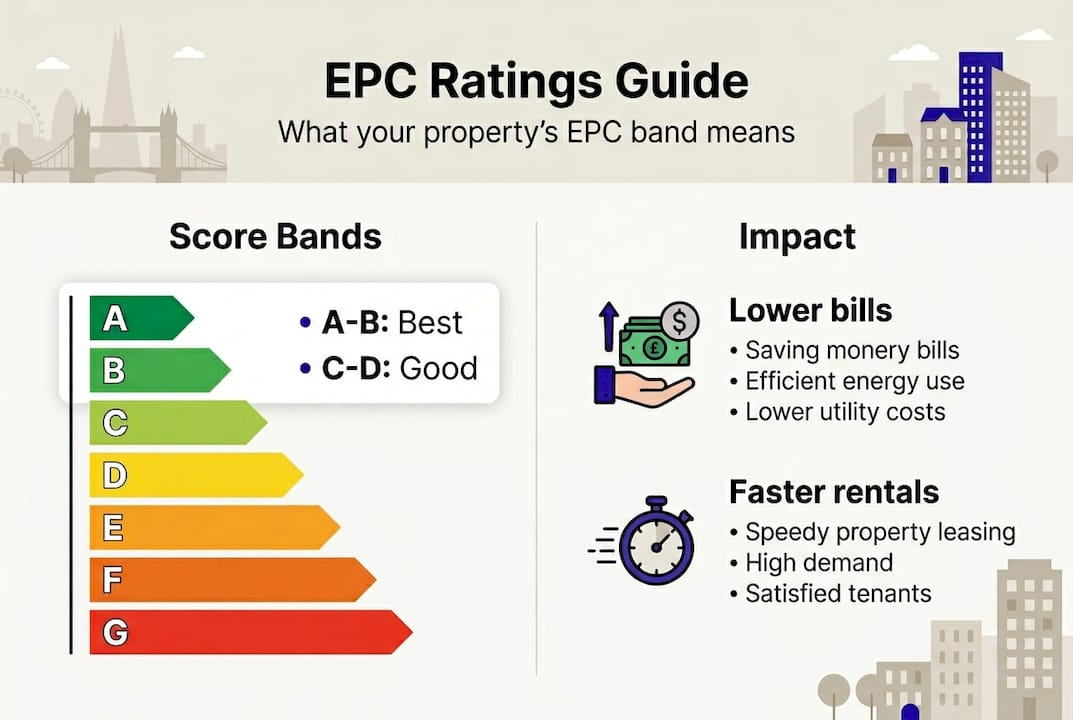
EPC bands run from A to G. Each band corresponds to a range of points calculated by the Standard Assessment Procedure, which measures annual energy costs relative to floor area. Here is a quick breakdown:
| Band | Score range | Typical property type | What it means |
|---|---|---|---|
| A | 92 to 100 | New build, Passivhaus | Extremely efficient, very low bills |
| B | 81 to 91 | Modern build post-2010 | Highly efficient, low running costs |
| C | 69 to 80 | Well-insulated older stock | Good efficiency, reasonable bills |
| D | 55 to 68 | Average older property | Moderate efficiency, average bills |
| E | 39 to 54 | Poorly insulated older stock | Low efficiency, higher bills |
| F | 21 to 38 | Pre-1940s unimproved | Very low efficiency, high bills |
| G | 1 to 20 | Unimproved period property | Worst performance, cannot legally let |
The national picture is telling. In 2024, 60.5% of EPCs were rated C or better, with C being the single most common band at 44.3%. New dwellings are overwhelmingly efficient, with 88% of new builds rated A or B in Q4 2025. Yet existing rentals average a D, and an estimated 10 to 20% of rentals still fall below an E.
For London landlords, this matters beyond compliance. Tenants are increasingly aware of energy costs. A C-rated property is easier to let, commands stronger rents, and appeals to a wider pool of applicants than a D or E-rated equivalent. Aiming for a C or above is no longer just about avoiding fines. It is about staying competitive in a market where energy efficiency is becoming a genuine selling point.

Improving your property’s EPC: costs, grants, and how upgrades pay off
If your property does not measure up, here is how to maximise your score and boost returns.
The good news is that many improvements deliver a meaningful EPC uplift for a relatively modest outlay. Costs to reach an E rating are often under £2,000, while reaching a C typically costs between £5,000 and £15,000, depending on the property’s current state. Grants through the ECO scheme can significantly reduce these costs for eligible properties.
The most effective upgrades for London properties include:
- Loft insulation: One of the cheapest and highest-impact improvements available, particularly in Victorian and Edwardian terraces.
- Cavity wall insulation: Suitable for many post-1920s properties and delivers a strong EPC boost.
- Double or triple glazing: Reduces heat loss and improves comfort, which tenants notice immediately.
- Upgrading to a modern condensing boiler: Older boilers are a major drag on EPC scores. A new A-rated boiler can shift a property up by one or two bands.
- Smart thermostats and controls: Low cost, easy to install, and contribute positively to the new multi-metric EPC framework coming in 2026 and 2027.
- Solar panels or heat pumps: Higher upfront cost but significant long-term gains in both EPC score and energy bill reductions.
| Improvement | Estimated cost | Typical EPC band gain |
|---|---|---|
| Loft insulation | £300 to £600 | Up to 1 band |
| Cavity wall insulation | £500 to £1,500 | Up to 1 band |
| New condensing boiler | £2,000 to £3,500 | 1 to 2 bands |
| Double glazing (full) | £4,000 to £8,000 | Up to 1 band |
| Solar panels | £5,000 to £9,000 | 1 to 2 bands |
Pro Tip: Start with insulation before any other upgrade. It consistently delivers the highest return on investment across all property types and is often the single biggest factor holding a property back from a C rating.
Properties rated C or above rent faster, attract more reliable tenants, and can support higher yields. The investment pays for itself, often within a few letting cycles.
Our take: what most EPC guides leave out for London landlords
Most EPC guides focus on the basics: get the certificate, meet the minimum, move on. We think that approach leaves London landlords exposed in ways they do not realise until it is too late.
Consider the edge cases. Flats and maisonettes are measured internally, listed buildings are not automatically exempt and require evidence to support any exemption claim, and HMOs need a whole-property EPC even when letting a single room. These are not rare situations in London. They are everyday property types, and misunderstanding them can lead to invalid certificates or unexpected compliance failures.
There is also a market reality that regulations have not yet caught up with. 88% of new dwellings already achieve an A or B rating. The market is moving ahead of the law. Tenants in newer properties are accustomed to lower bills and better comfort. When they look at older rental stock, the gap is obvious and it affects their decision.
Waiting until the 2030 deadline to upgrade is not a neutral choice. It means years of slower lettings, lower rents, and a rushed, more expensive upgrade programme when the deadline arrives. Early movers gain a competitive edge and spread the cost sensibly. That is the advice most guides skip.
Get help with your EPC compliance in London
Navigating EPC rules, upcoming reforms, and property-specific complications is a lot to manage alongside everything else that comes with being a London landlord. That is where we can help. At Complete EPC, our qualified assessors work across London every day, handling everything from straightforward flat assessments to complex HMO and listed building situations. Whether you need EPC certificate guidance to understand your obligations, a clear walkthrough of the London EPC process, or advice on EPC exemptions that may apply to your property, we provide straightforward, expert support at competitive rates. Act now to avoid penalties and position your property for stronger returns.
Frequently asked questions
How long does an EPC certificate last for landlords in London?
EPC certificates are valid for 10 years from the date of issue, but you should update yours if significant energy-related changes are made to the property.
What is the minimum EPC rating required for a rental property?
The current minimum is E for all privately rented homes, but this will rise to a C for all rentals by October 2030, so planning ahead is essential.
Are any properties exempt from EPC requirements?
Some properties may qualify for temporary exemptions, but listed buildings and HMOs are not automatically exempt and must meet specific evidential requirements before any exemption is accepted.
What happens if I rent out a property without a valid EPC?
You face a fine of up to £5,000 per property, enforced by your local authority, along with potential delays to your letting and reputational risk with agents and tenants.